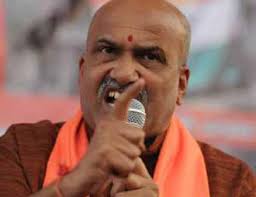
AB Ibrahim cautions against withdrawal of cases against Pramod Muthalik

[email protected] (CD Network)
January 1, 2016

muthalikMangaluru, Jan 1: Dakshina Kannada Deputy Commissioner AB Ibrahim has expressed deep concern over the reports on possibility of withdrawal of more than a dozen cases against Sri Rama Sene leader Pramod Muthalik.

In a letter addressed to Additional Chief Secretary of the Home Department Mr Ibrahim cautioned against the proposal to drop 13 cases, including 12 hate-speech cases against Muthalik.

“Such a move would send wrong signals and demoralise the police force,” the deputy commissioner said.

It’s worth mentioning here that the Home Ministry had written to the Director of Prosecution to get the opinion of prosecutors on the proposal to drop the 13 cases, including the infamous 2009 pub attack case. Muthalik himself had expressed surprise and shock over the development.

Mr. Ibrahim, in his letter dated December 28, 2015 advised the government against giving freedom to those who indulge in immoral policing and spread communal hatred.

Withdrawal of cases against Muthalik could motivate other fringe elements to take law into their own hands, the DC said.

Comments

aharkul
 - 
Sunday, 3 Jan 2016

Very good decision taken by DC

A. Mangalore
 - 
Saturday, 2 Jan 2016

Excellent. It is the right decision of the District Commissioner.
Satyameva Jayathe. The honest officer never bent for any pressure. God bless you .

Add new comment

  • Coastaldigest.com reserves the right to delete or block any comments.
  • Coastaldigset.com is not responsible for its readers’ comments.
  • Comments that are abusive, incendiary or irrelevant are strictly prohibited.
  • Please use a genuine email ID and provide your name to avoid reject.
coastaldigest.com web desk
July 4,2020

Bengaluru, Jul 4: In a heart-wrenching incident, a 65-year-old coronavirus patient at Hanumath Nagar in South Bengaluru died outside his house waiting for an ambulance on Friday evening. The body was kept on the road for more three hours.

The deceased tested positive for coronavirus on Friday and immediately called an ambulance to reach a hospital. However, according to his family members, as he waited for the ambulance for nearly three hours, he collapsed on the road in front of his house complaining of breathlessness and died.

As the body lay unattended on the road, it began to rain heavily. Soon, videos of the body lying on the road in the heavy rain went viral on social media. 

A senior doctor in charge of the division, however, claimed that the ambulance had arrived in less than half an hour but the patient had died before they reached the spot. 

"The patient had given samples on Thursday at KIMS and tested positive on Friday. BBMP officials informed them that they would reach his house. But the man, fearing that he may be stigmatised in the locality, began walking to the corner of the road and collapsed on the street and died," the officer said. 

Another health official from Basavanagudi limits said: "As the ambulance staff do not transport the dead, they informed the hearse van, which was set to arrive in 30 minutes. But due to the sudden rain and heavy traffic ahead of the curfew hours, they were stranded for almost three hours later." The officials also said the deceased had been suffering from cardiac ailments for almost 10 years. 

Regretting the incident, BBMP officials said they were helpless as was an acute shortage of hearse vans. "We were told that there were 20 deaths today and there are only eight hearse vans available. They had to shift this patient after attending to another mortality and were stuck in traffic. By then, due to the fear of infection, nobody attended to the deceased," the officer explained. 

BBMP commissioner B H Anil Kumar said that such incidents should not recur and ordered an investigation and sought a report. "We will ensure that such incidents do not recur," Kumar said.  

Following outrage on social media, a hearse van was summoned and the body was shifted to the Victoria Hospital mortuary as per the protocol. Police have opened a case of unnatural death.

Comments

Add new comment

  • Coastaldigest.com reserves the right to delete or block any comments.
  • Coastaldigset.com is not responsible for its readers’ comments.
  • Comments that are abusive, incendiary or irrelevant are strictly prohibited.
  • Please use a genuine email ID and provide your name to avoid reject.
News Network
June 7,2020

Bengaluru, Jun 7: An eminent scientist on Sunday suggested a shift system in schools to prevent spread of the coronavirus and continuing with online classes with focus on project-based learning in a big way to promote creativity.

Former Director General of the Defence Research and Development Organisation (DRDO) V K Saraswat supported the idea of online teaching in the absence of regular classes in view of closure of schools due to the COVID-19 pandemic.

But, he said it should be organised in far better and more interactive ways so that delivery of knowledge can be better. The NITI Aayog member stressed the need for schools to have a strategy when they reopen keeping in mind the safety of students.

May be they will have to organise shifts so that within the same space they can handle the students; May be they will have to employ more teachers, and they can run two shifts. "May be half the strength in a class can come in the morning and others in the afternoon.

Or students of first to sixth standard can come in the morning and seventh to tenth can come in the afternoon, Saraswat told PTI. Reopening strategy will have to be worked out by the education department, added the former Chief Scientific Advisor to the Defence Minister.

Along with normal classes, online education should be continued as a regular system in future, and promoted in a big way because that is the way technology is going to help delivery of knowledge, he added. Saraswat also raised the pitch for reforms in the education sector, saying India is facing the problem of rote learning.

Rote learning has to give way for more project-based teaching, he underlined. Children should be made to work on projects at home and that can be done online. That will also support the changeover from rote learning to creative learning.

I personally believe the education delivery system -- primary, secondary and college levels -- has to be completely changed because creativity in India is less and creativity would come only if we replace rote learning with project-based learning, Saraswat said.

On some academics holding the view that the marks-based model is killing the education system in India as it does not promote creativity, he said evaluation of any outcome is important. Even when we perform in our normal way, evaluation cannot be replaced.

Otherwise, you cant find out how much you have succeeded in delivery. Certainly evaluation cannot be dispensed with. He did not agree with some experts, who favoured a single, uniform system for school education in India by dispensing with CBSE, ICSE and state boards. I am not for normalising everything in life.

I personally believe variety should be there. This concept of one kind of a system is okay for a Communist society, society which was trying to drive everybody like a herd, he said.

Creativity comes with variety, and there is nothing wrong in having different kinds of education system, but one thing which is important is we have to integrate vocational training as part of the education curriculum," Saraswat said. Vocational part cannot be kept away from the education system, he added.

Comments

Add new comment

  • Coastaldigest.com reserves the right to delete or block any comments.
  • Coastaldigset.com is not responsible for its readers’ comments.
  • Comments that are abusive, incendiary or irrelevant are strictly prohibited.
  • Please use a genuine email ID and provide your name to avoid reject.
Agencies
July 5,2020

The deadly coronavirus that entered India while there was still nip in the air has beaten rising mercury, humid conditions, unique Indian genome and has entered monsoon season with more potency as fresh cases are only breaking all records in the country.

India recorded a single-day spike of record 24,850 new coronavirus cases on Sunday, taking its total tally to 6.73 lakh corona-positive cases.

Top Indian microbiologists were hopeful in March that after the 21-day lockdown, as summer approaches, the rise in temperature would play an important role in preventing the drastic spread of COVID-19 virus in India.

Several virologists hinted that by June this year, the impact of COVID-19 would be less than what it appeared in March-April.

The claims have fallen flat as the virus is mutating fast, becoming more potent than ever.

According to experts, the novel coronavirus is a new virus whose seasonality and response to hot humid weather was never fully understood.

"The theory was based on the fact that high temperatures can kill the virus as in sterilisation techniques used in healthcare. But these are controlled environment conditions. There are many other factors besides temperature, humidity which influence the transmission rate among humans," Dr Anu Gupta, Head, Microbiologist and Infection Control, Fortis Escorts Heart Institute, told IANS.

There is no built-up immunity to COVID-19 in humans.

"Also, asymptomatic people might be passing it to many others unknowingly. New viruses tend not to follow the seasonal trend in their first year," Gupta emphasized.

Globally, as several countries are now experiencing hot weather, the World Health Organization (WHO) reported a record hike in the number of coronavirus cases, with the total rising by 2,12,326 in 24 hours in the highest single-day increase since COVID-19 broke out.

So far over 11 million people worldwide have tested positive for the disease which has led to over 5,25,000 deaths, according to data from Johns Hopkins University. The US remained the worst-hit country with over 28 lakh cases, followed by Brazil with 15.8 lakh.

According to Sandeep Nayar, Senior Consultant and HOD, Respiratory Medicine, Allergy & Sleep Disorders, BLK Super Speciality Hospital in New Delhi, whether temperature plays a role in COVID-19 infection is highly debated.

One school of thought said in the tropical regions of South Asia, the virus might not thrive longer.

"On the other hand, another school of thought has found that novel Coronavirus can survive in a hot and humid environment and tropical climate does not make a difference to the virus. According to them, this is what distinguishes the novel coronavirus from other common viruses, which usually wane in hot weather," stressed Nayar.

Not much has been studied in the past and no definite treatment or vaccine is available to date.

"Every day, new properties and manifestation of the disease come up. As of now, the only way to prevent this monster is by taking appropriate precautions. Hand hygiene, social distancing, cough etiquette and face masks definitely reduce spread of COVID-19 infection," Nayar told IANS.

Not just top Indian health experts, even Indian-American scientists had this theory in mind that sunshine and summer may ebb the spread of the coronavirus.

Ravi Godse, Director of Discharge Planning, UPMC Shadyside Pennsylvania in the US told IANS in April: "In the summer, the humidity can go up as well, meaning more water drops in the air. If the air is saturated with water and somebody sneezes virus droplets into such air, it is likely that the droplets will fall to the ground quicker, making them less infectious. So the short answer is yes, summer/sunshine could be bettera.

According to Dr Puneet Khanna, Head of Respiratory Medicine and Pulmonology, Manipal Hospital, Delhi, COVID-19 death rates are not too different in tropical countries but since the disease affected them late it was yet to show its peak in these areas.

"The virus can survive well in hot and humid countries and this is proven now," he stressed.

Comments

Add new comment

  • Coastaldigest.com reserves the right to delete or block any comments.
  • Coastaldigset.com is not responsible for its readers’ comments.
  • Comments that are abusive, incendiary or irrelevant are strictly prohibited.
  • Please use a genuine email ID and provide your name to avoid reject.