AB Ibrahim cautions against withdrawal of cases against Pramod Muthalik

[email protected] (CD Network)
January 1, 2016

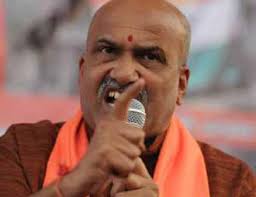
muthalikMangaluru, Jan 1: Dakshina Kannada Deputy Commissioner AB Ibrahim has expressed deep concern over the reports on possibility of withdrawal of more than a dozen cases against Sri Rama Sene leader Pramod Muthalik.

In a letter addressed to Additional Chief Secretary of the Home Department Mr Ibrahim cautioned against the proposal to drop 13 cases, including 12 hate-speech cases against Muthalik.

“Such a move would send wrong signals and demoralise the police force,” the deputy commissioner said.

It’s worth mentioning here that the Home Ministry had written to the Director of Prosecution to get the opinion of prosecutors on the proposal to drop the 13 cases, including the infamous 2009 pub attack case. Muthalik himself had expressed surprise and shock over the development.

Mr. Ibrahim, in his letter dated December 28, 2015 advised the government against giving freedom to those who indulge in immoral policing and spread communal hatred.

Withdrawal of cases against Muthalik could motivate other fringe elements to take law into their own hands, the DC said.

Comments

aharkul
 - 
Sunday, 3 Jan 2016

Very good decision taken by DC

A. Mangalore
 - 
Saturday, 2 Jan 2016

Excellent. It is the right decision of the District Commissioner.
Satyameva Jayathe. The honest officer never bent for any pressure. God bless you .

Add new comment

  • Coastaldigest.com reserves the right to delete or block any comments.
  • Coastaldigset.com is not responsible for its readers’ comments.
  • Comments that are abusive, incendiary or irrelevant are strictly prohibited.
  • Please use a genuine email ID and provide your name to avoid reject.
Ram Puniyani
June 29,2020

In Minneapolis, US an African American, George Floyd lost his life as the white policeman, Derek Chauvin, caught hold of him and put his knee on his neck. This is a technique developed by Israel police. For nine long minutes the knee of the while policeman was on the neck of George, who kept shouting, I can’t breathe.

Following this gruesome murder America erupted with protests, ‘Black lives matter’. The protestors were not just African Americans but also a large section of whites. Within US one police Chief apologized for the act of this. In a touching gesture of apology the police force came on its knees. This had reverberations in different parts of the World.

The act was the outcome of the remnants of the racial hatred against blacks by the whites. It is the hatred and the perceptions which are the roots of such acts of violence. What was also touching that the state of democracy in US is so deep that even the police apologized, the nation, whites and blacks, stood up as a sensitive collective against this violence.

US is not the only country where the brutal acts of violence torment the marginalized sections of society. In India there is a list of dalits, minorities and adivasis who are regularly subjected to such acts. But the reaction is very different. We have witnessed the case of Tabrez Ansari, who was tied to the pole by the mob and beaten ruthlessly. When he was taken to police station, police took enough time to take him to hospital and Tabrez died.

Mohsin Sheikh, a Pune techie was murdered by Hindu Rashtra Sena mob, the day Modi came to power in 2014. Afrazul was killed by Shambhulal Regar, videotaped the act released on social media. Regar believed that Muslims are indulging in love Jihad, so deserve such a fate. Mohammad Akhlaq is one among many names who were mob lynched on the issue of beef cow. The list can fill pages after pages.

Recently a young dalit boy was shot dead for the crime of entering a temple. In Una four dalits were stripped above waste and beaten mercilessly. Commenting on this act the Union Minister Ramvilas Paswan commented that it is a minor incident. Again the list of atrocities against dalits is long enough. The question is what Paswan is saying is the typical response to such gruesome murders and tortures. In US loss of one black life, created the democratic and humane response. In India there is a general silence in response to these atrocities. Some times after a good lapse of time, the Prime Minister will utter, ‘Mother Bharati has lost a son’. Most of the time victim is blamed. Some social groups raise their voice in some fora but by and large the deafening silence from the country is the norm.

India is regarded as the largest democracy. Democracy is the rule of law, and the ground on which the injustices are opposed. In America though the present President is insensitive person, but its institutions and processes of democratic articulations are strong. The institutions have deepened their roots and though prejudices may be guiding the actions of some of the officers like the killer of George, there are also police officers who can tell their President to shut up if he has nothing meaningful to say on the issue. The prejudices against Blacks may be prevalent and deep in character, still there are large average sections of society, who on the principles of ‘Black lives matter’. There are large sections of vocal population who can protest the violation of basic norms of democracy and humanism.

In India by contrast there are multiple reasons as to why the lives of Tabrez Ansari, Mohammad Akhlaq, Una dalit victims and their likes don’t matter. Though we claim that we are a democracy, insensitivity to injustices is on the rise. The strong propaganda against the people from margins has become so vicious during last few decades that any violence against them has become sort of a new normal. The large populace, though disturbed by such brutalities, is also fed the strong dose of biases against the victims. The communal forces have a great command over effective section of media and large section of social media, which generates Hate against these disadvantaged groups, thereby the response is muted, if at all.

As such also the process of deepening of our democracy has been weak. Democracy is a dynamic process; it’s not a fixed entity. Decades ago workers and dalits could protest for their rights. Now even if peasants make strong protests, dominant media presents it as blocking of traffic! How the roots of democracy are eroded and are visible in the form where the criticism of the ruling dispensation is labelled as anti National..

Our institutions have been eroded over a period of time, and these institutions coming to the rescue of the marginalized sections have been now become unthinkable. The outreach of communal, divisive ideology, the ideology which looks down on minorities, dalits and Adivasis has risen by leaps and bounds.

The democracy in India is gradually being turned in to a hollow shell, the rule of law being converted in to rule of an ideology, which does not have faith in Indian Constitution, which looks down upon pluralism and diversity of this country, which is more concerned for the privileges of the upper caste, rich and affluent. The crux of the matter is the weak nature of democracy, which was on way to become strong, but from decades of 1980s, as emotive issues took over, the strength of democracy started dwindling, and that’s when the murders of the types of George Floyd, become passé. One does complement the deeper roots of American democracy and its ability to protect the democratic institutions, which is not the case in India, where protests of the type, which were witnessed after George Floyd’s murder may be unthinkable, at least in the present times. 

Comments

Add new comment

  • Coastaldigest.com reserves the right to delete or block any comments.
  • Coastaldigset.com is not responsible for its readers’ comments.
  • Comments that are abusive, incendiary or irrelevant are strictly prohibited.
  • Please use a genuine email ID and provide your name to avoid reject.
News Network
March 11,2020

Bengaluru, Mar 11: Amid the prevailing political uncertainty in Madhya Pradesh with Jyotiraditya Scindia's exit, Congress leader DK Shivakumar on Wednesday asserted that "leaders may come and go but no one can destroy Congress."

"No one can destroy Congress. Leaders may come, leaders may go, that doesn't make any difference," said Shivakumar while speaking to news agency on the current political scenario for Congress in Madhya Pradesh.

Speaking about the Madhya Pradesh Congress MLAs, who are lodged in Bengaluru, he said: "All the Madhya Pradesh MLAs who are here do not want to lose their membership. I am sure they will understand, go back and save the government."

On Tuesday, Congress sent two of its leaders -- Sajjan Singh Verma and Govind Singh -- to Bengaluru in order to pacify some of the rebel MLAs who are lodged in a hotel there and who claimed to have resigned from the state Legislative Assembly.

After meeting with 19 party MLAs who have tendered their resignations, Congress leader Sajjan Singh Verma on Wednesday said they are neither willing to support Jyotiraditya Scindia nor in favour of joining BJP as they were "misled and taken to Bengaluru" in Karnataka.

"Nobody is ready to go with Scindia ji. They said they were misled and taken to Bengaluru, most of them said they are not ready to join BJP," Verma told ANI on being asked about the 19 MLAs.

"I just came from Bengaluru and now I am going to Jaipur. Besides 5-6 ministers and one MLA, we all are going to Jaipur. They (MLAs) have said they have the blood of Congress and they will remain in the party. Since Scindia was a senior party leader, all our MLAs followed his order as a courtesy," he said.

The Congress leader further claimed that BJP is using both "muscle and money power" to influence Congress MLAs.

He also claimed that he is strongly in contact with 7-8 BJP MLAs.

Most of the rebel MLAs are perceived close to Scindia and are apparently unhappy at Scindia being "ignored" in the party. The grand old party has been witnessing an internal turf war in Madhya Pradesh since the party formed the government in the state in 2018.

Scindia is likely to join BJP later today.

Comments

Add new comment

  • Coastaldigest.com reserves the right to delete or block any comments.
  • Coastaldigset.com is not responsible for its readers’ comments.
  • Comments that are abusive, incendiary or irrelevant are strictly prohibited.
  • Please use a genuine email ID and provide your name to avoid reject.
Agencies
February 23,2020

Bengaluru, Feb 23: Bolstered by the Supreme Court's interim nod for the gazette notification of the Mahadayi Water Dispute Tribunal award by the Central government, Karnataka decided to allot funds for the drinking water project in the state's northwest region, an official said on Saturday.

"Funds will be allotted in the state budget for fiscal 2020-21 to complete the Kalasa-Banduri project across the Mahadayi river for supplying drinking water to the four drought-prone northern districts in the state," the official of the water resources department told media on anonymity.

As Chief Minister B.S. Yediyurappa also holds the finance portfolio, he has agreed to allocate funds for the project, held up for years in the legal battle with the neighbouring Goa and Maharashtra over the sharing of the river water among the three coastal states.

Yediyurappa is slated to present the state budget for the ensuing fiscal in the legislative assembly on March 2.

"We will resume the project work once the Centre notifies the award though it will be binding on the final outcome of the apex court's hearing the review petitions of Goa and Maharashtra against the Tribunal award," the official noted.

A division bench of Justice D.Y. Chandrachud and Justice Hemant Gupta on Thursday passed an interim order on the Tribunal award, allowing the central water resources ministry to notify it for implementation and posted the case for final hearing in July.

The Tribunal on August 14, 2018 allocated 13.42 thousand million cubic feet (tmcft) of the river water to the southern state for irrigation and drinking water supply to towns and villages across Bagalkot, Belagavi, Dharwad and Gadag districts, which are in the arid region of the Deccan plateau.

The four districts are about 400-550 km northwest of Bengaluru in the southern state.

Of the 13.42 tmcft water, 5.5 tmcft will be used in the river basin and for diversion into the depleted Malaprabha reservoir while the balance 7.92 tmcft will be utilized for hydel power generation instead of allowing the water to go into the Arabian Sea on the state's west coast through Goa.

Goa, which opposed Karnataka's demand for 36.66 tmcft, was allocated 24 tmcft, while Maharashtra got 1.3 tmcft.

The Tribunal assessed that 188.06 tmc feet water is available at 75 per cent dependability.

The three-member Tribunal is headed by Chairman Justice J.M. Panchal, Justice Viney Mittal and Justice P.S. Naayana.

The Union government had set up the inter-state Tribunal on November 16, 2010 for the djudication of the Mahadayi basin water allocation among the three riparian and contiguous states.

Goa and Maharashtra claimed 122.6 tmc feet and 6.35 tmc feet of the river water respectively.

The Tribunal, which commenced sittings on September 6, 2012, held 1,209 sittings for over 6 years.

Supreme Court senior counsel F.S. Nariman represented the state before the Tribunal to present its case.

The Tribunal's chairman and two members inspected the river basin area across the three coastal states from December 12-24, 2013.

The 77km-long Mahadayi or Mandovi river originates at Bhimgad in the Western Ghats in Belagavi district and flows into the neighbouring Goa through Maharashtra and joins the Arabian Sea off the west coast.

Though the river flows 29 km in Karnataka and 52 km in Goa, its catchment area is spread over 2,032 km in the southern state as against 1,580 km in the western state (Goa).

Comments

Add new comment

  • Coastaldigest.com reserves the right to delete or block any comments.
  • Coastaldigset.com is not responsible for its readers’ comments.
  • Comments that are abusive, incendiary or irrelevant are strictly prohibited.
  • Please use a genuine email ID and provide your name to avoid reject.