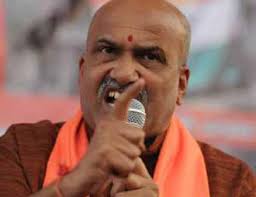
AB Ibrahim cautions against withdrawal of cases against Pramod Muthalik

[email protected] (CD Network)
January 1, 2016

muthalikMangaluru, Jan 1: Dakshina Kannada Deputy Commissioner AB Ibrahim has expressed deep concern over the reports on possibility of withdrawal of more than a dozen cases against Sri Rama Sene leader Pramod Muthalik.

In a letter addressed to Additional Chief Secretary of the Home Department Mr Ibrahim cautioned against the proposal to drop 13 cases, including 12 hate-speech cases against Muthalik.

“Such a move would send wrong signals and demoralise the police force,” the deputy commissioner said.

It’s worth mentioning here that the Home Ministry had written to the Director of Prosecution to get the opinion of prosecutors on the proposal to drop the 13 cases, including the infamous 2009 pub attack case. Muthalik himself had expressed surprise and shock over the development.

Mr. Ibrahim, in his letter dated December 28, 2015 advised the government against giving freedom to those who indulge in immoral policing and spread communal hatred.

Withdrawal of cases against Muthalik could motivate other fringe elements to take law into their own hands, the DC said.

Comments

aharkul
 - 
Sunday, 3 Jan 2016

Very good decision taken by DC

A. Mangalore
 - 
Saturday, 2 Jan 2016

Excellent. It is the right decision of the District Commissioner.
Satyameva Jayathe. The honest officer never bent for any pressure. God bless you .

Add new comment

  • Coastaldigest.com reserves the right to delete or block any comments.
  • Coastaldigset.com is not responsible for its readers’ comments.
  • Comments that are abusive, incendiary or irrelevant are strictly prohibited.
  • Please use a genuine email ID and provide your name to avoid reject.
News Network
April 4,2020

Mangaluru, Apr 4: Dakshina Kannada district deputy commissioner (DC) Sindhu B Rupesh in an official reminder has ordered milk unions to disburse about 5,000 litres of milk to residents of notified and non-notified slums, construction labourers and migrant labourers and their families in shelters in the district.

A decision regarding the free distribution of milk to such needy families was taken in a meeting by the chief minister on April 1.

The DC has ordered cooperative milk unions in the district to distribute milk to such families from April 4 till April 14.

Comments

Add new comment

  • Coastaldigest.com reserves the right to delete or block any comments.
  • Coastaldigset.com is not responsible for its readers’ comments.
  • Comments that are abusive, incendiary or irrelevant are strictly prohibited.
  • Please use a genuine email ID and provide your name to avoid reject.
coastaldigest.com news network
April 22,2020

Newsroom, Apr 22: Dozens of Tablighi Jamaat members from across the country who have been successfully recovered and have now tested negative for the novel coronavirus have come forward and donate their plasma for the treatment of Covid-19 patients.

The Tablighis from Tamil Nadu were the first to take this decision. According to them, apart from helping the critically ill patients to recover from COVID-19, was to counter the ‘baseless accusations’ that Tablighis were responsible for the spread of the virus following the religious congregation of the sect held at Delhi’s Nizamuddin area last month.

Mohammad Abbas, a thirty-eight year old businessman from Tiruppur was on Sunday discharged from Coimbatore’s ESI hospital. “As soon as I got discharged, I met the district administration officials and the dean of the hospital and told them that they may contact me anytime if they needed me to donate my plasma,” Abbas was quoted as saying by an English daily.

“It has only been one day since I was discharged but I’ve already spoken to others (from the Jamaat) who have recovered and they were all ready to donate,” he added. 

Leader's call

Maulana Saad Kandhalvi, a prominent leader of Tablighi Jamaat, who has been booked by the Delhi Police for holding a religious congregation, too has appealed to coronavirus survivors to donate blood plasma for infected people.

In a letter issued on Tuesday, Saad said most of the members who were quarantined did not have any infection and they tested negative for COVID-19.

"Even from amongst the ones who tested positive for the disease, a majority of them have now undergone treatment and are now cured while I and a few others are still under quarantine.

"It is required that such people who are now cured of this disease should donate blood plasma to others who are still fighting the disease and are under treatment," he said.

He also has urged the followers of the organisation to pray at home in the month of Ramadan instead of going to mosques. 

Plasma therapy

Convalescent Plasma Therapy is an experimental procedure for COVID-19 patients.

In this therapy, the antibodies of a person who has recovered from the virus are taken and transfused into a sick person (having the virus) to help boost the person’s immune system.

The recovered COVID-19 patient’s blood develops antibodies to battle against COVID-19.

Once the blood of the first patient is infused to the second patient, those antibodies will start fighting against the coronavirus in the second person.

The process for donating plasma is similar to donating blood and takes about an hour.

Several countries around the world including the United Kingdom and the United States have also started plasma therapy trials.

In India, several states like Kerala, Gujarat and Punjab have already started using Plasma Therapy for the corona-infected patients.

Comments

Add new comment

  • Coastaldigest.com reserves the right to delete or block any comments.
  • Coastaldigset.com is not responsible for its readers’ comments.
  • Comments that are abusive, incendiary or irrelevant are strictly prohibited.
  • Please use a genuine email ID and provide your name to avoid reject.
News Network
April 29,2020

Washington, Apr 29: A US government panel on Tuesday called for India to be put on a religious freedom blacklist over a "drastic" downturn under Prime Minister Narendra Modi, triggering a sharp rebuttal from New Delhi.

The US Commission on International Religious Freedom recommends but does not set policy, and there is virtually no chance the State Department will follow its lead on India, an increasingly close US ally.

In an annual report, the bipartisan panel narrowly agreed that India should join the ranks of "countries of particular concern" that would be subject to sanctions if they do not improve their records.

"In 2019, religious freedom conditions in India experienced a drastic turn downward, with religious minorities under increasing assault," the report said.

It called on the United States to impose punitive measures, including visa bans, on Indian officials believed responsible and grant funding to civil society groups that monitor hate speech.

The commission said that Modi's Hindu nationalist government, which won a convincing election victory last year, "allowed violence against minorities and their houses of worship to continue with impunity, and also engaged in and tolerated hate speech and incitement to violence."

It pointed to comments by Home Minister Amit Shah, who notoriously referred to mostly Muslim migrants as "termites," and to a citizenship law that has triggered nationwide protests.

It also highlighted the revocation of the autonomy of Kashmir, which was India's only Muslim-majority state, and allegations that Delhi police turned a blind eye to mobs who attacked Muslim neighborhoods in February this year.

Coronavirus state-wise India update: Total number of confirmed cases, deaths on April 29

The Indian government, long irritated by the commission's comments, quickly rejected the report.

"Its biased and tendentious comments against India are not new. But on this occasion, its misrepresentation has reached new levels," foreign ministry spokesman Anurag Srivastava said.

"We regard it as an organization of particular concern and will treat it accordingly," he said in a statement.

The State Department designates nine "countries of particular concern" on religious freedom -- China, Eritrea, Iran, Myanmar, North Korea, Pakistan, Saudi Arabia, Tajikistan and Turkmenistan.

The commission asked that all nine countries remain on the list. In addition to India, it sought the inclusion of four more -- Nigeria, Russia, Syria and Vietnam.

Pakistan, India's historic rival, was added by the State Department in 2018 after years of appeals by the commission.

In its latest report, the commission said that Pakistan "continued to trend negatively," voicing alarm at forced conversions of Hindus and other minorities, abuse of blasphemy prosecutions and a ban on the Ahmadi sect calling itself Muslim.

India's citizenship law fast-tracks naturalization for minorities from neighbouring countries -- but not if they are Muslim.

Modi's government says it is not targeting Muslims but rather providing refuge to persecuted people and should be commended.

But critics consider it a watershed move by Modi to define the world's largest democracy as a Hindu nation and chip away at independent India's founding principle of secularism.

Tony Perkins, the commission's chair, called the law a "tipping point" and voiced concern about a registry in the northeastern state of Assam, under which 1.9 million people failed to produce documentation to prove that they were Indian citizens before 1971 when mostly Muslim migrants flowed in during Bangladesh's bloody war of independence.

"The intentions of the national leaders are to bring this about throughout the entire country," Perkins told an online news conference.

"You could potentially have 100 million people, mostly Muslims, left stateless because of their religion. That would be, obviously, an international issue," said Perkins, a Christian activist known for his opposition to gay rights who is close to President Donald Trump's administration.

Three of the nine commissioners dissented -- including another prominent Christian conservative, Gary Bauer, who voiced alarm about India's direction but said the ally could not be likened to non-democracies such as China.

"I am deeply concerned that this public denunciation risks exactly the opposite outcome than the one we all desire," Bauer said.

Trump, who called for a ban on Muslim immigration to the US when he ran for president, hailed Modi on a February visit to New Delhi.


Comments

Add new comment

  • Coastaldigest.com reserves the right to delete or block any comments.
  • Coastaldigset.com is not responsible for its readers’ comments.
  • Comments that are abusive, incendiary or irrelevant are strictly prohibited.
  • Please use a genuine email ID and provide your name to avoid reject.