Abdul Rauf Puthige of TRF, 21 others conferred DK Zilla Rajyotsava Award

[email protected] (CD Network | Suresh Kumar)
November 1, 2016

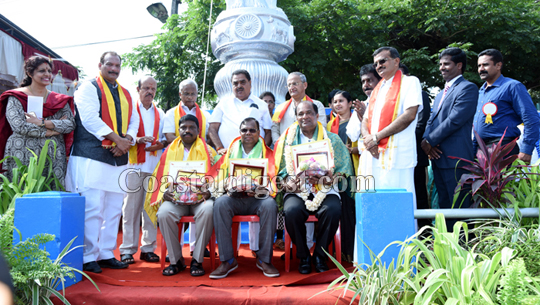
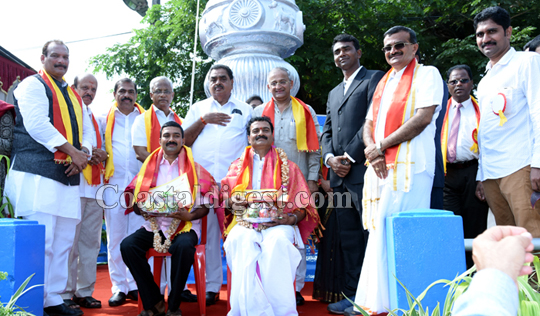
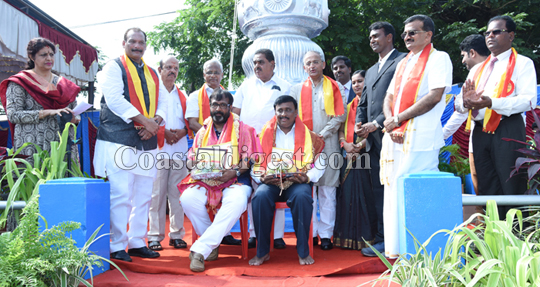
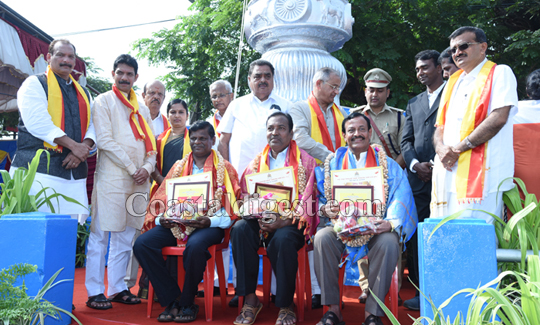
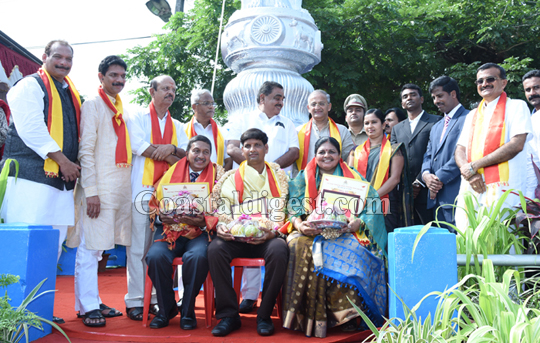
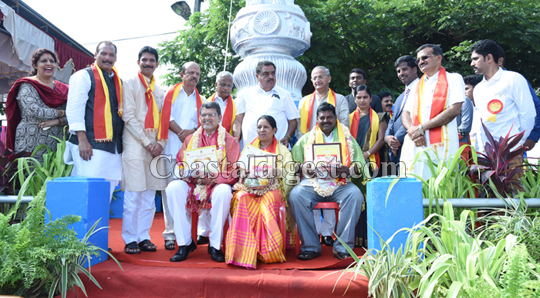
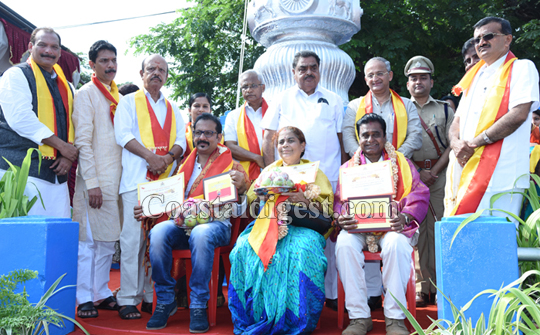
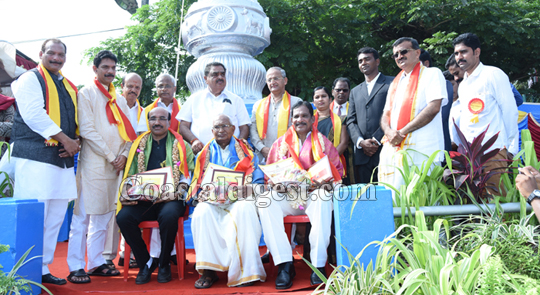
Mangaluru, Nov 1: As many as 22 achievers of various fields including heads of the organisations were conferred with Dakshina Kannada Zilla Kannada Rajyotsava Prashasthi on Tuesday.
award 6

Abdul Rauf Puthige, founder of Talent Research Foundation, Ramakrishna R, Kannada journalist, Khalid Tannirbavi, artiste, were among those how received the award at Rajyotsava ceremony held in Nehru Maidan.

Dakshina Kannada district in charge minister B Ramanath Rai conferred the awards in the presence of deputy commissioner K G Jagadeesha, Dakshina Kannada MP Nalink Kumar Kateel, Mangaluru South MLA J R Lobo, MLC Ivan D'Souza, Dakshina Kannada Zilla Kannada Sahitya Parishad president Pradeep Kumar Kalkura and other dignitaries.

The winners of Dakshina Kannada Zilla Kannada Rajyotsava Award-2016 are:

1.            Prabhakara Mayya, Nada village, Belthangady (Agriculture)

2.            S M Aboobakar Sooribailu, Bantwal (education)

3.            B Seetaram Tolpady, Agrahara, Dharmasthala (Yakshagana)

4.            M Sumitra Kumar, Pandeshwar, Mangaluru (Sprots)

5.            Talent Research Foundation (TRF), Mangaluru (Social Work)

6.            Bhaskar Kulal Barke, Haleyangady (Literature)

7.            Satya P Mantyayimane, Naravi, Belthangady (Folklore)

8.            Ramakrishna R, Boloor, Mangaluru (Journalism)

9.            Dr Alonans Suresh Joseph Aranha, Karnad, Mulky (Medicine)

10.          Gopalakshina Bangera Madwa, Bantwal (Fine Arts)

11.          Khalid Tannirbavi, NMPT, Mangaluru (Music)

12.          Jayanti S Bangera Kandangodlu, Moodbidri (Theatre and Tulu Literature)

13.          Narayana Kotyan Bolar, Mangaluru (Sports/Wrestling)

14.          P Sadu Poojary, Katipalla, Mangaluru (Education)

15.          Modambail Ravi Shetty, Puttur (Social Work)

16.          S Jagadish Anchar, Sootarpete, Kankanady (Sports-writing)

17.          Yogesh Kumar K S Nadakkara, Belthangady (Social Work)

18.          Brahmashree Narayana Guru Seva Sangha, Sasihithlu, Mulky (Social Work)

19.          Swsthik Kalakendra, Jalligudde, Mangaluru (Social Work)

20.          Sri Sharadamba Bhajana Mandali, Sullia (Social Work)

21.          Jagadish Shetty, Bejai, Mangaluru (Yoga)

22.          Hameed Koornadka, Puttur (Visual Media)
award 1

award 2

award 3

award 4

award 5

award 7

award 8

Comments

Shahul
 - 
Wednesday, 2 Nov 2016

Hearty congratulation to Mr.Khaled Tannerubavi and all the winners of D.K. Rajyothsava award.

Shahul
 - 
Wednesday, 2 Nov 2016

Congratulations to TRF team and its founder Mr.Abdul Rauf Puthige. Keep it up and continue the social work to benefit the poor and needy people in our community and society.

All the best may Allah bestow with more awards.

George
 - 
Tuesday, 1 Nov 2016

Deserving people.. Congrats to all

Add new comment

  • Coastaldigest.com reserves the right to delete or block any comments.
  • Coastaldigset.com is not responsible for its readers’ comments.
  • Comments that are abusive, incendiary or irrelevant are strictly prohibited.
  • Please use a genuine email ID and provide your name to avoid reject.
coastaldigest.com news network
May 26,2020

Bengaluru, May 26: Karnataka chief minister BS Yediyurappa has been urged to cancel the proposed SSLC examinations in Karnataka and allow “mass-pass” for every student in the wake of covid-19 crisis. A group of intellectuals and educationists have put forth this demand.

In the letter released by educationist VP Niranjan Aradhya, said that they were listing the scientific reasons to the CM for cancellation of exams which are slated to be held from June 25 to July 4th.

In the letter, the intellectuals have elucidated a number of reasons for cancelling the upcoming exams. “There are close to 8.5 lakh students and 2.5 lakh staff involved. If we include parents who would drop their kids at the exam centre, around 30 lakh people will be involved in the process, making it a risky affair. Though the government has said that it will separate the students with fever or other ailments, will students admit to having fever? What if they consume paracetamol and come to write exams?” asks the letter. 

Added to this, the question papers have to be sent from the district and taluk centres and there may be chances of transmission.

“Even if we conduct exams, then what about the students who have failed? Every year, around 2.5 lakh students fail in the exam. Will the government conduct the supplementary exams again? The whole process of conducting exams comes at a huge cost of Rs 20 cr to Rs 25 crore. Hence, we are suggesting that the government cancels the exams and pass the entire group of student en masse,” said the letter.

Comments

Add new comment

  • Coastaldigest.com reserves the right to delete or block any comments.
  • Coastaldigset.com is not responsible for its readers’ comments.
  • Comments that are abusive, incendiary or irrelevant are strictly prohibited.
  • Please use a genuine email ID and provide your name to avoid reject.
News Network
May 3,2020

Bengaluru, May 3: The Commissioner of Health and Family Welfare Services in the government of Karnataka KA Dayanand issued an order approving quarantine of asymptomatic COVID-19 infected international passengers on payment basis at star hotels.

The international passengers in the state have been categorised into A, B and C groups depending on their symptoms and co-morbid conditions. Category A passengers are symptomatic and are being sent to isolation hospitals which may be COVID care centres.

Category B and C passengers are asymptomatic and are being sent to institutional facilities like hostels, guest houses, hotels, etc.

"On the basis of demands by category B and C passengers to provide them star hotel accommodation on a self-payment basis, they have been granted the choice of staying in those hotels at their own cost. The BBMP Special Commissioner/Deputy Commissioner can have a meeting with such hotels and finalise the negotiated rate," Commissioner Dayanand said in the order.

"The hotels for category B passengers should have round the clock presence of health personnel while hotels for category C passengers should be visited by health staff once a day," he added.

Comments

Add new comment

  • Coastaldigest.com reserves the right to delete or block any comments.
  • Coastaldigset.com is not responsible for its readers’ comments.
  • Comments that are abusive, incendiary or irrelevant are strictly prohibited.
  • Please use a genuine email ID and provide your name to avoid reject.
Ram Puniyani
March 14,2020

In the wake of Citizenship Amendment Act (CAA) UN High Commissioner, Michele Bachelet, has filed an intervention in the Supreme Court petition challenging the constitutionality of the Citizenship Amendment Act, as she is critical of CAA. Responding to her, India’s Foreign Minister S. Jai Shanker strongly rebutted her criticism, saying that the body (UNHCR) has been wrong and is blind to the problem of cross border terrorism. The issue on hand is the possibility of scores of people, mainly Muslims, being declared as stateless. The problem at hand is the massive exercise of going through the responses/documents from over 120 crore of Indian population and screening documents, which as seen in Assam, yield result which are far from truthful or necessary.

The issue of CAA has been extensively debated and despite heavy critique of the same by large number of groups and despite the biggest mass opposition ever to any move in Independent India, the Government is determined on going ahead with an exercise which is reminiscent of the dreaded regimes which are sectarian and heartless to its citizens, which have indulged in extinction of large mass of people on grounds of citizenship, race etc. The Foreign minister’s assertion is that it is a matter internal to India, where India’s sovereignty is all that matters! As far as sovereignty is concerned we should be clear that in current times any sovereign power has to consider the need to uphold the citizenship as per the principle of non-discrimination which is stipulated in Art.26 of the International Covenant on Civil and Political (ICCPR) rights.

Can such policies, which affect large number of people and are likely to affect their citizenship be purely regarded as ‘internal’? With the World turning into a global village, some global norms have been formulated during last few decades. The norms relate to Human rights and migrations have been codified. India is also signatory to many such covenants in including ICCPR, which deals with the norms for dealing with refugees from other countries. One is not talking of Chicago speech of Swami Vivekanand, which said that India’s greatness has been in giving shelter to people from different parts of the World; one is also not talking of the Tattariaya Upanishad’s ‘Atithi Devovhav’ or ‘Vasudhaiva Kutumbkam’ from Mahaupanishad today.

What are being talked about are the values and opinions of organizations which want to ensure to preserve of Human rights of all people Worldwide. In this matter India is calling United Nations body as ‘foreign party’; having no locus standi in the case as it pertains to India’s sovereignty. The truth is that since various countries are signatories to UN covenants, UN bodies have been monitoring the moves of different states and intervening at legal level as Amicus (Friend of the Court) to the courts in different countries and different global bodies. Just to mention some of these, UN and High Commissioner for Human Rights has often submitted amicus briefs in different judicial platforms. Some examples are their intervention in US Supreme Court, European Court of Human Rights, International Criminal Court, and the Inter-American Court of Human Rights. These are meant to help the Courts in areas where UN bodies have expertise.

 Expertise on this has been jointly formulated by various nations. These interventions also remind the nations as to what global norms have been evolved and what are the obligations of individual states to the values which have evolved over a period of time. Arvind Narrain draws our attention to the fact that, “commission has intervened in the European Court of Human Rights in cases involving Spain and Italy to underscore the principle of non-refoulement, which bars compulsory expulsion of illegal migrants… Similarly, the UN has intervened in the International Criminal Court in a case against the Central African Republic to explicate on the international jurisprudence on rape as a war crime.”

From time to time organizations like Amnesty International and Human Rights Watch have been monitoring the status of Human rights of different countries. This puts those countries in uncomfortable situation and is not welcome by those establishments. How should this contradiction between ‘internal matter’, ‘sovereignty’ and the norms for Human rights be resolved? This is a tough question at the time when the freedom indices and democratic ethos are sliding downwards all over the world. In India too has slid down on the scale of these norms.

In India we can look at the intervention of UN body from the angle of equality and non discrimination. Democratic spirit should encourage us to have a rethink on the matters which have been decided by the state. In the face of the greatest mass movement of Shaheen bagh, the state does need to look inwards and give a thought to international morality, the spirit of global family to state the least.

The popular perception is that when Christians were being persecuted in Kandhmal the global Christian community’s voice was not strong enough. Currently in the face of Delhi carnage many a Muslim majority countries have spoken. While Mr. Modi claims that his good relations with Muslim countries are a matter of heartburn to the parties like Congress, he needs to relook at his self gloating. Currently Iran, Malaysia, Indonesia and many Muslim majority countries have spoken against what Modi regime is unleashing in India. Bangladesh, our neighbor, has also seen various protests against the plight of Muslims in India. More than the ‘internal matter’ etc. what needs to be thought out is the moral aspect of the whole issue. We pride ourselves in treading the path of morality. What does that say in present context when while large section of local media is servile to the state, section of global media has strongly brought forward what is happening to minorities in India.   

The hope is that Indian Government wakes up to its International obligations, to the worsening of India’s image in the World due to CAA and the horrific violence witnessed in Delhi.

Comments

Add new comment

  • Coastaldigest.com reserves the right to delete or block any comments.
  • Coastaldigset.com is not responsible for its readers’ comments.
  • Comments that are abusive, incendiary or irrelevant are strictly prohibited.
  • Please use a genuine email ID and provide your name to avoid reject.