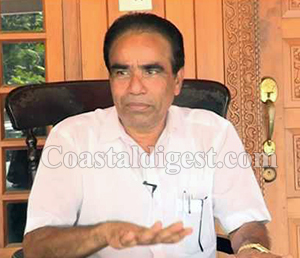
Abdul Razak retains Manjeshwar; BJP loses by 89 votes

[email protected] (CD Network)
May 19, 2016

pbrazakManjeshwar, May 19: The Bharatiya Janata Party's efforts to enter Kerala Legislative Assembly through Manjeshwar segment has finally failed as the Indian Union Muslim League has managed to retain the constituency.

Sitting MLA PB Abdul Razak, who harped on the development projects he has initiated in the relatively backward area in the last five years, has emerged victorious again.

This time all the three fronts had opted to field the same candidates who contested the 2011 Assembly election in Manjeshwar.

BJP candidate K Surendran, for the sixth consecutive times has emerged as the runner-up. This time it was a “just miss” for him as he lost the election to Mr Razak by a margin of 89 votes. In 2011 the margin was of 5,828 votes.

The unconditional support offered to the Left Democratic Front by the influential Sunni leader Kanthapuram AP Abubacker Musliyar did not make any impact on the result in Manjeshwar even though the winning margin is reduced.

Also Read:

After defeat BJP workers turn violent across Kasaragod; CPI MLA attacked

No major surprise in Kasaragod district: Muslim League 2, CPI(M) 2, CPI 1

CPI(M) worker killed in a bomb attack in Kannur amid LDF victory celebrations

Thanks for all the love... It's just a beginning, says Sreesanth after defeat

LDF regains power in Kerala, BJP opens account; CPI(M) focuses on finalising CM

BJP scripts history in Kerala as 86-year-old Rajagopal wins Nemom Seat

No Modi wave in Kasaragod: Muslim League's Nellikkunnu defeats Thantri

Comments

Think possitive
 - 
Friday, 20 May 2016

He won the election because of SDPI.

Abdullah
 - 
Thursday, 19 May 2016

I think this AP Kanthapura played spoilsport

Mohidin
 - 
Thursday, 19 May 2016

Congrats Sir, Much needed victory in Manjseshwar, most of the jobless goons of BD & BJP from South Kanara were in Manjeshwar, now they can go back to Somalia with feku

Azhar
 - 
Thursday, 19 May 2016

ALhamdulillah
Mr. P B Abdul Razak Bhai Ki Jaaaai...

Add new comment

  • Coastaldigest.com reserves the right to delete or block any comments.
  • Coastaldigset.com is not responsible for its readers’ comments.
  • Comments that are abusive, incendiary or irrelevant are strictly prohibited.
  • Please use a genuine email ID and provide your name to avoid reject.
coastaldigest.com news network
June 23,2020

Mangaluru, Jun 23: A charter flight carrying as many as 166 people including a child stranded in United Arab Emirates today reached Mangaluru. 

The flight was chartered by M Friends Charitable Trust, Mangaluru and My Community Foundation with the sole intention of helping the repatriation of stranded passengers such as pregnant women, elderly people and those who are in need of emergency medical care. 

The flydubia flight FZ4617 took off from Dubai at 2 p.m. and landed at Mangaluru International Airport at 7:22 p.m.

The passengers who arrived from UAE hail from different parts of coastal Karnataka and passengers themselves had borne the ticket fare for their travel.

M Friends president Haneef Haji Goltamajalu has thanked representatives of My Community Foundation and M Friends Trusty Ashraf Abbas Kunjattur, M Friends NRI leader Haneef Puttur, general secretary Rasheed Vittla for their efforts in chartering the flight.

In the last three weeks, 13 special flights with around 2150 passengers from various Gulf countries had landed at Mangaluru airport. 

Already, throat swab samples of 1814 passengers, who had arrived in Mangaluru, have been tested and 239 people with international travel history have tested positive and the samples of 1,575 passengers have tested negative so far.

Comments

Add new comment

  • Coastaldigest.com reserves the right to delete or block any comments.
  • Coastaldigset.com is not responsible for its readers’ comments.
  • Comments that are abusive, incendiary or irrelevant are strictly prohibited.
  • Please use a genuine email ID and provide your name to avoid reject.
News Network
March 30,2020

Bengaluru, Mar 30: The nationwide lockdown has left the state on the brink of a fresh agrarian crisis.

The lack of transport facilities spells doom for ready-to-harvest grapes worth Rs 500-600 crore in Bengaluru Rural, Chikkaballapur and Kolar districts. Unable to find buyers, several farmers have begun dumping their produce into compost pits.

On Sunday, Munishamappa, a farmer in Chikkaballapur, emptied four truckloads of grapes into the pit as buyers didn’t turn up due to the lockdown. “If the grapes wither and fall to the ground, it will affect the soil’s fertility and I will be forced to dispose of them,” he said.

Venkata Krishnappa, Munishamappa’s son, said their 1.5-acre vineyard yielded 25 tonnes of grapes. “Just before the lockdown, 10 tonnes were harvested and delivered to the market. Due to lack of transport, buyers haven’t turned up for the remaining 15 tonnes which we are dumping into the pit.”

For latest updates on coronavirus outbreak, click here

Anjaneya Reddy, a farmer leader, said that in Chikkaballapur alone, they have cultivated grapes on 2,000 acres. “Even if you consider 15 tonnes per acre as yield, there are about 30,000 tonnes ready to be harvested in the district. At a market rate of Rs 50 to Rs 60 per kilogram, the net worth will be Rs 200 crore to Rs 300 crore. And if you consider the crop in Kolar and Bengaluru Rural, grapes worth Rs 500 to Rs 600 crore are at stake,” he explained.

The ‘Dilkush’ grapes is the most preferred variety of domestic consumption, according to the farmers.

This apart, farmers would have invested about Rs 3 lakh to 4 lakh per acre on fertilisers, pesticide and labour. “With markets being shut and no of the transport facilities available, farmers are forced to dump their produce into pits. It is high time the government intervened and provided us with market options so that farmers can sell at an affordable price of Rs 30 to 40,” Reddy said.

Somu, a farmer in Ganjam village of Srirangapattana, dumped two tonnes of chikku (sapota) citing market shutdown in Mandya. Reddy appealed to the government to emulate the Maharashtra model where the government is helping farmers market fruits through Hopcoms or dairy units as nutrient supplements to people.

Comments

Add new comment

  • Coastaldigest.com reserves the right to delete or block any comments.
  • Coastaldigset.com is not responsible for its readers’ comments.
  • Comments that are abusive, incendiary or irrelevant are strictly prohibited.
  • Please use a genuine email ID and provide your name to avoid reject.
Agencies
May 8,2020

Washington D.C., May 8: The prime time for brain development in a child's life is the first year, where the infant spends most of the time asleep. It is the time when neural connections form and sensory memories are encoded.

However, when sleep is disrupted, as occurs more often among children with autism, brain development may be affected, too.

New research led by the University of Washington finds that sleep problems in a baby's first 12 months may not only precede an autism diagnosis but also may be associated with altered growth trajectory in a key part of the brain, the hippocampus.

The study, which was published in the American Journal of Psychiatry, researchers report that in a sample of more than 400 taken of 6- to 12-month-old infants, those who were later diagnosed with autism were more likely to have had difficulty falling asleep.

It also states that this sleep difficulty was associated with altered growth trajectories in the hippocampus.

"The hippocampus is critical for learning and memory, and changes in the size of the hippocampus have been associated with poor sleep in adults and older children.

As many as 80 per cent of the children with autism spectrum disorder have sleep problems," said Annette Estes, director of the UW Autism Center and senior author of the study.

"In our clinical experience, parents have a lot of concerns about their children's sleep, and in our work on early autism intervention, we observed that sleep problems were holding children and families back," added Estes, who is also a UW professor of speech and hearing sciences.

"It could be that altered sleep is part-and-parcel of autism for some children. One clue is that behavioural interventions to improve sleep don't work for all children with autism, even when their parents are doing everything just right. This suggests that there may be a biological component to sleep problems for some children with autism," said Estes.

To consider links among sleep, brain development, and autism, researchers at the IBIS Network looked at MRI scans of 432 infants, surveyed parents about sleep patterns, and measured cognitive functioning using a standardized assessment.

At the outset of the study, infants were classified according to their risk for developing autism: Those who were at higher risk of developing autism -- about two-thirds of the study sample -- had an older sibling who had already been diagnosed.

Infant siblings of children with autism have a 20 per cent chance of developing autism spectrum disorder -- a much higher risk than children in the general population.

In the current study, 127 of the 432 infants were identified as "low risk" at the time the MRI scans were taken because they had no family history of autism.

They later evaluated all the participants at 24 months of age to determine whether they had developed autism. Of the roughly 300 children originally considered "high familial risk," 71 were diagnosed with autism spectrum disorder at that age.

Problems with sleep were more common among the infants later diagnosed with an autism spectrum disorder, as were larger hippocampi. No other subcortical brain structures were affected, including the amygdala, which is responsible for certain emotions and aspects of memory, or the thalamus, a signal transmitter from the spinal cord to the cerebral cortex.

The authors note that while parents reported more sleep difficulties among infants who developed autism compared to those who did not, the differences were very subtle and only observed when looking at group averages across hundreds of infants.

Sleep patterns in the first years of life change rapidly as infants transition from sleeping around the clock to a more adult-like sleep/wake cycle. Until further research is completed, Estes said, it is not possible to interpret challenges with sleep as an early sign of increased risk for autism.


Comments

Add new comment

  • Coastaldigest.com reserves the right to delete or block any comments.
  • Coastaldigset.com is not responsible for its readers’ comments.
  • Comments that are abusive, incendiary or irrelevant are strictly prohibited.
  • Please use a genuine email ID and provide your name to avoid reject.