ABVP activists force professor to touch students' feet

Agencies
October 1, 2018

Mandsaur, Oct 1: A video purportedly showing a government college professor in Madhya Pradesh touching the feet of some ABVP activists after they threatened to lodge a police complaint against him over his objection to them raising "patriotic" slogans has surfaced.

According to sources in the Government Commerce College in Mandasaur, professor Dinesh Gupta was teaching students on September 26 when Akhil Bhartiya Vidyarthi Parishad (ABVP) activists raised "patriotic" slogans.

Gupta came out of the classroom and asked them not to disturb but they ignored him. The activists threatened the professor that they would approach the police for trying to stop them from raising 'patriotic' slogans, they said.

The professor got scared and touched the feet of the activists and apologised to them, the sources claimed.

When contacted, ABVP Mandsaur district convenor Pawan Sharma said it was an "emotional act" by the professor and occurred when BSc students were awaiting results of their third-semester examination.

"The students were protesting and shouting slogans like 'Bharat Mata Ki Jai'. They were on their way to give a memorandum to the college principal on the issue when professor Gupta came out of the classroom and objected to the shouting," he said.

He said when the students registered their protest with the principal, the professor came there and suddenly started touching feet of students who started running.

"After a while, the professor sat with me and said that he turned emotional and didn't nurse any grudge against anyone," the ABVP leader claimed.

Congress president Rahul Gandhi had on Friday expressed anguish over the incident.

"The ruling party's student leaders have disrespected a teacher... In a country where a teacher is considered god what kind of culture is this that students threaten teacher and the teacher has to touch their feet," Gandhi tweeted in Hindi.

Comments

jj
 - 
Monday, 1 Oct 2018

WHAT AN EMOTION !!! GOD SAVE THIS COUNTRY

Add new comment

  • Coastaldigest.com reserves the right to delete or block any comments.
  • Coastaldigset.com is not responsible for its readers’ comments.
  • Comments that are abusive, incendiary or irrelevant are strictly prohibited.
  • Please use a genuine email ID and provide your name to avoid reject.
Agencies
August 2,2020

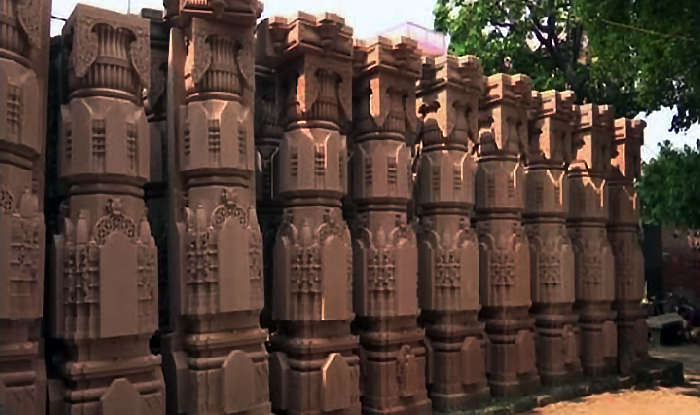
Ayodhya, Aug 2: With the foundation laying ceremony of the grand Ram temple around the corner, the work at the stone-carving workshop of Ram Janambhoomi in Ayodhya has reached its final stage.

Speaking to news agency, caretaker of Ram temple stone workshop Hanuman Yadav said, "Stonework is ready for the construction work till the first floor of the temple. Cleaning work is almost done but some work is still left which will be done soon after the trust's meeting."

Talking about the characteristics of the sandstone chosen work the construction, he said, "It was chosen for the construction as it can withstand rigours for thousands of years. These designated stones are minutely carved according to the need of the temple."

The stone-carving workshop for the Ram temple construction was established in Ayodhya by the Vishwa Hindu Parishad (VHP) in 1990.

On August 5 when Prime Minister Narendra Modi will visit Ayodhya for rituals that will mark the beginning of Ram temple construction, Hanumangarhi is the first stop he would be visiting.

The construction of Ram temple will begin in Ayodhya after the ceremony to lay the foundation stone in which various dignitaries from the political and religious fields are likely to participate apart from RSS chief Mohan Bhagwat. 

Comments

Add new comment

  • Coastaldigest.com reserves the right to delete or block any comments.
  • Coastaldigset.com is not responsible for its readers’ comments.
  • Comments that are abusive, incendiary or irrelevant are strictly prohibited.
  • Please use a genuine email ID and provide your name to avoid reject.
News Network
January 9,2020

New Delhi, Jan 9: JNU students who tried to march towards the Rashtrapati Bhavan on Thursday protesting the violence on the university campus were stopped by police and later detained.

The police also resorted to baton charge to control the mob who tried to block the traffic at Janpath. Using loudspeakers, the police also appealed to the crowd to maintain peace.

Before the students tried to proceed towards the Rashtrapati Bhavan, a delegation of JNU Students' Union and JNU Teachers' Association also met Human Resource Development (HRD) Ministry officials and demanded the removal of Vice-Chancellor M Jagadesh Kumar from his post.

Comments

Add new comment

  • Coastaldigest.com reserves the right to delete or block any comments.
  • Coastaldigset.com is not responsible for its readers’ comments.
  • Comments that are abusive, incendiary or irrelevant are strictly prohibited.
  • Please use a genuine email ID and provide your name to avoid reject.
Agencies
June 6,2020

United Nations, Jun 6: The coronavirus disease has not "exploded" in India, but the risk of that happening remains as the country moves towards unlocking its nationwide lockdown that was imposed in March to contain the Covid-19, according to a top WHO expert.

WHO Health Emergencies Programme Executive Director Michael Ryan on Friday said the doubling time of the coronavirus cases in India is about three weeks at this stage.

“So the direction of travel of the epidemic is not exponential but it is still growing,” he said, adding that the impact of the pandemic is different in different parts of India and varies between urban and rural settings.

“In South Asia, not just in India but in Bangladesh and...in Pakistan, other countries in South Asia, with large dense populations, the disease has not exploded. But there is always the risk of that happening,” Ryan said in Geneva.

He stressed that as the disease generates and creates a foothold in communities, it can accelerate at any time as has been seen in a number of settings.

Ryan noted that measures taken in India such as the nationwide lockdown have had an impact in slowing transmission but the risk of an increase in cases looms as the country opens up.

“The measures taken in India certainly had an impact in dampening transmission and as India, as in other large countries, open up and as people begin to move again, there's always a risk of the disease bouncing back up,” he said.

He added that there are specific issues in India regarding the large amount of migration, the dense populations in the urban environment and the fact that many workers have no choice but to go to work every day.

India went past Italy to become the sixth worst-hit nation by the COVID-19 pandemic.

India saw a record single-day jump of 9,887 coronavirus cases and 294 deaths on Saturday, pushing the nationwide infection tally to 2,36,657 and the death toll to 6,642, according to the health ministry.

The lockdown in India, was first clamped on March 25 and spanned for 21 days, while the second phase of the curbs began on April 15 and stretched for 19 days till May 3. The third phase of the lockdown was in effect for 14 days and ended on May 17. The fourth phase ended on May 31.

The country had registered 512 coronavirus infection cases till March 24.

The nation-wide lockdown in containment zones will continue till June 30 in India but extensive relaxations in a phased manner from June 8 are listed in the Union home ministry's fresh guidelines on tackling the Covid-19 pandemic issued last week.

WHO Chief Scientist Soumya Swaminathan said the over 200,000 current coronavirus cases in India, a country of over 1.3 billion people, "look big but for a country of this size, it's still modest.”

She stressed that it is important for India to keep track of the growth rate, the doubling time of the virus and to make sure that that number doesn't get worse.

She said that India is a “heterogeneous and huge country” with very densely populated cities and much lower density in some rural areas and varying health systems in different states and these offer challenges to the control of Covid-19.

Swaminathan added that as the lockdown and restrictions are lifted, it must be ensured that all precautions are taken by people.

“We've been making this point repeatedly that really if you want behaviour change at a large level, people need to understand the rationale for asking them to do certain things (such as) wearing masks,” she said.

In many urban areas in India, it's impossible to maintain physical distancing, she said adding that it then becomes very important for people to wear appropriate face coverings when they are out, in office settings, in public transport and educational institutions.

“As some states are thinking about opening, every institution, organisation, industry and sector needs to think about what are the measures that need to be put in place before you can allow a functioning and it may never be back to normal.”

She said that in many professions working from home can be encouraged but in several jobs, people have to go to work and in such cases measures must be put in place that allow people to protect themselves and others.

“I think communication and behaviour change is a very large part of this whole exercise,” she added.


Comments

Add new comment

  • Coastaldigest.com reserves the right to delete or block any comments.
  • Coastaldigset.com is not responsible for its readers’ comments.
  • Comments that are abusive, incendiary or irrelevant are strictly prohibited.
  • Please use a genuine email ID and provide your name to avoid reject.