


ABVP, AISA activists clash over blocking of Umar Khalid’s visit to Ramjas college

February 22, 2017

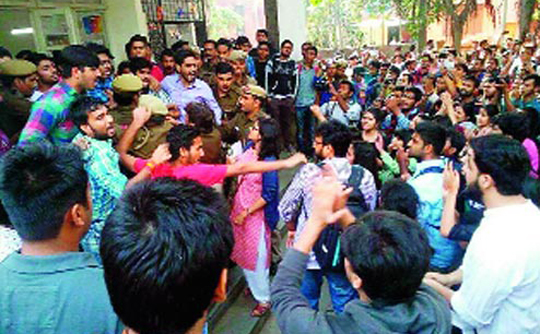
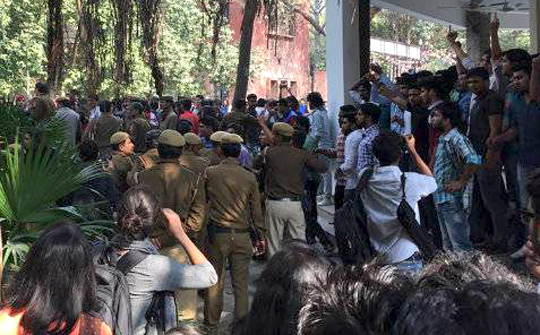
New Delhi, Feb 22: A clash broke out between activists of ABVP and AISA of Delhi University on Wednesday, a day after JNU student Umar Khalid’s visit to Ramjas College was cancelled following protests by students. The college authorities had to withdraw the invitation to Khalid, who was charged with sedition last year, and Shehla who was face of the movement demanding release of the students arrested in that case. According to reports, ABVP activists were staging a protest in the college on Wednesday, which led to a clash between them and AISA members. Both ABVP and AISA are student political groups representing divergent ideologies.
nat1

Umar Khalid and former JNUSU vice-president Shehla Rashid were invited to speak at a seminar in Ramjas College on Tuesday but their visit was cancelled after ABVP and DUSU members gathered outside the college gate and shouted slogans against them. There were also allegations of the protesters using violent methods like stone pelting.
ramjas

Meanwhile, there was a section of teachers, students and members of left- affiliated All India Students’ Association (AISA), who were agitated over the college’s decision to ‘bow down’ to “threat to freedom of speech” had decided to march to Maurice Nagar police station calling for action against ABVP members for resorting to vandalism.

During the clash, AISA members tried to barge inside the premises to ‘rescue the captives’. An AISA member said, “The students have been locked inside and those trying to come out were beaten up by ABVP goons. We tried to barge in inside the college to rescue the students but they are attacking us as well. They have come prepared with hockey sticks.”

After assessing the situation outside, Ramjas College Principal Rajender Prasad said he is in discussion with the teachers who were organisers of the event and requested both the groups to not disrupt the peace and harmony in the college.

The protesters also clashed with police personnel deployed at the scene. Umar Khalid was among JNU students who were charged with sedition after February 9 episode last year in which a group of students were seen shouting ‘anti-India’ slogans in mobile footage.

Comments

shaji
 - 
Wednesday, 22 Feb 2017

Its right time to declare ABVP a terrorist group and ban it. They came there with sticks / stones / sharp metals to attached AISA students and much to the strange police did not stop them from attacking AISA students. ABVP is fully supported by BJP and they are followign fool step of their masters in creating disturbance in the society.

Add new comment

  • Coastaldigest.com reserves the right to delete or block any comments.
  • Coastaldigset.com is not responsible for its readers’ comments.
  • Comments that are abusive, incendiary or irrelevant are strictly prohibited.
  • Please use a genuine email ID and provide your name to avoid reject.
Agencies
March 25,2020

New Delhi, Mar 25: The Indian Rail Catering and Tourism Corporation (IRCTC) on Wednesday appealed to the people not to cancel their e-tickets on their own in case of trains being cancelled by the national transporter due to nation-wide lockdown to help curb the spread of novel coronavirus pandemic.

Clearing the doubts of the railway passengers, IRCTC spokesperson Siddharth Singh said, "Doubts have been raised regarding cancellation of e-tickets subsequent to the halting of railway passenger trains.

"It may be submitted that for trains cancelled by the railways in its complete run, refund on e-tickets is full and automatic. In this case, no cancellation exercise is required to be done on the part of the user," he said.

The IRCTC official said that if user cancels his e-ticket in situations of train cancellations, there are chances he may get "less refund". "Hence passengers are advised not to cancel e-tickets on their own for those trains which have been cancelled by the railways," he said.

He also said that the refund amount will be credited to the user account used for booking e-tickets automatically and no charges will be deducted by the railways in case of train cancellation.

His remarks came as the national transporter announced the suspension of the passenger, mail and express services from March 23 till March 31. However, the railways extended the suspension of services till April 14 in the wake of the three week lockdown announced by Prime Minister Narendra Modi from March 25 during his second special address to the nation on Tuesday night.

The railways has cancelled over 13,600 passengers trains across the country in a bid to combat the spread of novel coronavirus. Only freight trains are running to ensure the supply of essential services. About 9,000 freight trains are transporting essential items every day across the country.

On Wednesday, India recorded 562 cases of COVID-19 with 10 deaths.

Comments

Add new comment

  • Coastaldigest.com reserves the right to delete or block any comments.
  • Coastaldigset.com is not responsible for its readers’ comments.
  • Comments that are abusive, incendiary or irrelevant are strictly prohibited.
  • Please use a genuine email ID and provide your name to avoid reject.
News Network
January 14,2020

Chennai/New Delhi, Jan 14: India's annual electricity demand in 2019 grew at its slowest pace in six years with December marking a fifth straight month of decline, government data showed, amid a broader economic slowdown that led to a drop in sales of everything from cars to cookies and also to factories cutting jobs.

Electricity demand is seen as an important indicator of industrial output in the country and a sustained decline could mean a further slowdown in the economy.

India's power demand grew at 1.1% in 2019, data from the Central Electricity Authority showed, the slowest pace of growth since a 1% uptick seen in 2013. The power demand growth slowdown in 2013 was preceded by three strong years of consumption growth of 8% or more.

In December, the country's power demand fell 0.5% from the year-earlier period, representing the fifth straight month of decline, compared with a 4.3% fall in November.

But in India's western states of Maharashtra and Gujarat, two of India's most industrialised provinces, monthly demand increased.

In October, power demand had fallen 13.2% from a year earlier, its steepest monthly decline in more than 12 years, as a slowdown in Asia's third-largest economy deepened.

Industry accounts for more than two-fifths of India's annual electricity consumption, while homes account for nearly a fourth and agriculture more than a sixth.

The slower demand growth is a blow for many debt-laden power producers, who are facing financial stress and are owed over $11 billion by state-run distribution companies.

India's overall economic growth slowed to 4.5% in the July-September quarter, government data released in November showed, the weakest pace since 2013 as consumer demand and private investment fell.

The government has estimated growth in the current financial year that runs through to March will be the slowest since the 2008 global crisis.

"This reflects overall economic slowdown, because if you look at other high frequency data like diesel consumption, everywhere you are seeing contraction," Rupa Rege Nitsure, chief economist at L&T Financial Holdings.

But India's central bank will not have much scope to cut rates to stimulate the economy because inflation has been rising sharply and reached 7.35% in December compared with 1.97% in January last year.

Economists say India's growth will continue to hover around 4.5% levels in the Oct-Dec quarter.

"In the Oct-Dec quarter as well growth (GDP) will be around the same level as July-September. My estimate for the full year is around 4.7% growth," Nitsure said.

Comments

Add new comment

  • Coastaldigest.com reserves the right to delete or block any comments.
  • Coastaldigset.com is not responsible for its readers’ comments.
  • Comments that are abusive, incendiary or irrelevant are strictly prohibited.
  • Please use a genuine email ID and provide your name to avoid reject.
Agencies
February 27,2020

New Delhi, Feb 27: The US Commission on International Religious Freedom (USCIRF) has said that the Delhi violence in which over 30 people were killed, was specifically targeted against the Muslims.

Expressing "grave concern over the ongoing violence taking place in Delhi", the USCIRF in a statement said that as President Donald Trump's inaugural visit to India winds down, North-East Delhi has been rocked by deadly rioting, with reports of violence and mobs specifically targeting Muslims.

"These incidents are even more concerning in the context of efforts within India to target and potentially disenfranchise Muslims across the country, in clear violation of international human rights standards," USCIRF Commissioner Anurima Bhargava said.

"According to reports, several mosques have also been set alight or vandalized. Many Muslim residents have been forced to flee the area. This unrest comes in the wake of widespread protests against the Citizenship (Amendment) Act following its passage in December 2019.

"The brutal and unchecked violence growing across Delhi cannot continue," Bhargava said adding that the Indian government must take swift action to ensure the safety of all of its citizens.

"Instead, reports are mounting that the Delhi police have not intervened in violent attacks against Muslims, and the government is failing in its duty to protect its citizens."

USCIRF Chair Tony Perkins said the ongoing violence in Delhi and the reported "attacks against Muslims, their homes and shops, and their houses of worship are greatly disturbing".

One of the essential duties of any responsible government, he said, is to provide protection and physical security for its citizens, regardless of faith.

"We urge the Indian government to take serious efforts to protect Muslims and others targeted by mob violence."

In its annual report last year, the USCIRF classified India as a "Tier 2" country for engaging in or tolerating religious freedom violations that meet at least one of the elements of the "systematic, ongoing, egregious standard for designations as a "country of particular concern (CPC)", under the International Religious Freedom Act.

The ongoing violence in North-East Delhi erupted after clashes between pro and anti-CAA protesters on Sunday.

Besides the casualties, over 200 others have been injured in the deadliest violence in the national capital in decades.

Comments

Add new comment

  • Coastaldigest.com reserves the right to delete or block any comments.
  • Coastaldigset.com is not responsible for its readers’ comments.
  • Comments that are abusive, incendiary or irrelevant are strictly prohibited.
  • Please use a genuine email ID and provide your name to avoid reject.