ABVP, AISA activists clash over blocking of Umar Khalid’s visit to Ramjas college

February 22, 2017

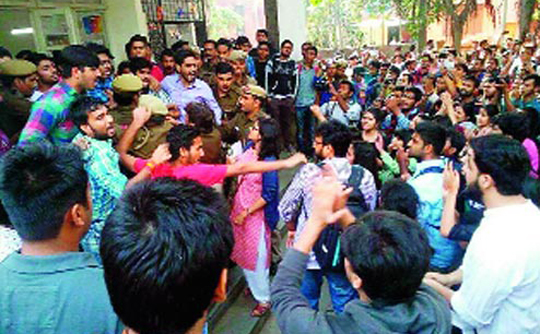
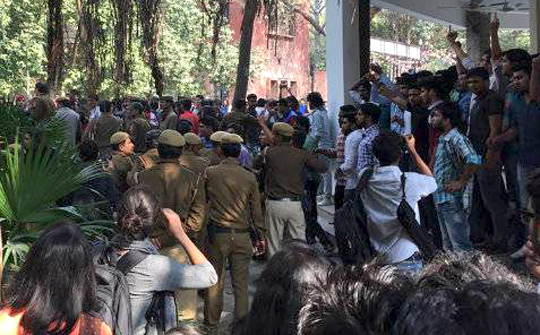
New Delhi, Feb 22: A clash broke out between activists of ABVP and AISA of Delhi University on Wednesday, a day after JNU student Umar Khalid’s visit to Ramjas College was cancelled following protests by students. The college authorities had to withdraw the invitation to Khalid, who was charged with sedition last year, and Shehla who was face of the movement demanding release of the students arrested in that case. According to reports, ABVP activists were staging a protest in the college on Wednesday, which led to a clash between them and AISA members. Both ABVP and AISA are student political groups representing divergent ideologies.

nat1

Umar Khalid and former JNUSU vice-president Shehla Rashid were invited to speak at a seminar in Ramjas College on Tuesday but their visit was cancelled after ABVP and DUSU members gathered outside the college gate and shouted slogans against them. There were also allegations of the protesters using violent methods like stone pelting.

ramjas

Meanwhile, there was a section of teachers, students and members of left- affiliated All India Students’ Association (AISA), who were agitated over the college’s decision to ‘bow down’ to “threat to freedom of speech” had decided to march to Maurice Nagar police station calling for action against ABVP members for resorting to vandalism.

During the clash, AISA members tried to barge inside the premises to ‘rescue the captives’. An AISA member said, “The students have been locked inside and those trying to come out were beaten up by ABVP goons. We tried to barge in inside the college to rescue the students but they are attacking us as well. They have come prepared with hockey sticks.”

After assessing the situation outside, Ramjas College Principal Rajender Prasad said he is in discussion with the teachers who were organisers of the event and requested both the groups to not disrupt the peace and harmony in the college.

The protesters also clashed with police personnel deployed at the scene. Umar Khalid was among JNU students who were charged with sedition after February 9 episode last year in which a group of students were seen shouting ‘anti-India’ slogans in mobile footage.

Comments

shaji
 - 
Wednesday, 22 Feb 2017

Its right time to declare ABVP a terrorist group and ban it. They came there with sticks / stones / sharp metals to attached AISA students and much to the strange police did not stop them from attacking AISA students. ABVP is fully supported by BJP and they are followign fool step of their masters in creating disturbance in the society.

Add new comment

  • Coastaldigest.com reserves the right to delete or block any comments.
  • Coastaldigset.com is not responsible for its readers’ comments.
  • Comments that are abusive, incendiary or irrelevant are strictly prohibited.
  • Please use a genuine email ID and provide your name to avoid reject.
News Network
June 20,2020

New Delhi, Jun 20: Diesel price on Saturday hit a record high after rates were hiked by 61 paise per litre while petrol price was up 51 paise, taking the cumulative increase in rates in two weeks to Rs 8.28 and Rs 7.62 respectively.

Petrol price in Delhi was hiked to Rs 78.88 per litre from Rs 78.37, while diesel rates were increased to Rs 77.67 a litre from Rs 77.06, according to a price notification of state oil marketing companies.

Rates have been increased across the country and vary from state to state depending on the incidence of local sales tax or VAT.

The 14th daily increase in rates since oil companies on June 7 restarted revising prices in line with costs after ending an 82-day hiatus in rate revision, has taken diesel prices to new high. Petrol price too is at a two-year high.

Prior to the current rally, diesel rate had touched a peak of Rs 75.69 per litre in Delhi on October 16, 2018.

The highest-ever petrol price was on October 4, 2018, when rates soared to Rs 84 a litre in Delhi.

When rates had peaked in October 2018, the government had cut excise duty on petrol and diesel by Rs 1.50 per litre each. State-owned oil companies were asked to absorb another Re 1 a litre to help cut retail rates by Rs 2.50 a litre.

Oil companies had quickly recouped the Re 1 and the government in July 2019 raised excise duty by Rs 2 a litre.

The 82-day freeze in rates this year was imposed in mid-March soon after the government hiked excise duty on petrol and diesel to shore up additional finances.

The government on March 14 hiked excise duty on petrol and diesel by Rs 3 per litre each and then again on May 5 by a record Rs 10 per litre in case of petrol and Rs 13 on diesel. The two hikes gave the government Rs 2 lakh crore in additional tax revenues.

Oil PSUs Indian Oil Corp (IOC), Bharat Petroleum Corp Ltd (BPCL) and Hindustan Petroleum Corp Ltd (HPCL), instead of passing on the excise duty hikes to customers, adjusted them against the fall in retail rates that was warranted because of a decline in international oil prices to two-decade lows.

International oil prices have since rebounded and oil firms are now adjusting retail rates in line with them.

In 14 hikes, petrol price has gone up by Rs 7.62 per litre and diesel by Rs 8.28 a litre.

Comments

Add new comment

  • Coastaldigest.com reserves the right to delete or block any comments.
  • Coastaldigset.com is not responsible for its readers’ comments.
  • Comments that are abusive, incendiary or irrelevant are strictly prohibited.
  • Please use a genuine email ID and provide your name to avoid reject.
News Network
March 13,2020

Mumbai, Mar 13:  Investor wealth worth nearly Rs 12 lakh crore was wiped out in less than 15 minutes of trading on the stock exchanges on Friday, with the two benchmarks, the BSE Sensex and the NSE Nifty, crashing over 10 per cent.

The 30-share BSE Sensex plummeted 3,380.59 points, or 10.31 per cent, to 29,397.55. It hit an intra-day low of 29,388.97, falling up to 3,389.17 points.

Trading was halted for 45 minutes in the early session after the index hit its lower circuit limit.

The BSE and NSE benchmark indices, however, pared most losses with the Sensex trading 835.40 points, or 2.55 per cent, lower at 31,942.74, and the Nifty was down 253.25 points or 2.64 per cent at 9,336.90 at 10.40 am.

The mayhem on Dalal Street eroded investor wealth worth Rs 12,92,479.88 crore, taking the total m-cap to Rs 1,12,78,172.75 crore on the BSE at 1020 hours.

The m-cap of BSE-listed companies stood at Rs 1,25,70,652.63 crore at the end of trading on Thursday.

Traders said besides global selloff, incessant foreign fund outflows also weighed on investor sentiments.

On a net basis, foreign institutional investors sold equities worth Rs 3,475.29 crore on Thursday, data available with stock exchanges showed.

On the BSE, 1,279 scrips declined, while 193 advanced and 40 remained unchanged.

Volatility heightened in global markets as benchmarks world over went into panic mode, insinuating a freakish selloff.

Bourses in Shanghai dropped over 3.32 per cent, Hong Kong 5.61 per cent, Seoul 7.58 per cent and Tokyo cracked up to 7.97 per cent.

Wall Street lost 10 per cent in overnight trade.

More than 1,30,000 cases of the novel coronavirus have been recorded in 116 countries and territories, killing at least 4,900 people.

The number of coronavirus patients in India has risen to 74, as per the health ministry.

Comments

Add new comment

  • Coastaldigest.com reserves the right to delete or block any comments.
  • Coastaldigset.com is not responsible for its readers’ comments.
  • Comments that are abusive, incendiary or irrelevant are strictly prohibited.
  • Please use a genuine email ID and provide your name to avoid reject.
News Network
February 1,2020

When it comes to the economy, dark days do loom large over India. May it be growth (lowest since 2008), inflation (highest in the last six years), or revenue collection (lowest in 10 years), the Indian economy is faltering. Hence, there is little leeway that can be assumed in the incumbent Union Budget 2020 (the first of the decade) if the economy needs to be boosted.

While presenting the decade's first Budget for India, finance minister Nirmala Sitharaman said on Saturday in Parliament:

Taxation

•             AADHAR based tax verification introduced

•             Review of customs duty exemptions in September 2020

•             GST refund process simplified

•             Electronic invoice implementation in phases

•             New digital scheme for tax litigation

•             PAN to be instantly allotted online against Aadhar

•             Vivaad se Vishwas Scheme: Defaulter to pay only disputed tax and no penalty or interest by 31 March 2020, post which additional amount can be paid till June 2020

•             Measure to promote affordable housing - tax holiday extended for developers

•             Concession on real estate transactions

•             Turnover threshold for audit raised to Rs 5 crore from 1 crore

•             Company audit requirements eased

•             Taxes on ESOPs (employee stock ownership) in start-ups deferred by 5 years

•             100% per cent tax exemption

•             Corporate Tax at 15%

•             Dividend Distribution Tax removed, dividend taxed only for recipients

•             No tax for 0-5 lakh

•             30% above 15 lakh

•             25% for income between Rs 12.5-15 lakh

•             20% for income between Rs 10-12.5 lakh

•             15% for income between Rs 7.5-10 lakh

•             10% for income between Rs 5-7.5 lakh, against the prevailing 20%

•             A new, optional simplified personal income tax regime for those not seeking exemptions


Major steps and initiatives taken by the government in finance

•             3.8 percent fiscal deficit estimated

•             GDP nominal growth expected at 10 per cent

•             Govt to sell part of holding LIC via IPO (initial public offering)- partial LIC disinvestment

•             Partial credit guarantee for NBFCs

•             New law for netting of financial contracts

•             Mechanism to end liquidity crisis

•             NRIs (non resident Indians) can invest in certain govt securities


Aspirational India: Caring society

•             App-based invoice financing loans for MSMEs

•             Amendment to Factoring Regulation Act to aid MSMEs

•             Pension Fund Regulatory and Development Authority (PFRDI) Act amendments

•             No criminal liabilities for civil acts

•             Auto-enrolment in universal pension scheme

•             5958 cr allocated for Ladakh

•             30757 cr allocated for J&K

•             Insurance for depositors raised to 5 lakh from 1 lakh

•             Robust mechanisms in place to monitor all PSU banks

•             Depositors’ money safe

•             100 cr for hosting G20 in 2022

•             National Recruitment Agency to be set up

•             Tax payers’ charter to be enshrined in statutes

•             Amendments for Companies Act

•             Tax payer charter proposed to free citizens from tax harassment

•             Businesses should have confidence that system is fair

•             4400 crore allocation for clean air and climate change policy

•             Aim to reduce carbon footprint - Warning to old thermal plants

•             Committed to preserve environment, tackle climate change

•             23150 crore for culture ministry

•             2500 crore for tourism sector

•             Institute of Heritage and Conservation to come up soon

•             Aim to set up more museums

•             5 archaeological sites to be made iconic

•             Proposal to end manual scavenging

•             53700 crore for welfare of STs

•             85000 crore for SCs and OBCs for 2021

•             35600 crore for nutritional schemes

•             Gross enrollment ratio of girls higher than boys in elementary level

•             Beti Bachao, Beti Padhao - tremendous results


Aspirational India: Infrastructure and economic development

•             Further reforms for transparent price discovery for natural gas

•             22000 crore for power sector

•             8000 crore for quantum technology in next 6 years

•             Two national level science schemes

•             Expand Jan Aushadhi Scheme

•             1 lakh gram panchayats to be connected via Bharat Net

•             6000 crore for Bharat Net

•             Data Centre parks to be set up across the country

•             National Gas Grid to be expanded

•             Reforms to help stressed DISCOMS (distribution companies)

•             Delhi-Mumbai Expressway by 2023

•             100 more airports by 2024

•             Plans to energise economic activity along river banks

•             Need to enhance sea ports

•             High Speed Mumbai-Ahmedabad train

•             More Tejas-type trains

•             4 station redevelopment projects under PP model

•             2000 km of strategic highways to be built, 11000 km of track electrification

•             Accelerated development of highways

•             National Logistics Policy to be released soon

•             Big push on infrastructure - 100 lakh crore

•             National Technical Textiles Mission to be set up

•             1480 crore outlay for textile sector

•             27300 crore for industrial development by 2021

•             Digital refund of duties for exporters

•             Boost domestic manufacturing - electronic equipment, mobile phone, medical devices

•             5 new smart cities in collaboration with states

•             Investment clearance cell to be set up for end to end facilitation

•             Entrepreneurship has been the strength of India


Aspirational India: Education and skills

•             High need for medical teachers and paramedics

•             Internships for engineers in panchayats

•             Rs 99300 cr for education sector

•             Large hospitals to be encouraged to start PG courses

•             Attach medical colleges to district hospitals

•             National police university to be set up

•             IND-SAT programme for overseas students for studying in India

•             New courses in 159 universities by 2026

•             Focus on education for jobs

•             Propose a fresh education policy

•             Urban local bodies should give opportunities to new engineers

•             Education needs more finances


Aspirational India: Healthcare

•             AI (artificial intelligence) to be used for Ayushman Bharat Scheme

•             69000 crore for health sector

•             Propose to set up more hospitals

•             Holistic vision for national healthcare


Aspirational India: Agriculture, Irrigation and rural development

•             Need to liberalise farm markets

•             108 million metric tonne milk production by 2021

•             2.83 lakh cr allocation for agriculture and irrigation

•             Propose raising fish production to 200 lakh tonne

•             Zero budget national farming

•             NABARD refinance scheme to be expanded

•             Village credit card scheme

•             Agriculture credit target for 2020 set at Rs 15 lakh crore

•             Village storage scheme for farmers, zero budget natural farming

•             Dhanya Lakshmi scheme for women in villages

•             Krishi Udaan by civil aviation ministry for air transport of such commodities over longer distances

•             Indian railways to set up 'kisan rail'

•             Govt to provide help to geo-tag warehouses

•             Financial inclusion has helped raise farm incomes

•             Plan for 100 water stressed districts

•             Scheme for 20 lakh farmers to set up solar pumps

•             Doubling farm income - model agricultural land leasing act, balanced use of fertilisers, solar pumps for 20 lakh farmers


Budget 2020 and its three focuses

•             Budget's first focus is 'Aspirational India'. Second focus: economic development for all. Third focus: building a caring society.

•             FDI at 284 billion dollars, achieved 7.84% growth

•             GST formalised the economy

•             Efficiency gained in logistics

•             16 lakh new tax payers added

•             Fundamentals of economy hold strong

•             Scaled up implementation of pro-poor schemes


Key challenges FM faces

•             India needs to grow by 9 per cent to 10 per cent a year to become the $5 trillion economy by 2024, as projected by the government. The government is now forecasting growth will come in at 5 per cent

•             The IMF, which had originally predicted 6.1 per cent growth for India in 2019, has revised that downwards to 4.8 per cent

•             The government’s likely to miss its fiscal deficit target for the current fiscal year of 3.3 per cent and hike its target to as much as 4 per cent for the next financial year

•             India will struggle to achieve 5 per cent GDP growth in 2020 - Economist Steve Hanke, Johns Hopkins University

•             Investment is forecast to grow at less than 1 per cent -- the lowest since 2004-05

•             India's unemployment rate rose to 7.5 per cent during September-December 2019 quarter, according to data released by think-tank Centre for Monitoring Indian Economy


 

Comments

Add new comment

  • Coastaldigest.com reserves the right to delete or block any comments.
  • Coastaldigset.com is not responsible for its readers’ comments.
  • Comments that are abusive, incendiary or irrelevant are strictly prohibited.
  • Please use a genuine email ID and provide your name to avoid reject.