


ABVP, AISA activists clash over blocking of Umar Khalid’s visit to Ramjas college

February 22, 2017

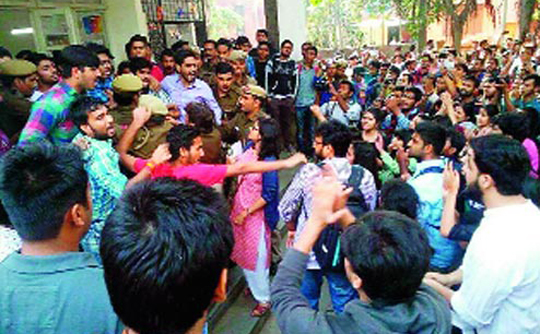
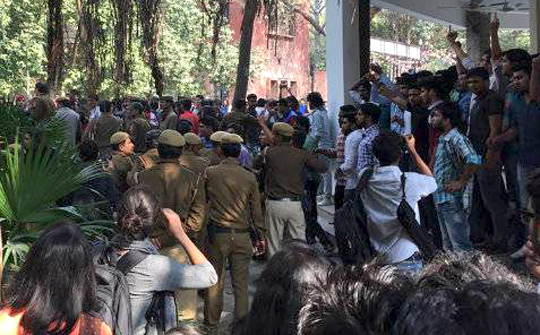
New Delhi, Feb 22: A clash broke out between activists of ABVP and AISA of Delhi University on Wednesday, a day after JNU student Umar Khalid’s visit to Ramjas College was cancelled following protests by students. The college authorities had to withdraw the invitation to Khalid, who was charged with sedition last year, and Shehla who was face of the movement demanding release of the students arrested in that case. According to reports, ABVP activists were staging a protest in the college on Wednesday, which led to a clash between them and AISA members. Both ABVP and AISA are student political groups representing divergent ideologies.
nat1

Umar Khalid and former JNUSU vice-president Shehla Rashid were invited to speak at a seminar in Ramjas College on Tuesday but their visit was cancelled after ABVP and DUSU members gathered outside the college gate and shouted slogans against them. There were also allegations of the protesters using violent methods like stone pelting.
ramjas

Meanwhile, there was a section of teachers, students and members of left- affiliated All India Students’ Association (AISA), who were agitated over the college’s decision to ‘bow down’ to “threat to freedom of speech” had decided to march to Maurice Nagar police station calling for action against ABVP members for resorting to vandalism.

During the clash, AISA members tried to barge inside the premises to ‘rescue the captives’. An AISA member said, “The students have been locked inside and those trying to come out were beaten up by ABVP goons. We tried to barge in inside the college to rescue the students but they are attacking us as well. They have come prepared with hockey sticks.”

After assessing the situation outside, Ramjas College Principal Rajender Prasad said he is in discussion with the teachers who were organisers of the event and requested both the groups to not disrupt the peace and harmony in the college.

The protesters also clashed with police personnel deployed at the scene. Umar Khalid was among JNU students who were charged with sedition after February 9 episode last year in which a group of students were seen shouting ‘anti-India’ slogans in mobile footage.

Comments

shaji
 - 
Wednesday, 22 Feb 2017

Its right time to declare ABVP a terrorist group and ban it. They came there with sticks / stones / sharp metals to attached AISA students and much to the strange police did not stop them from attacking AISA students. ABVP is fully supported by BJP and they are followign fool step of their masters in creating disturbance in the society.

Add new comment

  • Coastaldigest.com reserves the right to delete or block any comments.
  • Coastaldigset.com is not responsible for its readers’ comments.
  • Comments that are abusive, incendiary or irrelevant are strictly prohibited.
  • Please use a genuine email ID and provide your name to avoid reject.
News Network
June 8,2020

New Delhi, Jun 8: Delhi Chief Minister Arvind Kejriwal has gone into self-quarantine after developing sore throat and fever, and will get himself tested for COVID-19 on Tuesday, officials said on Monday.

They said the chief minister, who is also a diabetic, was feeling unwell since Sunday afternoon.

"He has mild fever and sore throat since Sunday afternoon. As advised by doctors, the chief minister will undergo COVID-19 test on Tuesday morning," officials said.

Officials said the CM had attended a Cabinet meeting on Sunday morning and thereafter, he did not attend any meeting.

The chief minister has been holding most of his meetings via video conferencing from his official residence for past two days.

This come as the number of coronavirus cases in the national capital crossed the 28,000-mark with 1,282 fresh infections while the death toll climbed to 812 on Sunday, a health bulletin issued by the Delhi government said. According to the health bulletin, the total number of COVID-19 cases in Delhi rose to 28,936 with 1,282 fresh cases.

A total of 51 fatalities were reported on June 6, the bulletin said, adding that these lives were lost between May 8 and June 5. It, however, said the cumulative death figure refers to fatalities where the primary cause of death was found to be COVID-19, according to a report of the Death Audit Committee on the basis of the case-sheets received from various hospitals.

Comments

Add new comment

  • Coastaldigest.com reserves the right to delete or block any comments.
  • Coastaldigset.com is not responsible for its readers’ comments.
  • Comments that are abusive, incendiary or irrelevant are strictly prohibited.
  • Please use a genuine email ID and provide your name to avoid reject.
News Network
March 6,2020

New Delhi, Mar 6: Union Finance Minister Nirmala Sitharaman on Friday will move the Insolvency and Bankruptcy Code (Second Amendment) Bill, 2019 for consideration and passing in Lok Sabha.

In December last year, the Union Cabinet had approved a proposal to promulgate an ordinance to amend the Insolvency and Bankruptcy Code (IBC) 2016.

The amendments will remove certain ambiguities in the IBC 2016 and ensure smooth implementation of the code, an official statement said.

The move is aimed at easing the insolvency resolution process and promoting the ease of doing business. Aimed at streamlining of the insolvency resolution process, the amendments seek to protect last-mile funding and boost investment in financially-distressed sectors.

Under the amendments, the liability of a corporate debtor for an offence committed before the corporate insolvency resolution process will cease.

The debtor will not be prosecuted for an offence from the date the resolution plan has been approved by the adjudicating authority if a resolution plan results in change in the management or control of the corporate debtor to a person who was not a promoter or in the management or control of the corporate debtor or a related party of such a person.

The amendments are aimed at providing more protection to bidders participating in the recovery proceedings and in turn boosting investor confidence in the country's financial system.

Comments

Add new comment

  • Coastaldigest.com reserves the right to delete or block any comments.
  • Coastaldigset.com is not responsible for its readers’ comments.
  • Comments that are abusive, incendiary or irrelevant are strictly prohibited.
  • Please use a genuine email ID and provide your name to avoid reject.
News Network
January 10,2020

New Delhi, Jan 10: One woman reported a rape every 15 minutes on average in India in 2018, according to government data released on Thursday, underlining its dismal reputation as one of the worst places in the world to be female.

The highly publicised gang rape and murder of a woman in a bus in New Delhi in 2012 brought tens of thousands onto the streets across India and spurred demands for action from film stars and politicians, leading to harsher punishments and new fast-track courts. But the violence has continued unabated.

Women reported almost 34,000 rapes in 2018, barely changed from the year before. Just over 85% led to charges, and 27% to convictions, according to the annual crime report released by the Ministry of Home Affairs.

Women's rights groups say crimes against women are often taken less seriously, and investigated by police lacking insensitivity.

"The country is still run by men, one (female prime minister) Indira Gandhi is not going to change things. Most judges are still men," said Lalitha Kumaramangalam, former chief of the National Commission for Women.

"There are very few forensic labs in the country, and fast-track courts have very few judges," said Kumaramangalam, a member of Prime Minister Narendra Modi's Bharatiya Janata Party (BJP).

The rape of a teenager in 2017 by former BJP state legislator Kuldeep Singh Sengar gained national attention when the accuser tried to kill herself the following year, accusing the police of inaction.

Five months before Sengar was convicted last December, the accuser's family had to be provided with security after a truck crashed into the car she was in, injuring her and killing two of her relatives.

A 2015 study by the Centre for Law & Policy Research in Bengaluru found that fast-track courts were indeed quicker, but did not handle a high volume of cases.

And a study in 2016 by Partners for Law in Development in New Delhi found that they still took an average of 8.5 months per case - more than four times the recommended period.

The government statistics understate the number of rapes as it is still considered a taboo to report rape in some parts of India and because rapes that end in the murder are counted purely as murders.

Comments

Add new comment

  • Coastaldigest.com reserves the right to delete or block any comments.
  • Coastaldigset.com is not responsible for its readers’ comments.
  • Comments that are abusive, incendiary or irrelevant are strictly prohibited.
  • Please use a genuine email ID and provide your name to avoid reject.