ABVP, AISA activists clash over blocking of Umar Khalid’s visit to Ramjas college

February 22, 2017

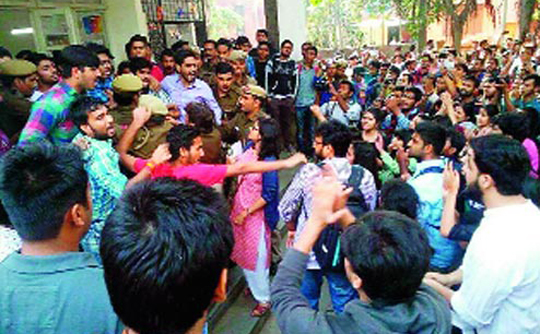
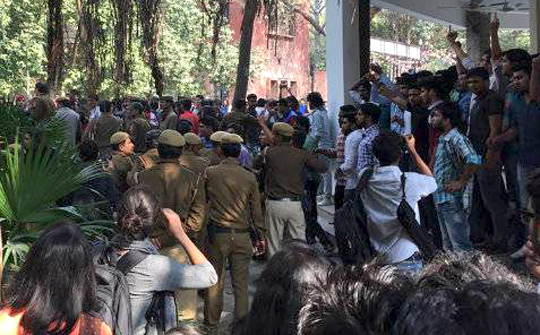
New Delhi, Feb 22: A clash broke out between activists of ABVP and AISA of Delhi University on Wednesday, a day after JNU student Umar Khalid’s visit to Ramjas College was cancelled following protests by students. The college authorities had to withdraw the invitation to Khalid, who was charged with sedition last year, and Shehla who was face of the movement demanding release of the students arrested in that case. According to reports, ABVP activists were staging a protest in the college on Wednesday, which led to a clash between them and AISA members. Both ABVP and AISA are student political groups representing divergent ideologies.

nat1

Umar Khalid and former JNUSU vice-president Shehla Rashid were invited to speak at a seminar in Ramjas College on Tuesday but their visit was cancelled after ABVP and DUSU members gathered outside the college gate and shouted slogans against them. There were also allegations of the protesters using violent methods like stone pelting.

ramjas

Meanwhile, there was a section of teachers, students and members of left- affiliated All India Students’ Association (AISA), who were agitated over the college’s decision to ‘bow down’ to “threat to freedom of speech” had decided to march to Maurice Nagar police station calling for action against ABVP members for resorting to vandalism.

During the clash, AISA members tried to barge inside the premises to ‘rescue the captives’. An AISA member said, “The students have been locked inside and those trying to come out were beaten up by ABVP goons. We tried to barge in inside the college to rescue the students but they are attacking us as well. They have come prepared with hockey sticks.”

After assessing the situation outside, Ramjas College Principal Rajender Prasad said he is in discussion with the teachers who were organisers of the event and requested both the groups to not disrupt the peace and harmony in the college.

The protesters also clashed with police personnel deployed at the scene. Umar Khalid was among JNU students who were charged with sedition after February 9 episode last year in which a group of students were seen shouting ‘anti-India’ slogans in mobile footage.

Comments

shaji
 - 
Wednesday, 22 Feb 2017

Its right time to declare ABVP a terrorist group and ban it. They came there with sticks / stones / sharp metals to attached AISA students and much to the strange police did not stop them from attacking AISA students. ABVP is fully supported by BJP and they are followign fool step of their masters in creating disturbance in the society.

Add new comment

  • Coastaldigest.com reserves the right to delete or block any comments.
  • Coastaldigset.com is not responsible for its readers’ comments.
  • Comments that are abusive, incendiary or irrelevant are strictly prohibited.
  • Please use a genuine email ID and provide your name to avoid reject.
News Network
March 20,2020

New Delhi, Mar 20: The four men convicted of the gang rape and murder of a Delhi woman on December 16, 2012 were hanged in the darkness of pre-dawn on Friday, ending a horrific chapter in India's long history of sexual assault that had seared the nation's soul. Mukesh Singh (32), Pawan Gupta (25), Vinay Sharma (26) and Akshay Kumar Singh (31) were executed at 5.30 am for the savage assault in an empty moving bus on the 23-year-old physiotherapy intern who came to be known the world over as Nirbhaya, the fearless one.

This is the first time that four men have been hanged together in Tihar Jail, South Asia's largest prison complex that houses more than 16,000 inmates. The executions were carried out after the men exhausted every possible legal avenue to escape the gallows. Their desperate attempts only postponed the inevitable by less than two months after the first date of execution was set for January 22.

They were hanged at 5.30 am, Director General of Prison Sandeep Goel said.

After raping and brutalising the woman, the men, one of whom was a juvenile at the time, dumped her on the road and left for dead on the cold winter night. Her friend who was with her was also severely beaten and thrown out along with her. She was so severely violated that her insides were spilling out when she was taken to hospital. She died in a Singapore hospital after battling for her life for a fortnight.

Six people, including the four convicts and the juvenile, were named as accused.

While Ram Singh allegedly committed suicide in the Tihar Jail days after the trial began in the case, the juvenile was released in 2015 after spending three years in a correctional home.

The road to the gallows was a long and circuitous one, going through the lower courts, the High Court, the Supreme Court and the president's office before going back to the Supreme Court that heard and rejected various curative petitions.

The death warrants were deferred by a court thrice on the grounds that the convicts had not exhausted all their legal remedies and that the mercy petition of one or the other was before the president.

On March 5, a trial court issued fresh death warrants for March 20 at 5.30 am as the final date for the execution.

Comments

Add new comment

  • Coastaldigest.com reserves the right to delete or block any comments.
  • Coastaldigset.com is not responsible for its readers’ comments.
  • Comments that are abusive, incendiary or irrelevant are strictly prohibited.
  • Please use a genuine email ID and provide your name to avoid reject.
News Network
March 25,2020

New Delhi, Mar 25: The government is likely to agree an economic stimulus package of more than Rs 1.5 lakh crore ($19.6 billion) to fight a downturn in the country that is currently locked down to stem the spread of coronavirus, two sources familiar with the matter told news agency.
The government has not yet finalised the package and discussions are ongoing between Prime Minister Narendra Modi's office, the finance ministry, and Reserve Bank of India (RBI), said both the sources, who asked not to be named as the matter was still under discussion.

One of the sources, a senior government official, said the stimulus plan could be as large as Rs 2.3 lakh crore, but final numbers were still in discussion.

The package could be announced by the end of the week, both sources added.

Comments

Add new comment

  • Coastaldigest.com reserves the right to delete or block any comments.
  • Coastaldigset.com is not responsible for its readers’ comments.
  • Comments that are abusive, incendiary or irrelevant are strictly prohibited.
  • Please use a genuine email ID and provide your name to avoid reject.
News Network
February 6,2020

Feb 6: India has been ranked 40th out of 53 countries on a global intellectual property index, even as the country has shown improvement in terms of scores when it comes to the protection of IP and copyright issues, a top American industry body said on Wednesday.

India was placed at 36th position among 50 countries in 2019.

India's score, however, increased from 36.04 per cent (16.22 out of 45) in 2019 to 38.46 per cent (19.23 out of 50) in 2020, a 2.42 per cent jump in an absolute score.

However, India's relative score increased by 6.71 per cent, according to the International IP Index released by Global Innovation Policy Center or GIPC of the US Chambers of Commerce.

This year, it finds itself on the 40th place among 53 countries. Two new Index economies (Greece and the Dominican Republic) scored ahead of India. The Philippines, and Ukraine leapfrogged India.

"Since the release of the 2016 National IPR Policy, the government of India has made a focused effort to support investments in innovation and creativity through increasingly robust IP protection and enforcement," the GIPC said.

Since 2016, India has improved the speed of processing for patent and trademark applications, increased awareness of IP rights among Indian innovators and creators, and facilitated the registration and enforcement of those rights, it added.

According to the eighth edition of the annual report, India's score on the Chamber's International IP Index demonstrates the country's growing investment in IP-driven innovation and creativity. The Index specifically highlights a number of reforms over the last year that strengthen India's overall IP ecosystem, it said.

"In 2019, the Delhi High Court used dynamic injunctions to disable access to copyright-infringing content online, resulting in an increase in India's score on two of the copyright-related indicators," it said.

"The use of these injunctions places India alongside global leaders in copyright enforcement, including Singapore and the UK. As a result, India scores ahead of 24 other economies in the copyright indicators," the report said.

The Delhi High Court also issued a series of judgements that provide clarity on existing statutes related to trademark protection online, resulting in a score increase on one of the trademark-related indicators, it added.

The courts issued two precedential rulings that raised the bar for the damages awarded in IP-infringement cases and may provide a deterrent for future infringement. This resulted in an increase in score on one of the trademark-related indicators, it said.

Global Innovation Policy Center or GIPC said India also continues to score well in the Systemic Efficiency indicator, scoring ahead of 28 other economies in these indicators.

"This is a result of a concerted effort by the Indian government to consult with stakeholders during IP policy formation and create greater awareness about the importance of IP protection,” it said adding that India also remains a leader in the use of targeted incentives and IP assets for small and medium-sized enterprises (SMEs).

“To continue this upward trajectory, much work remains to be done to introduce transformative changes to India’s overall IP framework and take serious steps to consistently implement strong IP standards," the report said.

GIPC has identified several challenges for India. Prominent among them being patentability requirements, patent enforcement, compulsory licensing, patent opposition, regulatory data protection, transparency in reporting seizures by customs, and Singapore Treaty of Law of TMs and Patent Law Treaty.

"We are encouraged that Indian policymakers seem to recognize this Index as a valuable resource in their efforts to strengthen the country’s promising innovation ecosystem and enhance its competitiveness in an increasingly knowledge-based global economy,” the report said.

Observing that no other economy stands to gain more from strong Indian IP than India itself, the report said for example, no industry has been hurt more by copyright violations in India than the country’s own Bollywood industry, which loses almost USD3 billion to piracy each year.

"The number one way the Modi administration can demonstrate its commitment to the success of the Atal Innovation Mission, Accelerating Growth for New India’s Innovations, Make in India, Digital India, and Startup India is to strengthen its IP framework in ways that promote the legal and regulatory certainty necessary for greater R&D investment, high-value jobs, and greater innovative and creative outputs,” it said.

"Strong IP standards can further solidify India's position as the world’s fastest-growing economy, bolstering its reputation as a destination for doing business, foreign businesses’ ability to invest and make in India, thereby supporting the growth of India’s own innovative and creative industries," the report said.


Comments

Add new comment

  • Coastaldigest.com reserves the right to delete or block any comments.
  • Coastaldigset.com is not responsible for its readers’ comments.
  • Comments that are abusive, incendiary or irrelevant are strictly prohibited.
  • Please use a genuine email ID and provide your name to avoid reject.