ABVP, AISA activists clash over blocking of Umar Khalid’s visit to Ramjas college

February 22, 2017

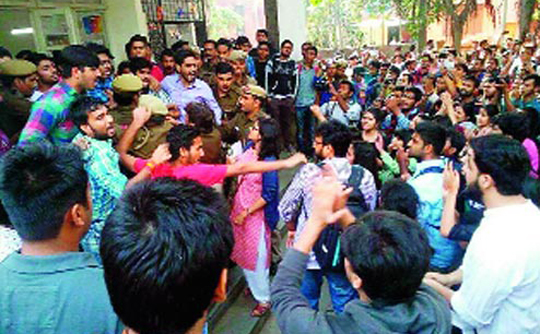
New Delhi, Feb 22: A clash broke out between activists of ABVP and AISA of Delhi University on Wednesday, a day after JNU student Umar Khalid’s visit to Ramjas College was cancelled following protests by students. The college authorities had to withdraw the invitation to Khalid, who was charged with sedition last year, and Shehla who was face of the movement demanding release of the students arrested in that case. According to reports, ABVP activists were staging a protest in the college on Wednesday, which led to a clash between them and AISA members. Both ABVP and AISA are student political groups representing divergent ideologies.
nat1

Umar Khalid and former JNUSU vice-president Shehla Rashid were invited to speak at a seminar in Ramjas College on Tuesday but their visit was cancelled after ABVP and DUSU members gathered outside the college gate and shouted slogans against them. There were also allegations of the protesters using violent methods like stone pelting.
ramjas

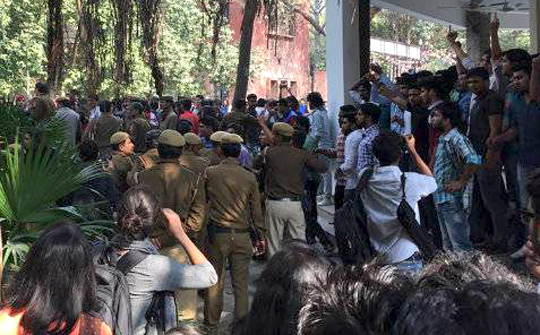
Meanwhile, there was a section of teachers, students and members of left- affiliated All India Students’ Association (AISA), who were agitated over the college’s decision to ‘bow down’ to “threat to freedom of speech” had decided to march to Maurice Nagar police station calling for action against ABVP members for resorting to vandalism.

During the clash, AISA members tried to barge inside the premises to ‘rescue the captives’. An AISA member said, “The students have been locked inside and those trying to come out were beaten up by ABVP goons. We tried to barge in inside the college to rescue the students but they are attacking us as well. They have come prepared with hockey sticks.”

After assessing the situation outside, Ramjas College Principal Rajender Prasad said he is in discussion with the teachers who were organisers of the event and requested both the groups to not disrupt the peace and harmony in the college.

The protesters also clashed with police personnel deployed at the scene. Umar Khalid was among JNU students who were charged with sedition after February 9 episode last year in which a group of students were seen shouting ‘anti-India’ slogans in mobile footage.

Comments

shaji
 - 
Wednesday, 22 Feb 2017

Its right time to declare ABVP a terrorist group and ban it. They came there with sticks / stones / sharp metals to attached AISA students and much to the strange police did not stop them from attacking AISA students. ABVP is fully supported by BJP and they are followign fool step of their masters in creating disturbance in the society.

Add new comment

  • Coastaldigest.com reserves the right to delete or block any comments.
  • Coastaldigset.com is not responsible for its readers’ comments.
  • Comments that are abusive, incendiary or irrelevant are strictly prohibited.
  • Please use a genuine email ID and provide your name to avoid reject.
March 27,2020

Mumbai, Mar 27: The RBI on Friday put on hold EMI payments on all term loans for three months and cut interest rate by steepest in more than 11 years as it joined the government effort to rescue a slowing economy that has now got caught in coronavirus whirlwind.

The Reserve Bank of India (RBI) cut repo to 4.4 per cent, the lowest in at least 15 years. Also, it reduced the cash reserve ratio maintained by the banks for the first time in over seven years. CRR for all banks was cut by 100 basis points to release Rs 1.37 lakh crore across banking system.

The reverse repo rate was cut by 90 bps to 4 per cent, creating an asymmetrical corridor.

RBI Governor Shaktikanta Das predicted a big global recession and said India will not be immune.

It all depends how India responds to the situation, he said.

Global slowdown could make things difficult for India too, despite some help from falling crude prices, Das said, adding food prices may soften even further on record crop production.

Aggregate demand may weaken and ease core inflation further, he noted.

The liquidity measures announced include auction of targeted long-term repo operation of 3 year tenor for total amount of Rs 1 lakh crore at floating rate and accommodation under Marginal Standing Facility to be increased from 2 per cent to 3 per cent of Statutory Liquidity Ratio (SLR) with immediate effect till June 30.

Combined, these three measures will make available a total Rs 3,74,000 crore to the country's financial system.

After cutting policy rates five times in 2019, the RBI had been on a pause since December in view of high inflation.

The measures announced come a day after the government unveiled a Rs 1.7 lakh crore package of free foodgrains and cash doles to the poor to deal with the economic impact of the unprecedented 21-day nationwide lockdown.

While the Monetary Policy Committee (MPC) of the RBI originally was slated to meet in the first week of April, it was advanced by a week to meet the challenge of coronavirus.

Comments

Add new comment

  • Coastaldigest.com reserves the right to delete or block any comments.
  • Coastaldigset.com is not responsible for its readers’ comments.
  • Comments that are abusive, incendiary or irrelevant are strictly prohibited.
  • Please use a genuine email ID and provide your name to avoid reject.
News Network
January 1,2020

New Delhi, Jan 1: In the backdrop of huge losses borne by airlines, Aviation Minister Hardeep Singh Puri has said the government is concerned that more airlines will shut down if predatory pricing continues. "Some predatory pricing is taking place" in airfares, the minister told reporters on Tuesday. Mr Puri however ruled out any plan by the government to regulate airfares. The remarks come amid high competition in the country's aviation sector, struggling against high fuel prices and other operating costs.

"The interesting thing that we have observed is that on Delhi-Mumbai route 20 years ago, the average fare was Rs 5,100. Today, the average fare is Rs 4,600. Some predatory pricing is taking place. It means people are selling tickets below their cost," he said.

"One of our concerns is that if there is predatory pricing, then the airlines will stop functioning. This is not Air India's problem only. Jet Airways got shut down. Before that, it was Kingfisher airline," he said.

IndiGo and SpiceJet - two of the country's biggest airlines - reported losses of Rs 1,062 crore and Rs 463 crore respectively in the second quarter of 2019-20. Other airlines have also reported losses in the quarter that ended on September 30, 2019.

Asked if predatory pricing is the reason for the ill health of the airlines, the minister said, "No, there are many reasons... Predatory pricing is one of the factors. But the profitability of an airline is dependent on (a) number of things."

Asked if the trend of predatory pricing has come down after regular discussion with the airlines, he said, "Yes, absolutely."

"It is (a) constant battle. An ideal situation from an airline's point of view is that they grow and they are also able to charge more fares. What fares they charge is their business. Our advice to them is to charge realistic fares," he added. "It should not be too high. And it is not in your business interests if you are imposing predatory fares."

The minister also said that the government is not planning to regulate fares. "No regulation. It has to be done within deregulation system.... If I put a cap on fare, the airline will start charging that cap only... that cap will become the normal fare... So, within a deregulated structure, we have to bring about an equilibrium," the minister said.

"Government, periodically, at my level or at secretary''s level, we sit down with the main aircraft operators and tell them it is in your interest not to allow such practices which undermine the civil aviation sector."

Comments

Add new comment

  • Coastaldigest.com reserves the right to delete or block any comments.
  • Coastaldigset.com is not responsible for its readers’ comments.
  • Comments that are abusive, incendiary or irrelevant are strictly prohibited.
  • Please use a genuine email ID and provide your name to avoid reject.
Agencies
July 30,2020

Mumbai, Jul 30: Counterfeiting incidents have increased 24 per cent in the country in 2019 over the previous year, creating an over Rs 1 lakh crore hole in the economy, according to a report.

The report also said counterfeiters are having a free run due to the pandemic-driven disruptions to organised supply chains and the resultant spike in consumer demand.

According to the report by ASPA, a self-regulated industry body of anti-counterfeiting and traceability solutions providers, counterfeiting has risen steadily in the last few years, and exploiting the pandemic as a cover for their activities.

Between February and April 2020, over 150 incidents of counterfeiting cases were reported, mostly about fake PPE kits, sanitisers and masks taking advantage of the high demand for these products, it noted.

"There was a 24 per cent increase in counterfeiting in 2019 over 2018, leading to the loss of more than Rs 1 lakh crore to the overall economy," said Nakul Pasricha, president of Authentication Solution Providers Association.

The association works with global authorities like the International Hologram Manufacturers Association, Counterfeit Intelligence Bureau of the Interpol, and domestic industry lobbies like Ficci, he said.

Counterfeiting is a universal issue and is 3.3 per cent of global trade, according to the OECD data, impacting social and economic development across the world.

The report lists the currency, FMCG, alcohol, pharma, documents, agriculture, infrastructure, automotive, tobacco, lifestyle and apparel, as the 10 sectors impacted most by counterfeiting.

Among these, currency, alcohol and FMCG continue to be the top three sectors with the highest counterfeiting in the last two years. The FMCG sector is most vulnerable, as counterfeit incidents rose 63 per cent between 2018 (79) and 2019 when the reported cases jumped to 129.

Within the states, the fakers have a free run in Uttar Pradesh, Bihar, Rajasthan, Madhya Pradesh, Bengal, Punjab, Jharkhand, Delhi, Gujarat, and Uttarakhand, calling for urgent actions to frame anti-counterfeiting policy measures.

According to the report, UP continues to be on top followed by Bihar, Rajasthan, and together these three states represent almost 45 per cent of all counterfeiting reported in the last two years.

What is more alarming is that counterfeiting is not limited to high-end luxury items today, as common everyday items as fake cumin seeds, mustard cooking oil, ghee, hair oils, soaps, baby care vaccines and medicines are aplenty in the markets.

"There is an urgent need for building and nurturing authentication ecosystems in the country with the active involvement and active participation of all stakeholders," said Pasricha.

Comments

Add new comment

  • Coastaldigest.com reserves the right to delete or block any comments.
  • Coastaldigset.com is not responsible for its readers’ comments.
  • Comments that are abusive, incendiary or irrelevant are strictly prohibited.
  • Please use a genuine email ID and provide your name to avoid reject.