ABVP, AISA activists clash over blocking of Umar Khalid’s visit to Ramjas college

February 22, 2017

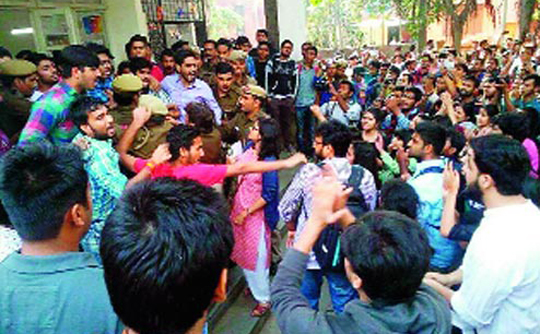
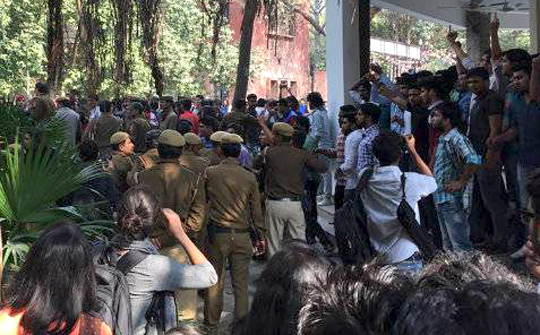
New Delhi, Feb 22: A clash broke out between activists of ABVP and AISA of Delhi University on Wednesday, a day after JNU student Umar Khalid’s visit to Ramjas College was cancelled following protests by students. The college authorities had to withdraw the invitation to Khalid, who was charged with sedition last year, and Shehla who was face of the movement demanding release of the students arrested in that case. According to reports, ABVP activists were staging a protest in the college on Wednesday, which led to a clash between them and AISA members. Both ABVP and AISA are student political groups representing divergent ideologies.

nat1

Umar Khalid and former JNUSU vice-president Shehla Rashid were invited to speak at a seminar in Ramjas College on Tuesday but their visit was cancelled after ABVP and DUSU members gathered outside the college gate and shouted slogans against them. There were also allegations of the protesters using violent methods like stone pelting.

ramjas

Meanwhile, there was a section of teachers, students and members of left- affiliated All India Students’ Association (AISA), who were agitated over the college’s decision to ‘bow down’ to “threat to freedom of speech” had decided to march to Maurice Nagar police station calling for action against ABVP members for resorting to vandalism.

During the clash, AISA members tried to barge inside the premises to ‘rescue the captives’. An AISA member said, “The students have been locked inside and those trying to come out were beaten up by ABVP goons. We tried to barge in inside the college to rescue the students but they are attacking us as well. They have come prepared with hockey sticks.”

After assessing the situation outside, Ramjas College Principal Rajender Prasad said he is in discussion with the teachers who were organisers of the event and requested both the groups to not disrupt the peace and harmony in the college.

The protesters also clashed with police personnel deployed at the scene. Umar Khalid was among JNU students who were charged with sedition after February 9 episode last year in which a group of students were seen shouting ‘anti-India’ slogans in mobile footage.

Comments

shaji
 - 
Wednesday, 22 Feb 2017

Its right time to declare ABVP a terrorist group and ban it. They came there with sticks / stones / sharp metals to attached AISA students and much to the strange police did not stop them from attacking AISA students. ABVP is fully supported by BJP and they are followign fool step of their masters in creating disturbance in the society.

Add new comment

  • Coastaldigest.com reserves the right to delete or block any comments.
  • Coastaldigset.com is not responsible for its readers’ comments.
  • Comments that are abusive, incendiary or irrelevant are strictly prohibited.
  • Please use a genuine email ID and provide your name to avoid reject.
Agencies
July 31,2020

New Delhi, Jul 31: With the highest single-day spike of 55,079 COVID-19 cases in the last 24 hours, India's coronavirus tally breached the 16 lakh mark on Friday, informed the Union Ministry of Health and Family Welfare.

With this latest spike, the total cases in the country stand at 16,38,871. Among these cases 5,45,318 are active. A total of 10,57,806 patients have been cured/discharged/migrated.

779 deaths due to COVID-19 have been reported in the country in the last 24 hours, taking the death toll to 35,747.

As per the Union Health Ministry, Maharashtra has a total of 1,48,454 active cases and recorded 14,729 deaths due to COVID-19.
Tamil Nadu has a total of 57,962 active cases and 3,838 deaths in the state.

Delhi has a total of 10,743 active cases and 3,936 deaths.

The Indian Council of Medical Research on Friday informed that a total number of COVID-19 samples tested up to 30th July is 1,88,32,970 including 6,42,588 samples tested yesterday.

Comments

Add new comment

  • Coastaldigest.com reserves the right to delete or block any comments.
  • Coastaldigset.com is not responsible for its readers’ comments.
  • Comments that are abusive, incendiary or irrelevant are strictly prohibited.
  • Please use a genuine email ID and provide your name to avoid reject.
News Network
January 20,2020

Davos, Jan 20: India's richest 1 per cent hold more than four-times the wealth held by 953 million people who make up for the bottom 70 per cent of the country's population, while the total wealth of all Indian billionaires is more than the full-year budget, a new study said on Monday.

Releasing the study 'Time to Care' here ahead of the 50th annual meeting of the World Economic Forum (WEF), rights group Oxfam also said the world's 2,153 billionaires have more wealth than the 4.6 billion people who make up 60 per cent of the planet's population.

The report flagged that global inequality is shockingly entrenched and vast and the number of billionaires has doubled in the last decade, despite their combined wealth having declined in the last year.

"The gap between rich and poor can't be resolved without deliberate inequality-busting policies, and too few governments are committed to these," said Oxfam India CEO Amitabh Behar, who is here to represent the Oxfam confederation this year.

The issues of income and gender inequality are expected to figure prominently in discussions at the five-day summit of the WEF, starting Monday. The WEF's annual global risks Report has also warned that the downward pressure on the global economy from macroeconomic fragilities and financial inequality continued to intensify in 2019.

Concern about inequality underlies recent social unrest in almost every continent, although it may be sparked by different tipping points such as corruption, constitutional breaches, or the rise in prices for basic goods and services, as per the WEF report.

Although global inequality has declined over the past three decades, domestic income inequality has risen in many countries, particularly in advanced economies and reached historic highs in some, the Global Risks Report flagged last week.

The Oxfam report further said "sexist" economies are fuelling the inequality crisis by enabling a wealthy elite to accumulate vast fortunes at the expense of ordinary people and particularly poor women and girls.

Regarding India, Oxfam said the combined total wealth of 63 Indian billionaires is higher than the total Union Budget of India for the fiscal year 2018-19 which was at Rs 24,42,200 crore.

"Our broken economies are lining the pockets of billionaires and big business at the expense of ordinary men and women. No wonder people are starting to question whether billionaires should even exist," Behar said.

As per the report, it would take a female domestic worker 22,277 years to earn what a top CEO of a technology company makes in one year.

With earnings pegged at Rs 106 per second, a tech CEO would make more in 10 minutes than what a domestic worker would make in one year.

It further said women and girls put in 3.26 billion hours of unpaid care work each and every day -- a contribution to the Indian economy of at least Rs 19 lakh crore a year, which is 20 times the entire education budget of India in 2019 (Rs 93,000 crore).

Besides, direct public investments in the care economy of 2 per cent of GDP would potentially create 11 million new jobs and make up for the 11 million jobs lost in 2018, the report said.

Behar said the gap between rich and poor cannot be resolved without deliberate inequality-busting policies, and too few governments are committed to these.

He said women and girls are among those who benefit the least from today's economic system.

"They spend billions of hours cooking, cleaning and caring for children and the elderly. Unpaid care work is the 'hidden engine' that keeps the wheels of our economies, businesses and societies moving.

"It is driven by women who often have little time to get an education, earn a decent living or have a say in how our societies are run, and who are therefore trapped at the bottom of the economy,” Behar added.

Oxfam said governments are massively under-taxing the wealthiest individuals and corporations and failing to collect revenues that could help lift the responsibility of care from women and tackle poverty and inequality.

Besides, the governments are also underfunding vital public services and infrastructure that could help reduce women and girls' workload, the report said.

As per the global survey, the 22 richest men in the world have more wealth than all the women in Africa.

Besides, women and girls put in 12.5 billion hours of unpaid care work each and every day -- a contribution to the global economy of at least USD 10.8 trillion a year, more than three times the size of the global tech industry.

Getting the richest one per cent to pay just 0.5 per cent extra tax on their wealth over the next 10 years would equal the investment needed to create 117 million jobs in sectors such as elderly and childcare, education and health.

Governments must prioritise care as being as important as all other sectors in order to build more human economies that work for everyone, not just a fortunate few, Behar said.

Oxfam said its calculations are based on the latest data sources available, including from the Credit Suisse Research Institute's Global Wealth Databook 2019 and Forbes' 2019 billionaires list.


Comments

Add new comment

  • Coastaldigest.com reserves the right to delete or block any comments.
  • Coastaldigset.com is not responsible for its readers’ comments.
  • Comments that are abusive, incendiary or irrelevant are strictly prohibited.
  • Please use a genuine email ID and provide your name to avoid reject.
News Network
July 18,2020

New Delhi, Jul 18: The Covid-19 lockdown-led reduction in air pollution levels across five Indian cities, including Delhi and Mumbai, may have prevented about 630 premature deaths, and saved USD 690 million in health costs in the country, according to a new study.

Scientists, including those from the University of Surrey in the UK, assessed the levels of harmful fine particulate matter (PM2.5) from vehicles and other sources in five Indian cities -- Delhi, Mumbai, Kolkata, Chennai and Hyderabad -- since the beginning of the lockdown period.

The study, published in the journal Sustainable Cities and Society, compared these lockdown PM2.5 figures from 25 March up until 11 May, with those from similar periods of the preceding five years, and found that the measure reduced pollution levels in all these places.

According to the scientists, during this period, the levels of these harmful air pollutants reduced by 10 per cent in Mumbai, and by up to 54 per cent in Delhi.

"The percentage reduction for the other cities ranged from 24 to 32 per cent, which was slightly smaller than the measured values for Delhi and Mumbai," the scientists noted in the study.

"While the reduction in PM2.5 pollution may not be surprising, the size of the reduction should make us all take notice of the impact we have been having on the planet," said Prashant Kumar, a co-author of the study from the University of Surrey.

The scientists said these reductions in PM2.5 were comparable to those reported in other cities across the world, such as in Austria's capital Vienna (60 per cent), and Shanghai (42 per cent) in China.

They also calculated the monetary value of the reduced mortality due to air pollution and found that the lowered levels of PM2.5 may have saved 630 people from premature death, and USD 690 million in health costs in India.

Coronavirus India update: State-wise total number of confirmed cases, deaths on July 17

According to the researchers, the present lockdown situation offers observational opportunities regarding potential control systems and regulations for improved urban air quality.

They said an integrated approach might help in understanding the overall impacts of Covid-19 lockdown-style interventions and support the implementation of relevant policy frameworks.

"This is an opportunity for us all to discuss and debate what the 'new normal' should look like - particularly when it comes to the quality of the air we breathe," Kumar said.

Comments

Add new comment

  • Coastaldigest.com reserves the right to delete or block any comments.
  • Coastaldigset.com is not responsible for its readers’ comments.
  • Comments that are abusive, incendiary or irrelevant are strictly prohibited.
  • Please use a genuine email ID and provide your name to avoid reject.