


ABVP, AISA activists clash over blocking of Umar Khalid’s visit to Ramjas college

February 22, 2017

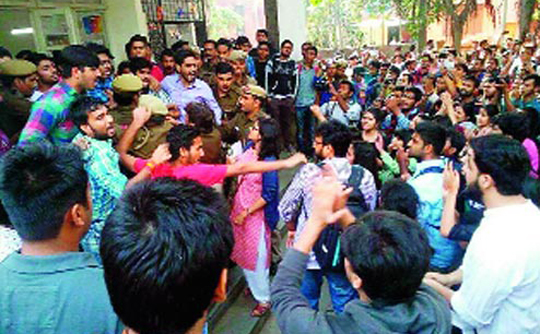
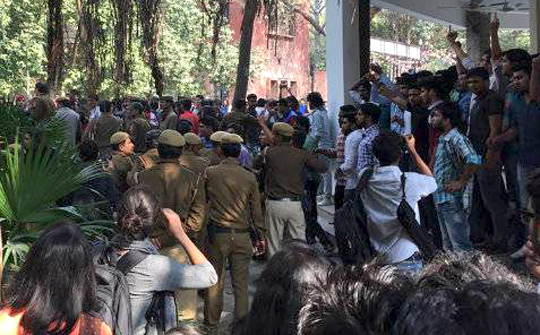
New Delhi, Feb 22: A clash broke out between activists of ABVP and AISA of Delhi University on Wednesday, a day after JNU student Umar Khalid’s visit to Ramjas College was cancelled following protests by students. The college authorities had to withdraw the invitation to Khalid, who was charged with sedition last year, and Shehla who was face of the movement demanding release of the students arrested in that case. According to reports, ABVP activists were staging a protest in the college on Wednesday, which led to a clash between them and AISA members. Both ABVP and AISA are student political groups representing divergent ideologies.
nat1

Umar Khalid and former JNUSU vice-president Shehla Rashid were invited to speak at a seminar in Ramjas College on Tuesday but their visit was cancelled after ABVP and DUSU members gathered outside the college gate and shouted slogans against them. There were also allegations of the protesters using violent methods like stone pelting.
ramjas

Meanwhile, there was a section of teachers, students and members of left- affiliated All India Students’ Association (AISA), who were agitated over the college’s decision to ‘bow down’ to “threat to freedom of speech” had decided to march to Maurice Nagar police station calling for action against ABVP members for resorting to vandalism.

During the clash, AISA members tried to barge inside the premises to ‘rescue the captives’. An AISA member said, “The students have been locked inside and those trying to come out were beaten up by ABVP goons. We tried to barge in inside the college to rescue the students but they are attacking us as well. They have come prepared with hockey sticks.”

After assessing the situation outside, Ramjas College Principal Rajender Prasad said he is in discussion with the teachers who were organisers of the event and requested both the groups to not disrupt the peace and harmony in the college.

The protesters also clashed with police personnel deployed at the scene. Umar Khalid was among JNU students who were charged with sedition after February 9 episode last year in which a group of students were seen shouting ‘anti-India’ slogans in mobile footage.

Comments

shaji
 - 
Wednesday, 22 Feb 2017

Its right time to declare ABVP a terrorist group and ban it. They came there with sticks / stones / sharp metals to attached AISA students and much to the strange police did not stop them from attacking AISA students. ABVP is fully supported by BJP and they are followign fool step of their masters in creating disturbance in the society.

Add new comment

  • Coastaldigest.com reserves the right to delete or block any comments.
  • Coastaldigset.com is not responsible for its readers’ comments.
  • Comments that are abusive, incendiary or irrelevant are strictly prohibited.
  • Please use a genuine email ID and provide your name to avoid reject.
News Network
April 28,2020

New Delhi, Apr 28: Outstanding loans amounting to Rs 68,607 crore of top 50 wilful bank loan defaulters in the country including firms of Mehul Choksi and Vijay Mallya have been technically written off till September 30, 2019, the Reserve Bank of India said in a RTI reply.

Absconding dimantaire Choksi's company Gitanjali Gems tops the list of these defaulters with a whopping amount of Rs 5,492 crore, according to the list.

This is followed by REI Agro with Rs 4,314 crore and Winsome Diamonds with Rs 4,076 crore.

Rotomac Global Private Limited has funded advances of Rs 2,850 crore which have been technically written off and Kudos Chemie Ltd with Rs 2,326 crore, Ruchi Soya Industries Limited, now owned by Ramdev's Patanjali, with Rs 2,212 crore and Zoom Developers Pvt Ltd with Rs 2,012 crore being the other companies.

Mallya's Kingfisher Airlines figures in the list at number 9, with outstanding of Rs 1943 crore which have been technically written off by the banks.

Forever Precious Jewellery and Diamonds Private Limited has loans of Rs 1,962 crore written off while Deccan Chronicle Holdings Limited have Rs 1915 crore written off loans.

Choksi's other firms Gili India and Nakshatra Brands also have loans of Rs 1,447 and Rs 1109 crore respectively written off.

REI Agro of Jhunjhunwala brothers is already under the scanner of ED. The CBI and ED are also probing alleged fraud by the owners of Winsome Diamonds.

Vikram Kothari's Rotomac is the fourth in the list. He and his son Rahul Kothari were arrested by the CBI for bank loan default.

In the last Parliament session, Rahul Gandhi had asked the government to provide a list of top 50 bank loans defaulters in the country, leading to sharp exchanges and uproar in the Lok Sabha.

"The information on top 50 wilful defaulters and their sum of funded amount outstanding and amount technically/prudentially written off as on September 30, 2019 reported in CRILC by banks, is provided," the RBI said in its written response dated April 24.

In his application, RTI activist Saket Gokhale had sought the list of defaulters as on February 16, but the RBI said the requested information is not available.

The RBI said that according to section 8 (1)(a) of RTI Act 2005 read with para 77 of Supreme Court judgement of December 16, 2015 in Jayantilal N Mistry case, information on overseas borrowers is exempted from public disclosure.

"Data is as reported by banks and RBI will not be held responsibly or accountable for any misreporting and/or incorrect reporting by the reporting entities," the RBI said in the written reply to the RTI query.

Comments

Add new comment

  • Coastaldigest.com reserves the right to delete or block any comments.
  • Coastaldigset.com is not responsible for its readers’ comments.
  • Comments that are abusive, incendiary or irrelevant are strictly prohibited.
  • Please use a genuine email ID and provide your name to avoid reject.
News Network
January 1,2020

New Delhi, Jan 1: Union Minister Prakash Javadekar launched a scathing attack on the Aam Aadmi Party and the Congress for allegedly inciting violence in Delhi against the Citizenship (Amendment) Act. Mr Javadekar said the violence over the amended citizenship law that broke out in areas like Jamia Nagar, Seelampur and Jama Masjid "cannot be forgiven".

"In Jamia, the Congress' Asib Khan and AAP's Amanatullah Khan delivered inciting speeches. They spread disinformation. The law is to give citizenship to people and not take citizenship away," Mr Javadekar told reporters.

He said the people of India understand the plans of the Congress and the AAP and both parties should apologise.

"We will bring out the truth. The fight is between anarchists and those who oppose them. Our agenda would be wholesome development of Delhi. The AAP strangulated municipal corporations' attempt on development. Rs 900 crore was not given. Today, the people of Delhi are surprised that the AAP slept through all these 4.5 years and in the remaining six months they have launched schemes," Mr Javadekar said.

"The work is done by someone else and the credit is taken by a different individual," the Union Minister said, referring to allegations that the government led by Chief Minister Arvind Kejriwal took credit for work done by BJP-ruled municipal agencies.

"Who did fogging in dengue season? Our corporations organised an awareness drive against water accumulation and dengue cases went down. During corporation polls, Kejriwal said don't choose BJP as dengue will claim lives. Now he is also claiming credit for decrease in dengue cases because of the work done by these corporations," Mr Javadekar said.

"I am an environment minister. We worked on pollution control. There is no limit to their (AAP's) lies. About unauthorised colonies, the AAP says we have not regularised it. We made a law signed by the President, yet they spread lies," Mr Javadekar said.

The election in Delhi will be held before the end of February.

Comments

Angry Indian
 - 
Wednesday, 1 Jan 2020

Wash you face with cow urine !!!

sorry sorry with DOG URINE...

you will be enlightened...


get lost moron...from wher u came....rat hole or A@@ hole

Fairman
 - 
Wednesday, 1 Jan 2020

Don’t pollute Delhi. Leave them alone.

Every citizen including your own BJP minded people all are very happy with Kerjrival and Aam Admi Party.


Every citizen in Delhi are very very happy.

For God sake leave alone, don’t disturb them as spoiled in other parts of the country.


Add new comment

  • Coastaldigest.com reserves the right to delete or block any comments.
  • Coastaldigset.com is not responsible for its readers’ comments.
  • Comments that are abusive, incendiary or irrelevant are strictly prohibited.
  • Please use a genuine email ID and provide your name to avoid reject.
News Network
January 24,2020

New Delhi, Jan 24: Although India's Ujjwala programme encouraged adoption of liquefied petroleum gas (LPG) for cooking among the poor, households availing the scheme have not shifted away from using highly polluting fuels like firewood, a study reveals.

The researchers, including those from the University of British Columbia (UBC) in Canada, found that additional incentives to encourage regular use of cooking gas are necessary for a complete transition to clean cooking fuel among poor rural households.

They noted that about 2.9 billion people across Asia, Africa, and Latin America burn solid fuels like firewood to meet their cooking energy needs.

This has significant negative implications for public health, the environment, and societal development, according to the researchers.

Through the Pradhan Mantri Ujjwala Yojana (PMUY), India has provided capital cost subsidies to poor women to adopt a clean-burning cooking fuel or LPG.

The researchers explained that within the first 40 months of the scheme, more than 80 million households obtained LPG stoves.

However, the full benefits of LPG adoption depend on near complete replacement of polluting fuels with LPG, according to a research-based policy brief published in the journal Nature Energy.

The scientists said this cannot be assumed solely on the basis of LPG presence in the household.

"Our research shows that Ujjwala was able to attract new consumers rapidly, but those consumers did not start using LPG on a regular basis," Abhishek Kar, a postdoc at Columbia University in the US, told PTI.

The study analysed LPG sales data for over 25,000 consumers, including PMUY beneficiaries, as well as general rural LPG consumers in Koppal district of Karnataka.

The scientists employed data covering all LPG purchases of PMUY beneficiaries through their first year in the programme.

They also assessed the general rural population's purchases during their first five years as consumers to assess the effect of experience on use.

The findings estimate that an average rural family needs to purchase five 14.2 kilogramme-cylinders annually to meet half of their cooking needs.

However, the study said just seven per cent of PMUY beneficiaries in Koppal purchased five or more cylinders annually, suggesting that the beneficiaries seldom use LPG.

The general (nonPMUY) consumers in this region use on average two times more LPG cylinders than PMUY beneficiaries, the researchers noted.

Yet, only 45 per cent of nonPMUY consumers use five or more cylinders per year -- even after several years of experience with LPG, they said.

The team assessed price and seasonal factors affecting LPG use among the general population over a three-year period.

It found that LPG consumers are sensitive to price and seasonality -- LPG cylinder refill rates are lower in the summer when agricultural activity is limited, and cash is scarce.

"There was no scheme incentives to promote use, except general LPG subsidies which is available to all, including the urban middle class," said Kar, who was a Ph.D. scholar at UBC when the research was published.

"If there is no additional income, what cost would a poor family on an already tight budget cut to pay for an extra expense on a regular basis.

"Ujjwala has started the scheme of 5 kg-cylinder in response, but the impact of that on LPG sales is still publicly unknown," he said.

These findings, the researchers noted, suggest the need for additional measures to promote regular LPG use for all rural populations.

Although the finding come from a single district in Southern India, it may also apply to other areas with similar socio-economic conditions, they said.

A more expansive evaluation of PMUY would help design targeted incentives to transform infrequent users to regular users, according to the researchers.

Comments

Add new comment

  • Coastaldigest.com reserves the right to delete or block any comments.
  • Coastaldigset.com is not responsible for its readers’ comments.
  • Comments that are abusive, incendiary or irrelevant are strictly prohibited.
  • Please use a genuine email ID and provide your name to avoid reject.