


ABVP, AISA activists clash over blocking of Umar Khalid’s visit to Ramjas college

February 22, 2017

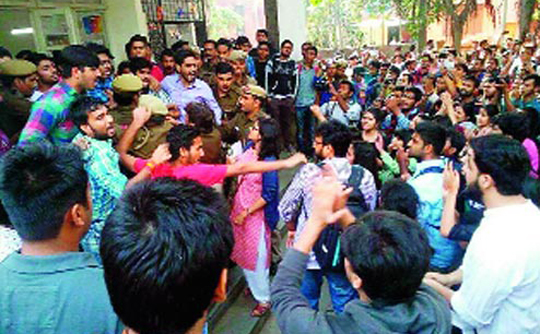
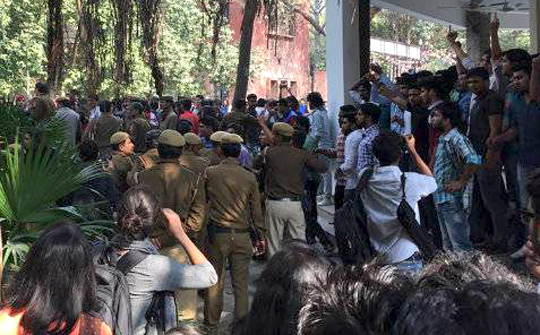
New Delhi, Feb 22: A clash broke out between activists of ABVP and AISA of Delhi University on Wednesday, a day after JNU student Umar Khalid’s visit to Ramjas College was cancelled following protests by students. The college authorities had to withdraw the invitation to Khalid, who was charged with sedition last year, and Shehla who was face of the movement demanding release of the students arrested in that case. According to reports, ABVP activists were staging a protest in the college on Wednesday, which led to a clash between them and AISA members. Both ABVP and AISA are student political groups representing divergent ideologies.
nat1

Umar Khalid and former JNUSU vice-president Shehla Rashid were invited to speak at a seminar in Ramjas College on Tuesday but their visit was cancelled after ABVP and DUSU members gathered outside the college gate and shouted slogans against them. There were also allegations of the protesters using violent methods like stone pelting.
ramjas

Meanwhile, there was a section of teachers, students and members of left- affiliated All India Students’ Association (AISA), who were agitated over the college’s decision to ‘bow down’ to “threat to freedom of speech” had decided to march to Maurice Nagar police station calling for action against ABVP members for resorting to vandalism.

During the clash, AISA members tried to barge inside the premises to ‘rescue the captives’. An AISA member said, “The students have been locked inside and those trying to come out were beaten up by ABVP goons. We tried to barge in inside the college to rescue the students but they are attacking us as well. They have come prepared with hockey sticks.”

After assessing the situation outside, Ramjas College Principal Rajender Prasad said he is in discussion with the teachers who were organisers of the event and requested both the groups to not disrupt the peace and harmony in the college.

The protesters also clashed with police personnel deployed at the scene. Umar Khalid was among JNU students who were charged with sedition after February 9 episode last year in which a group of students were seen shouting ‘anti-India’ slogans in mobile footage.

Comments

shaji
 - 
Wednesday, 22 Feb 2017

Its right time to declare ABVP a terrorist group and ban it. They came there with sticks / stones / sharp metals to attached AISA students and much to the strange police did not stop them from attacking AISA students. ABVP is fully supported by BJP and they are followign fool step of their masters in creating disturbance in the society.

Add new comment

  • Coastaldigest.com reserves the right to delete or block any comments.
  • Coastaldigset.com is not responsible for its readers’ comments.
  • Comments that are abusive, incendiary or irrelevant are strictly prohibited.
  • Please use a genuine email ID and provide your name to avoid reject.
News Network
January 31,2020

New Delhi, Jan 31: Substantial competition and low tariff rates by telecom operators since 2016 have led to a financial stress in the sector, the Economic Survey said on Friday.

The data price in the country came down by over 99 per cent during 2016-2019, making it among the lowest tariff in the world, according to the survey.

"Since 2016, the sector has witnessed substantial competition and price cutting by the telecom service providers (TSPs), creating financial stress in the sector. As a result, the sector is experiencing consolidation. While some operators have filed for bankruptcy, others have merged, in their quest to improve viability," the survey report said.

In April-June 2019, the price of data was Rs 7.7 per gigabyte (GB) as compared to Rs 200 per GB in June 2016, it added.

"The Average Revenue Per User (ARPU) for GSM based mobile services has also gone down substantially from Rs 126 in June 2016 to Rs 74.30 in June 2019," the survey said.

The tariff war started in the market with entry of new telecom operator Reliance Jio in September 2016.

"BSNL and MTNL are also affected by the tariff war that has impacted their cash flow resulting in mounting losses," the survey said.

The financial health of the public sector telecom firms plummeted to a level where they have been finding hard to pay employees salaries in time.

The government has drawn up a plan to revive these PSUs which is still in works.

The revival plan consists of several measures, including reduction of staff cost through voluntary retirement scheme, allotment of spectrum for 4G services, monetisation of land and building, tower and fibre assets of BSNL and MTNL, debt restructuring through sovereign guarantee bonds and ''in-principle'' approval for merger of BSNL and MTNL.

The survey said that the wireless telephony now constitutes 98.27 per cent of all subscriptions whereas share of landline telephones now stands at only 1.73 per cent where market share is dominated by private sector players.

"The overall tele-density in India stands at 90.45 per cent, the rural tele-density being 57.35 per cent and urban teledensity being 160.71 per cent at the end of September 2019. The private sector dominates with a share of 88.81 per cent (106.06 crore connections) at the end of September, 2019 while the share of public sector was 11.19 per cent (13.36 crore connections)," the survey said.

The lower price of data has also lead in surge of broadband connections and average consumption of the internet.

Total broadband connections increased by about ten times, from 6.1 crore in 2014 to 59.46 crore in June 2019, the survey said.

The number of internet subscribers (both broadband and narrowband put together) stood at 66.53 crore at the end of June 2019 as compared to 25.16 crore in 2014.

The number of mobile internet subscribers was 64.36 lakh at the end of June 2019 while the number of wireline internet subscribers was 2.17 crore.

"India is now the global leader in monthly data consumption, with average consumption per subscriber per month increasing 157 times from 62 MB in 2014 to 9.8 GB in June 2019. The cost of data has also reduced substantially, enabling affordable internet access for millions of citizens," the survey said.

Comments

Add new comment

  • Coastaldigest.com reserves the right to delete or block any comments.
  • Coastaldigset.com is not responsible for its readers’ comments.
  • Comments that are abusive, incendiary or irrelevant are strictly prohibited.
  • Please use a genuine email ID and provide your name to avoid reject.
Agencies
February 6,2020

New Delhi, Feb 6: Unemployment rate in the country as per a new survey was 6.1 per cent in 2017-18, the government informed Rajya Sabha on Wednesday.

Minister of State for Labour Santosh Gangwar said the government is conducting a new Periodic Labour Force Survey (PLFS) with new parameters and bigger sample size, and its results cannot be compared with previous surveys in this regard.

"As per the new Periodic Labour Force Survey being conducted by the government, the labour force participation is 36.9 per cent and the rate of unemployment for 2017-18 is 6.1 per cent," he said.

Replying to supplementaries during the Question Hour, the minister said the report of this survey is very different than the surveys conducted in previous years.

This survey is not comparable to previous surveys, he said, adding it was an attempt to provide authentic data with the new survey conducted through the Ministry of Statistics.

"We are focusing on infrastructure development and ease of doing business and India's position in the world has improved. India has improved its position to 63rd rank now in 2019 against 196 in previous years," he said.

"Our government is very conscious of creating employment opportunities and is running such programme which generates employment.

"The way our government is functioning, employment opportunities are being created and the youths are getting jobs also," the minister said.

Gangwar said the government has stopped the previous survey as the sample size was low and an attempt is being made to improve the data by adding various parameters and provide more authentic data.

The minister said it will take time for collection of data as households have to be visited on the ground for authentic data collection in rural areas also.

Comments

Add new comment

  • Coastaldigest.com reserves the right to delete or block any comments.
  • Coastaldigset.com is not responsible for its readers’ comments.
  • Comments that are abusive, incendiary or irrelevant are strictly prohibited.
  • Please use a genuine email ID and provide your name to avoid reject.
News Network
May 22,2020

Bengaluru, May 22: Amazon.com Inc’s India unit said it would hire 50,000 temporary workers to meet a surge in online shopping in the country, where customers have been stuck indoors for two months in a lockdown to fight the coronavirus outbreak.

E-commerce firms faced massive disruption in the initial days of the lockdown in India, but a slow easing of the stringent regulations has allowed them to resume large parts of their operations.

"We want to continue helping customers all over India get everything they need so they can continue to practice social distancing," Amazon senior executive Akhil Saxena said in a statement on the company's blog. (bit.ly/2A1Wv7O)

“(The move) will also keep as many people as possible working during this pandemic while providing a safe work environment for them,” said Saxena, Amazon’s VP for customer fulfillment operations in APAC, MENA & Latam.

The temporary hires will work in Amazon’s fulfillment centers and as part of its delivery network, the company said, making the announcement at a time when various other companies in the country have been forced to cut jobs as they try to tide over the health crisis.

Amazon itself has pushed its annual global Prime Day event, traditionally a summer affair, to September, the Wall Street Journal reported on Thursday.

In India, where the Jeff Bezos-led company faces stiff competition from Walmart Inc’s Flipkart, Amazon earlier said it plans to create 1 million jobs by 2025.

The company also said on Thursday it plans to enter the food delivery business in India, pitting itself against well-established startups such as Swiggy and Zomato.

Comments

Add new comment

  • Coastaldigest.com reserves the right to delete or block any comments.
  • Coastaldigset.com is not responsible for its readers’ comments.
  • Comments that are abusive, incendiary or irrelevant are strictly prohibited.
  • Please use a genuine email ID and provide your name to avoid reject.