ABVP protesters defy police warning; several injured in lathicharge

August 19, 2016

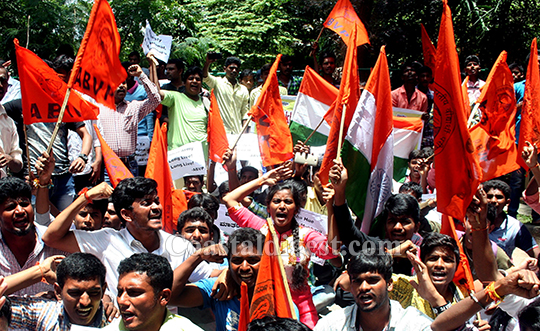
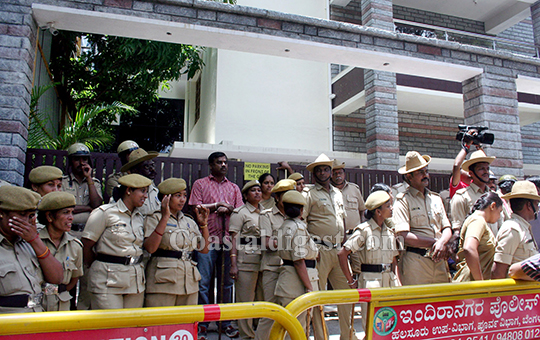
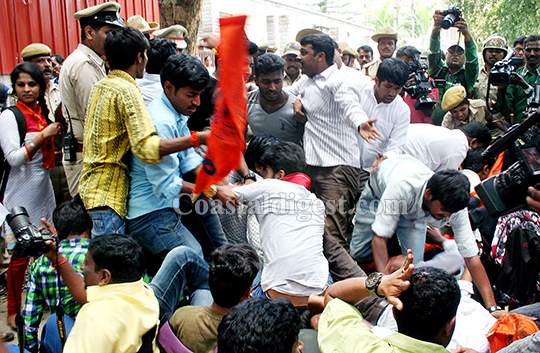
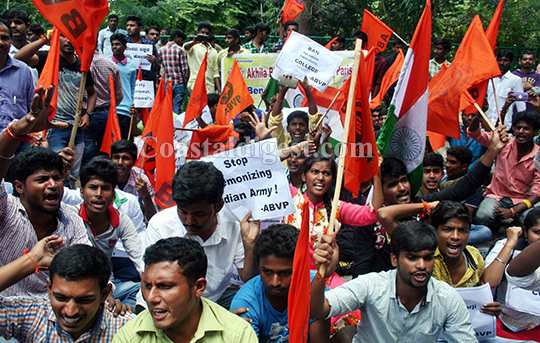
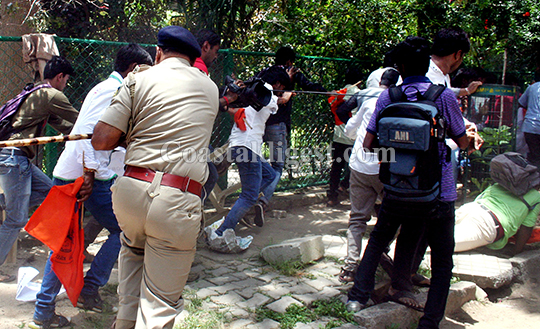
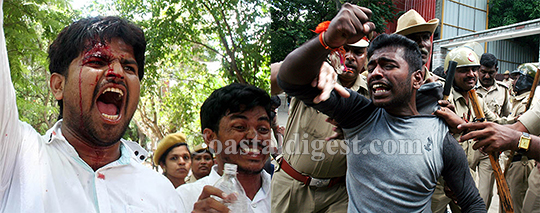
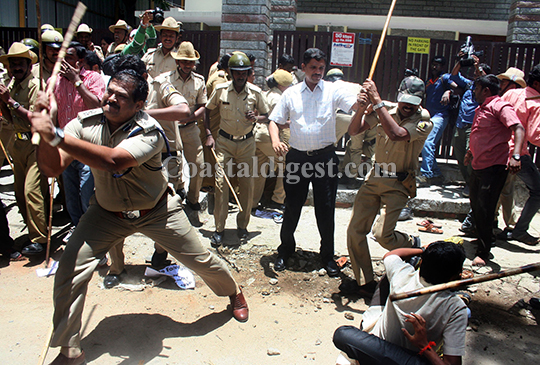
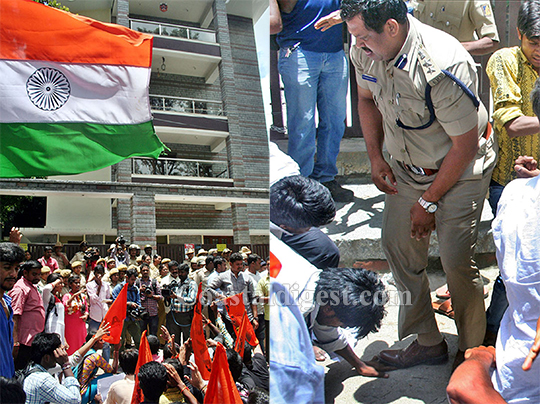
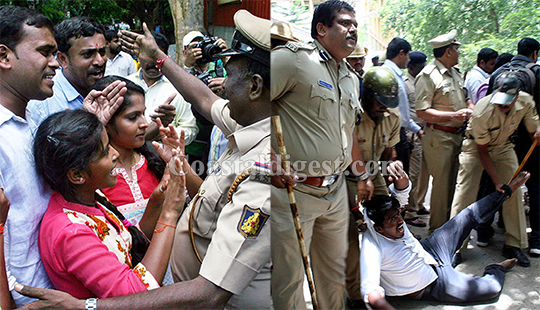
Bengaluru, Aug 19: Police today resorted to 'mild' lathicharge to disperse ABVP activists staging a protest in front of the Amnesty International India office here demanding arrest of those who allegedly raised anti-India slogans at an Amnesty event.
 abvpPAm 3 copy

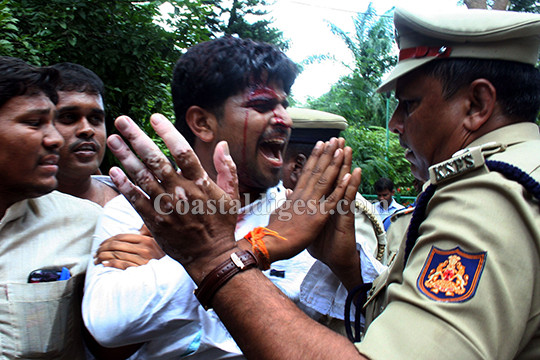
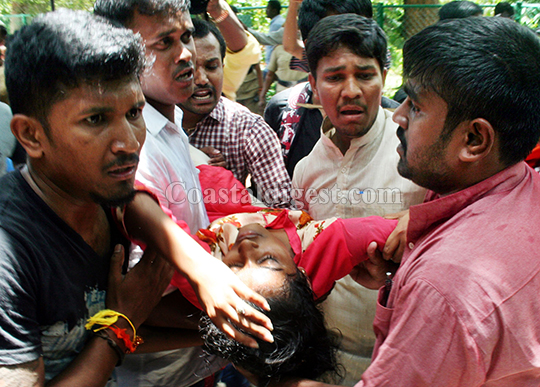
Several ABVP activists were injured, with a girl student fainting in the commotion before she was rushed to a hospital, police said, adding they detained many activists during the crackdown on the protest.

Additional Commissioner of Police Bengaluru East P Harishekaran said police had to disperse protesters as they tried to burn an effigy in a residential area.

"With two bottles of petrol they tried to burn an effigy in front of Amnesty International here. We had in prior warned them against any effigy burning as it is a residential area and from the security point of view," he said.

The protesters alleged that the police under the DCP's leadership behaved in an "inhuman" way and more than 10 ABVP activists were injured in the lathicharge.
abvpPAm 1

Calling their protest "peaceful", ABVP National General Secretary Vinay Bidre said, "We demanded that police vacate Amnesty staff who were recording our protest from their office. We told police we won't cause any harm to them. We did not try to barge into their premises and tried to burn Amnesty's effigy, but police unnecessarily used force on us."

He accused the Congress-led Karnataka government and police of protecting those involved in anti-national sloganeering.

Stating that ABVP would continue its protest, Bidre claimed, "We will intensify our protest across the state after today's atrocity, we will show this government student power."
abvpPAm 4

As a precautionary step, police have asked Amnesty International India to keep its office in Bengaluru closed until the ABVP protest subsides, following which the organisation had asked its employees to work from other locations.

Amnesty International had on Saturday organised the event as part of a campaign to seek justice for "victims of human rights violations" in Jammu and Kashmir, which took an ugly turn with heated exchanges and alleged raising of pro-Kashmir 'Independence' and anti-Army slogans.

ABVP activists had submitted a CD containing video recording of the event after filing a complaint with police, who have registered an FIR against Amnesty International.

IPC sections 142 (Being member of an unlawful assembly), 143 (whoever is a member of an unlawful assembly), 147 (rioting), 124A (sedition), 153A (promoting enmity between different groups on grounds of religion, race, place of birth, residence, language and doing acts prejudicial to maintenance of harmony) have been invoked against the organisation.
abvpPAm 2abvpPAm 3

abvpPAm 1 copy

abvpPAm 2 copy

abvpPAm 5

abvpPAm 6

abvpPAm 7

abvpPAm 8

Comments

Rikaz
 - 
Saturday, 20 Aug 2016

Police are doing a good job up there! Great!

THINKERS
 - 
Saturday, 20 Aug 2016

in the past Students were innocence.
When politics involves students, the status of innocence is removed..
First know the meaning of Anti national...
I think U should first visit NAGPUR and hoist indian Flag there and protest if not hoisted. for your info the cheddis sometimes hoist pakistani flag ... we request .. just tell them to hoist indian not pakistani flag.

Satyameva jayate
 - 
Friday, 19 Aug 2016

You desh premi so called pillas ... don't just oppose the nation for anyone's comments..and just be the pillas of your BJP and Honduras father's.....first yourself do something for this nation and set an example....
You guys are just frustration for this nation...enough

Add new comment

  • Coastaldigest.com reserves the right to delete or block any comments.
  • Coastaldigset.com is not responsible for its readers’ comments.
  • Comments that are abusive, incendiary or irrelevant are strictly prohibited.
  • Please use a genuine email ID and provide your name to avoid reject.
Media Release
February 14,2020

Veteran journalist P. Sainath has said that the nation is in a crisis. And this crisis is not limited to just the rural area. It has become a national crisis at various areas such as agriculture, education, economy, job creation etc.

He was delivering the endowment lecture on the topic ‘Indian democracy at the post-liberalization and post-truth era’ at Media Manthan 2020 organized by the PG department of journalism and mass communication at St Aloysius College (Autonomous). 

Mr Sainath said that the many policies adopted in the 90s led to India becoming unusually unequal. Referring to the speech Ambedkar had made at the Constituent Assembly while handing over the draft of the Constitution, Mr Sainath said, “Ambedkar had warned about the weakness of Indian democracy that liberty without equality allows the supremacy of a few over the multitude. Liberty, equality and fraternity must be kept together as we cannot have one without the other.” 

Mr Sainath stated that the agrarian crisis was no longer about the loss of productivity, employment or about farmer suicide; it was a societal, civilizational crisis. Commenting on the lopsided policies such as cow-slaughter ban, he explained how cow slaughter ban had adversely affected many industries due to their interdependency. While Muslims who slaughtered cows were rendered helpless, the cattle traders who were mostly OBCs lost their earnings as the cattle prices crashed. An important industry like Kolhapur sandals industry in Maharashtra went bankrupt as a result of the cow slaughter ban in Maharashtra. He said the policymakers had no idea how the rural industries were interconnected. Demonetisation too devastated the rural economy as 98 percent of rural transactions happen through cash. 

Mr Sainath also spoke about the crisis of inequality which affects the Dalits and the Adivasis far more than anyone else as 90 percent of the rural households take home less than Rs 10,000/- per month. “Women are yet another group whose labour is never counted in the gross domestic product. Women and girls globally do unpaid work which amounts to about 12.5 billion working hours per year. Monetarily speaking, this is worth 10.8 trillion dollars,” Mr Sainath added. 

Speaking about the crisis of jobs Mr Sainath said that major companies were laying off employees just to create more profits for the investors and the adoption of artificial intelligence in the industry would further destroy millions of jobs.

Rector of St Aloysius College Institutions Fr Dionysius Vaz SJ, Principal Dr (Fr) Praveen Martis SJ, HOD of Journalism and Mass Communication department Dr (Fr) Melwyn Pinto SJ were present.

‘Veerappan and Vijay Mallya’s business models are interesting!’

Addressing the gathering during his endowment lecture on Friday, Mr Sainath made an interesting comment on the so called ‘revenue model’. “Whenever I visit IIMs and IITs for lectures on my PARI project, the students there ask me what my revenue model for my project is. I tell them that I do not have a revenue model. In fact, journalism does not begin with a revenue model. Gandhiji, Ambedkar, Bhagat Singh were all great journalists. But they did not have a revenue model,” Mr Sainath said.

On a lighter note, he said that the best revenue model that he liked was that of forest brigand Veerappan and liquor baron Vijay Mallya. “Veerappan ruled the forest for forty years and from the top ministers to the villagers he could dictate terms and liver royally. Similarly, Mallya’s revenue model was to steal the banks and run away abroad and live like a king,” Mr Sainath added.

Journalism is not and can never be a business. It is a calling, he opined. While newspaper can be a business, television can be a business, journalism per se cannot be reduced to a business. “Unfortunately today, journalists are recruited on a contract basis and they have no bargaining power; and there are no unions to fight for their cause. Hence, they are at the mercy of the corporate media houses for their survival and are made to write stories that cannot be called journalism,” Mr Sainath said.

Answering a question as to the pressures he faced as a journalist, he said that external pressures from the government or others could be very well handled. It is the internal pressures from once own media house that journalists find it difficult to manage.


Comments

Add new comment

  • Coastaldigest.com reserves the right to delete or block any comments.
  • Coastaldigset.com is not responsible for its readers’ comments.
  • Comments that are abusive, incendiary or irrelevant are strictly prohibited.
  • Please use a genuine email ID and provide your name to avoid reject.
News Network
July 28,2020

Bengaluru, Jul 28: After the Central Board of Secondary Education (CBSE) reduced the syllabi for Classes 9 to 12 due to COVID-19 pandemic, the Karnataka government has followed the suit. The Department of Public Instruction has omitted the chapters on legendary south Indian rulers Hyder Ali and Tipu Sultan from the textbooks of Class 7 in their attempt to reduce syllabus for state board schools by 30 per cent. 

The department, however, has decided to retain similar chapters on Tipu Sultan in 6th and 10th Classes, though the syllabus in text books for all classes from 1 to 10th has been trimmed. 

The trimmed textbooks uploaded on the website of the Department of State Education Research and Training (DSERT) by Karnataka state Textbook Society revealed removal of chapters on Tipu Sultan for the seventh grade.

Justifying the decision, officials said, "students study similar chapters in Class 6 and more in the 10th grade." Yet another senior official from the Text Book Society said, "Trimming does not mean we have removed half of the syllabus from textbooks. It is only keeping in mind the repetition we have condensed the chapters. In case students study about a particular dynasty in higher grades, then the same had been removed from lower grades."

A few months ago, there was an uproar over dropping of content on Tipu Sultan and MLAs from the ruling BJP also demanded the same and petitioned to the Chief Minister. Even an expert committee led by Prof Baraguru Ramachandrappa suggested to not drop any content on the historic figure. However, the department still decided to drop lessons from one of the classes while keeping the syllabus short for the next 120 active academic days.

Earlier this month, a controversy had erupted over the CBSE's decision to omit topics like federalism, secularism, citizenship, etc while reducing the syllabus for Classes 9 to 12. The education board had issued a detailed clarification later, stating that topics claimed to be dropped "are either being covered by the rationalised syllabus or in the Alternative Academic Calendar of NCERT".

"The rationalisation of syllabus up to 30 per cent has been undertaken by the Board for nearly 190 subjects of class 9 to 12 for the academic session 2020-21 as a one-time measure only. The objective is to reduce the exam stress of students due to the prevailing health emergency situation and prevent learning gaps," it said.

Last week, the Congress in Uttar Pradesh expressed its concern over 'deliberate and systematic' deletions of chapters related to the freedom struggle and the party's role in it from the Class 10-12 syllabi of the Secondary Education Board.

Comments

Add new comment

  • Coastaldigest.com reserves the right to delete or block any comments.
  • Coastaldigset.com is not responsible for its readers’ comments.
  • Comments that are abusive, incendiary or irrelevant are strictly prohibited.
  • Please use a genuine email ID and provide your name to avoid reject.
coastaldigest.com news network
February 29,2020

Mangaluru, Feb 29: The state general assembly (SGA) of Karnataka unit of the Popular Front of India was held from February 27 to 29, 2020 at Puttur in Dakshina Kannada district wherein new functionaries were elected for the next two years.

Yasir Hasan was elected president of the state unit of the organisation while Nasir Pasha was elected general secretary. Ayub K Agnady, Mohammed Sharief and Shahid Nasir were elected vice president, secretary and treasurer respectively.

The state executive committee members are: Abdul Khader, Abdul Majeed, Sharief Kodaje and Mohammed Tafseer.

The SAG commenced with the hoisting of flag by outgoing president Muhammad Saqib on February 27. The three day meeting analyzed the growth and activities of the PFI for the past two years. It was observed that the organization has received positive acceptance among the society.

Comments

Add new comment

  • Coastaldigest.com reserves the right to delete or block any comments.
  • Coastaldigset.com is not responsible for its readers’ comments.
  • Comments that are abusive, incendiary or irrelevant are strictly prohibited.
  • Please use a genuine email ID and provide your name to avoid reject.