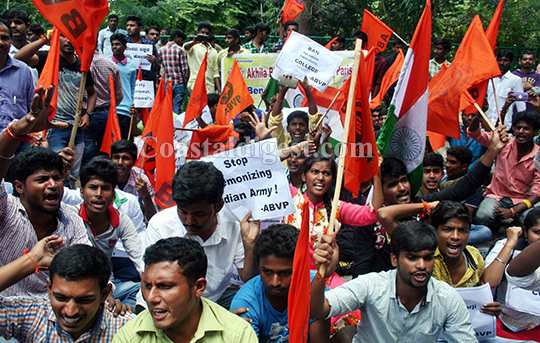
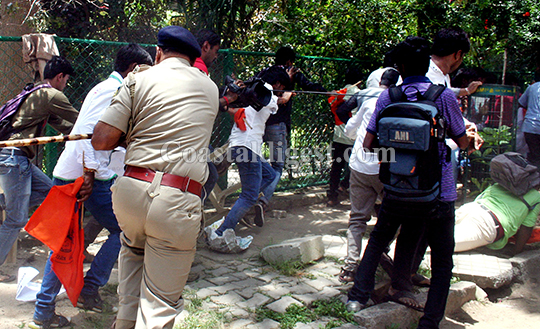
ABVP protesters defy police warning; several injured in lathicharge

August 19, 2016

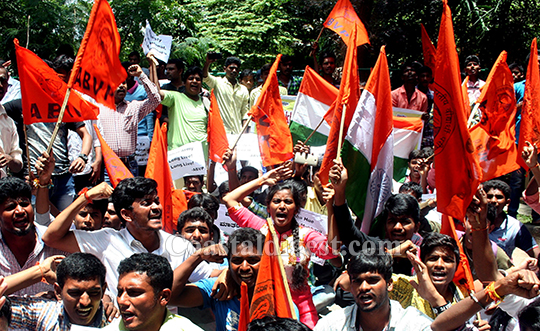
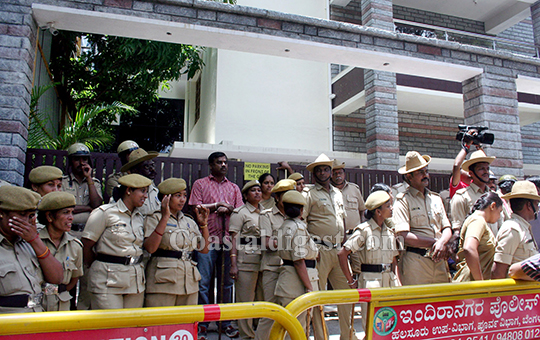
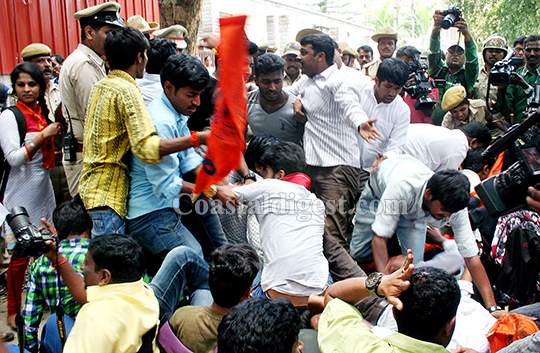
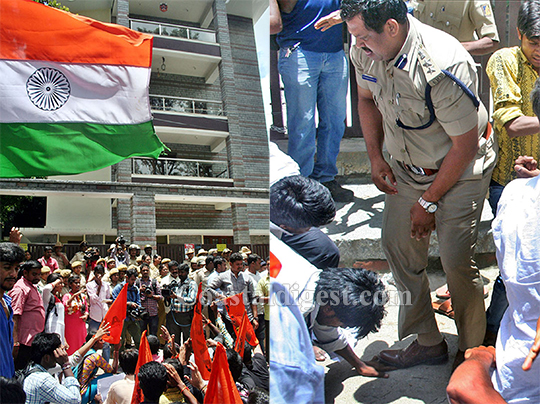
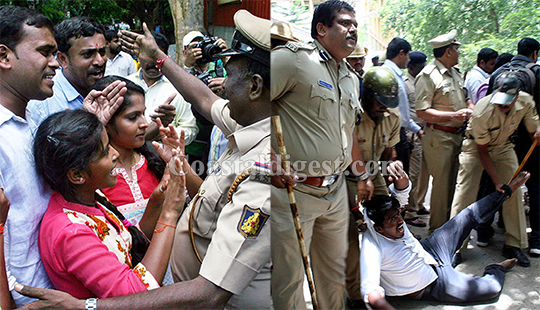
Bengaluru, Aug 19: Police today resorted to 'mild' lathicharge to disperse ABVP activists staging a protest in front of the Amnesty International India office here demanding arrest of those who allegedly raised anti-India slogans at an Amnesty event.
 abvpPAm 3 copy

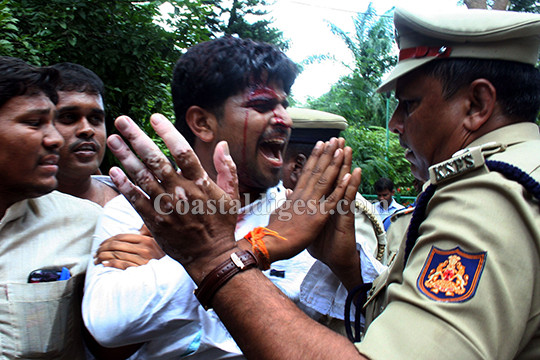
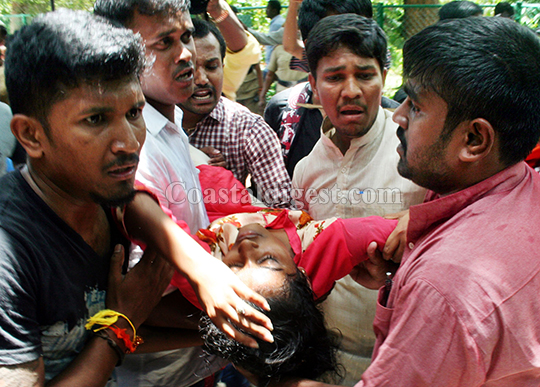
Several ABVP activists were injured, with a girl student fainting in the commotion before she was rushed to a hospital, police said, adding they detained many activists during the crackdown on the protest.

Additional Commissioner of Police Bengaluru East P Harishekaran said police had to disperse protesters as they tried to burn an effigy in a residential area.

"With two bottles of petrol they tried to burn an effigy in front of Amnesty International here. We had in prior warned them against any effigy burning as it is a residential area and from the security point of view," he said.

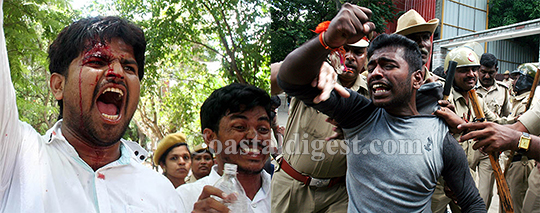
The protesters alleged that the police under the DCP's leadership behaved in an "inhuman" way and more than 10 ABVP activists were injured in the lathicharge.
abvpPAm 1

Calling their protest "peaceful", ABVP National General Secretary Vinay Bidre said, "We demanded that police vacate Amnesty staff who were recording our protest from their office. We told police we won't cause any harm to them. We did not try to barge into their premises and tried to burn Amnesty's effigy, but police unnecessarily used force on us."

He accused the Congress-led Karnataka government and police of protecting those involved in anti-national sloganeering.

Stating that ABVP would continue its protest, Bidre claimed, "We will intensify our protest across the state after today's atrocity, we will show this government student power."

abvpPAm 4

As a precautionary step, police have asked Amnesty International India to keep its office in Bengaluru closed until the ABVP protest subsides, following which the organisation had asked its employees to work from other locations.

Amnesty International had on Saturday organised the event as part of a campaign to seek justice for "victims of human rights violations" in Jammu and Kashmir, which took an ugly turn with heated exchanges and alleged raising of pro-Kashmir 'Independence' and anti-Army slogans.

ABVP activists had submitted a CD containing video recording of the event after filing a complaint with police, who have registered an FIR against Amnesty International.

IPC sections 142 (Being member of an unlawful assembly), 143 (whoever is a member of an unlawful assembly), 147 (rioting), 124A (sedition), 153A (promoting enmity between different groups on grounds of religion, race, place of birth, residence, language and doing acts prejudicial to maintenance of harmony) have been invoked against the organisation.
abvpPAm 2abvpPAm 3

abvpPAm 1 copy

abvpPAm 2 copy

abvpPAm 5

abvpPAm 6

abvpPAm 7

abvpPAm 8

Comments

Rikaz
 - 
Saturday, 20 Aug 2016

Police are doing a good job up there! Great!

THINKERS
 - 
Saturday, 20 Aug 2016

in the past Students were innocence.
When politics involves students, the status of innocence is removed..
First know the meaning of Anti national...
I think U should first visit NAGPUR and hoist indian Flag there and protest if not hoisted. for your info the cheddis sometimes hoist pakistani flag ... we request .. just tell them to hoist indian not pakistani flag.

Satyameva jayate
 - 
Friday, 19 Aug 2016

You desh premi so called pillas ... don't just oppose the nation for anyone's comments..and just be the pillas of your BJP and Honduras father's.....first yourself do something for this nation and set an example....
You guys are just frustration for this nation...enough

Add new comment

  • Coastaldigest.com reserves the right to delete or block any comments.
  • Coastaldigset.com is not responsible for its readers’ comments.
  • Comments that are abusive, incendiary or irrelevant are strictly prohibited.
  • Please use a genuine email ID and provide your name to avoid reject.
Wafa Sultana
April 4,2020

Over the last couple of days when the world was occupied with unifying efforts to fight the deadly Covid19 pandemic, sections of Indian media provided viewers a familiar scapegoat – the Indian Muslims – who are often stereotyped as a community being constantly at loggerheads with the citizenry and the State. Biased media channels were quick to resort to blaming the entire Muslim community for the spread of the disease in the country, thanks to an ill-timed Tablighi Jamaat gathering at its international headquarters in Delhi’s Nizamuddin. Unsurprisingly, the opprobrium was also marked by a sudden spike in WhatsApp forwards of videos with people wearing skullcaps licking spoons and performing Sufi breathing rituals, suggesting some sort of wild conspiracy on the part of the community to spread the virus.  Some media channels were quick to formulate, hypothesize and provide loose definitions of a newly discovered form of Jihad i.e. ‘Corona Jihad ’ thereby vilifying the Islamic faith and its followers.

While the investigation on the culpability of the organizers of the Nizamuddin event is still ongoing, there is enough information to suggest that the meeting was held before any lockdown was in force, and the problem began when there was no way of getting people out once the curfew was announced. Be that as it may, there is little doubt that organizing a meet of such a scale when there is a global pandemic smacks of gross misjudgment, and definitely the organizers should be held accountable if laws or public orders were defied. Attendees who attempt to defy quarantine measures must be dealt with strictly. However, what is alarming is that the focus and narrative have now shifted from the unfortunate event at Nizamuddin to the Tablighi Jamaat itself.

For those not familiar with the Tablighi Jamaat, the organization was founded in 1926 in Mewat by scholar Maulana Mohammad Ilyas. The Jamaat’s main objective was to get Muslim youth to learn and practice pristine Islam shorn of external influences. This is achieved through individuals dedicating time for moral and spiritual upliftment secluded from the rest of the world for a brief period of time. There is no formal membership process. More senior and experienced participants typically travel from one mosque to other delivering talks on religious topics, inviting local youth to attend and then volunteer for a spiritual retreat for a fixed number of days to a mosque in a nearby town or village to present the message to their co-religionists. Contrary to ongoing Islamophobic rhetoric, the movement does not actively proselytize. The focus is rather on getting Muslims to learn the teachings and practices of Islam.  This grassroots India-based movement has now grown to almost all countries with substantial Muslim populations. Its annual meets, or ‘ijtemas’ are among the largest Islamic congregations in the world after the annual Haj. One of the reasons for its popularity and wide network in the subcontinent and wordwide is the fact that it has eschewed the need for scholarly intervention, focusing on peer learning of fundamental beliefs and practice rather than high-falutin ideological debates. The Tablighi Jamaat also distinguishes itself from other Islamic movements through its strictly apolitical nature, with a focus on individual self-improvement rather than political mobilization. Hardships and difficulty in the world are expected to be face through ‘sabr’ (patience) and ‘dua’ (supplication),  than through quest for political power or influence. In terms of ideology, it is very much based on mainstream Sunni Islamic principles derived from the Deobandi school.

So, why is all this background important in the current context? While biased media entities have expectedly brought out their Islamophobic paraphernalia out for full display, more neutral commentators have tried to paint the Tablighi Jamaat as a fringe group and have tried to distance it from 'mainstream Muslims'. While the intent is no doubt innocent, this is a trap we must not fall into. This narrative, unfortunately, is also gaining ground due to apathy some Muslims have for the group, accusing it of being “disconnected from the realities of the world”. Unlike other Muslim organizations and movements, the Tablighi Jamat, by virtue of its political indifference, does not boast of high-profile advocates and savvy spokespersons who can defend it in mainstream or social media.  The use of adjectives such as 'outdated' and 'orthodox' by liberal columnists to describe the Jamaat feeds into the malignant attempt to change the narrative from the control of the spread of the pandemic due to the Nizamuddin gathering to 'raison d'etre' of the organization itself.

A large mainstream religious group like the Tablighi Jamaat with nearly a hundred-year history, normally considered to be peaceful, apolitical and minding its own business is now suddenly being villainized owing to unfortunate circumstances. Biased media reactions filled with disgust and hate seem to feed the Indian public conscience with a danngerous misconception - to be a nominal Muslim is okay but being a practicing one is not.  For those committed to the truth and fighting the spread of Islamophobia, the temptation to throw the entire Tablighi Jamaat under the bus must be resisted.

The writer is a lawyer and research scholar at Qatar University. Her research interests include Islamic law and politics.

Comments

zahoorahmed
 - 
Saturday, 4 Apr 2020

great article! provides a great perspective on tableeg jamat

Add new comment

  • Coastaldigest.com reserves the right to delete or block any comments.
  • Coastaldigset.com is not responsible for its readers’ comments.
  • Comments that are abusive, incendiary or irrelevant are strictly prohibited.
  • Please use a genuine email ID and provide your name to avoid reject.
News Network
May 30,2020

Bengaluru, May 30: People travelling to Bengaluru by flight or train must pay to get their Covid-19 tests done at designated private labs.

This is being done to improve the participation of private labs that have been approved by the Indian Council of Medical Research to do testing. Many of these labs are running at sub-optimal levels.

The new rule will also help the special categories of passengers and their attendants to leave early for home quarantine after giving the sample once the swab collection centres are established at airports and railway stations. The nodal officers at these places will coordinate in establishing the swab collection centres.

Each test will cost Rs 650 per sample. XCyton Diagnostics will cater to air passengers. Rail passengers will be tested at Neuberg Anand Reference Laboratory, Cancyte Technologies Pvt Ltd, Aster Labs, Narayana Hrudayalaya, Vydehi Hospital and Syngene International Ltd.

Comments

Add new comment

  • Coastaldigest.com reserves the right to delete or block any comments.
  • Coastaldigset.com is not responsible for its readers’ comments.
  • Comments that are abusive, incendiary or irrelevant are strictly prohibited.
  • Please use a genuine email ID and provide your name to avoid reject.
Agencies
June 30,2020

Washington, Jun 30: Researchers in China have discovered a new type of swine flu that is capable of triggering a pandemic, according to a study published Monday in the US science journal PNAS.

Named G4, it is genetically descended from the H1N1 strain that caused a pandemic in 2009.

It possesses "all the essential hallmarks of being highly adapted to infect humans," say the authors, scientists at Chinese universities and China's Center for Disease Control and Prevention.

The researchers then carried out various experiments including on ferrets, which are widely used in flu studies because they experience similar symptoms to humans -- principally fever, coughing and sneezing. 

G4 was observed to be highly infectious, replicating in human cells and causing more serious symptoms in ferrets than other viruses.

Tests also showed that any immunity humans gain from exposure to seasonal flu does not provide protection from G4.

According to blood tests which showed up antibodies created by exposure to the virus, 10.4 percent of swine workers had already been infected.

The tests showed that as many as 4.4 percent of the general population also appeared to have been exposed.

The virus has therefore already passed from animals to humans but there is no evidence yet that it can be passed from human to human -- the scientists' main worry.

"It is of concern that human infection of G4 virus will further human adaptation and increase the risk of a human pandemic," the researchers wrote.

The authors called for urgent measures to monitor people working with pigs.

"The work comes as a salutary reminder that we are constantly at risk of new emergence of zoonotic pathogens and that farmed animals, with which humans have greater contact than with wildlife, may act as the source for important pandemic viruses," said James Wood, head of the department of veterinary medicine at Cambridge University.

A zoonotic infection is caused by a pathogen that has jumped from a non-human animal into a human.

Comments

Add new comment

  • Coastaldigest.com reserves the right to delete or block any comments.
  • Coastaldigset.com is not responsible for its readers’ comments.
  • Comments that are abusive, incendiary or irrelevant are strictly prohibited.
  • Please use a genuine email ID and provide your name to avoid reject.