ACB arrests land acquisition officer, revenue inspector for taking bribe

[email protected] (CD Network | Photos by Chakravarthi)
January 4, 2017

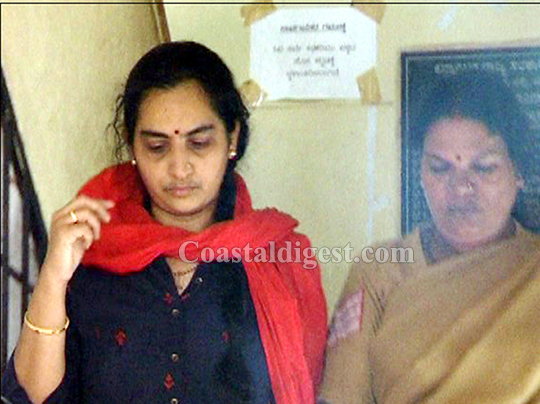
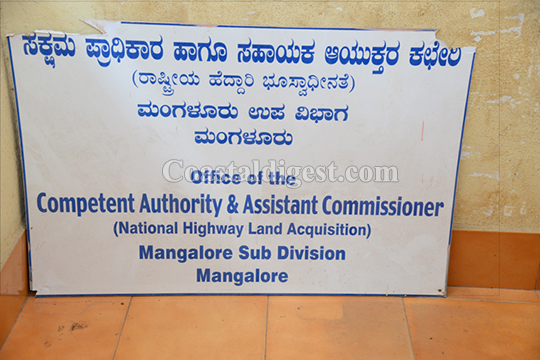
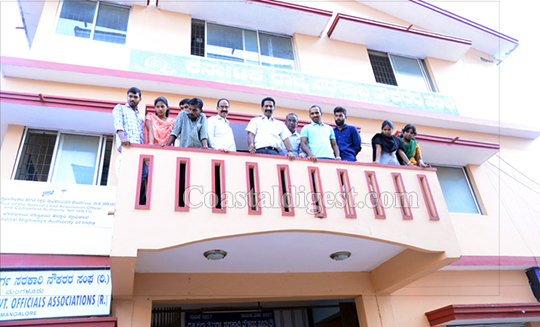
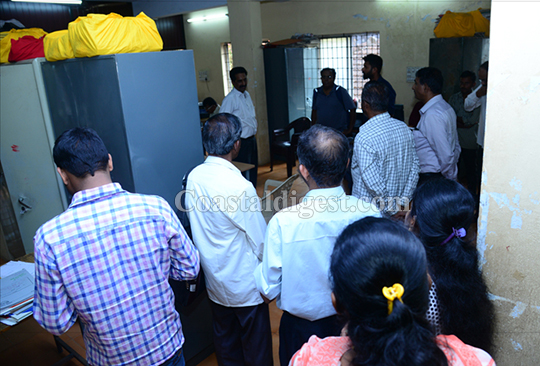
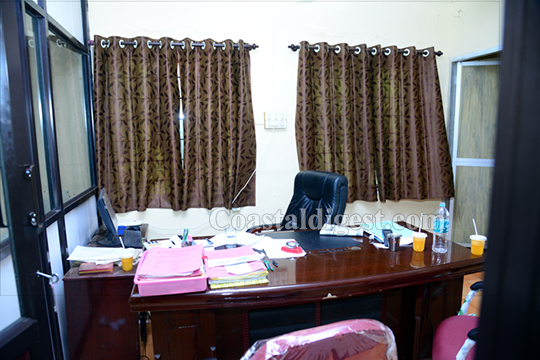
Mangaluru, Jan 4: A special land acquisition officer of NHAI and a revenue inspector were arrested by the Anti-Corruption Bureau (ACB) on Wednesday on charge of accepting a bribe of Rs 20,000 and Rs 5,000 for clearing a cheque, at NHAI office.

raid 1

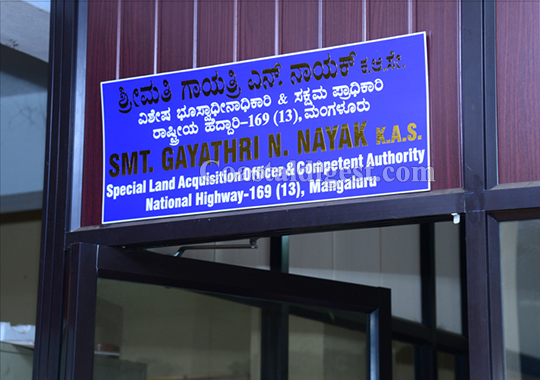
The arrested have been identified as Gayathri N Nayak, assistant commissioner, special land acquisition officer and executive director of Dr Shivaram Karanth Pilikula Nisargadhama and Tukrappa, revenue inspector, NHAI

According to Sudhir M Hegde, DSP, ACB, DK they had acted upon complaint of Yogish Kumar from Mulki where he complained that Gayathri N Nayak and Tukrappa had demanded Rs 25,000 for clearing a cheque of Rs 18 lakh.

The cheque was given as compensation to his two cents of land acquired by NHAI for road widening near Mulki.

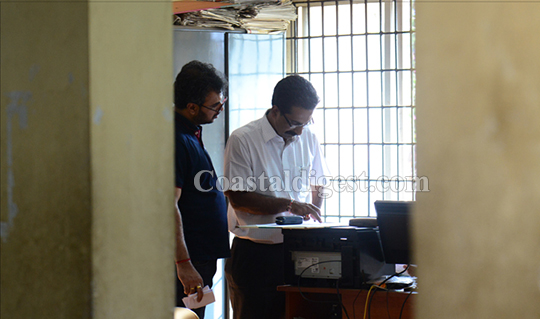
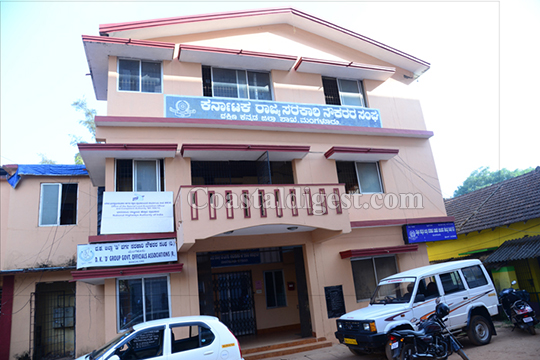
Based on his complaint, ACB sleuths arrested duo when Yogish went to NHAI office near Mini Vidhana Soudha to give bribe total of Rs 25,000.

Sudhir added that arrested persons have been sent to Judicial Custody till January 18.

raid 4

raid 5

raid 7

raid 9

raid 10

raid 11

raid 12

Comments

Add new comment

  • Coastaldigest.com reserves the right to delete or block any comments.
  • Coastaldigset.com is not responsible for its readers’ comments.
  • Comments that are abusive, incendiary or irrelevant are strictly prohibited.
  • Please use a genuine email ID and provide your name to avoid reject.
coastaldigest.com news network
April 22,2020

Newsroom, Apr 22: Dozens of Tablighi Jamaat members from across the country who have been successfully recovered and have now tested negative for the novel coronavirus have come forward and donate their plasma for the treatment of Covid-19 patients.

The Tablighis from Tamil Nadu were the first to take this decision. According to them, apart from helping the critically ill patients to recover from COVID-19, was to counter the ‘baseless accusations’ that Tablighis were responsible for the spread of the virus following the religious congregation of the sect held at Delhi’s Nizamuddin area last month.

Mohammad Abbas, a thirty-eight year old businessman from Tiruppur was on Sunday discharged from Coimbatore’s ESI hospital. “As soon as I got discharged, I met the district administration officials and the dean of the hospital and told them that they may contact me anytime if they needed me to donate my plasma,” Abbas was quoted as saying by an English daily.

“It has only been one day since I was discharged but I’ve already spoken to others (from the Jamaat) who have recovered and they were all ready to donate,” he added. 

Leader's call

Maulana Saad Kandhalvi, a prominent leader of Tablighi Jamaat, who has been booked by the Delhi Police for holding a religious congregation, too has appealed to coronavirus survivors to donate blood plasma for infected people.

In a letter issued on Tuesday, Saad said most of the members who were quarantined did not have any infection and they tested negative for COVID-19.

"Even from amongst the ones who tested positive for the disease, a majority of them have now undergone treatment and are now cured while I and a few others are still under quarantine.

"It is required that such people who are now cured of this disease should donate blood plasma to others who are still fighting the disease and are under treatment," he said.

He also has urged the followers of the organisation to pray at home in the month of Ramadan instead of going to mosques. 

Plasma therapy

Convalescent Plasma Therapy is an experimental procedure for COVID-19 patients.

In this therapy, the antibodies of a person who has recovered from the virus are taken and transfused into a sick person (having the virus) to help boost the person’s immune system.

The recovered COVID-19 patient’s blood develops antibodies to battle against COVID-19.

Once the blood of the first patient is infused to the second patient, those antibodies will start fighting against the coronavirus in the second person.

The process for donating plasma is similar to donating blood and takes about an hour.

Several countries around the world including the United Kingdom and the United States have also started plasma therapy trials.

In India, several states like Kerala, Gujarat and Punjab have already started using Plasma Therapy for the corona-infected patients.

Comments

Add new comment

  • Coastaldigest.com reserves the right to delete or block any comments.
  • Coastaldigset.com is not responsible for its readers’ comments.
  • Comments that are abusive, incendiary or irrelevant are strictly prohibited.
  • Please use a genuine email ID and provide your name to avoid reject.
News Network
May 22,2020
Bengaluru, May 22: Evacuation planes from Male in Maldives and Doha in Qatar landed in Bengaluru with returnees from Karnataka after they were stranded for two months due to suspension of international flights since March 23 and the extended lockdown, an official said on Friday.
 
"An Air-India flight (#0266) with 152 passengers from Male and its subsidiary Express flight (IX-0822) with 177 returnees and 5 infants from Doha landed here safely at 6.50 pm. and 9.05 pm respectively," an airline official told media persons in Bengaluru.
 
Both the flights are first from their respective countries to Bengaluru, bringing in returnees to the southern state in the second phase of the Vande Bharat mission, being carried out to evacuate Indians stranded the world over.
 
"As per the standard operating procedure and guidelines of the state health department, all the passengers were screened with thermal device and tested to ensure they were asymptomatic before leaving the airport," a nodal officer said.
 
The returnees were given a spare mask to wear all the time and a sanitiser to wash their hands.
 
"The luggage of all passengers was screened and disinfected before handing over to them after they completed formalities such as filling the self-declaration form and downloading of the Quarantine App for contact tracing later,” said the official.
 
The passengers were ferried from the airport in state-run buses in batches for 14-day institutional quarantine in hotels and resorts across the city.
 
The flights were the 6th and 7th flights to Karnataka, of the national carrier and its Express arm, which are operating the service to repatriate thousands of Indians, including distressed workers, migrants, students, senior citizens and tourists, stranded overseas.
 
Five flights have flown about 650 returnees till date from May 18-21 under the mission's second phase to Bengaluru and Mangaluru on the west coast. The passengers have been brought from Dubai in the UAE, Kuala Lumpur in Malaysia, Muscat in Oman, Dammam in Saudi Arabia and San Francisco in the US.
 
The remaining flights to Karnataka will land in Bengaluru and Mangaluru over the next 12 days till June 3 from 9-10 more destinations the world over.
 
In the first phase of the mission from May 7-17, the airline and its arm flew 6 flights to the state from May 11-15, bringing in 800 passengers, including 623 to Bengaluru and 177 to Mangaluru from London, Singapore, San Francisco and Dubai.

Comments

Add new comment

  • Coastaldigest.com reserves the right to delete or block any comments.
  • Coastaldigset.com is not responsible for its readers’ comments.
  • Comments that are abusive, incendiary or irrelevant are strictly prohibited.
  • Please use a genuine email ID and provide your name to avoid reject.
Agencies
July 8,2020

The Central Board of Secondary Education (CBSE) has rationalised by up to 30 per cent the syllabus for classes 9 to 12 for the academic year 2020-21 to reduce course load on students amid the COVID-19 crisis, Union HRD Minister Ramesh Pokhriyal 'Nishank' announced on Tuesday.

The curriculum has been rationalised while retaining the core elements, the Human Resource Development said.

Among the chapters dropped after the rationalisation exercise are lessons on democracy and diversity, demonetisation, nationalism, secularism, India's relations with its neighbours and growth of local governments in India, among others.

"Looking at the extraordinary situation prevailing in the country and the world, CBSE was advised to revise the curriculum and reduce course load for the students of classes 9 to 12.

"To aid the decision, a few weeks back I also invited suggestions from all educationists on the reduction of syllabus for students and I am glad to share that we received more than 1.5K suggestions. Thank you, everyone, for the overwhelming response," Nishank tweeted.

"Considering the importance of learning achievement, it has been decided to rationalise syllabus up to 30 per cent by retaining the core concepts," he added.

The Union minister said the changes made in the syllabi have been finalised by the respective course committees with the approval of the curriculum committee and the Governing Body of the Board.

"The heads of schools and teachers have been advised by the board to ensure that the topics that have been reduced are also explained to the students to the extent required to connect different topics. However, the reduced syllabus will not be part of the topics for internal assessment and year-end board examination.

"Alternative academic calendar and inputs from the NCERT on transacting the curriculum using different strategies shall also be part of the teaching pedagogy in the affiliated schools," a senior official of the HRD ministry said.

For classes 1 to 8, the National Council of Education Research and Training (NCERT) has already notified an alternative calendar and learning outcomes.

According to the updated curriculum, among the chapters deleted from class 10 syllabus are-- democracy and diversity, gender, religion and caste, popular struggles and movement, challenges to democracy

For class 11, the deleted portions included chapters on federalism, citizenship, nationalism, secularism, growth of local governments in India.

Similarly, class 12 students will not be required to study chapters on India's relations with its neighbours, changing nature of India's economic development, social movements in India and demonetisation, among others.

Universities and schools across the country have been closed since March 16 when the central government announced a nationwide classroom shutdown as one of the measures to contain the COVID-19 outbreak.

A nationwide lockdown was announced on March 24, which came into effect the next day. While the government has eased several restrictions, schools and colleges continue to remain closed.


Comments

Add new comment

  • Coastaldigest.com reserves the right to delete or block any comments.
  • Coastaldigset.com is not responsible for its readers’ comments.
  • Comments that are abusive, incendiary or irrelevant are strictly prohibited.
  • Please use a genuine email ID and provide your name to avoid reject.