


Acche Din: Unemployment in India rising rapidly, reveals survey

October 1, 2016

New Delhi, Oct 1: Joblessness in India is running at a five-year high of 5% of the 15-plus-years work force. Over a third of working people are employed for less than a year and 68% of households are earning up to only Rs 10,000 per month, according to a new employment-unemployment (EU) survey report conducted by the Labour Bureau.

joblessOver 7.8 lakh persons in 1.6 lakh households were surveyed across the country between April and December 2015. Expectedly, urban areas continue to provide more and better paying jobs compared with the rural areas. While 82% of job seekers get year-round jobs in urban areas, just 53% of rural job seekers manage to get such security.

About 42% of workers in rural areas work for less than 12 months in a year, a result of dependence on seasonal agriculture work. Unsurprisingly, this means that 77% of the rural households end up with an average monthly income of less than Rs 10,000. In urban areas, about half the households earn between Rs 10,000 and Rs 50,000 per month.

These findings of the first large sample survey after the Modi government took power in June 2014 show that even after more than a year of seeing the new government's policies in action, the situation on the ground continues to be dire and effectively the same as in the preceding UPA's rule. It shows a continuation of a distressing job situation — and hence economic status — that was reflected in earlier surveys like the 68th round of NSSO and the Socio-Economic & Caste Census (SECC) in 2011-12.

What does 5% unemployment and 35% underemployment mean in hard numbers? Projecting from Census 2011 figures, India had a 15-years-and-older labour force of about 45 crore.

So, 5% of that is a whopping 2.3 crore persons. In addition, there are those who work but not for the whole year, signifying hidden unemployment.

This works out to nearly 16 crore persons.

Women's employment continues to stagnate with 8.7% of women in the labour force without jobs.

Comparison to previous surveys done by the labour bureau show that the unemployment rate rose from about 3.8% in 2011 to 4.9% in 2013. This was a period of relative economic slowdown compared to earlier in the decade. But growth has been recorded at 7.3% in 2015-16 — yet the jobs situation has worsened. The Modi government's pronouncements for job creation, like Make in India, Start-Up India and Digital India do not seem to have had the desired impact.

The labour bureau survey also found that about 47% of the working population was self-employed.

This would be mostly farmers, shopkeepers, and enterprise owners. But the low economic level of this section is revealed by the fact that 85% of such households had a monthly income of less than Rs 10,000.

Another 33% of households earn their living through casual employment.

Regular wage or salary earning households make up just 17% of all, although this is the kind of work that pays more with 43% of people earning more than Rs 10,000.

Comments

mangalorean
 - 
Sunday, 2 Oct 2016

Yes..

This is not only increasing in India but also affecting globally! Population increasing rapidly and same time requirements also has to increase but not happening why??

Its only because we are becoming more greedy day by day so to increase the wealth over night we are forgetting what we are doing!
No proper deal, fraud while making the deal, not paying to supplier or customer, duplicate and chemical contained material supplying all over the world. in short there is no proper give and take policy and forgetting humanity!!

Hoe we can expect success in any field. Business getting loss and company do not want to hire the employees.

then from where we can expect the blessings..

Satyameva jayate
 - 
Saturday, 1 Oct 2016

Please contact Naren and Viren for real survey and support.....ha haa...khudh milk see baahar hai...also our Pm....wit please

Add new comment

  • Coastaldigest.com reserves the right to delete or block any comments.
  • Coastaldigset.com is not responsible for its readers’ comments.
  • Comments that are abusive, incendiary or irrelevant are strictly prohibited.
  • Please use a genuine email ID and provide your name to avoid reject.
coastaldigest.com news network
August 5,2020

Mangaluru, Aug 5: Normal life was thrown out of gear as heavy rain and gusty winds lashed large parts of coastal and malnad districts of Karnataka in last 48 hours. Widespread power outages due to tree fall and minor landslides were reported in last 24 hours.

Meanwhile, Indian Meteorological Department has sounded a red alert for Uttara Kannada, Udupi and Dakshina Kannada districts 8:30am of August 5.

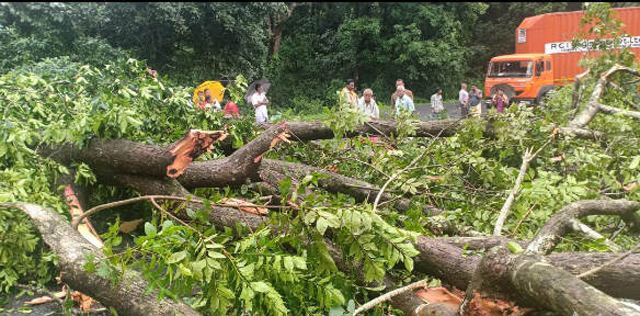
In Mangaluru city there were several tree falls disrupting power supply in key areas of the city. Four electricity poles were damaged after a tree fell on Boloor Jarandaya road due to rain and heavy winds. In Neermarga too, there were a couple of tree falls in the morning cutting off power supply, which was not restored till this report was sent.

Mescom bore the brunt of the rains in Udupi and Dakshina Kannada District and at the last count as many as 148 electric poles, 23 transformers and 65 kilometer conductor wires were damaged due to poles being damaged in tree fall and landslides.

Traffic was affected on Charmadi Ghat on the Mangaluru-Chikkamagaluru route due to a tree fall on the second hair pin bend. 

On Monday, landslides near Kottigehara, Chikkamagaluru District, left traffic badly affected. Though normalcy has been restored on the route after blocking the road for restoration till Tuesday morning, locals fear more landslides due to continuous downpour.

Kodagu district too received heavy rainfall in past 24 hours which resulted in water logging in low-lying areas.

In the Coast, Uttara Kannada received the highest amount of rainfall at 91mm, followed by Udupi at 75 and DK at 73mm. The highest Rainfall of 241 mm was recorded at Castlerock, Supa Taluk in Uttara Kannada District.

KSNMDC bulletin stated that widespread moderate to heavy rains associated with strong surface winds at times and isolated very heavy to extreme heavy rains was likely over Udupi, Dakshina Kannada and Uttara Kannada districts It also stated that wind speeds ranging between 50kmph to 60 kmph was forecast along the coast of Karnataka from Mangaluru to Karwar, warning fishermen not to venture into the sea.

Comments

Add new comment

  • Coastaldigest.com reserves the right to delete or block any comments.
  • Coastaldigset.com is not responsible for its readers’ comments.
  • Comments that are abusive, incendiary or irrelevant are strictly prohibited.
  • Please use a genuine email ID and provide your name to avoid reject.
News Network
July 25,2020

Bengaluru, Jul 25: The Karnataka government on Saturday announced a waiver of crematorium fees for those who succumb to the COVID-19 infection in Bengaluru and said the city civic body would bear the cost.

It said that from now on, families of the COVID deceased need not pay any fees fixed by the city civic body- Bruhat Bengaluru Mahanagara Palike (BBMP)- across 12 electric crematoriums in the city.

"There were reports in the media about difficulties faced in performing the last rites of those who died due to COVID-19 infections. Aimed at resolving those difficulties, certain decisions have been taken," Revenue Minister R Ashoka said.

He told reporters here that BBMP had fixed Rs 250 as the cremation fee, Rs 100 for the ash collection pot and Rs 900 for the bier (bamboo stretcher on which the body is carried), all of which have been waived for COVID deaths.

"So it will be a waiver of Rs 1,250 per cremation. The BBMP will bear this cost," he added.

Ashoka also announced Rs 500 per body incentive for the personnel who conduct the last rites of COVID victims.

"This is in recognition of their services at a time when family members of the deceased are not ready to touch the body and not ready to take the body in some cases," he said.

Noting that the government has identified 23 acres of land at five places around Bengaluru for burial or cremation of COVID victims, Ashoka locals in all these areas are protesting against it.

Appealing to the people for cooperation during these difficult times, he said the government's intention was to ensure respectful burial or cremation for the deceased.

"Obstructing it is not right, it is not Indian tradition," he said.

Pointing out that it takes almost a day's time for a COVID victim's body to be handed over for burial or cremation, he said "scientifically, according to experts and doctors, the virus will not remain alive for more than three hours.

...Also, bodies are either burnt or buried eight feet below. So there will not be any problem for those living in nearby areas and it will not spread infection. Cooperate with humanity," he said.

"These lands identified are for all religions and communities and once the pandemic subsides, can be used for other deaths as well," he said.

Comments

Add new comment

  • Coastaldigest.com reserves the right to delete or block any comments.
  • Coastaldigset.com is not responsible for its readers’ comments.
  • Comments that are abusive, incendiary or irrelevant are strictly prohibited.
  • Please use a genuine email ID and provide your name to avoid reject.
News Network
May 19,2020

Bengaluru, May 19: Containment zones in Karnataka will be much smaller in size under the latest lockdown norms. However, rules and loopholes will be tightened and action against violators will be stringent in order to check the spread of the disease.

Revised guidelines issued by the Centre to the state, reveal containment zones are delineated based on mapping of cases and contacts. Intensive action will be carried out in these areas with the aim of breaking the chain of transmission. Therefore, the area of a containment zone should be appropriately defined by the district administration/local urban bodies with technical inputs at local level.

The health department is considering shrinking the size of containment zones from the existing 100 metres to open up more space for economic activities. Medical education minister K Sudhakar, also a member of the Covid taskforce, said additional chief secretary (health department) Javed Akthar will issue a new definition of a containment zone after the Covid-19 taskforce holds its next meeting.

“We are planning to further shrink it and restrict containment zones to an apartment complex, independent house or even a lane where the Covid-19 patient resides,” Sudhakar said. He went on to say bigger containment zones will impede businesses and normal activities in the vicinity, something which the government wants to avoid.

The minister said Karnataka will also do away with colour-coding districts. “With restrictions being relaxed for almost all activities, it does not make sense to pursue with colour codes. It is either containment zone or outside containment zone,” he said.

In rural areas, the minister said containment zones will be identified by the taluk heads. Government sources say it is difficult to restrict activities to certain areas or smaller location in rural areas as farmers and people will have to travel to the outskirts of their villages for their livelihood.

An official said, a containment operation (large outbreak or cluster) is deemed successful when no case is reported in 28 days from the containment zone.

Comments

Add new comment

  • Coastaldigest.com reserves the right to delete or block any comments.
  • Coastaldigset.com is not responsible for its readers’ comments.
  • Comments that are abusive, incendiary or irrelevant are strictly prohibited.
  • Please use a genuine email ID and provide your name to avoid reject.