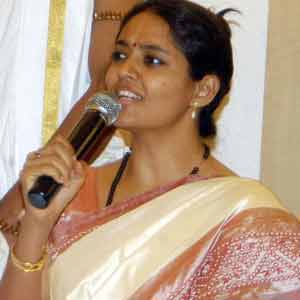
Actress Ranjitha dons saffron, becomes Nithyananda's sanyasini 'Ma Anandmayi'

[email protected] (News Network)
December 28, 2013

Actress-Ranjitha-Pressmeet

Bangalore, Dec 28: Tamil film actress Ranjitha, whose name was closely linked to the alleged sex scandal involving Bidadi Dhyanapeet Ashram's Swami Nithyananda, was conferred 'Sanyasa Deekshe' by the controversial godman on his 37th birthday on Friday.

The actress was among 70 devotees, including a few foreign nationals, who received the deekshe. Ranjitha was clad in a saffron dress and chanted mantras (prayers) before being administered the sacred vow, sources in the ashram said. She has now assumed the name Maa Anandamayi.

Over a hundred devotees from Andhra Pradesh, Kerala and Tamil Nadu attended the event. Religious rituals started at 6 am and went on till 9 pm. A few hoardings of Nithyananda were installed on the premises and Kannada and Tamil film songs were sung during a procession preceding the deeksha ceremony.

Entry for visitors was restricted and four policemen were guarding the premises. The ashram residents themselves had made the security arrangements and closed the main door. Tension prevailed for a while when a handful of  cameramen climbed the compound of the ashram and started shooting the proceedings. The ashramites allegedly threw stones at them and berated them for the intrusion.

A few Kannada organisations held protests outside the ashram and demanded that Nithyananda be exiled from the State. They tore down banners and hoardings and set tyres on fire, shouting anti-Nithyananda slogans and performed a mock funeral procession.

Comments

Sharyn
 - 
Tuesday, 19 Jan 2016

After I initially left a commentt I seem to have clicked on the -Notify me when new comments are
added- cueckbox annd now every time a comment is added I recieve 4 emails with the same
comment. There has to be an easy method you can remove me
from that service? Thanks a lot!

Also visit my website; commercial cleaning equipment: http://ge.tt/3LE0GgR2/v/0

Add new comment

  • Coastaldigest.com reserves the right to delete or block any comments.
  • Coastaldigset.com is not responsible for its readers’ comments.
  • Comments that are abusive, incendiary or irrelevant are strictly prohibited.
  • Please use a genuine email ID and provide your name to avoid reject.
News Network
February 5,2020

Bengaluru, Feb 5: Despite installing a BJP government in Karnataka through disguised operation Kamala, the Prime Minister Narendra Modi-led union government has continued its step motherly attitude towards this south Indian state.

Under the new formula adopted to share central taxes among states Karnataka will be the worst-affected. Though the 15th Finance Commission has recommended a special grant of Rs 5,495 crore for the state for 2020-21, the Centre appears reluctant to pay up and instead has asked for the proposal to be reviewed.

During the Union budget, the report of the 14th Finance Commission headed by NK Singh for 2020-21 was tabled in Lok Sabha. It shows besides Karnataka, Telangana, Mizoram and Kerala saw their central tax share decrease, while Uttar Pradesh, Bihar and Maharashtra were top gainers.

Karnataka's share has decreased from 4.7% provided by the previous finance commission, to 3.6%. Acknowledging there is a steep decline in Karnataka's share from 2019-20, the finance commission has recommended a special grant of Rs 5,495 crore for the state.

Its share in 2019-20 was Rs 36,675 crore, but under the new formula, Karnataka will get only Rs 31,180 crore in 2020-21 from the divisible pool of Rs 8.5 lakh crore - a decline of 22.5%.

Also, the decrease for Karnataka comes on the back of a shortfall in 2019-20. While the state was entitled to Rs 39,806 crore from the divisible pool, it got only Rs 36,675 crore as the Centre suffered a tax revenue shortfall of Rs 1.5 lakh crore.

What is more disheartening though is the Centre's refusal to pay the special grant. Instead, the Union finance ministry has asked the finance commission to reconsider the recommendation. This has prompted the state to take up the issue with the Centre.

"The decline in central taxes devolution comes at a time when the state is going through a tough financial situation. Steps are being taken to ensure Karnataka gets justice," said chief secretary TM Vijay Bhaskar.

Officials said besides corrective measures for 2020-21, the focus will be on ensuring a fair share in subsequent years. However, Karnataka has little chance of getting its dues as the Centre is known to be prudent when distributing tax proceeds among states.

"The Centre has certain views on devolution. We have done our duty by submitting the interim report. It's up to the states to convince the Centre," said Ravi Kota, joint secretary of 15th Finance Commission.

Under the new formula, the commission changed the weightage for some of the six criteria it considers - population, area, forest cover, income distance, demographic performance and tax effort.


Comments

Add new comment

  • Coastaldigest.com reserves the right to delete or block any comments.
  • Coastaldigset.com is not responsible for its readers’ comments.
  • Comments that are abusive, incendiary or irrelevant are strictly prohibited.
  • Please use a genuine email ID and provide your name to avoid reject.
News Network
May 28,2020

Udupi, May 28: The India Meteorologic Department (IMD) on Thursday warned fishermen in coastal belt of Karnataka against venturing out into the deep sea between May 31 and June 4.

The Department stated that depression is expected to occur in the south-eastern part of Arabian Sea and the nearby areas and it would be dangerous for the fishermen of Karnataka, Kerala and Lakshadweep to go out towards the deep sea.

The Department officials said that they would provide information on development in weather conditions. In the backdrop of the current weather forecast, however, the fishermen in the western coastline were advised against venturing into the sea.

Comments

Add new comment

  • Coastaldigest.com reserves the right to delete or block any comments.
  • Coastaldigset.com is not responsible for its readers’ comments.
  • Comments that are abusive, incendiary or irrelevant are strictly prohibited.
  • Please use a genuine email ID and provide your name to avoid reject.
News Network
April 2,2020

The current physical distancing guidelines provided by the World Health Organisation (WHO) and by the US Centers for Disease Control and Prevention (CDC) may not be adequate to curb the coronavirus spread, according to a research which says the gas cloud from a cough or sneeze may help virus particles travel up to 8 metres. The research, published in the Journal of the American Medical Association, noted that the the current guidelines issued by the WHO and CDC are based on outdated models from the 1930s of how gas clouds from a cough, sneeze, or exhalation spread.

Study author, MIT associate professor Lydia Bourouiba, warned that droplets of all sizes can travel 23 to 27 feet, or 7-8 metres, carrying the pathogen.

According to Bourouiba, the current guidelines are based on "arbitrary" assumptions of droplet size, "overly simplified", and "may limit the effectiveness of the proposed interventions" against the deadly pandemic.

 She explained that the old guidelines assume droplets to be one of two categories, small or large, taking short-range semi-ballistic trajectories when a person exhales, coughs, or sneezes.

However based on more recent discoveries, the MIT scientist said, sneezes and coughs are made of a puff cloud that carries ambient air, transporting within it clusters of droplets of a wide range of sizes.

Bourouiba warned that this puff cloud, with ambient air entrapped in it, can offer the droplets moisture and warmth that can prevent it from evaporation in the outer environment.

"The locally moist and warm atmosphere within the turbulent gas cloud allows the contained droplets to evade evaporation for much longer than occurs with isolated droplets," she said.

"Under these conditions, the lifetime of a droplet could be considerably extended by a factor of up to 1000, from a fraction of a second to minutes," the researcher explained in the study.

The MIT scientist, who has researched the dynamics of coughs and sneezes for years, added that these droplets settle along the trajectory of a cough or sneeze contaminating surfaces, with their residues staying suspended in the air for hours.

"Even when maximum containment policies were enforced, the rapid international spread of COVID-19 suggests that using arbitrary droplet size cutoffs may not accurately reflect what actually occurs with respiratory emissions, possibly contributing to the ineffectiveness of some procedures used to limit the spread of respiratory disease," Bourouiba wrote in the study

Comments

Add new comment

  • Coastaldigest.com reserves the right to delete or block any comments.
  • Coastaldigset.com is not responsible for its readers’ comments.
  • Comments that are abusive, incendiary or irrelevant are strictly prohibited.
  • Please use a genuine email ID and provide your name to avoid reject.