



After military raid, India looks at more ways to pressure Pakistan

September 30, 2016

New Delhi, Sep 30: Beyond Thursday's raid by Indian special forces into Pakistan's side of divided Kashmir, New Delhi is considering new economic and diplomatic measures to bring pressure to bear on its neighbour, Indian officials said.
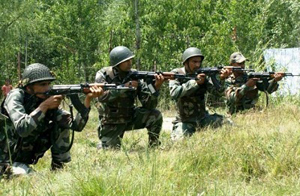
militaryIn a rare public acknowledgement, Indian officials said teams of elite troops crossed the de facto border dividing the nuclear-armed rivals in the Himalayan state, killing several militants it believed were planning to attack major cities.

The raids were a direct response to an attack earlier this month on an army base in Kashmir that India blamed on Pakistan-based militants.

Pakistan denied India had conducted raids on territory it administers and said it was not involved in stoking trouble in Indian-controlled Kashmir. It has demanded New Delhi produce credible evidence to back its claims.

Some Indian officials said the military was not planning further attacks or a major military offensive against Pakistan.

But they said Prime Minister Narendra Modi's government was debating whether to use New Delhi's rising economic and diplomatic weight to squeeze Pakistan, a country one-fifth its size and with an economy seven times smaller.

"The objective is not just to go across the border and kill 10-12 people," said an Indian security official involved in the daily consultations since the Sept. 18 attack on an army base in the border town of Uri in which 18 Indian soldiers were killed.

"The objective is to bring about a change in Pakistani behaviour, and for that you need to move on multiple levels.

"The strategy will involve all instruments of national power. Military is only one of the options," added the official, who asked not to be identified because of the sensitivity of the issue.

Options under consideration include choking trade with Pakistan that takes place through third countries such as the United Arab Emirates, officials said, even though it is limited and in India's favour.

New Delhi is also considering building dams on rivers running into Pakistan and intensifying diplomatic pressure, hoping that it can show other countries how militants based in Pakistan impact the rest of the world, the officials added.

According to one of them, India could try to dissuade international companies from conducting business in Pakistan.

On The Offensive

The steps being considered signal a far more assertive posture by India under Modi's nationalist administration than the previous government, but it risks further escalating tensions between the countries.

Recent Indian governments have held off launching military strikes, including when gunmen from Pakistan mounted a three-day assault on Mumbai in 2008, for fear it could invite retaliation from Pakistan that could escalate into a nuclear conflict in the worst-case scenario.

One Indian security official described the new Indian approach as moving from a "defensive posture to defensive offence", under which India works on the vulnerabilities of Pakistan - its economy, internal security and international image as an unstable nation, home to militant Islamist groups.

"Pakistan's vulnerability is many times higher than that of India," the official said.Hours after Thursday's raid, one Indian government official said New Delhi would review its economic relationship, including trade flows, with Pakistan.

But he downplayed the possibility of India taking measures such as blocking travel between the two countries, saying the reality of policy-making was much more sober.

Blocking Trade

Official trade between India and Pakistan was a modest $2.6 billion in 2014, but informal trade is estimated to be closer to $5 billion, with jewellery, textiles and machinery exported from India through third-country ports such as Dubai.

India's informal imports from Pakistan through the same channels consist of textiles, dry fruits, spices and cement.

Indian security planners said a crackdown on such trade, in which some former members of Pakistan's powerful military are believed to be active, would help increase the pressure.

The head of Pakistan's Board of Investment, Miftah Ismail, said sanctions had usually not worked elsewhere in the world.

He said there was little trade between the two countries, and since much of it was in India's favour, any restrictions would affect India more than Pakistan.

"If India does (go ahead with economic sanctions), Pakistan will somehow react, and we will further impoverish the people in both countries," said Ismail, who is also a special assistant to the Pakistan prime minister. "I don't see anything good coming out of this."

Comments

Add new comment

  • Coastaldigest.com reserves the right to delete or block any comments.
  • Coastaldigset.com is not responsible for its readers’ comments.
  • Comments that are abusive, incendiary or irrelevant are strictly prohibited.
  • Please use a genuine email ID and provide your name to avoid reject.
News Network
March 18,2020

Muzaffarpur, Mar 18: Prisoners in the central jail here are working overtime to produce facemasks to prevent the deadly COVID-19 striking. In addition to providing protection to fellow inmates and prison staff, the produce will be shared with nine district and sub jails falling under Muzaffarpur Central Prison as well, Deputy Superintendent of the jail Sunil Kumar Maurya said. From supplications at places of worship to hectic activities at the biggest hospital, this north Bihar district is witnessing invocation of all powers, human and otherwise, to prevent novel coronavirus hitting them.

Although nobody has so far tested positive for the dreaded virus in Bihar, where the state government has imposed a semi-lockdown as a preventive measure, Muzaffarpur which hit the headlines last year for losing close to 200 children to an outbreak of brain fever seems determined not to fall prey to yet another virulent affliction.

On making of facemasks by about 50 prisoners, the Deputy Superintendent of the jail said, "We have had a tradition of producing fabric at the Muzaffarpur Central Jail. An idea was floated why not use the skills acquired for producing masks which are in great demand but in short supply.

The local administration seems impressed with the endeavour of the social outcasts to rise to a global challenge.

"It is a welcome step. Despite all precautions, we never know who is going to catch the infection at which place. The efforts by prisoners to protect themselves and the staff manning their premises is laudable. "Full assistance will be provided to Central Jail authorities in supply of the masks to other prisons," Sub Divisional Magistrate (East) Kundan Kumar said.

A conservative town inhabited by a deeply religious citizenry, Muzaffarpur is also witnessing prayer congregations at temples and mosques in keeping with the tradition here of people of all faiths coming together when faced with a major challenge.

The Garib Nath temple, a renowned shrine devoted to Lord Shiva which attracts devotees from far and wide, is witness to the power of faith trumping the biggest fears as the footfall seems to have increased since the outbreak.

The temples mahant Vinay Pathak says, "faith can move mountains. People come here in search of strength to face a crisis which has caused worldwide scare. We advise the visitors to conduct regular 'havans' at their houses just like we have been performing here. "The smoke emitted by burning of purified offerings cleanses the air and, who knows, could be an antidote as well," Pathak added.

Chanting of 'Mahamrityunjay mantra', which the faith believe to be potent enough to dispel illness and untimely death, is taking place round the clock at the shrine in addition to 'havans', the mahant said.

Just a few yards away stands the Chhata Chowk mosque where large number of devotees appear in skull-caps to offer namaz.

"It is a pandemic threatening to engulf the entire world and dua (prayers) are needed as much as dawa (medicines). May God, who is one, listen to the common wish expressed by humanity in myriad ways," says Imtiaz Ahmed, a devout local resident.

Meanwhile, the health authorities are busy with their own efforts, not leaving prevention and cure to divine intervention.

District Medical Officer Shailesh Kumar Singh says a total of 42 people here who have come from abroad, have been tested but their results have been negative.

"Nonetheless, a five-bed special ward has been set up at the Sadar Hospital, manned by medical staff armed with a special kit comprising medicines and other logistics required for primary care of those with suspected symptoms," he said.

The SKMCH referral hospital, which bore the brunt of last years brain fever epidemic accounting for over 120 deaths is fully geared up to meet the latest challenge.

SKMCH superintendent Sunil Shahi says "we have a 30- ward insulation ward ready. Samples of patients with suspected symptoms are being routinely sent to RMRI, Patna. We appeal to all to remain alert, but avoid panic."

Comments

Add new comment

  • Coastaldigest.com reserves the right to delete or block any comments.
  • Coastaldigset.com is not responsible for its readers’ comments.
  • Comments that are abusive, incendiary or irrelevant are strictly prohibited.
  • Please use a genuine email ID and provide your name to avoid reject.
News Network
May 25,2020

New Delhi, May 25: Realtors' apex body CREDAI has written a letter to Prime Minister Narendra Modi, seeking immediate relief measures to tide over the crisis caused by the COVID-19 pandemic.

The association, which has around 15,000 developer members, has sought one-time debt restructuring, lower interest rate on home loans and tax sops to boost liquidity and demand in the sector.

In an open letter to the prime minister, the Confederation of Real Estate Developers' Associations of India (CREDAI) said, "In this distressful situation arising out of the COVID-19 calamity, we in the real estate sector seek immediate relief for our survival."

Stating that the sector contributes substantially to the country's GDP and has backward and forward linkages with almost 250 industries, CREDAI said, "Our survival, therefore, is not just desirable, it is rather crucial for the economy."

Liquidity crunch, stagnant demand and cartelization of raw materials are major impediments for the industry to kickstart, it added.

CREDAI made seven recommendations to revive the sector and sought immediate intervention from the prime minister.

Pointing out that the situation is "much worse" than global financial crisis in 2008, CREDAI said "a one-time restructuring scheme as was permitted by RBI in 2008 may be quickly instituted by all lending institutions."

Since real estate was already reeling under a cyclical downturn before COVID-19, debt restructuring needs to be allowed for all accounts which were standard as on December 31, 2019, it added.

CREDAI demanded that all banks, non-banking financial companies (NBFCs) and housing finance companies (HFCs) should be directed to provide additional credit equal to 20 per cent of the existing real estate project related advances with no additional security and without the classification of project as NPA.

The penal interest charged by banks and financial institutions should be suspended for a period of one year or until such time as it takes for the pandemic to abate.

To revive housing demand, CREDAI suggested that "government should reduce the maximum rate of interest on new home loans to 5 per cent by subsidizing the interest component of EMIs for next five years."

The limit of principal deduction on housing loan under Section 80C should be increased to 2.5 lakh.

Interest deduction under Section 24 on housing loan for homebuyers may be increased to Rs 10 lakh, it said.

There should be no capital gains for residential properties held for a period longer than one year.

CREDAI also demanded that the subvention scheme be allowed again by National Housing Bank (NHB) and the Reserve Bank.

Under the scheme, builders used to pay EMIs on behalf of homebuyers during construction of projects.

"The economic uncertainty and job insecurity at the moment would not allow purchase of residential property at this time. A scheme whereby a homebuyer would need to pay only margin money with no EMI for 24 months will address this insecurity," the letter said.

The association pointed out that prices of cement and steel have been increased during the lockdown period, and asked for crackdown on cartelisation by manufacturers.

On the GST front, CREDAI said that the current regime of GST provides a rate of 1 per cent  for affordable housing.

"The limit of Rs 45 lakh serves as a criterion of affordability for the purpose of GST. On all other housing, GST is applied at the rate of 5 per cent without input tax credit. It has been felt that the criterion of Rs 45 lakh is too low an index of affordability anywhere across the country, and especially so in the metros," the letter said.

It will serve as an inducement to buyers in the metros if the benefit of GST at the rate of 1 per cent is extended to units costing up to Rs 75 lakh, the association said.

CREDAI pointed out that the flat rate of 5 per cent GST for under construction residential housing is causing cost build up and is acting as a deterrent for sale of under construction projects since there is no GST on completed units.

It suggested that GST rate of 1 per cent and 5 per cent, without input tax credit, should continue.

"However, an option of GST @12 per cent for normal housing/ 8 per cent for affordable housing (with 1/3rd deduction for land i.e. effective GST rate of 8 per cent for normal housing and effective GST rate of 5 per cent for affordable housing) with input tax credit (ITC) benefits in line with the scheme applicable for the works contracts for government may be revived and made applicable to the real estate," the letter said.

Lastly, CREDAI demanded that a Rs 25,000 crore stress fund for completing stalled housing projects should be deployed at the earliest.

"We shall be grateful for your much-needed intervention for the above mentioned measures required to revive the real estate sector," CREDAI said in the letter to the PM.

Comments

Add new comment

  • Coastaldigest.com reserves the right to delete or block any comments.
  • Coastaldigset.com is not responsible for its readers’ comments.
  • Comments that are abusive, incendiary or irrelevant are strictly prohibited.
  • Please use a genuine email ID and provide your name to avoid reject.
News Network
February 14,2020

London, Feb 14: Liquor tycoon Vijay Mallya once again asked the Indian banks to take back 100 per cent of the principal amount owed to them at the end of his three-day British High Court appeal on Thursday against an extradition order to India.

The 64-year-old former Kingfisher Airlines boss, wanted in India on charges of fraud and money laundering amounting to an alleged Rs 9,000 crores in unpaid bank loans, said the Enforcement Directorate (ED) and the Central Bureau of Investigation (CBI) are fighting over the same assets and not treating him reasonably in the process.

“I request the banks with folded hands, take 100 per cent of your principal back, immediately,” he said outside the Royal Courts of Justice in London.

“The Enforcement Directorate attached the assets on the complaint by the banks that I was not paying them. I have not committed any offenses under the PMLA (Prevention of Money Laundering Act) that the Enforcement Directorate should suo moto attach my assets," he said.

"I am saying, please banks take your money. The ED is saying no, we have a claim over these assets. So, the ED on the one side and the banks on the other are fighting over the same assets,” he added.

Asked about heading back to India, he noted: “I should be where my family is, where my interests are.

"If the CBI and the ED are going to be reasonable, it’s a different story. What all they are doing to me for the last four years is totally unreasonable.”

Lord Justice Stephen Irwin and Justice Elisabeth Laing, the two-member bench presiding over the appeal, concluded hearing the arguments in the case and said they will be handing down their verdict at a later date after considering the oral as well as written submissions in the “very dense” case over the next few weeks.

On a day of heated arguments between Mallya’s barrister, Clare Montgomery, and Crown Prosecution Service (CPS) counsel Mark Summers, arguing on behalf of the Indian government, both sides clashed over the prima facie case of fraud and deception against Mallya.

“We submit that he lied to get the loans, then did something with the money he wasn’t supposed to and then refused to give back the money. All this could be perceived by a jury as patently dishonest conduct,” said Summers.

“What they [Kingfisher Airlines] were saying [to the banks] about profitability going forward was knowingly wrong,” he said, as he took the High Court through evidence to counter Mallya’s lawyers’ claims that Westminster Magistrates Court Judge Emma Arbuthnot had fallen into error when she found a case to answer in the Indian courts against Mallya.

Mallya, who remains on bail on an extradition warrant, is not required to attend the hearings but has been in court to observe the proceedings since the three-day appeal opened on Tuesday. A key defence to disprove a prima facie case of fraud and misrepresentation on his part has revolved around the fact that Kingfisher Airlines was the victim of economic misfortune alongside other Indian airlines.

However, the CPS has argued that “there is enough in the 32,000 pages of overall evidence to fulfil the [extradition] treaty obligations that there is a case to answer”. “There is not just a prima facie case but overwhelming evidence of dishonesty… and given the volume and depth of evidence the District Judge [Arbuthnot] had before her, the judgment is comprehensive and detailed with the odd error but nothing that impacts the prima facie case,” said Summers.

At the start of the appeal, Mallya’s counsel claimed Arbuthnot did not look at all of the evidence because if she had, she would not have fallen into the multiple errors that permeate her judgment. The High Court must establish if the magistrates’ court had in fact fallen short on a point of law in its verdict in favour of extradition.

Representatives from the Enforcement Directorate (ED) and Central Bureau of Investigation (CBI), as well as the Indian High Commission in London, have been present in court to take notes during the course of the appeal hearing.

Mallya had received permission to appeal against his extradition order signed off by former UK home secretary Sajid Javid last February only on one ground, which challenges the Indian government's prima facie case against him of fraudulent intentions in acquiring bank loans.

At the end of a year-long extradition trial at Westminster Magistrates’ Court in London in December 2018, Judge Arbuthnot had found “clear evidence of dispersal and misapplication of the loan funds” and accepted a prima facie case of fraud and a conspiracy to launder money against Mallya, as presented by the CPS on behalf of the Indian government.

Mallya remains on bail since his arrest on an extradition warrant in April 2017 involving a bond worth 650,000 pounds and other restrictions on his travel while he contests that ruling.

Comments

Add new comment

  • Coastaldigest.com reserves the right to delete or block any comments.
  • Coastaldigset.com is not responsible for its readers’ comments.
  • Comments that are abusive, incendiary or irrelevant are strictly prohibited.
  • Please use a genuine email ID and provide your name to avoid reject.