After Modi biopic, Vivek Oberoi gearing up to contest from Gujarat in 2024 polls

Agencies
April 8, 2019

Apr 8: Actor Vivek Oberoi, who plays Prime Minister Narendra Modi in a yet-to-be-released biopic, Saturday said he “might think” of contesting from Vadodara in the 2024 Lok Sabha polls “if he joins politics”.

The actor was participating in an interactive session with students of Parul University in Vadodra to promote the Omung Kumar-directed film PM Narendra Modi.

The Supreme Court on Friday refused urgent listing of a plea seeking stay on the release of the biopic.

On Thursday, the apex court had agreed to hear on April 8 a Congress leader’s plea which sought deferment of the biopic’s release till the completion of the upcoming Lok Sabha polls, alleging that it was designed to “manipulate, influence and impress viewers and voters”.

“If I join politics, I might think of contesting from Vadodara in the 2024 Lok Sabha elections just because of the love and affection people gave PM Narendra Modi when he contested from here,” Oberoi said after being asked whether he would take the political plunge.

He told students that he observed the PM’s body language and way of talking to prepare for his role in the biopic.

He claimed it took 16 days to finalise his look for the film.

“It is an inspiring film about a man who has become Prime Minister of the country and one of the world’s biggest leaders without any backing or caste politics,” he said.

Comments

indian
 - 
Tuesday, 9 Apr 2019

one of the worls biggest ###### man ever existed in india is Pm modi and second was vivek...

Add new comment

  • Coastaldigest.com reserves the right to delete or block any comments.
  • Coastaldigset.com is not responsible for its readers’ comments.
  • Comments that are abusive, incendiary or irrelevant are strictly prohibited.
  • Please use a genuine email ID and provide your name to avoid reject.
Agencies
July 29,2020

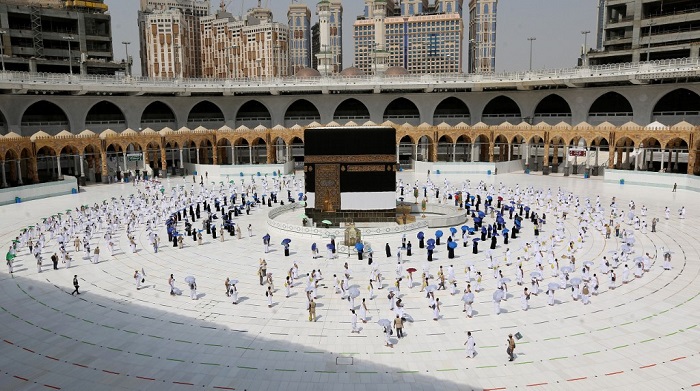
Dubai, Jul 29: Muslim pilgrims on Wednesday begin the annual Haj, downsized this year as the Saudi hosts strive to prevent a coronavirus outbreak during the five-day pilgrimage.

The Haj, one of the five pillars of Islam and a must for able-bodied Muslims at least once in their lifetime, is usually one of the world's largest religious gatherings.

But this year only up to 10,000 people already residing in the Kingdom will participate in the ritual, a tiny fraction of the 2.5 million pilgrims from around the world that attended last year.

"There are no security-related concerns in this pilgrimage, but (downsizing) is to protect pilgrims from the danger of the pandemic," said Khalid bin Qarar Al Harbi, Saudi Arabia's director of public security.

Pilgrims will be required to wear masks and observe social distancing during a series of religious rites that are completed over five days in the holy city of Makkah and its surroundings in western Saudi Arabia.

Those selected to take part in the Haj were subject to temperature checks and placed in quarantine as they began trickling into Makkah at the weekend.

State media showed health workers sanitising their luggage, and some pilgrims reported being given electronic wristbands to allow authorities to monitor their whereabouts.

Workers, clutching brooms and disinfectant, were seen cleaning the area around the Kaaba, the structure at the centre of the Grand Mosque draped in gold-embroidered cloth towards which Muslims around the world pray.

Haj authorities have cordoned off the Holy Kaaba this year, saying pilgrims will not be allowed to touch it, to limit the chances of infection.

They also reported setting up multiple health facilities, mobile clinics and ambulances to cater to the pilgrims.

Saudi authorities said only around 1,000 pilgrims residing in the Kingdom would be permitted for the Haj. Some 70 per cent of the pilgrims are foreigners residing in the Kingdom, while the rest will be Saudi citizens, authorities said.

All worshippers were required to be tested for coronavirus before arriving in the holy city of Makkah and will also have to quarantine after the pilgrimage as the number of cases in the Kingdom nears 270,000.

They were given elaborate amenity kits that include sterilised pebbles for a stoning ritual, disinfectants, masks, a prayer rug and the Ihram, a seamless white garment worn by pilgrims, according to a Haj ministry programme document.

"I did not expect, among millions of Muslims, to be blessed with approval," Emirati pilgrim Abdullah Al Kathiri said in a video released by the Saudi media ministry.

"It is an indescribable feeling... especially since it is my first pilgrimage."

The Haj ministry said non-Saudi residents of the Kingdom from around 160 countries competed in the online selection process but it did not say how many people applied.

Despite the pandemic, many pilgrims consider it safer to participate in this year's ritual without the usual colossal crowds cramming into tiny religious sites, which make it a logistical nightmare and a health hazard.

Comments

Add new comment

  • Coastaldigest.com reserves the right to delete or block any comments.
  • Coastaldigset.com is not responsible for its readers’ comments.
  • Comments that are abusive, incendiary or irrelevant are strictly prohibited.
  • Please use a genuine email ID and provide your name to avoid reject.
News Network
May 26,2020

New Delhi, May 26: With India now in the bracket of top 10 nations worst hit by the novel coronavirus, experts have attributed the surge in cases to easing of travel restrictions and movement of migrants besides enhanced testing capacity.

According to AIIMS Director, Randeep Guleria, the present rise in cases has been reported predominantly from hotspot areas but there is a possibility of further rise in the number of COVID-19 cases in the coming few days due to increased travel.

"Those who are asymptomatic or are in presymptomatic stage will pass through screening mechanisms and may reach areas where there have been minimal or less cases," Guleria said.

He said there was a need for more intense surveillance and monitoring in areas where migrants have returned to contain the spread of the disease.

If proper social distancing and hand hygiene is not maintained at a time when people are out on roads, the coronavirus infection will transmit much faster, he said.

Guleria also noted that testing capacity has been significantly ramped up which is reflecting in the increasing number of cases being detected.

Commenting on the partial resumption of rail and road transport services and migrants returning to their native places, Dr Chandrakant S Pandav, former president of the Indian Public Health Association and Indian Association of Preventive and social medicine, said the floodgates have been opened.

"This is a classic case of creating an enabling environment for coronavirus to spread like wildfire. In the coming few days, the number will rise dramatically. While it is true that lockdown cannot go on forever, the opening up should have been in a measured, calibrated and informed manner," he said.

"Travelling leads to spread of the infection. Now, the government will have to ensure even stronger surveillance to curb the infection but if that will be done is something to be observed," he said.

The death toll due to COVID-19 rose to 4,167 and the number of cases climbed to 1, 45,380 in the country, registering an increase of 146 deaths and 6,535 cases since Monday 8 am, according to the Union Health Ministry.

Dr K K Aggarwal, President of the Confederation of Medical Association of Asia and Oceania (CMAAO), and former IMA President, said there will be a further surge in cases in the coming days if migration continues without any proper social distancing.

"Within the next ten days, the cases will cross two lakh. The very fact that number of cases was rising before the end of the third lockdown and continuing during the fourth lockdown means that people are not following physical distancing as required," he said.

"Even in the last week of May when the temperature is very high, the rising number of cases would mean that human-to-human transmission is more important than surface-to-human transmission. Normally in heat the surface-to-human transmission should have reduced the new cases by half which has not happened," Aggarwal said.

However, Professor K Srinath Reddy, president of the Public Health Foundation of India, said an increase in the number of cases reflects both an increase in testing rates and an increase in spread.

"What we need to see is the number of new tests performed per day and the number of new cases that were identified from them. That gives a better idea of the rate of spread than the total number of new cases alone.

"We also have to see if the testing criteria has remained the same between the two periods of comparison.We may open up gradually but will have to continue case detection, contact tracing and follow personal protection measures as vigorously as possible," he added.

A total of 31,26,119 samples have been tested as on May 26, 9 am and 92,528 samples have been tested in the last 24 hours, ICMR officials said.

India is the tenth most affected nation by the pandemic after the US, Russia, UK, Spain, Italy, Brazil, Germany, Turkey and France, as per the John Hopkins University data.

The country has recorded 6,088, 6,654, 6,767 and 6977 cases on May 22, 23, 24 and 25 respectively. Also, the number of RT-PCR tests for detection of COVID-19 in the country crossed the 30-lakh mark on Monday.

The first two phases of the lockdown led to 14-29 lakh COVID-19 cases being averted, while the number of lives saved in that period was between 37,000 and 78,000, the government said last Friday, citing various studies, and asserted that the unprecedented shutdown has paid "rich dividends" in the fight against the pandemic.


Comments

Add new comment

  • Coastaldigest.com reserves the right to delete or block any comments.
  • Coastaldigset.com is not responsible for its readers’ comments.
  • Comments that are abusive, incendiary or irrelevant are strictly prohibited.
  • Please use a genuine email ID and provide your name to avoid reject.
News Network
May 20,2020

London, May 20: The current physical distancing guidelines of 6 feet may be insufficient to prevent COVID-19 transmission, according to a study which says a mild cough in low wind speeds can propel saliva droplets by as much as 18 feet.

Researchers, including those from the University of Nicosia in Cyprus, said a good baseline for studying the airborne transmission of viruses, like the one behind the COVID-19 pandemic, is a deeper understanding of how particles travel through the air when people cough.

In the study, published in the journal Physics of Fluids, they said even with a slight breeze of about four kilometres per hour (kph), saliva travels 18 feet in 5 seconds.

"The droplet cloud will affect both adults and children of different heights," said study co-author Dimitris Drikakis from the University of Nicosia.

According to the scientists, shorter adults and children could be at higher risk if they are located within the trajectory of the saliva droplets.

They said saliva is a complex fluid, which travels suspended in a bulk of surrounding air released by a cough, adding that many factors affect how saliva droplets travel in the air.

These factors, the study noted, include the size and number of droplets, how they interact with one another and the surrounding air as they disperse and evaporate, how heat and mass are transferred, and the humidity and temperature of the surrounding air.

In the study, the scientists created a computer simulation to examine the state of every saliva droplet moving through the air in front of a coughing person.

The model considered the effects of humidity, dispersion force, interactions of molecules of saliva and air, and how the droplets change from liquid to vapour and evaporate, along with a grid representing the space in front of a coughing person.

Each grid, the scientists said, holds information about variables like pressure, fluid velocity, temperature, droplet mass, and droplet position.

The study analysed the fates of nearly 1,008 simulated saliva droplets, and solved as many as 3.7 million equations.

"The purpose of the mathematical modelling and simulation is to take into account all the real coupling or interaction mechanisms that may take place between the main bulk fluid flow and the saliva droplets, and between the saliva droplets themselves," explained Talib Dbouk, another co-author of the study.

However, the researchers added that further studies are needed to determine the effect of ground surface temperature on the behaviour of saliva in air.

They also believe that indoor environments, especially ones with air conditioning, may significantly affect the particle movement through air.

This work is important since it concerns safety distance guidelines, and advances the understanding of the transmission of airborne diseases, Drikakis said.

Comments

Add new comment

  • Coastaldigest.com reserves the right to delete or block any comments.
  • Coastaldigset.com is not responsible for its readers’ comments.
  • Comments that are abusive, incendiary or irrelevant are strictly prohibited.
  • Please use a genuine email ID and provide your name to avoid reject.