


After violence Bengaluru limping back to normalcy; Central forces deployed

April 20, 2016

Bengaluru, Apr 20: Caught off guard by sudden eruption of violence during the garment workers' protest over the Provident Fund issue, authorities have deployed central forces in the city and clamped prohibitory orders.
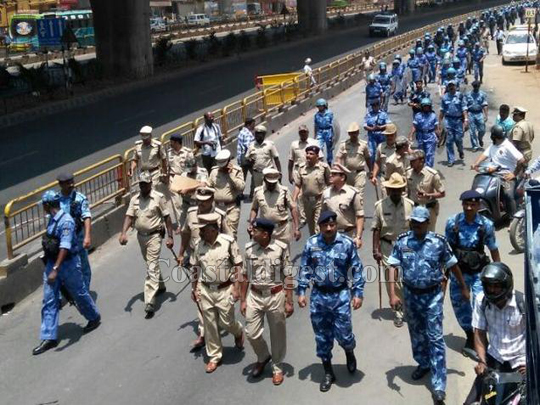
force 1

Rapid Action Force personnel today staged a flag march along the Jalahalli Cross stretch, one of the worst-hit by the violence yesterday, even as police arrested about 50 persons in connection with the untoward incidents.

Along the stretch from Madiwala to Bengaluru's IT corridor Electronics City which saw widespread protest and violence, 15 platoons of Karnataka State Reserve Police (KSRP), three platoons of Central Reserve Police Force and RAF and six to seven City Armed Reserve (CAR) platoons have been deployed, a top police official said.

"We have registered around 18 cases, yesterday nine and day before nine; and about 50 persons have been arrested so far," Additional Commissioner of Police (East-Bengaluru City) Harishekaran said.

He said photographs and footage of those involved in stone pelting, assault on police and torching of vehicles are available with police and they would be arrested.

In a spurt of violence, protesting garment workers set several vehicles ablaze and attacked a police station here yesterday forcing the government to revoke the amendment to Provident Fund rules that caused the unexpected spontaneous unrest.

Protesters had gone on the rampage pelting stones at Hebbagodi police station and torching seized vehicles there.

The agitation which began on Monday, spun out of control yesterday in which several people, including 25 policemen, were injured and traffic was thrown out of gear as thousands of workers took to the streets at different places.

City Police Commissioner has promulgated prohibitory orders under section 144 of CrPC in the limits of Bengaluru city till the midnight of April 22.

Harishekharan said police are also visiting garment factories and informing workers about the government's stand.

"There is no protest or procession today...in spite of this our bandobast will continue," he added.

Workers opposing amendment to Employees Provident Funds and Miscellaneous Provisions Act have expressed fear that the new rule would take away their right over the employer's contribution of Provident Fund till they attain 58 years.

Buckling under protests, government revoked the order tightening rules for withdrawal of Provident Fund money, hours after deciding to keep it in abeyance for three more months.

Meanwhile, a few media representatives today petitioned Chief Minister Siddaramaiah seeking action against police officials who were allegedly involved in violence against scribes who had gone to cover the protest by garment workers.

Both Chief Minister Siddaramaiah and Home Minister G Parameshwara assured action after inquiry.

"...lathicharge on journalists is wrong, we will inquire in to it and take action. I have already spoken to the Commissioner," Siddaramaiah said.

Also Read: Violence rocks Bengaluru for 2nd day; buses set on fire, police station attacked

Comments

KhasaiKhaane
 - 
Thursday, 21 Apr 2016

@ Kumar

Siddu decided on withdrawal of PF, So he is respnosible.. yeah right!
Hindu Mahasabha says MoNa (Modi) irresponsible decision on PF withdrawal was the reason for the riots! Anti-Nationals!?

Confused bhakt!

Add new comment

  • Coastaldigest.com reserves the right to delete or block any comments.
  • Coastaldigset.com is not responsible for its readers’ comments.
  • Comments that are abusive, incendiary or irrelevant are strictly prohibited.
  • Please use a genuine email ID and provide your name to avoid reject.
News Network
April 7,2020

Mandya, Apr 7: A man who was suspected of having the COVID-19 infection, escaped from the isolation ward of the Mandya Institute of Medical Sciences (MIMS), on Monday, creating panic among the people and hospital staff.

The man had earlier been in quarantine in Malavalli. On Sunday night He was shifted to MIMS Hospital, after he complained of throat infection and breathing problems and was kept in an isolation ward.

On Monday morning, however, the hospital staff found missing from the ward. They immediately reported the matter and launched a search for him. Superintendent of Police K Parashuram and Additional SP V J Shobharani and others rushed to the spot and began an inquiry. They also viewed the CCTV footage.

Comments

Add new comment

  • Coastaldigest.com reserves the right to delete or block any comments.
  • Coastaldigset.com is not responsible for its readers’ comments.
  • Comments that are abusive, incendiary or irrelevant are strictly prohibited.
  • Please use a genuine email ID and provide your name to avoid reject.
Wafa Sultana
April 4,2020

Over the last couple of days when the world was occupied with unifying efforts to fight the deadly Covid19 pandemic, sections of Indian media provided viewers a familiar scapegoat – the Indian Muslims – who are often stereotyped as a community being constantly at loggerheads with the citizenry and the State. Biased media channels were quick to resort to blaming the entire Muslim community for the spread of the disease in the country, thanks to an ill-timed Tablighi Jamaat gathering at its international headquarters in Delhi’s Nizamuddin. Unsurprisingly, the opprobrium was also marked by a sudden spike in WhatsApp forwards of videos with people wearing skullcaps licking spoons and performing Sufi breathing rituals, suggesting some sort of wild conspiracy on the part of the community to spread the virus.  Some media channels were quick to formulate, hypothesize and provide loose definitions of a newly discovered form of Jihad i.e. ‘Corona Jihad ’ thereby vilifying the Islamic faith and its followers.

While the investigation on the culpability of the organizers of the Nizamuddin event is still ongoing, there is enough information to suggest that the meeting was held before any lockdown was in force, and the problem began when there was no way of getting people out once the curfew was announced. Be that as it may, there is little doubt that organizing a meet of such a scale when there is a global pandemic smacks of gross misjudgment, and definitely the organizers should be held accountable if laws or public orders were defied. Attendees who attempt to defy quarantine measures must be dealt with strictly. However, what is alarming is that the focus and narrative have now shifted from the unfortunate event at Nizamuddin to the Tablighi Jamaat itself.

For those not familiar with the Tablighi Jamaat, the organization was founded in 1926 in Mewat by scholar Maulana Mohammad Ilyas. The Jamaat’s main objective was to get Muslim youth to learn and practice pristine Islam shorn of external influences. This is achieved through individuals dedicating time for moral and spiritual upliftment secluded from the rest of the world for a brief period of time. There is no formal membership process. More senior and experienced participants typically travel from one mosque to other delivering talks on religious topics, inviting local youth to attend and then volunteer for a spiritual retreat for a fixed number of days to a mosque in a nearby town or village to present the message to their co-religionists. Contrary to ongoing Islamophobic rhetoric, the movement does not actively proselytize. The focus is rather on getting Muslims to learn the teachings and practices of Islam.  This grassroots India-based movement has now grown to almost all countries with substantial Muslim populations. Its annual meets, or ‘ijtemas’ are among the largest Islamic congregations in the world after the annual Haj. One of the reasons for its popularity and wide network in the subcontinent and wordwide is the fact that it has eschewed the need for scholarly intervention, focusing on peer learning of fundamental beliefs and practice rather than high-falutin ideological debates. The Tablighi Jamaat also distinguishes itself from other Islamic movements through its strictly apolitical nature, with a focus on individual self-improvement rather than political mobilization. Hardships and difficulty in the world are expected to be face through ‘sabr’ (patience) and ‘dua’ (supplication),  than through quest for political power or influence. In terms of ideology, it is very much based on mainstream Sunni Islamic principles derived from the Deobandi school.

So, why is all this background important in the current context? While biased media entities have expectedly brought out their Islamophobic paraphernalia out for full display, more neutral commentators have tried to paint the Tablighi Jamaat as a fringe group and have tried to distance it from 'mainstream Muslims'. While the intent is no doubt innocent, this is a trap we must not fall into. This narrative, unfortunately, is also gaining ground due to apathy some Muslims have for the group, accusing it of being “disconnected from the realities of the world”. Unlike other Muslim organizations and movements, the Tablighi Jamat, by virtue of its political indifference, does not boast of high-profile advocates and savvy spokespersons who can defend it in mainstream or social media.  The use of adjectives such as 'outdated' and 'orthodox' by liberal columnists to describe the Jamaat feeds into the malignant attempt to change the narrative from the control of the spread of the pandemic due to the Nizamuddin gathering to 'raison d'etre' of the organization itself.

A large mainstream religious group like the Tablighi Jamaat with nearly a hundred-year history, normally considered to be peaceful, apolitical and minding its own business is now suddenly being villainized owing to unfortunate circumstances. Biased media reactions filled with disgust and hate seem to feed the Indian public conscience with a danngerous misconception - to be a nominal Muslim is okay but being a practicing one is not.  For those committed to the truth and fighting the spread of Islamophobia, the temptation to throw the entire Tablighi Jamaat under the bus must be resisted.

The writer is a lawyer and research scholar at Qatar University. Her research interests include Islamic law and politics.

Comments

zahoorahmed
 - 
Saturday, 4 Apr 2020

great article! provides a great perspective on tableeg jamat

Add new comment

  • Coastaldigest.com reserves the right to delete or block any comments.
  • Coastaldigset.com is not responsible for its readers’ comments.
  • Comments that are abusive, incendiary or irrelevant are strictly prohibited.
  • Please use a genuine email ID and provide your name to avoid reject.
News Network
May 18,2020

Bengaluru, May 18: A large number of people in India are planning inter-city bus travel within a month of the lifting of travel restrictions, according to a randomised online survey of over 10,300 customers of redBus, India's largest online bus ticketing platform.

Nearly 57 per cent of the respondents are planning to travel within a month post the lockdown. However, there is a high standard of expectation on the implementation of measures to make buses safe for travel with over 79 per cent wanting deep cleaning and sanitisation of buses after every trip.

Hand sanitisers, mandatory masks and temperature screening for all passengers are next in expectations for bus travel. Over 78 per cent of the respondents want the implementation of hygienic conditions at boarding points and 70 per cent want social distancing protocols to be implemented at boarding points.

"The survey does underscore the fact that given the adherence to safety protocols, bus travel is possibly one of the safest options for travel since the number of travellers are fewer, checks can be done individually and the whole factor of pick up and drop as close to home as possible minimises the number of contacts throughout the journey," said redBus Chief Executive Officer Prakash Sangam.

In addition, online booking further reduces the number of contact points as people can book bus tickets directly from their home. Further, there is a heightened awareness of personal hygiene and safety measures which is important for the travel to be safe.

"The large number of people waiting to travel not only points to the need but also the importance it has for the revival of economic activity as very few of them would be travelling for leisure," said Sangam.

The survey also showed that passengers put a very high consideration on hygiene, sanitation and disinfection -- over 73 per cent -- and social distancing (63 per cent) and much lower consideration to traditional factors such as travel cost (22 per cent), comfort (21 per cent) and punctuality (18 per cent).

The survey was conducted among redBus customers across India. Only 5 per cent of the respondents were willing to postpone their travel to over six months while the rest had plans to travel within that period.

Comments

Add new comment

  • Coastaldigest.com reserves the right to delete or block any comments.
  • Coastaldigset.com is not responsible for its readers’ comments.
  • Comments that are abusive, incendiary or irrelevant are strictly prohibited.
  • Please use a genuine email ID and provide your name to avoid reject.