



Ahead of Modi's visit, US official says Trump realises India has been 'force for good'

Agencies
June 24, 2017

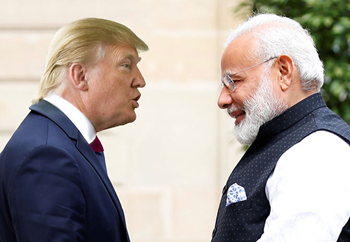
Washington, Jun 24: Ahead of Prime Minister Narendra Modi's much-awaited United States of America visit, the Trump administration has rejected reports that it has been ignoring India.21modi-trump
Talking to reporters, a senior administration official said: "I think that it would be wrong to say that this administration has been ignoring or not focused on India."

"I think that the US really appreciates India, and I think that President Trump realises that India has been a force for good in the world and that it's a relationship that's important. And I think that will come through in the visit on Monday," the official added.

The PM arrives in the US on Sunday and is scheduled to meet President Donald Trump face-to-face for the first time at the White House on Monday.

The senior administration official made the remarks while responding to questions on whether the US-India relationship has drifted under the new government, in part, because of President Trump and the administration's support to China.

"I think it's a bit unfair. I mean, we're only six months into the administration. But there have been two very good phone calls between President Trump and Prime Minister Modi that you can point to as showing both countries' interest in the relationship," the White House official argued.

"Yes, this will be the first opportunity for them to sit down and have a conversation, but I think that this is still fairly early on in the administration," the official said.

Meanwhile, White House Press Secretary Sean Spicer said President Trump and Prime Minister Modi would have a very robust discussion when they meet at the White House.

"During the meeting, the President and the Prime Minister will discuss ongoing cooperation, including counter-terrorism, defence partnership in the Indo-Pacific region, global cooperation, burden-sharing, trade, law enforcement, and energy," Spicer said in response to a question.

Senator Mark Warner, Co-Chair of the Senate India Caucus hoped that Trump, in his meeting with Prime Minister Modi, shows enthusiastic support for deepening the US-India relationship, which enjoys strong bipartisan support.

"The relationship is ripe for additional cooperation in areas such as the development of aircraft carrier technology, space surveillance, unmanned aerial vehicles, cyber and increased defense manufacturing," Warner said.

"As we venture further into the Asian Century, there is little doubt of the increasing significance of India on the world stage. Our cooperation helps increase global security and advance economic opportunity in both countries," Warner said in response to a question.

On whether the contentious H-1B visa issue would come up for discussion during the meeting, a senior administration official said it was unlikely to be raised from the US side but if raised by the Indian side, the Americans were ready for it.

Ahead of the visit, Indian Ambassador to the US Navtej Sarna said the first face-to-face meeting between Prime Minister Modi and President Trump will give them an opportunity to look at the entire gamut of Indo-US engagement and to exchange views on issues of global interest.

At the invitation of Trump, the Prime Minister would spend several hours with the US President at the White House on Monday afternoon, which would end with a dinner later that night.

This would be the first working dinner being hosted by Trump for a foreign leader at the White House.

"I think that just shows the amount of care that has gone in on the part of the White House to welcome our Prime Minister and the kind of planning that has gone into make this a very special visit," Sarna said.

"This (dinner) is a special gesture and it is appreciated," he said.

On the agenda of the meeting, a senior administration official told reporters that the civil nuclear deal would be part of the discussions between Prime Minister Modi and President Trump.

The White House also emphasised that the US was looking forward to its nuclear reactors contributing to India's energy security.

It said the US is interested in providing India with the kind of defence technology it normally reserves for its closest allies, signalling the Trump administration's resolve to strengthen the bilateral defence relationship.

Meanwhile, Secretary of State Rex Tillerson met Foreign Secretary S Jaishankar here and told him that Prime Minister Modi's Washington visit would strengthen the Indo-US relationship and help advance the common interest in fighting terrorism and promoting economic growth.

The two agreed that the two countries have a deep and growing strategic partnership and hope to work more closely on regional and global issues.

Jaishankar also met other senior officials at the State Department.

Ahead of his visit, Prime Minister Modi on Friday said he will hold in-depth discussions with President Trump during his visit to Washington and hoped to build a forward-looking vision for a partnership with the new administration.

The Prime Minister said the visits were aimed at enhancing bilateral engagement in various areas.

He said India's partnership with the United States is multi-layered and diverse, supported by not just governments but all the stakeholders on both sides.

"I look forward to building a forward-looking vision for our partnership with the new administration in the United States under President Trump," Modi said.

"I look forward to this opportunity to have an in-depth exchange of views on further consolidating the robust and wide-ranging partnership between India and the United States," he said.

Comments

Add new comment

  • Coastaldigest.com reserves the right to delete or block any comments.
  • Coastaldigset.com is not responsible for its readers’ comments.
  • Comments that are abusive, incendiary or irrelevant are strictly prohibited.
  • Please use a genuine email ID and provide your name to avoid reject.
News Network
January 7,2020

Dubai/Washington, Jan 7: Iran's Supreme Leader Ayatollah Ali Khamenei wept in grief with hundreds of thousands of mourners thronging Tehran's streets on Monday for the funeral of military commander Qassem Soleimani, killed by a U.S. drone on U.S. President Donald Trump's orders.

The coffins of General Qassem Soleimani and Iraqi militia leader Abu Mahdi al-Muhandis, who also died in Friday's attack in Baghdad, were draped in their national flags and passed from hand to hand over the heads of mourners in central Tehran.

Responding to Trump's threats to hit 52 Iranian sites if Tehran retaliates for the drone strike, Iran's President Hassan Rouhani pointedly wrote on Twitter: "Never threaten the Iranian nation." And Soleimani's successor vowed to expel U.S. forces from the Middle East in revenge.

Khamenei, 80, led prayers at the funeral, pausing as his voice cracked with emotion. Soleimani, 62, was a national hero in Iran, even to many who do not consider themselves supporters of Iran's clerical rulers.

Aerial footage showed people, many clad in black, packing thoroughfares and side streets in the Iranian capital, chanting "Death to America!" - a show of national unity after anti-government protests in November in which many demonstrators were killed.

The crowd, which state media said numbered in the millions, recalled the masses of people that gathered in 1989 for the funeral of the Islamic Republic's founder, Ayatollah Ruhollah Khomeini. Soleimani, architect of Iran's drive to extend its influence across the Middle East, was widely seen as Iran's second most powerful figure behind Khamenei.

His killing of Soleimani has prompted concern around the world that a broader regional conflict could flare.

Trump on Saturday vowed to strike 52 Iranian targets, including cultural sites, if Iran retaliates with attacks on Americans or U.S. assets, and stood by his threat on Sunday, though American officials sought to downplay his reference to cultural targets. The 52 figure, Trump noted, matched the number of U.S. Embassy hostages held for 444 days after the 1979 Iranian Revolution.

Rouhani, regarded as a moderate, responded to Trump on Twitter.

"Those who refer to the number 52 should also remember the number 290. #IR655," Rouhani wrote, referring to the 1988 shooting down of an Iranian airline by a U.S. warship in which 290 were killed.

Trump also took to Twitter to reiterate the White House stance that "Iran will never have a nuclear weapon" but gave no other details.

'ACTIONS WILL BE TAKEN'

General Esmail Ghaani, Soleimani's successor as commander of the Quds Force, the elite unit of Iran's Revolutionary Guards charged with overseas operations, promised to "continue martyr Soleimani's cause as firmly as before with the help of God, and in return for his martyrdom we aim to rid the region of America."

"God the Almighty has promised to take martyr Soleimani's revenge," he told state television. "Certainly, actions will be taken."

Other political and military leaders have made similar, unspecific threats. Iran, which lies at the mouth of the key Gulf oil shipping route, has a range of proxy forces in the region through which it could act.

Iran's demand for U.S. forces to withdraw from the region gained traction on Sunday when Iraq's parliament passed a resolution calling for all foreign troops to leave the country.

Iraqi caretaker Prime Minister Abdel Abdul Mahdi told the U.S. ambassador to Baghdad on Monday that both nations needed to implement the resolution, the premier's office said in a statement. It did not give a timeline.

The United States has about 5,000 troops in Iraq.

Soleimani built a network of proxy militia that formed a crescent of influence - and a direct challenge to the United States and its regional allies led by Saudi Arabia - stretching from Lebanon through Syria and Iraq to Iran. Outside the crescent, Iran nurtured allied Palestinian and Yemeni groups.

He notably mobilised Shi'ite Muslim militia forces in Iraq that helped to crush ISIS, the Sunni militant group that had seized control of swathes of Syria and Iraq in 2014.

Washington, however, blames Soleimani for attacks on U.S. forces and their allies.

The funeral moves to Soleimani's southern home city of Kerman on Tuesday. Zeinab Soleimani, his daughter, told mourners in Tehran that the United States would face a "dark day" for her father's death, adding, "Crazy Trump, don't think that everything is over with my father's martyrdom."

NUCLEAR DEAL

Iran stoked tensions on Sunday by dropping all limitations on its uranium enrichment, another step back from commitments under a landmark deal with major powers in 2015 to curtail its nuclear programme that Trump abandoned in 2018.

In response, European signatories may launch a dispute resolution process against Iran this week that could lead to a renewal of the United Nations sanctions that were lifted as part of the deal, European diplomats said on Monday.

Diplomats said France, Britain and Germany could make a decision ahead of an EU foreign ministers' meeting on Friday that would assess whether there were any ways to salvage the deal.

After quitting the deal, the United States imposed new sanctions on Iran, saying it wanted to halt Iranian oil exports, the main source of government revenues. Iran's economy has been in freefall as the currency has plunged.

Trump adviser Kellyanne Conway said on Monday that he was still confident he could renegotiate a new nuclear agreement "if Iran wants to start behaving like a normal country."

Tehran has said Washington must return to the existing nuclear pact and lift sanctions before any talks can take place.

The United States advised American citizens in Israel and the Palestinian territories to be vigilant, citing the risk of rocket fire amid heightened tensions. As a U.S. ally against Iran, Israel is concerned about possible rocket attacks from Gaza, ruled by Iranian-backed Palestinian Islamists, or major Iran proxy Hezbollah in Lebanon.

Democratic critics of Trump have said the Republican president was reckless in authorising the strike, with some saying his threat to hit cultural sites amounted to a vow to commit war crimes. Trump also threatened sanctions against Iraq and said Baghdad would have to pay Washington for an air base in Iraq if U.S. troops were required to leave.

Comments

Add new comment

  • Coastaldigest.com reserves the right to delete or block any comments.
  • Coastaldigset.com is not responsible for its readers’ comments.
  • Comments that are abusive, incendiary or irrelevant are strictly prohibited.
  • Please use a genuine email ID and provide your name to avoid reject.
Agencies
January 9,2020

Washington, Jan 9: The U.S. and Iran stepped back from the brink of possible war Wednesday as President Donald Trump signaled he would not retaliate militarily for Iran's missile strikes on Iraqi bases housing U.S. troops. No one was harmed in the strikes, but U.S. forces in the region remained on high alert.

Speaking from the White House, Trump seemed intent on deescalating the crisis, which spiralled after he authorized the assassination of Iran's top general, Qassem Soleimani. Iran responded overnight by firing more than a dozen missiles at two installations in Iraq, its most direct assault on America since the 1979 seizure of the U.S. Embassy in Tehran.

Trump's takeaway was that “Iran appears to be standing down, which is a good thing for all parties concerned and a very good thing for the world.”

The region remained on edge, however, and American troops including a quick-reaction force dispatched over the weekend were on high alert. Hours after Trump spoke, an ‘incoming’ siren went off in Baghdad's Green Zone after what seemed to be small rockets “impacted” the diplomatic area, a Western official said. There were no reports of casualties.

Iran's Supreme Leader Ayatollah Ali Khamenei said the overnight strike was not necessarily the totality of Iran's response. “Last night they received a slap,” Khamenei said. “These military actions are not sufficient (for revenge). What is important is that the corrupt presence of America in this region comes to an end.”

The strikes had pushed Tehran and Washington perilously close to all-out conflict and left the world waiting to see whether the American president would respond with more military force. Trump, in his nine-minute, televised address, spoke of a robust U.S. military with missiles that are “big, powerful, accurate, lethal and fast.'' But then he added: “We do not want to use it."

Iran for days had been promising to respond forcefully to Soleimani's killing, but its limited strike on two bases--one in the northern Iraqi city of Irbil and the other at Ain al-Asad in western Iraq--appeared to signal that it too was uninterested in a wider clash with the U.S. Foreign minister Mohammad Javad Zarif tweeted that the country had “concluded proportionate measures in self-defence.”

Trump said the U.S. was “ready to embrace peace with all who seek it.” That marked a sharp change in tone from his warning a day earlier that “if Iran does anything that they shouldn't be doing, they're going to be suffering the consequences, and very strongly.”

Trump opened his remarks at the White House by reiterating his promise that “Iran will never be allowed to have a nuclear weapon.” Iran had announced in the wake of Soleimani's killing that it would no longer comply with any of the limits on uranium enrichment in the 2015 nuclear deal crafted to keep it from building a nuclear device.

The president, who had earlier pulled the U.S. out of the deal, seized on the moment of calm to call for negotiations toward a new agreement that would do more to limit Iran's ballistic missile programmes and constrain regional proxy campaigns like those led by Soleimani.

Trump spoke of new sanctions on Iran, but it was not immediately clear what those would be.

Comments

Add new comment

  • Coastaldigest.com reserves the right to delete or block any comments.
  • Coastaldigset.com is not responsible for its readers’ comments.
  • Comments that are abusive, incendiary or irrelevant are strictly prohibited.
  • Please use a genuine email ID and provide your name to avoid reject.
News Network
July 11,2020

Istanbul, Jul 11: Turkish President Recep Tayyip Erdogan announced Friday that the Hagia Sophia, one of the architectural wonders of the world, would be reopened for Muslim worship, sparking fury in the Christian community and neighbouring Greece.

His declaration came after a top Turkish court revoked the sixth-century Byzantine monument's status as a museum, clearing the way for it to be turned back into a mosque.

The UNESCO World Heritage site in historic Istanbul, a magnet for tourists worldwide, was first constructed as a cathedral in the Christian Byzantine Empire but was converted into a mosque after the Ottoman conquest of Constantinople in 1453.

The Council of State, Turkey's highest administrative court, unanimously cancelled a 1934 cabinet decision to turn it into a museum and said Hagia Sophia was registered as a mosque in its property deeds.

The landmark ruling could inflame tensions not just with the West and Turkey's historic foe Greece but also Russia, with which Erdogan has forged an increasingly close partnership in recent years.

'Millions of Christians not heard'

Greece swiftly branded the move by Muslim-majority Turkey an "open provocation to the civilised world".

"The nationalism displayed by Erdogan... takes his country back six centuries," Culture Minister Lina Mendoni said in a statement.

The Russian Orthodox Church was equally scathing.

"The concern of millions of Christians were not heard," Church spokesman Vladimir Legoida told Interfax news agency.

The decision "shows that all pleas regarding the need to handle the situation extremely delicately were ignored," he said.

UNESCO chief Audrey Azoulay said she "deeply regrets" the decision made without prior dialogue with the UN's cultural agency.

The move was also condemned by the US Commission on International Religious Freedom, which said it was an "unequivocal politicisation" of the monument.

Hagia Sophia, which stands opposite the impressive Sultanahmet Mosque -- often called the Blue Mosque, has been a museum since 1935 and open to believers of all faiths.

Transforming it from a mosque was a key reform under the new republic born out of the ashes of the Ottoman Empire.

Sharing a presidential decree which named Hagia Sophia as a "mosque", Erdogan announced its administration would be handed over to Turkey's religious affairs directorate known as Diyanet.

"May we be blessed," he commented. The decree was published on the official gazette.

Erdogan has in recent years placed great emphasis on the battles which resulted in the defeat of Byzantium by the Ottomans, with lavish celebrations held every year to mark the conquest.

Muslim clerics have occasionally recited prayers in the museum on key anniversaries or religious holidays.

"The decision is intended to score points with Erdogan's pious and nationalist constituents," said Anthony Skinner of the risk assessment firm Verisk Maplecroft.

"Hagia Sophia is arguably the most conspicuous symbol of Turkey's Ottoman past -- one which Erdogan is leveraging to strengthen his base while snubbing domestic and foreign rivals," he told AFP.

'Chains broken'

A few hundred Turks carrying Turkish flags gathered outside Hagia Sophia shouting "Chains broken, Hagia Sophia reopened".

Police heightened security measures around the building, according to AFP journalists.

"It's been a dream since we were kids," said Erdal Gencler, an Istanbul resident.

"(Hagia Sophia) finds its true purpose again. We are very excited, proud, and hopeful that there will be beautiful services here," he added.

Fatma, a woman with tearful eyes, said: "Of course I am crying. (Hagia Sophia) belongs to us."

Ahead of the court decision, Justice Minister Abdulhamit Gul shared a picture of Hagia Sophia on his official Twitter account, with a message: "Have a good Friday."

Finance Minister Berat Albayrak, Erdogan's son-in-law, tweeted that Hagia Sophia would be reopened to Muslim worship "sooner or later", referring to a quote from Turkish poet Necip Fazil Kisakurek.

The Council of State had on July 2 debated the case brought by a Turkish group -- the Association for the Protection of Historic Monuments and the Environment, which demanded Hagia Sophia be reopened for Muslim prayers.

Since 2005, there have been several attempts to change the building's status. In 2018, the Constitutional Court rejected one application.

Despite occasional protests outside the site by Islamic groups, Turkish authorities had until now kept the building as a museum.

Comments

Add new comment

  • Coastaldigest.com reserves the right to delete or block any comments.
  • Coastaldigset.com is not responsible for its readers’ comments.
  • Comments that are abusive, incendiary or irrelevant are strictly prohibited.
  • Please use a genuine email ID and provide your name to avoid reject.