


Air India stake sale will be 'very, very difficult' says Arvind Panagariya

June 3, 2017

New Delhi, Jun 3: Selling stake in Air India will be "very, very difficult" with its debt burden of Rs 52,000 crore and the government has to decide if there should be partial or full write-off of debt, NITI Aayog Vice Chairman Arvind Panagariya said on Friday.Panagariya
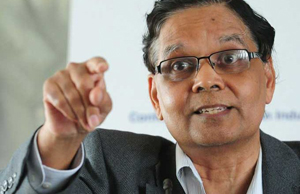
Loss-making Air India, surviving on taxpayers' money, is facing tough business conditions amid stiff competition.

Stressing that the government has to first decide whether the national airline should be privatised or not, Panagariya said various issues need to be discussed.

"Assuming that the decision is made to privatise (Air India), then the issue comes what is the universe of potential buyers... only the national buyers or will we allow foreign entities also to bid for it," he said at a press meet here.

Panagariya noted that another issue is if the government should retain some stake in it, however small, "because there is the issue that it (Air India) is a national carrier and therefore, we should maintain that".

About the airline's debt burden, the NITI Aayog Vice Chairman said the last number he heard was Rs 52,000 crore.

"That's a very large number... selling it (Air India) with the existing debt is going to be very very difficult even say, it is open to both domestic and foreign buyers".

"Something will need to be done on debt issue also. The question largely is whether the government of India writes off the entire debt or some part of it. All this needs to be discussed," he said.

NITI Aayog has given its recommendations on making Air India strong and viable and those are being looked into by the Civil Aviation Ministry.

"NITI Aayog has given its suggestion to the Civil Aviation Ministry... Civil Aviation Ministry has to explore all the possibilities as to how the privatisation of Air India can be done," Finance Minister Arun Jaitley said on Thursday.

On Thursday, Jaitley and his Civil Aviation counterpart, Ashok Gajapathi Raju, discussed the future course for debt- ridden Air India and senior officials had indicated that a decision on privatisation would be taken within three months.

Air India has been in the red since the merger with Indian Airlines in 2007. However, it posted an operational profit of Rs 105 crore on account of low fuel prices and increased passenger numbers in 2015-16.

Staying afloat on little over Rs 30,000 crore bailout package extended by the previous UPA regime, Air India is in discussions with lenders on ways to restructure the loans.

Comments

Add new comment

  • Coastaldigest.com reserves the right to delete or block any comments.
  • Coastaldigset.com is not responsible for its readers’ comments.
  • Comments that are abusive, incendiary or irrelevant are strictly prohibited.
  • Please use a genuine email ID and provide your name to avoid reject.
Agencies
April 23,2020

New Delhi, Apr 23: The nationwide lockdown in India which started about a month ago has impacted nearly 40 million internal migrants, the World Bank has said.

The lockdown in India has impacted the livelihoods of a large proportion of the country's nearly 40 million internal migrants. Around 50,000 60,000 moved from urban centers to rural areas of origin in the span of a few days, the bank said in a report released on Wednesday.

According to the report -- 'COVID-19 Crisis Through a Migration Lens' -- the magnitude of internal migration is about two-and-a-half times that of international migration.

Lockdowns, loss of employment, and social distancing prompted a chaotic and painful process of mass return for internal migrants in India and many countries in Latin America, it said.

Thus, the COVID-19 containment measures might have contributed to spreading the epidemic, the report said.

Governments need to address the challenges facing internal migrants by including them in health services and cash transfer and other social programmes, and protecting them from discrimination, it said.

World Bank said that coronavirus crisis has affected both international and internal migration in the South Asia region.

As the early phases of the crisis unfolded, many international migrants, especially from the Gulf countries, returned to countries such as India, Pakistan, and Bangladesh until travel restrictions halted these flows.

Some migrants had to be evacuated by governments, such as those of China and Iran, it said.

Before the coronavirus crisis, migrant outflows from the region were robust, the report said.

The number of recorded, primarily low-skilled emigrants from India and Pakistan rose in 2019 relative to the prior year but is expected to decline in 2020 due to the pandemic and oil price declines impacting the Gulf countries.

In India, the number of low-skilled emigrants seeking mandatory clearance for emigration rose slightly by eight percent to 368,048 in 2019.

In Pakistan, the number of emigrants jumped 63 per cent to 6,25,203 in 2019, largely due to a doubling of emigration to Saudi Arabia, it said.

According to the bank, migration flows are likely to fall, but the stock of international migrants may not decrease immediately, since migrants cannot return to their countries due to travel bans and disruption to transportation services.

In 2019, there were around 272 million international migrants.

The rate of voluntary return migration is likely to fall, except in the case of a few cross-border migration corridors in the South (such as Venezuela-Colombia, Nepal-India, Zimbabwe South Africa, Myanmar-Thailand), it said.

Migrant workers tend to be vulnerable to the loss of employment and wages during an economic crisis in their host country, more so than native-born workers.

Lockdowns in labour camps and dormitories can also increase the risk of contagion among migrant workers.

Many migrants have been stranded due to the suspension of transport services. Some host countries have granted visa extensions and temporary amnesty to migrant workers, and some have suspended the involuntary return of migrants, it said.

Observing that government policy responses to the COVID-19 crisis have largely excluded migrants and their families back home, the World Bank said there is a strong case for including migrants in the near-term health strategies of all countries, given the externalities associated with the health status of an entire population in the face of a highly contagious pandemic.

The Bank said governments would do well to consider short, medium and long-term interventions to support stranded migrants, remittance infrastructure, loss of subsistence income for families back home, and access to health, housing, education, and jobs for migrant workers in host/transit countries and their families back home.

The pandemic has also highlighted the global shortage of health professionals and an urgent need for global cooperation and long-term investments in medical training, it said.

Comments

Add new comment

  • Coastaldigest.com reserves the right to delete or block any comments.
  • Coastaldigset.com is not responsible for its readers’ comments.
  • Comments that are abusive, incendiary or irrelevant are strictly prohibited.
  • Please use a genuine email ID and provide your name to avoid reject.
Agencies
May 5,2020

Jammu and Kashmir, May 5: Awarding the prestigious Pulitzer Prize to three Indian photographers, the Pulitzer Board at Columbia University claimed that it was for their work in Kashmir as "India revoked its independence".

The award to Channi Anand, Mukhtar Khan and Dar Yasin in the feature photography category for their pictures for the Associated Press was announced on Monday.

The prizes, considered the most prestigious for US journalism, are associated with the university's Graduate School of Journalism where the judging is done and is announced, although this year it was done remotely.

Besides a certificate, the prizes carry a cash award of $15,000, except the public service category for which a gold medal is awarded.

The public service prize went to The Anchorage Daily News for a series that dealt with policing in Alaska state.

In making the award to the three, the Board said on its website that it was "for striking images of life in the contested territory of Kashmir as India revoked its independence, executed through a communications blackout".

Besides making the false claim about "independence" of Kashmir being "revoked", the board that includes several leading journalists did not explain how their photographs could have reached the AP within hours of the incidents recorded "through a communication blackout".

India's Central government only revoked Article 370 of the Constitution that gave Jammu and Kashmir a special status and it was not independent.

Indian journalists were allowed to operate in Kashmir, while only non-Indian journalists were barred.

The wording of the award announcement calls into question the credibility of the Pulitzer Board that gives out what are considered prestigious journalism awards.

The portfolio of pictures by the three on the Pulitzer web site included one of a masked person attacking a police vehicle and another of masked people with variants of the Kashmir flag, besides photos of mourners and protesters.

One of the finalists for the Pulitzer Prize for explanatory journalism was a reporter of Indian descent at The Los Angeles Times, Swetha Kannan, who was nominated for her work with two colleagues on the seas rising due to climate change.

Comments

Add new comment

  • Coastaldigest.com reserves the right to delete or block any comments.
  • Coastaldigset.com is not responsible for its readers’ comments.
  • Comments that are abusive, incendiary or irrelevant are strictly prohibited.
  • Please use a genuine email ID and provide your name to avoid reject.
News Network
July 9,2020

New Delhi, Jul 9: India reported the highest single-day spike of 24,879 new positive cases and 487 deaths in the last 24 hours, taking the total number of COVID-19 cases in the country to 7,67,296, according to the Union Ministry of Health and Family Welfare.

Out of the total number of cases, 2,69,789 are active, 4,76,378 have been cured/discharged/migrated and 21,129 have died.

Maharashtra remains the worst-affected state due to COVID-19 with as many as 2,23,724 cases, including 91,084 active, 1,23,192 cured/discharged and 9,448 deaths.

It is followed by Tamil Nadu (1,22,350) and Delhi (1,04,864).

Meanwhile, a total of 1,07,40,832 samples have been tested for COVID-19 till July 8. Of these, 2,67,061 samples were tested yesterday, stated Indian Council of Medical Research (ICMR).

Comments

Add new comment

  • Coastaldigest.com reserves the right to delete or block any comments.
  • Coastaldigset.com is not responsible for its readers’ comments.
  • Comments that are abusive, incendiary or irrelevant are strictly prohibited.
  • Please use a genuine email ID and provide your name to avoid reject.