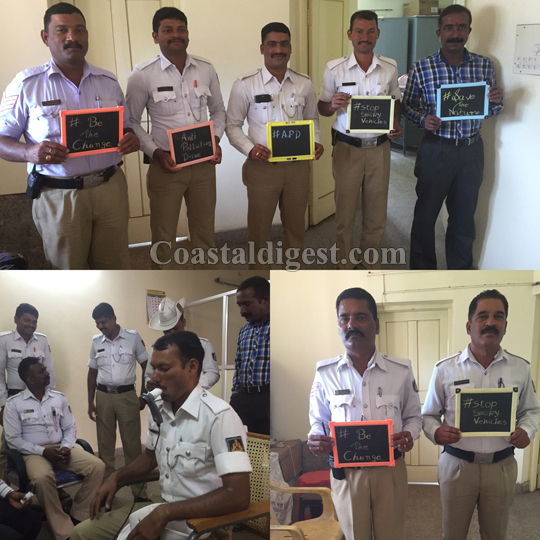
Air pollution spoiling health of traffic cops in Mangaluru, confirms test

[email protected] (CD Network)
May 9, 2016

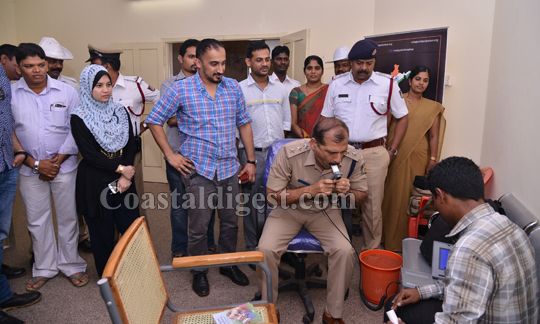
Mangaluru, May 9: The pulmonary function test (PFT) conducted on the traffic police by the Anti-Pollution Drive (APD) Foundation has showed a significant correlation in lung functions and exposure to vehicular pollutants.
pft 2

According to the results of the test and the subsequent study, reduction in air pollution can reduce the number of traffic police falling prey to restrictive lung disease. Reduction in exposure by use of protective gears like pollution mask and reduction in the duration of exposure in a day would also help in improving their lung function. Monitoring vehicles, which are on roads for over 10 years for pollution, would also help in minimising the level of pollution, the foundation said in a press release.

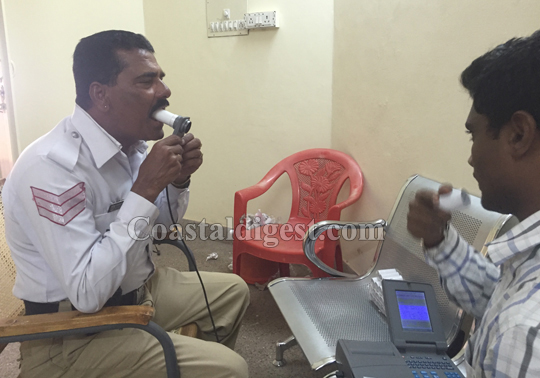
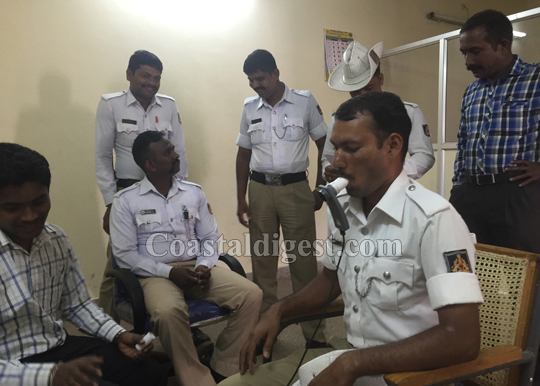
The PFT by computerised spirometer, measuring FVC, FEV1, FEV1/FVC, PEFR, and FEF25-75 per cent, was measured by pulmonologists from the Department of Respiratory Medicine at Yenepoya Medical College.

The test showed that significant number of traffic personnel have affected lungs. The results indicated that 22.3 per cent of the policemen having five and less than five years of service are showing signs of restrictive lungs. About 26.3 per cent policemen, having more than five years' experience, are showing restrictive lung capacity.

The Foundation which has germinated from this city has observed that Mangaluru is one of the rapidly growing cities in the country and the growth is associated with an enormous increase in vehicular traffic emitting exhausts and polluting the atmosphere. Airborne dust plays a major part in the overall atmospheric pollution and motor vehicle emissions are the most significant sources of pollution in an urban environment. Road traffic produces volatile organic compounds, suspended particulate matter, oxides of sulphur, oxides of nitrogen, and carbon monoxide which makes adverse health effects on the exposed population, it said.

It said the traffic-related air pollution is a day-to-day health hazard to individuals who commute to offices, school and colleges. Several students use the public transportation or the transportation provided by the educational institutes and they are exposed to hazardous toxins in the air. Schoolchildren, who are exposed to pollution at a tender age, develop health hazards is their respiratory system due to automobile exhaust. Every year, the percentage of asthmatic children is increasing in urban areas. Vehicular pollution is the sole pollution contributing elements in a large scale within city limits affecting residents, school students and officer goers.

APD?Foundation Founder Abdullah A Rehman said observing respiratory complaints among the retired traffic police would help in studying the long-term effects of the occupation. Through PFT results, APD further wants to study the health impacts of pollution in Mangaluru and related issues.

He added, “The foundation will be able to identify the impact on the most-affected group based on the PFT results. We will then identify the location and area that they are working and start monitoring the pollution levels in these areas. We will also use this information to work towards categorical mitigation.”

ACP (Traffic) Uday Nayak said the tests conducted by the foundation have helped the police a lot. “It is good to know the health condition of the police, especially the traffic police personnel,” he said and added that the hospitals have offered to provide free treatment to the affected police personnel.
pft 3

pft 4

pft 1

Comments

Swetha
 - 
Monday, 9 May 2016

really sad to see traffic police in this heavy heat climate.

Priyanka
 - 
Monday, 9 May 2016

my father is working in police department, i m very much worried about his health.

Saleem
 - 
Monday, 9 May 2016

really effecting health of traffic police, must wear musk all the time while on duty.

Manikanta
 - 
Monday, 9 May 2016

yahh rain, air pollution, heat make them sick.

Add new comment

  • Coastaldigest.com reserves the right to delete or block any comments.
  • Coastaldigset.com is not responsible for its readers’ comments.
  • Comments that are abusive, incendiary or irrelevant are strictly prohibited.
  • Please use a genuine email ID and provide your name to avoid reject.
News Network
April 5,2020

Bengaluru, Apr 5: The COVID-19 related lockdown has substantially improved the air quality of Bengaluru, taking it from satisfactory level to good, a senior state pollution control board offcial said here on Sunday.

"During the course of the lockdown 19 problem, we reached good position from satisfactory.

It is between zero to 50 AQI (Air Quality Index) now. We have good quality air," the Karnataka State Pollution Control Board member secretary Basavaraj Patil told PTI.

He said the indicator for knowing the air quality in

"If the AQI is zero to 50 then it is good. If it is 50 to 100 then it is satisfactory. 101 to 150 is moderate and if it is 151 to 200, then it is poor, he explained.

Patil said as per available recrods, there has been a 60 to 65 per cent reduction in pollution during the lockdown.

The city railway station and Peenya industrial area, which used to be among the areas with highest AQI, has seen pollution levels come down significantly, he said.

Another major contributor of pollution was construction activities, which too had ground to a halt due to the lockdown, resulting in zero dust emission.

Patil opined that the improved air quality would boost the immune system of the people.

"It will improve the immune system of people, including those who have breathing problems like asthma," he said.

He asked the public to learn lessons from the lockdown and later switch to sustainable means of transport such as public transport, walking and cycling,.

"We can still reduce the pollution load even after the lockdown is over," Patil said.

Comments

Add new comment

  • Coastaldigest.com reserves the right to delete or block any comments.
  • Coastaldigset.com is not responsible for its readers’ comments.
  • Comments that are abusive, incendiary or irrelevant are strictly prohibited.
  • Please use a genuine email ID and provide your name to avoid reject.
News Network
June 7,2020

Bengaluru, Jun 7: An eminent scientist on Sunday suggested a shift system in schools to prevent spread of the coronavirus and continuing with online classes with focus on project-based learning in a big way to promote creativity.

Former Director General of the Defence Research and Development Organisation (DRDO) V K Saraswat supported the idea of online teaching in the absence of regular classes in view of closure of schools due to the COVID-19 pandemic.

But, he said it should be organised in far better and more interactive ways so that delivery of knowledge can be better. The NITI Aayog member stressed the need for schools to have a strategy when they reopen keeping in mind the safety of students.

May be they will have to organise shifts so that within the same space they can handle the students; May be they will have to employ more teachers, and they can run two shifts. "May be half the strength in a class can come in the morning and others in the afternoon.

Or students of first to sixth standard can come in the morning and seventh to tenth can come in the afternoon, Saraswat told PTI. Reopening strategy will have to be worked out by the education department, added the former Chief Scientific Advisor to the Defence Minister.

Along with normal classes, online education should be continued as a regular system in future, and promoted in a big way because that is the way technology is going to help delivery of knowledge, he added. Saraswat also raised the pitch for reforms in the education sector, saying India is facing the problem of rote learning.

Rote learning has to give way for more project-based teaching, he underlined. Children should be made to work on projects at home and that can be done online. That will also support the changeover from rote learning to creative learning.

I personally believe the education delivery system -- primary, secondary and college levels -- has to be completely changed because creativity in India is less and creativity would come only if we replace rote learning with project-based learning, Saraswat said.

On some academics holding the view that the marks-based model is killing the education system in India as it does not promote creativity, he said evaluation of any outcome is important. Even when we perform in our normal way, evaluation cannot be replaced.

Otherwise, you cant find out how much you have succeeded in delivery. Certainly evaluation cannot be dispensed with. He did not agree with some experts, who favoured a single, uniform system for school education in India by dispensing with CBSE, ICSE and state boards. I am not for normalising everything in life.

I personally believe variety should be there. This concept of one kind of a system is okay for a Communist society, society which was trying to drive everybody like a herd, he said.

Creativity comes with variety, and there is nothing wrong in having different kinds of education system, but one thing which is important is we have to integrate vocational training as part of the education curriculum," Saraswat said. Vocational part cannot be kept away from the education system, he added.

Comments

Add new comment

  • Coastaldigest.com reserves the right to delete or block any comments.
  • Coastaldigset.com is not responsible for its readers’ comments.
  • Comments that are abusive, incendiary or irrelevant are strictly prohibited.
  • Please use a genuine email ID and provide your name to avoid reject.
News Network
March 25,2020

Chithradurga, Mar 25: COVID-19-positive cases in Karnataka jumped to 42 from 33 on Tuesday, with nine cases added to the list overnight. The daughter of G M Siddeshwara, Davanagere MP, is the latest case.

Sources from the Siddeshwara family said that the MP’s daughter, along with her two children, who started from Guyana, first landed at New York airport and from there, she took a flight to New Delhi.

From Delhi, she flew to Bengaluru. And then, she and her children travelled with her father in a chaffeur-driven car on March 21 to their house in Bheemasamudra.


Siddeshwara said that protocol for COVID-19 had been followed and all who returned were under self-quarantine at his house. However, the administration was not informed of her travel history till the samples were given for test, Chitradurga Deputy Commissioner Vinoth Priya R told TNIE. The DC said the test results of the MP’s daughter were collected by district health authorities and sent to Shivamogga Institute of Medical Sciences on March 22.

The test turned out to be positive for COVID-19 and she was shifted to the isolation ward at Chigateri district hospital in Davanagere. This is the first positive case in Chitradurga.The patient, who is the wife of an Indian Diplomat in Guyana, complained of flu-like symptoms and remained self-quarantined at her house at Bheemasamudra. Her condition was informed to the health department, which collected her samples and forwarded it to the SIMS for tests, results of which arrived on Tuesday evening.

The DC said that samples of family members including the two children, and those working at the MP’s house would be collected and sent for testing to ensure proper protocol is followed. The administration has declared a ‘red zone of a 5km radius around Siddeshwara’s house at Bheemasamudra. DHO Dr Palaksha said that the patient is not suffering any serious problems and is normal. However, we have put her in the isolation ward of Chigateri District Hospital in Davangere, he said.

Comments

Add new comment

  • Coastaldigest.com reserves the right to delete or block any comments.
  • Coastaldigset.com is not responsible for its readers’ comments.
  • Comments that are abusive, incendiary or irrelevant are strictly prohibited.
  • Please use a genuine email ID and provide your name to avoid reject.