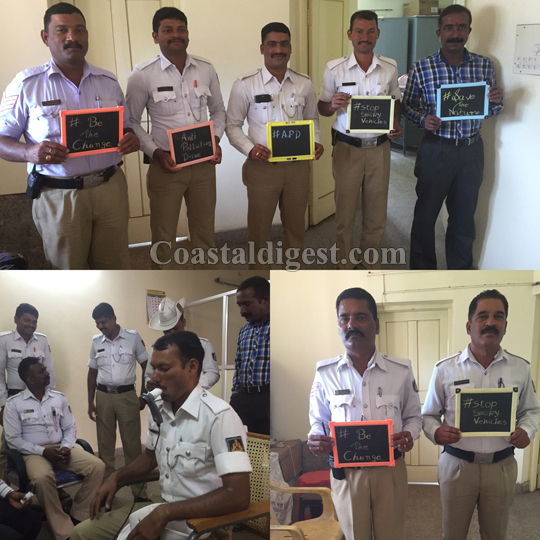
Air pollution spoiling health of traffic cops in Mangaluru, confirms test

[email protected] (CD Network)
May 9, 2016

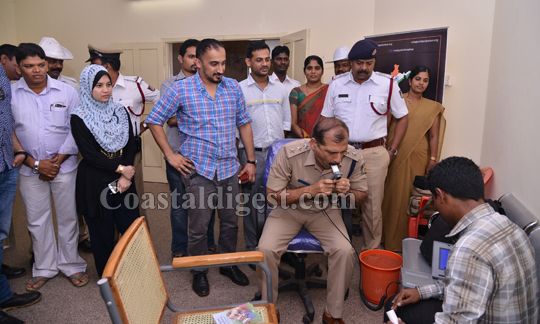
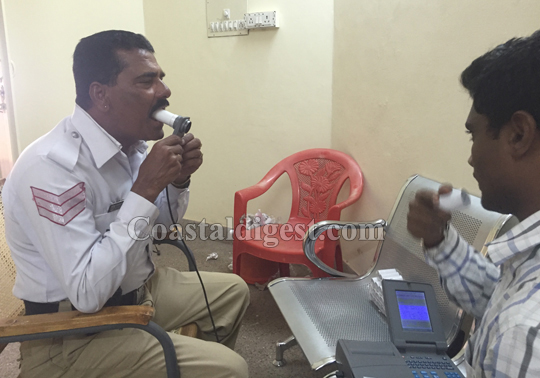
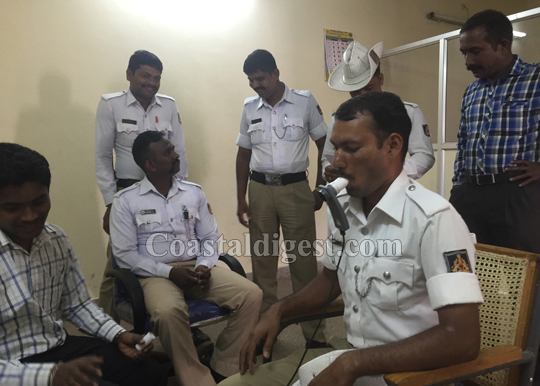
Mangaluru, May 9: The pulmonary function test (PFT) conducted on the traffic police by the Anti-Pollution Drive (APD) Foundation has showed a significant correlation in lung functions and exposure to vehicular pollutants.
pft 2

According to the results of the test and the subsequent study, reduction in air pollution can reduce the number of traffic police falling prey to restrictive lung disease. Reduction in exposure by use of protective gears like pollution mask and reduction in the duration of exposure in a day would also help in improving their lung function. Monitoring vehicles, which are on roads for over 10 years for pollution, would also help in minimising the level of pollution, the foundation said in a press release.

The PFT by computerised spirometer, measuring FVC, FEV1, FEV1/FVC, PEFR, and FEF25-75 per cent, was measured by pulmonologists from the Department of Respiratory Medicine at Yenepoya Medical College.

The test showed that significant number of traffic personnel have affected lungs. The results indicated that 22.3 per cent of the policemen having five and less than five years of service are showing signs of restrictive lungs. About 26.3 per cent policemen, having more than five years' experience, are showing restrictive lung capacity.

The Foundation which has germinated from this city has observed that Mangaluru is one of the rapidly growing cities in the country and the growth is associated with an enormous increase in vehicular traffic emitting exhausts and polluting the atmosphere. Airborne dust plays a major part in the overall atmospheric pollution and motor vehicle emissions are the most significant sources of pollution in an urban environment. Road traffic produces volatile organic compounds, suspended particulate matter, oxides of sulphur, oxides of nitrogen, and carbon monoxide which makes adverse health effects on the exposed population, it said.

It said the traffic-related air pollution is a day-to-day health hazard to individuals who commute to offices, school and colleges. Several students use the public transportation or the transportation provided by the educational institutes and they are exposed to hazardous toxins in the air. Schoolchildren, who are exposed to pollution at a tender age, develop health hazards is their respiratory system due to automobile exhaust. Every year, the percentage of asthmatic children is increasing in urban areas. Vehicular pollution is the sole pollution contributing elements in a large scale within city limits affecting residents, school students and officer goers.

APD?Foundation Founder Abdullah A Rehman said observing respiratory complaints among the retired traffic police would help in studying the long-term effects of the occupation. Through PFT results, APD further wants to study the health impacts of pollution in Mangaluru and related issues.

He added, “The foundation will be able to identify the impact on the most-affected group based on the PFT results. We will then identify the location and area that they are working and start monitoring the pollution levels in these areas. We will also use this information to work towards categorical mitigation.”

ACP (Traffic) Uday Nayak said the tests conducted by the foundation have helped the police a lot. “It is good to know the health condition of the police, especially the traffic police personnel,” he said and added that the hospitals have offered to provide free treatment to the affected police personnel.
pft 3

pft 4

pft 1

Comments

Swetha
 - 
Monday, 9 May 2016

really sad to see traffic police in this heavy heat climate.

Priyanka
 - 
Monday, 9 May 2016

my father is working in police department, i m very much worried about his health.

Saleem
 - 
Monday, 9 May 2016

really effecting health of traffic police, must wear musk all the time while on duty.

Manikanta
 - 
Monday, 9 May 2016

yahh rain, air pollution, heat make them sick.

Add new comment

  • Coastaldigest.com reserves the right to delete or block any comments.
  • Coastaldigset.com is not responsible for its readers’ comments.
  • Comments that are abusive, incendiary or irrelevant are strictly prohibited.
  • Please use a genuine email ID and provide your name to avoid reject.
News Network
June 26,2020

Bengaluru, Jun 26: The National Restaurant Association of India (NRAI) on Thursday came up with a Standard Operating Procedure (SOP) for restaurants whereby among other physical distancing norms, it has suggested a 2-metre gap between tables.

Formulated in partnership with Releski, a Bengaluru based skill-tech company, the SoP suggests that in case of back-to-back seating, people sitting with their backs towards each other will have their seats divided by 'Plexiglass' divider raised up to 2 meters from the ground.

"In a typical restaurant, the improvised seating plan should have a minimum distance of 2 metres between tables. The distance of 2 metres (6 feet) between tables should measure from one edge of the table to the other table's edge," it said.

In case of loose or free seating such as in banquet style or food court style seating, a minimum 2 meters of distance should be maintained between tables.

The guidelines noted that, to encourage physical distancing, restaurants have to sacrifice their seating capacity, to promote health and safety, and also to gain trust from their patrons.

"In order to perform this, divide your restaurants under different sectors. Pull out your restaurant's floor plan and colour code different sections red and yellow. Red sections are potential areas where maximum footfall or traffic is observed. Yellow sections are areas where the footfalls are average," it said.

All the red sections are encircled or bordered by placing barricades or Q manager and will open at specific points to access the yellow section and all the opening points will have hand sanitisers and sprays, and every guest who walks from red zones to yellow zones will sanitise himself/herself to reduce the chances of contamination.

For air conditioning, the guidelines of CPWD shall be followed which inter alia emphasises that the temperature setting of all air conditioning devices should be in the range of 24-30 degree Celsius, relative humidity should be in the range of 40- 65 per cent, intake of fresh air should be as much as possible and cross ventilation should be adequate, the guidelines suggested.

The industry body has also suggested appointment of a COVID-free Ambassador who would operate as the Chief Health Officer within the restaurant team, preferably from the management team in each shift.

The ambassador's would put the new daily work routines into practice, to monitor compliance with good practice and to lead the preventative measures, adapt to health & safety recommendations and requirements of the restaurant and oversee the implementation of the norms.

Anurag Katriar, President of NRAI and CEO & Executive Director of deGustibus Hospitality, said: "Every restaurant cutting across formats is facing the harsh reality of subdued to shut business volumes in the present and the uncertainty of business environment in the future. One thing is certain that hygiene and safety will be a key differentiator in the post-pandemic restaurant operations."

Comments

Add new comment

  • Coastaldigest.com reserves the right to delete or block any comments.
  • Coastaldigset.com is not responsible for its readers’ comments.
  • Comments that are abusive, incendiary or irrelevant are strictly prohibited.
  • Please use a genuine email ID and provide your name to avoid reject.
News Network
April 5,2020

Bengaluru, Apr 5: Opening of Karnataka's borders to Kerala at this point in time will be like "embracing death," chief minister B S Yediyurappa said on Saturday making clear his government's stand not opening the state border.

The chief minister repeatedly said that for his government interest of the people of the state was supreme.

Yediyurappa made his stand clear in a letter to former prime minister and JD(S) patriarch H D Deve Gowda.

Gowda had recently written to the chief minister on March 31 seeking relaxation of the border restrictions on "humanitarian" grounds.

He had also written to Kerala chief minister Pinarayi Vijayan expressing his anguish against Karnataka authorities for imposing restriction and promising to raise the matter with prime minister Narendra Modi.

Stating the decision to close the border was not sudden, Yediyurappa said, it was a conscious decision after analysing the health situation in the area following the spread of COVID-19.

The chief minister cited the Indian Medical Association, Mangaluru branch data regarding the spread of Covid-19 in Kasargod of Kerala and surrounding areas which was alarming.

Noting that the region has nearly 106 positive coronaviruscases, he said, "this is the region with most number of infections in the country."

If this restriction is removed, it puts the health of the people of Karnataka in to risk and create a situation of "embracing death", so we will not be able to open the border, Yediyurappa said.

He also clarified that there was no prejudice behind his government's decision, and the interest of the people of the state was of utmost importance.

"...There is also no political maliciousness. We want to have good and brotherly relationship with neighbouring states," he said, adding that opening the border will open a pandora's box that will be disastrous for the state.

Yediyurappa also thanked opposition parties for their support to his government in its fight against COVID-19.

Comments

Add new comment

  • Coastaldigest.com reserves the right to delete or block any comments.
  • Coastaldigset.com is not responsible for its readers’ comments.
  • Comments that are abusive, incendiary or irrelevant are strictly prohibited.
  • Please use a genuine email ID and provide your name to avoid reject.
News Network
January 23,2020

Bengaluru, Jan 23: Karnataka government on Thursday notified the much-hyped anti-superstition law that aims to prevent and eradicate "inhuman evil practices".

According to Social Welfare principal Secretary G Kumar Naik, the state social welfare department has issued a gazette notification and The Karnataka Prevention and Eradication of Inhuman Evil Practices and Black Magic Act, 2017, that intends to protect the common people against "evil" and "sinister" practices, shall come into force with effect from January 4 2020, the government notification issued earlier this month read.

The act seeks to combat and eradicate such inhuman practices propagated and performed in the name of "black magic" by conmen with the sinister motive of exploiting the common people, thereby destroying the social fabric of the society.

Comments

Add new comment

  • Coastaldigest.com reserves the right to delete or block any comments.
  • Coastaldigset.com is not responsible for its readers’ comments.
  • Comments that are abusive, incendiary or irrelevant are strictly prohibited.
  • Please use a genuine email ID and provide your name to avoid reject.