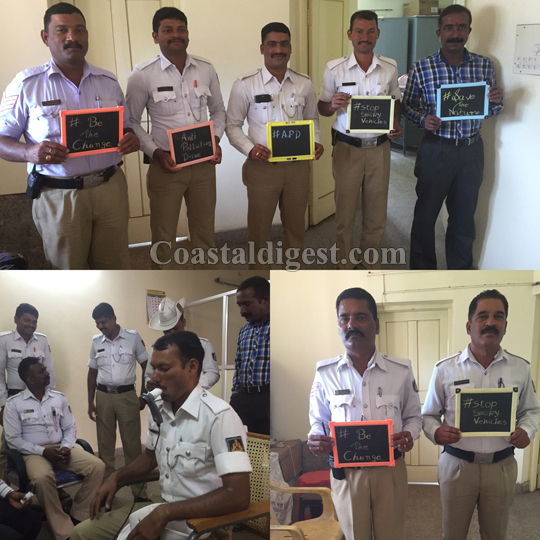
Air pollution spoiling health of traffic cops in Mangaluru, confirms test

[email protected] (CD Network)
May 9, 2016

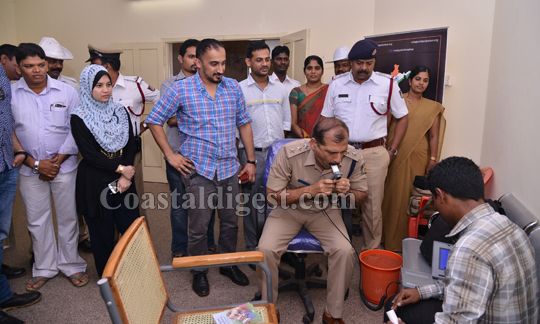
Mangaluru, May 9: The pulmonary function test (PFT) conducted on the traffic police by the Anti-Pollution Drive (APD) Foundation has showed a significant correlation in lung functions and exposure to vehicular pollutants.
pft 2

According to the results of the test and the subsequent study, reduction in air pollution can reduce the number of traffic police falling prey to restrictive lung disease. Reduction in exposure by use of protective gears like pollution mask and reduction in the duration of exposure in a day would also help in improving their lung function. Monitoring vehicles, which are on roads for over 10 years for pollution, would also help in minimising the level of pollution, the foundation said in a press release.

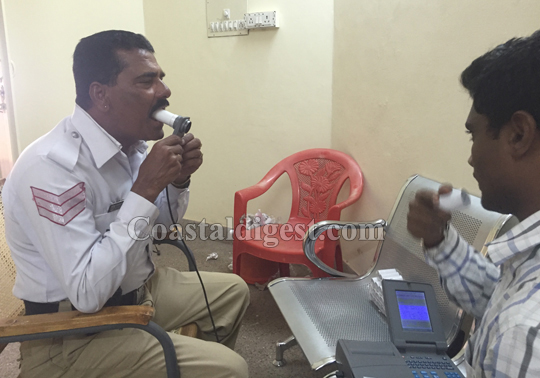
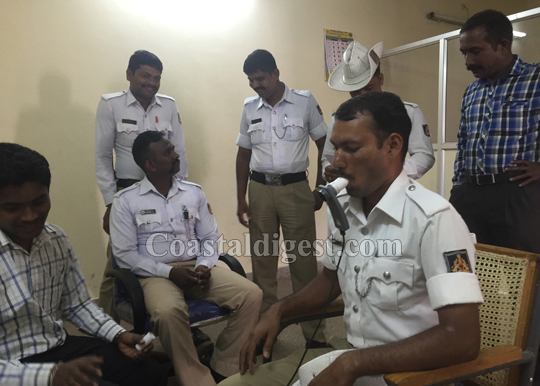
The PFT by computerised spirometer, measuring FVC, FEV1, FEV1/FVC, PEFR, and FEF25-75 per cent, was measured by pulmonologists from the Department of Respiratory Medicine at Yenepoya Medical College.

The test showed that significant number of traffic personnel have affected lungs. The results indicated that 22.3 per cent of the policemen having five and less than five years of service are showing signs of restrictive lungs. About 26.3 per cent policemen, having more than five years' experience, are showing restrictive lung capacity.

The Foundation which has germinated from this city has observed that Mangaluru is one of the rapidly growing cities in the country and the growth is associated with an enormous increase in vehicular traffic emitting exhausts and polluting the atmosphere. Airborne dust plays a major part in the overall atmospheric pollution and motor vehicle emissions are the most significant sources of pollution in an urban environment. Road traffic produces volatile organic compounds, suspended particulate matter, oxides of sulphur, oxides of nitrogen, and carbon monoxide which makes adverse health effects on the exposed population, it said.

It said the traffic-related air pollution is a day-to-day health hazard to individuals who commute to offices, school and colleges. Several students use the public transportation or the transportation provided by the educational institutes and they are exposed to hazardous toxins in the air. Schoolchildren, who are exposed to pollution at a tender age, develop health hazards is their respiratory system due to automobile exhaust. Every year, the percentage of asthmatic children is increasing in urban areas. Vehicular pollution is the sole pollution contributing elements in a large scale within city limits affecting residents, school students and officer goers.

APD?Foundation Founder Abdullah A Rehman said observing respiratory complaints among the retired traffic police would help in studying the long-term effects of the occupation. Through PFT results, APD further wants to study the health impacts of pollution in Mangaluru and related issues.

He added, “The foundation will be able to identify the impact on the most-affected group based on the PFT results. We will then identify the location and area that they are working and start monitoring the pollution levels in these areas. We will also use this information to work towards categorical mitigation.”

ACP (Traffic) Uday Nayak said the tests conducted by the foundation have helped the police a lot. “It is good to know the health condition of the police, especially the traffic police personnel,” he said and added that the hospitals have offered to provide free treatment to the affected police personnel.
pft 3

pft 4

pft 1

Comments

Swetha
 - 
Monday, 9 May 2016

really sad to see traffic police in this heavy heat climate.

Priyanka
 - 
Monday, 9 May 2016

my father is working in police department, i m very much worried about his health.

Saleem
 - 
Monday, 9 May 2016

really effecting health of traffic police, must wear musk all the time while on duty.

Manikanta
 - 
Monday, 9 May 2016

yahh rain, air pollution, heat make them sick.

Add new comment

  • Coastaldigest.com reserves the right to delete or block any comments.
  • Coastaldigset.com is not responsible for its readers’ comments.
  • Comments that are abusive, incendiary or irrelevant are strictly prohibited.
  • Please use a genuine email ID and provide your name to avoid reject.
coastaldigest.com web desk
July 4,2020

Bengaluru, Jul 4: In a heart-wrenching incident, a 65-year-old coronavirus patient at Hanumath Nagar in South Bengaluru died outside his house waiting for an ambulance on Friday evening. The body was kept on the road for more three hours.

The deceased tested positive for coronavirus on Friday and immediately called an ambulance to reach a hospital. However, according to his family members, as he waited for the ambulance for nearly three hours, he collapsed on the road in front of his house complaining of breathlessness and died.

As the body lay unattended on the road, it began to rain heavily. Soon, videos of the body lying on the road in the heavy rain went viral on social media. 

A senior doctor in charge of the division, however, claimed that the ambulance had arrived in less than half an hour but the patient had died before they reached the spot. 

"The patient had given samples on Thursday at KIMS and tested positive on Friday. BBMP officials informed them that they would reach his house. But the man, fearing that he may be stigmatised in the locality, began walking to the corner of the road and collapsed on the street and died," the officer said. 

Another health official from Basavanagudi limits said: "As the ambulance staff do not transport the dead, they informed the hearse van, which was set to arrive in 30 minutes. But due to the sudden rain and heavy traffic ahead of the curfew hours, they were stranded for almost three hours later." The officials also said the deceased had been suffering from cardiac ailments for almost 10 years. 

Regretting the incident, BBMP officials said they were helpless as was an acute shortage of hearse vans. "We were told that there were 20 deaths today and there are only eight hearse vans available. They had to shift this patient after attending to another mortality and were stuck in traffic. By then, due to the fear of infection, nobody attended to the deceased," the officer explained. 

BBMP commissioner B H Anil Kumar said that such incidents should not recur and ordered an investigation and sought a report. "We will ensure that such incidents do not recur," Kumar said.  

Following outrage on social media, a hearse van was summoned and the body was shifted to the Victoria Hospital mortuary as per the protocol. Police have opened a case of unnatural death.

Comments

Add new comment

  • Coastaldigest.com reserves the right to delete or block any comments.
  • Coastaldigset.com is not responsible for its readers’ comments.
  • Comments that are abusive, incendiary or irrelevant are strictly prohibited.
  • Please use a genuine email ID and provide your name to avoid reject.
News Network
February 12,2020

New Delhi, Feb 12: Buoyed by the Aam Aadmi Party's stellar performance in the Delhi Assembly elections, the Maharashtra unit of the party has decided to fight all forthcoming local elections, including the Mumbai elections.

The AAP’s Bengaluru unit will also contest the municipal corporation polls likely to take place in August or September.

AAP National Executive Member Preeti Sharma Menon said the party will try to “replicate the Delhi model of pragmatism, performance, and people centric policies”.

“We are sure that Maharashtra will shower us with the same faith and love as Delhi has done so,” she said.

The party has decided to field candidates in all the 198 wards of the Bruhat Bengaluru Mahanagara Palike (BBMP).

"We have been planning to contest the BBMP election when we received a major shot in the arm. The Delhi victory happened because of the good work, which we want to replicate here," AAP's co-convener in Karnataka and party's BBMP campaign in charge Shanthala Damle told PTI on Tuesday.

Born out of an anti-corruption movement, the AAP led by Delhi chief minister Arvind Kejriwal registered the second landslide victory by winning 63 out of 70 seats in the Delhi Assembly elections.

According to Damle, AAP in Bengaluru was working in full swing to make its presence felt in the city. "The party has already done its ground workin terms of election campaign and reaching out to the people in Bengaluru," she added.

According to her, the party has already opened around 10 offices and about 50 people have been announced as the assembly president or ward president.

Last month, the party launched a 40-minute movie called 'Hosa Bengaluru' (New Bengaluru) and conducted 50 shows already.

"It shows the Delhi model and explains what can be done in Bengaluru. So that is part of our vision," the AAP leader said.

In its next level of the campaign, AAP intends to conduct 'Jana Samvada' (Dialogue with people) in every street and in every ward.

The preparedness of the party can be gauged from the fact that it has identified many of its candidates for the BBMP elections.

The party has never tasted success in Karnataka anywhere but the Delhi's success story has kindled a new hope as many people would now be waiting to join the AAP, Damle said. The AAP cadres in Bengaluru burst into celebration soon after it became clear that the party was going to script history by forming government for the third consecutive time since its inception.

Sporting their signature caps, party workers lit crackers, danced on the Delhi election song 'Lage Raho Kejriwal'.

Comments

Add new comment

  • Coastaldigest.com reserves the right to delete or block any comments.
  • Coastaldigset.com is not responsible for its readers’ comments.
  • Comments that are abusive, incendiary or irrelevant are strictly prohibited.
  • Please use a genuine email ID and provide your name to avoid reject.
Media Release
February 14,2020

Veteran journalist P. Sainath has said that the nation is in a crisis. And this crisis is not limited to just the rural area. It has become a national crisis at various areas such as agriculture, education, economy, job creation etc.

He was delivering the endowment lecture on the topic ‘Indian democracy at the post-liberalization and post-truth era’ at Media Manthan 2020 organized by the PG department of journalism and mass communication at St Aloysius College (Autonomous). 

Mr Sainath said that the many policies adopted in the 90s led to India becoming unusually unequal. Referring to the speech Ambedkar had made at the Constituent Assembly while handing over the draft of the Constitution, Mr Sainath said, “Ambedkar had warned about the weakness of Indian democracy that liberty without equality allows the supremacy of a few over the multitude. Liberty, equality and fraternity must be kept together as we cannot have one without the other.” 

Mr Sainath stated that the agrarian crisis was no longer about the loss of productivity, employment or about farmer suicide; it was a societal, civilizational crisis. Commenting on the lopsided policies such as cow-slaughter ban, he explained how cow slaughter ban had adversely affected many industries due to their interdependency. While Muslims who slaughtered cows were rendered helpless, the cattle traders who were mostly OBCs lost their earnings as the cattle prices crashed. An important industry like Kolhapur sandals industry in Maharashtra went bankrupt as a result of the cow slaughter ban in Maharashtra. He said the policymakers had no idea how the rural industries were interconnected. Demonetisation too devastated the rural economy as 98 percent of rural transactions happen through cash. 

Mr Sainath also spoke about the crisis of inequality which affects the Dalits and the Adivasis far more than anyone else as 90 percent of the rural households take home less than Rs 10,000/- per month. “Women are yet another group whose labour is never counted in the gross domestic product. Women and girls globally do unpaid work which amounts to about 12.5 billion working hours per year. Monetarily speaking, this is worth 10.8 trillion dollars,” Mr Sainath added. 

Speaking about the crisis of jobs Mr Sainath said that major companies were laying off employees just to create more profits for the investors and the adoption of artificial intelligence in the industry would further destroy millions of jobs.

Rector of St Aloysius College Institutions Fr Dionysius Vaz SJ, Principal Dr (Fr) Praveen Martis SJ, HOD of Journalism and Mass Communication department Dr (Fr) Melwyn Pinto SJ were present.

‘Veerappan and Vijay Mallya’s business models are interesting!’

Addressing the gathering during his endowment lecture on Friday, Mr Sainath made an interesting comment on the so called ‘revenue model’. “Whenever I visit IIMs and IITs for lectures on my PARI project, the students there ask me what my revenue model for my project is. I tell them that I do not have a revenue model. In fact, journalism does not begin with a revenue model. Gandhiji, Ambedkar, Bhagat Singh were all great journalists. But they did not have a revenue model,” Mr Sainath said.

On a lighter note, he said that the best revenue model that he liked was that of forest brigand Veerappan and liquor baron Vijay Mallya. “Veerappan ruled the forest for forty years and from the top ministers to the villagers he could dictate terms and liver royally. Similarly, Mallya’s revenue model was to steal the banks and run away abroad and live like a king,” Mr Sainath added.

Journalism is not and can never be a business. It is a calling, he opined. While newspaper can be a business, television can be a business, journalism per se cannot be reduced to a business. “Unfortunately today, journalists are recruited on a contract basis and they have no bargaining power; and there are no unions to fight for their cause. Hence, they are at the mercy of the corporate media houses for their survival and are made to write stories that cannot be called journalism,” Mr Sainath said.

Answering a question as to the pressures he faced as a journalist, he said that external pressures from the government or others could be very well handled. It is the internal pressures from once own media house that journalists find it difficult to manage.


Comments

Add new comment

  • Coastaldigest.com reserves the right to delete or block any comments.
  • Coastaldigset.com is not responsible for its readers’ comments.
  • Comments that are abusive, incendiary or irrelevant are strictly prohibited.
  • Please use a genuine email ID and provide your name to avoid reject.