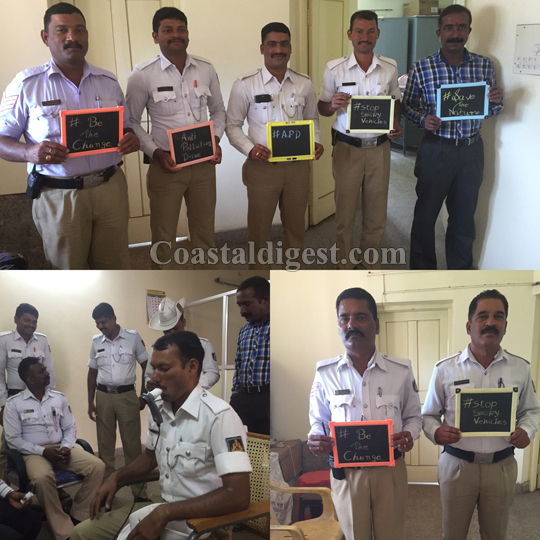
Air pollution spoiling health of traffic cops in Mangaluru, confirms test

[email protected] (CD Network)
May 9, 2016

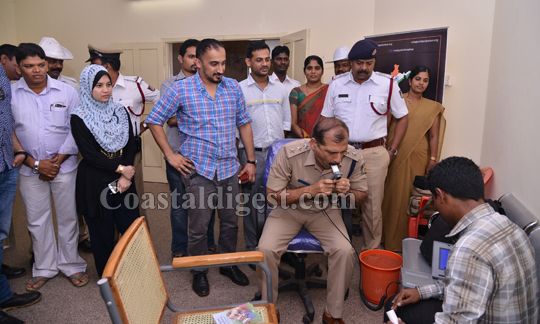
Mangaluru, May 9: The pulmonary function test (PFT) conducted on the traffic police by the Anti-Pollution Drive (APD) Foundation has showed a significant correlation in lung functions and exposure to vehicular pollutants.
pft 2

According to the results of the test and the subsequent study, reduction in air pollution can reduce the number of traffic police falling prey to restrictive lung disease. Reduction in exposure by use of protective gears like pollution mask and reduction in the duration of exposure in a day would also help in improving their lung function. Monitoring vehicles, which are on roads for over 10 years for pollution, would also help in minimising the level of pollution, the foundation said in a press release.

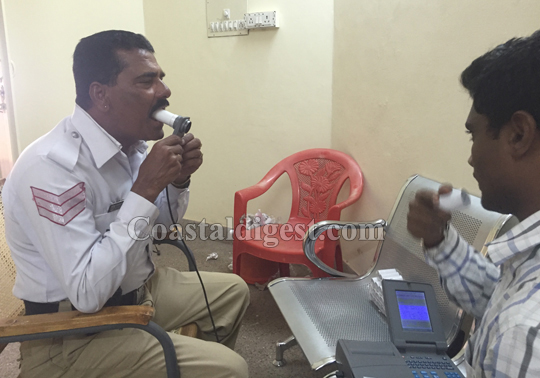
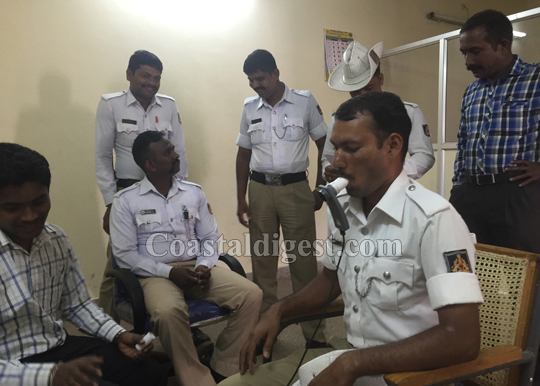
The PFT by computerised spirometer, measuring FVC, FEV1, FEV1/FVC, PEFR, and FEF25-75 per cent, was measured by pulmonologists from the Department of Respiratory Medicine at Yenepoya Medical College.

The test showed that significant number of traffic personnel have affected lungs. The results indicated that 22.3 per cent of the policemen having five and less than five years of service are showing signs of restrictive lungs. About 26.3 per cent policemen, having more than five years' experience, are showing restrictive lung capacity.

The Foundation which has germinated from this city has observed that Mangaluru is one of the rapidly growing cities in the country and the growth is associated with an enormous increase in vehicular traffic emitting exhausts and polluting the atmosphere. Airborne dust plays a major part in the overall atmospheric pollution and motor vehicle emissions are the most significant sources of pollution in an urban environment. Road traffic produces volatile organic compounds, suspended particulate matter, oxides of sulphur, oxides of nitrogen, and carbon monoxide which makes adverse health effects on the exposed population, it said.

It said the traffic-related air pollution is a day-to-day health hazard to individuals who commute to offices, school and colleges. Several students use the public transportation or the transportation provided by the educational institutes and they are exposed to hazardous toxins in the air. Schoolchildren, who are exposed to pollution at a tender age, develop health hazards is their respiratory system due to automobile exhaust. Every year, the percentage of asthmatic children is increasing in urban areas. Vehicular pollution is the sole pollution contributing elements in a large scale within city limits affecting residents, school students and officer goers.

APD?Foundation Founder Abdullah A Rehman said observing respiratory complaints among the retired traffic police would help in studying the long-term effects of the occupation. Through PFT results, APD further wants to study the health impacts of pollution in Mangaluru and related issues.

He added, “The foundation will be able to identify the impact on the most-affected group based on the PFT results. We will then identify the location and area that they are working and start monitoring the pollution levels in these areas. We will also use this information to work towards categorical mitigation.”

ACP (Traffic) Uday Nayak said the tests conducted by the foundation have helped the police a lot. “It is good to know the health condition of the police, especially the traffic police personnel,” he said and added that the hospitals have offered to provide free treatment to the affected police personnel.
pft 3

pft 4

pft 1

Comments

Swetha
 - 
Monday, 9 May 2016

really sad to see traffic police in this heavy heat climate.

Priyanka
 - 
Monday, 9 May 2016

my father is working in police department, i m very much worried about his health.

Saleem
 - 
Monday, 9 May 2016

really effecting health of traffic police, must wear musk all the time while on duty.

Manikanta
 - 
Monday, 9 May 2016

yahh rain, air pollution, heat make them sick.

Add new comment

  • Coastaldigest.com reserves the right to delete or block any comments.
  • Coastaldigset.com is not responsible for its readers’ comments.
  • Comments that are abusive, incendiary or irrelevant are strictly prohibited.
  • Please use a genuine email ID and provide your name to avoid reject.
News Network
June 20,2020

Bengaluru, Jun 20: The Karnataka Health Department has issued guidelines on the admission of COVID-19 patients in private hospitals after clinical assessment, mandating that the district surveillance officer (DSO) should be first informed to initiate further procedures, an official said on Friday.

"A health team sent by the DSO should visit the home or hospital where the patient is staying. The team should conduct a rapid assessment of his or her health condition," said Karnataka's Additional Chief Secretary Jawaid Akhtar.

In the rapid health condition assessment, the team should first check the patient's body temperature, followed by SpO2 (oxygen saturation) level and confirm if there are any comorbidities such as hypertension, diabetes, tuberculosis, HIV, cancer, stroke etc.

Depending on the health condition of patients, Akhtar said, two categories have been made.

"Those who have body temperature greater than 37.5 degrees Celsius, SpO2 level below 94 percent, elderly (above 60 years) and suffering from known comorbid conditions should be taken to a dedicated Covid hospital (DCH)," he said.

"All other patients, even if older but not suffering from co-morbidities, those below 60 and suffering from co-morbidities and asymptomatic cases should be taken to a dedicated Covid health centre (DCHC) or a private hospital as opted by the patient," he added.

Private hospitals have been asked to pitch in due to the rising number of cases in Karnataka. Currently, there are 2943 active cases in the state after 337 cases were reported on Friday.

"The patients are assessed clinically and evaluated at DCHCs or private hospitals with appropriate diagnostic tests. After evaluation, if the patients are asymptomatic, they are shifted to a COVID Care Centre (CCC) for further management," said Akhtar.

CCCs are expected to be equipped with ventilated rooms, pulse oximeters, handheld thermal scanners and blood pressure apparatus.

A nurse has to be present round the clock for every 50 patients and should visit each patient twice a day for assessment whereas the medical officer has to visit the CCC once a day. He should also be available on call in case of an emergency.

Staff serving food and others should wear personal protective equipment and an N-95 mask. Explaining the procedures at DCHCs, Akhtar said general examinations for medical conditions like body temperature, BP, pulse, oxygen saturation and urine output should be in place.

Investigations such as complete blood count, fasting blood sugar, random blood sugar, liver function tests, renal function tests, ECG and chest X-ray facilities should be available.

"DCHCs should ensure that above examinations are over in an orderly timeline of 24 hours and depending on the examination, the patient is continued to be lodged at the DCHC or sent to DCH or CCC," said the senior officer.

Likewise, the discharge policy should be done as per the protocols issued by the Health Department from time to time.

The Karnataka government is yet to fix an upper limit on the cost of treating COVID-19 patients in private hospitals. While reports indicated that this could be capped at Rs 5200 per day, health officials are yet to specify this is the case. Private hospitals in the state have asked the government to take a collaborative approach in deciding the fixed cap on treatment cost.

Comments

Add new comment

  • Coastaldigest.com reserves the right to delete or block any comments.
  • Coastaldigset.com is not responsible for its readers’ comments.
  • Comments that are abusive, incendiary or irrelevant are strictly prohibited.
  • Please use a genuine email ID and provide your name to avoid reject.
News Network
March 4,2020

New Delhi, Mar 4: The Supreme Court on Wednesday directed a trial court in Ramanagara district of Karnataka to ensure the presence of absconding self-styled godman Swami Nithyananda to face trial in a 2010 rape case.

A bench headed by Chief Justice SA Bobde also allowed a plea by K Lenin alias Nithya Dharmananda, former driver of Nithyananda and had filed a complaint against Nithyananda, for cancellation of non-bailable warrants issued against him.

The apex court ordered the cancellation of the non-bailable warrants issued against the complainant in the case on the condition he shows up before the trial court in Ramanagara district today itself.

He had challenged the Karnataka High Court's February order where non-bailable warrants were issued against Lenin for not appearing before the court for recording evidence.

"Having heard the counsel appearing for the petitioner and upon perusal of the record, we see no reason to interfere with the judgment and order passed by the High Court, which merely directs the petitioner to give evidence in support of his complaint," read the apex court order passed on Tuesday.

The Bench also directed that "the concerned trial court shall make every effort to ensure the presence of accused (Nithyananda) to face the proceedings."

The Karnataka High Court had last month cancelled the bail granted to Nithyananda, even as the state police claimed the absconding godman was on a 'spiritual tour'.

Nithyananda is facing charges of rape and indulging in unnatural sex. He was arrested on April 22, 2010, however, granted bail on June 11, the same year.

Comments

Add new comment

  • Coastaldigest.com reserves the right to delete or block any comments.
  • Coastaldigset.com is not responsible for its readers’ comments.
  • Comments that are abusive, incendiary or irrelevant are strictly prohibited.
  • Please use a genuine email ID and provide your name to avoid reject.
News Network
May 10,2020

Mangaluru, May 10: A special train carrying 1,140 migrant workers stranded here in the lockdown has left Mangaluru railway station for Jharkhand.

Dakshina Kannada MP Nalin Kumar Kateel and Vedavyas Kamath, MLA, were present at the railway station on Saturday night when the train left.

Kamath said the workers who had registered on the state governments Seva Sindhu portal were brought to the railway station in Karnataka State Road Transport Corporation buses.

A health check-up was carried out before they boarded the train.

The district administration also provided food packets and water to the migrants at the station.

Three more trains will leave from Mangaluru for Uttar Pradesh, Bihar, and Jharkhand soon, he said.

Meanwhile, in a statement, Dakshina Kannada Deputy Commissioner Sindhu P Rupesh said train services are being arranged for migrant workers who have registered their names on the Seva Sindhu portal.

The workers will be informed when trains are arranged to their destinations and they need not throng the railway station unnecessarily, she said.

Around 20,000 workers have so far registered themselves online, including 5,000 from Jharkhand, 3,000 from Uttar Pradesh and 4,000 from Bihar.

Hundreds of migrant workers had on Friday staged a protest at the central railway station here, demanding that they be sent back home.

The workers went back to their camps only after district authorities and police gave them assurance that trains will be arranged in three days.

Comments

Add new comment

  • Coastaldigest.com reserves the right to delete or block any comments.
  • Coastaldigset.com is not responsible for its readers’ comments.
  • Comments that are abusive, incendiary or irrelevant are strictly prohibited.
  • Please use a genuine email ID and provide your name to avoid reject.