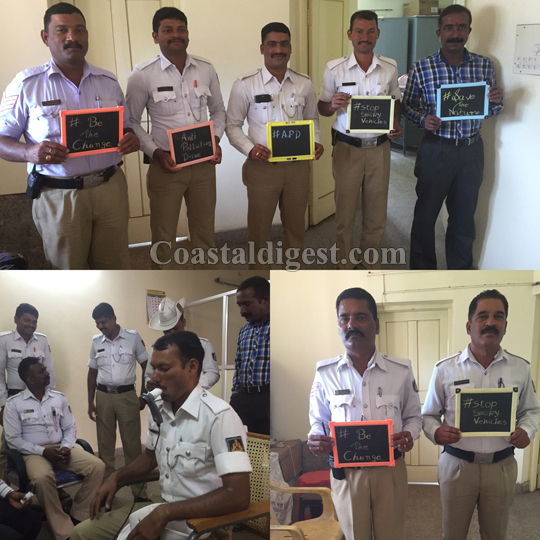
Air pollution spoiling health of traffic cops in Mangaluru, confirms test

[email protected] (CD Network)
May 9, 2016

Mangaluru, May 9: The pulmonary function test (PFT) conducted on the traffic police by the Anti-Pollution Drive (APD) Foundation has showed a significant correlation in lung functions and exposure to vehicular pollutants.
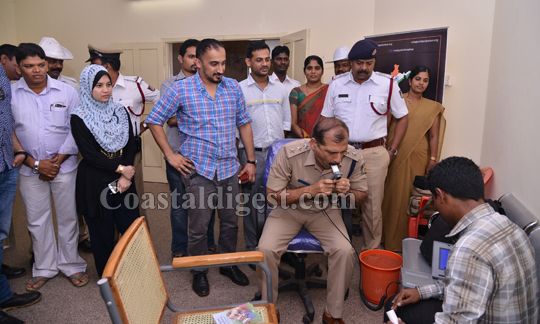
pft 2

According to the results of the test and the subsequent study, reduction in air pollution can reduce the number of traffic police falling prey to restrictive lung disease. Reduction in exposure by use of protective gears like pollution mask and reduction in the duration of exposure in a day would also help in improving their lung function. Monitoring vehicles, which are on roads for over 10 years for pollution, would also help in minimising the level of pollution, the foundation said in a press release.

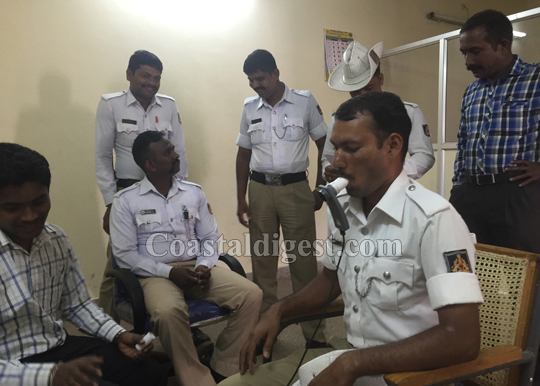
The PFT by computerised spirometer, measuring FVC, FEV1, FEV1/FVC, PEFR, and FEF25-75 per cent, was measured by pulmonologists from the Department of Respiratory Medicine at Yenepoya Medical College.

The test showed that significant number of traffic personnel have affected lungs. The results indicated that 22.3 per cent of the policemen having five and less than five years of service are showing signs of restrictive lungs. About 26.3 per cent policemen, having more than five years' experience, are showing restrictive lung capacity.

The Foundation which has germinated from this city has observed that Mangaluru is one of the rapidly growing cities in the country and the growth is associated with an enormous increase in vehicular traffic emitting exhausts and polluting the atmosphere. Airborne dust plays a major part in the overall atmospheric pollution and motor vehicle emissions are the most significant sources of pollution in an urban environment. Road traffic produces volatile organic compounds, suspended particulate matter, oxides of sulphur, oxides of nitrogen, and carbon monoxide which makes adverse health effects on the exposed population, it said.

It said the traffic-related air pollution is a day-to-day health hazard to individuals who commute to offices, school and colleges. Several students use the public transportation or the transportation provided by the educational institutes and they are exposed to hazardous toxins in the air. Schoolchildren, who are exposed to pollution at a tender age, develop health hazards is their respiratory system due to automobile exhaust. Every year, the percentage of asthmatic children is increasing in urban areas. Vehicular pollution is the sole pollution contributing elements in a large scale within city limits affecting residents, school students and officer goers.

APD?Foundation Founder Abdullah A Rehman said observing respiratory complaints among the retired traffic police would help in studying the long-term effects of the occupation. Through PFT results, APD further wants to study the health impacts of pollution in Mangaluru and related issues.

He added, “The foundation will be able to identify the impact on the most-affected group based on the PFT results. We will then identify the location and area that they are working and start monitoring the pollution levels in these areas. We will also use this information to work towards categorical mitigation.”

ACP (Traffic) Uday Nayak said the tests conducted by the foundation have helped the police a lot. “It is good to know the health condition of the police, especially the traffic police personnel,” he said and added that the hospitals have offered to provide free treatment to the affected police personnel.
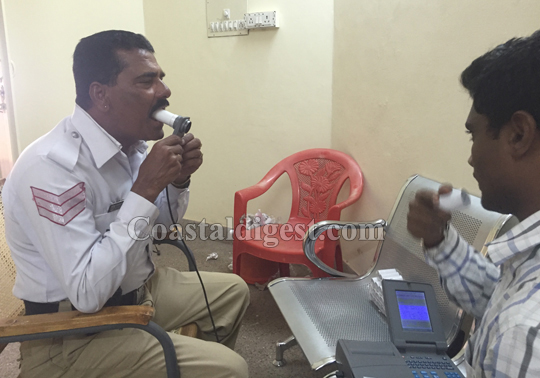
pft 3

pft 4

pft 1

Comments

Swetha
 - 
Monday, 9 May 2016

really sad to see traffic police in this heavy heat climate.

Priyanka
 - 
Monday, 9 May 2016

my father is working in police department, i m very much worried about his health.

Saleem
 - 
Monday, 9 May 2016

really effecting health of traffic police, must wear musk all the time while on duty.

Manikanta
 - 
Monday, 9 May 2016

yahh rain, air pollution, heat make them sick.

Add new comment

  • Coastaldigest.com reserves the right to delete or block any comments.
  • Coastaldigset.com is not responsible for its readers’ comments.
  • Comments that are abusive, incendiary or irrelevant are strictly prohibited.
  • Please use a genuine email ID and provide your name to avoid reject.
News Network
April 3,2020

Bengaluru, April 3: Former prime minister HD Deve Gowda has written to Kerala Chief Minister Pinarayi Vijayan stating that he has communicated in writing to Karnataka Chief Minister BS Yediyurappa to make arrangements for the passing of vehicles related to medical facilities and essential goods between Mangaluru and Kasargod.

"What made me write this letter is the pain and anguish I experienced when BM Farookhji, the national working president of JDS and K Krishnan Kutty, MLA and a member of your Cabinet and member of JDS, a coalition partner of your government brought to my notice the inhuman and inappropriate action on part of the authorities of Karnataka to block the interstate highway between Mangaluru and Kasargod, bringing the traffic movements between the two states and particularly to Kasargod district having a sizeable population of Kannadigas to a grinding halt," Gowda wrote in the letter.

"I immediately wrote a letter to Yeddiyurappaji, the Chief Minister of Karnataka to make arrangements to permit goods movement and the passage of ambulances and other vehicles for any emergency. But authorities of Karnataka government appears to be very adamant despite the assurance given before the High Court," it added.

Gowda said that the situation is very grim since he learnt that four to five patients died for want of medical facilities since the ambulances ferrying the patients were denied permission to cross the border, to avail treatment from the hospitals at Mangaluru.

He also condemned the Karnataka government for denying access to medical facilities to people in Kerala.

"I very strongly condemn the attitude of the BJP government in Karnataka denying access to people from Kerala to avail medical facilities on emergency and also the movement of essential goods for the survival of the people and deprivation of such emergency services amounts to violation of human rights and opposed to all norms of humanity and humanitarian considerations," the letter read.
Gowda said he will take up the issue with Prime Minister Narendra Modi.

"I take this opportunity to assure you that I will take up this issue with the Prime Minister who had assured while imposing 21 days of lockdown that the supply of essential commodities will be maintained and hospital facilities will be kept open round the clock so as to prevent any untoward incident," he stated.

Comments

Add new comment

  • Coastaldigest.com reserves the right to delete or block any comments.
  • Coastaldigset.com is not responsible for its readers’ comments.
  • Comments that are abusive, incendiary or irrelevant are strictly prohibited.
  • Please use a genuine email ID and provide your name to avoid reject.
News Network
May 3,2020

Bengaluru, May 3: The Commissioner of Health and Family Welfare Services in the government of Karnataka KA Dayanand issued an order approving quarantine of asymptomatic COVID-19 infected international passengers on payment basis at star hotels.

The international passengers in the state have been categorised into A, B and C groups depending on their symptoms and co-morbid conditions. Category A passengers are symptomatic and are being sent to isolation hospitals which may be COVID care centres.

Category B and C passengers are asymptomatic and are being sent to institutional facilities like hostels, guest houses, hotels, etc.

"On the basis of demands by category B and C passengers to provide them star hotel accommodation on a self-payment basis, they have been granted the choice of staying in those hotels at their own cost. The BBMP Special Commissioner/Deputy Commissioner can have a meeting with such hotels and finalise the negotiated rate," Commissioner Dayanand said in the order.

"The hotels for category B passengers should have round the clock presence of health personnel while hotels for category C passengers should be visited by health staff once a day," he added.

Comments

Add new comment

  • Coastaldigest.com reserves the right to delete or block any comments.
  • Coastaldigset.com is not responsible for its readers’ comments.
  • Comments that are abusive, incendiary or irrelevant are strictly prohibited.
  • Please use a genuine email ID and provide your name to avoid reject.
News Network
April 28,2020

Bengaluru, Apr 28: Karnataka has found that the rapid antibody test kits for COVID-19 that the Centre supplied to the state have only 47% sensitivity. The state will be returning the kits to the Indian Council of Medical Research (ICMR).

Karnataka had received 11,400 rapid antibody test kits from the ICMR a few days back, out of which it had sent around 200 of them to NIMHANS for validation.

After the ICMR, on Monday, sent a circular to all states to return the test kits to the suppliers, Dr CN Manjunath, Director, Jayadeva Institute of Cardiovascular Sciences and Research, and nodal officer for lab testing in the state's COVID-19 task force, said, "We have cancelled the orders we placed to Guangzhou Wondfo Biotech and Zhuhai Livzon Diagnostics for one lakh rapid antibody test kits. Since the ICMR supplied us with 11,400 kits out of the 6.5 lakh kits it procured, we will be returning the kits to them."

Manjunath told said that the validation at NIMHANS revealed the kits to have only 47% sensitivity. Sensitivity is the ability of a test to identify the true-positives in a population, i.e., the actual number of people who've been infected with the disease. With the rapid antibody testing kits being shelved, the state's plan to randomly test high risk groups has taken a backseat. 

So far, the state has tested 43,791 samples. 

Karnataka now has 22 testing facilities -- 14 government and seven private labs. Many private labs have not tested any samples so far because of the lack of test kits (the state has made it clear that it will not provide test kits to private labs). So, getting an ICMR approval for testing has become a moot point.p

Agreeing to the setback the state's plans of ramping up testing has taken, Manjunath said, "It is true that RT-PCR test kits are in shortage. Even Pune's Mylabs had a shortage in supplying test kits. But we are relying on institutes like Kidwai, Narayana Health and Biocon's Syngene that have received approval for testing. They're big institutes and we hope that they will test a large number of samples."

On reports that the Centre has RT-PCR test kits that will last for only a week, he said, "We have test kits that will last for eight to 10 days. We have ordered for more. We are hoping to receive them before the current kits run out."

Comments

Add new comment

  • Coastaldigest.com reserves the right to delete or block any comments.
  • Coastaldigset.com is not responsible for its readers’ comments.
  • Comments that are abusive, incendiary or irrelevant are strictly prohibited.
  • Please use a genuine email ID and provide your name to avoid reject.