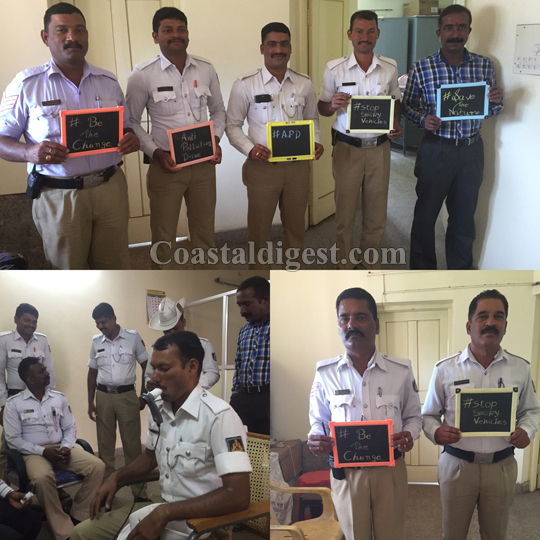
Air pollution spoiling health of traffic cops in Mangaluru, confirms test

[email protected] (CD Network)
May 9, 2016

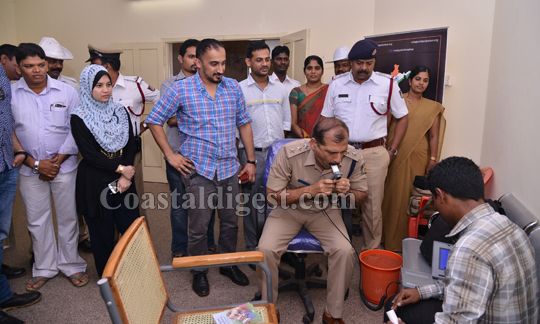
Mangaluru, May 9: The pulmonary function test (PFT) conducted on the traffic police by the Anti-Pollution Drive (APD) Foundation has showed a significant correlation in lung functions and exposure to vehicular pollutants.
pft 2

According to the results of the test and the subsequent study, reduction in air pollution can reduce the number of traffic police falling prey to restrictive lung disease. Reduction in exposure by use of protective gears like pollution mask and reduction in the duration of exposure in a day would also help in improving their lung function. Monitoring vehicles, which are on roads for over 10 years for pollution, would also help in minimising the level of pollution, the foundation said in a press release.

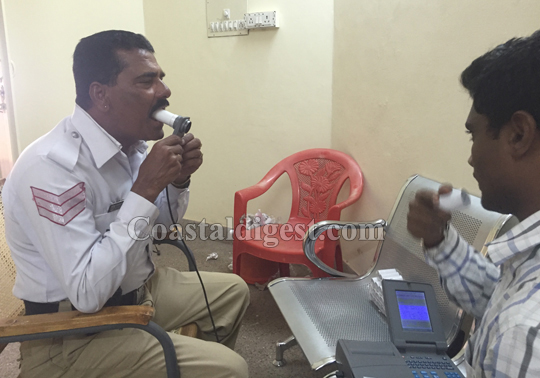
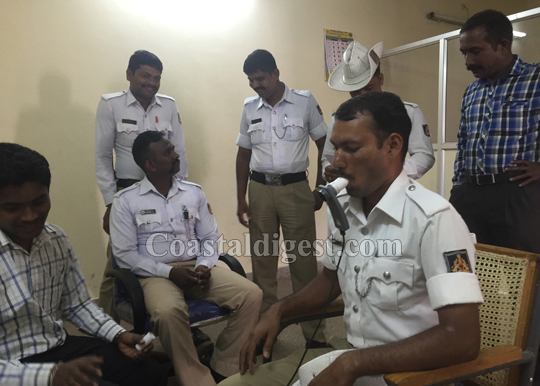
The PFT by computerised spirometer, measuring FVC, FEV1, FEV1/FVC, PEFR, and FEF25-75 per cent, was measured by pulmonologists from the Department of Respiratory Medicine at Yenepoya Medical College.

The test showed that significant number of traffic personnel have affected lungs. The results indicated that 22.3 per cent of the policemen having five and less than five years of service are showing signs of restrictive lungs. About 26.3 per cent policemen, having more than five years' experience, are showing restrictive lung capacity.

The Foundation which has germinated from this city has observed that Mangaluru is one of the rapidly growing cities in the country and the growth is associated with an enormous increase in vehicular traffic emitting exhausts and polluting the atmosphere. Airborne dust plays a major part in the overall atmospheric pollution and motor vehicle emissions are the most significant sources of pollution in an urban environment. Road traffic produces volatile organic compounds, suspended particulate matter, oxides of sulphur, oxides of nitrogen, and carbon monoxide which makes adverse health effects on the exposed population, it said.

It said the traffic-related air pollution is a day-to-day health hazard to individuals who commute to offices, school and colleges. Several students use the public transportation or the transportation provided by the educational institutes and they are exposed to hazardous toxins in the air. Schoolchildren, who are exposed to pollution at a tender age, develop health hazards is their respiratory system due to automobile exhaust. Every year, the percentage of asthmatic children is increasing in urban areas. Vehicular pollution is the sole pollution contributing elements in a large scale within city limits affecting residents, school students and officer goers.

APD?Foundation Founder Abdullah A Rehman said observing respiratory complaints among the retired traffic police would help in studying the long-term effects of the occupation. Through PFT results, APD further wants to study the health impacts of pollution in Mangaluru and related issues.

He added, “The foundation will be able to identify the impact on the most-affected group based on the PFT results. We will then identify the location and area that they are working and start monitoring the pollution levels in these areas. We will also use this information to work towards categorical mitigation.”

ACP (Traffic) Uday Nayak said the tests conducted by the foundation have helped the police a lot. “It is good to know the health condition of the police, especially the traffic police personnel,” he said and added that the hospitals have offered to provide free treatment to the affected police personnel.
pft 3

pft 4

pft 1

Comments

Swetha
 - 
Monday, 9 May 2016

really sad to see traffic police in this heavy heat climate.

Priyanka
 - 
Monday, 9 May 2016

my father is working in police department, i m very much worried about his health.

Saleem
 - 
Monday, 9 May 2016

really effecting health of traffic police, must wear musk all the time while on duty.

Manikanta
 - 
Monday, 9 May 2016

yahh rain, air pollution, heat make them sick.

Add new comment

  • Coastaldigest.com reserves the right to delete or block any comments.
  • Coastaldigset.com is not responsible for its readers’ comments.
  • Comments that are abusive, incendiary or irrelevant are strictly prohibited.
  • Please use a genuine email ID and provide your name to avoid reject.
News Network
May 7,2020

Amaravati, May 7: Telugu Desam Party (TDP) president and former chief minister N Chandrababu Naidu on Wednesday said that Karnataka Chief Minister BS Yediyurappa has assured him to offer immediate help to stranded Andhra fishermen.

Around 300 Andhra Pradesh fishermen are stranded on the coast of Malpe village in Udupi district.

"Karnataka CM has responded very positively and assured to offer the stranded fishermen immediate help. The fishermen hail from Srikakulam district in Andhra Pradesh.

Yediyurappa has also said that their team was also contacting Andhra Pradesh authorities to safely bring them back to their home state," Naidu said in a statement on Twitter.

In a separate letter to Yediyurappa, Naidu lauded the tremendous efforts that the government of Karnataka has been putting to fight COVID-19 and expressed his solidarity with the people there in this critical time.

Naidu said that many Telugu people that have migrated to other states for work were facing various problems due to the COVID-induced lockdown.

"In this backdrop, I would like to bring to your notice that around 300 fishing folk from Srikakulam District are stranded in Malpe Village, Udupi District, Karnataka. Their families, relatives and well-wishers are deeply worried for their safety and well being," Naidu said.

The TDP chief said that on behalf of those families and on his own behalf, he would appeal for sending the stranded fishermen back to their respective homes.

"In case that is not possible, I request you to provide them with shelter, food, water, medical aid and other essential commodities until the end of COVID lockdown," TDP chief said in a letter.

Comments

Add new comment

  • Coastaldigest.com reserves the right to delete or block any comments.
  • Coastaldigset.com is not responsible for its readers’ comments.
  • Comments that are abusive, incendiary or irrelevant are strictly prohibited.
  • Please use a genuine email ID and provide your name to avoid reject.
Ram Puniyani
January 14,2020

In the beginning of January 2020 two very disturbing events were reported from Pakistan. One was the attack on Nankana Sahib, the holy shrine where Sant Guru Nanak was born. While one report said that the place has been desecrated, the other stated that it was a fight between two Muslim groups. Prime Minister of Pakistan Imran Khan condemned the incident and the main accused Imran Chisti was arrested. The matter related to abduction and conversion of a Sikh girl Jagjit Kaur, daughter of Pathi (One who reads Holy Guru Granth Sahib in Gurudwara) of the Gurudwara. In another incident one Sikh youth Ravinder Singh, who was out on shopping for his marriage, was shot dead in Peshawar.

While these condemnable attacks took place on the Sikh minority in Pakistan, BJP was quick enough to jump to state that it is events like this which justify the Citizenship Amendment Act (CAA). Incidentally CAA is the Act which is discriminatory and relates to citizenship with Religion, which is not as per the norms of Indian constitution. There are constant debates and propaganda that population of Hindus has come down drastically in Pakistan and Bangla Desh. Amit Shah, the Home minister stated that in Pakistan the population of Hindus has come down from 23% at the time of partition to 3.7% at present. And in Bangla Desh it has come down from 22% to present 8%.

While not denying the fact that the religious minorities are getting a rough deal in both these countries, the figures which are presented are totally off the mark. These figures don’t take into consideration the painful migrations, which took place at the time of partition and formation of Bangla Desh later. Pakistan census figures tell a different tale. Their first census was held in 1951. As per this census the overall percentage of Non Muslim in Pakistan (East and West together) was 14.2%, of this in West Pakistan (Now Pakistan) it was 3.44 and in Eat Pakistan it was 23.2. In the census held in Pakistan 1998 it became 3.72%. As far as Bangla Desh is concerned the share of Non Muslims has gone down from 23.2 (1951) to 9.6% in 2011.

The largest minority of Pakistan is Ahmadis, (https://minorityrights.org/country/pakistan/) who are close to 4 Million and are not recognised as Muslims in Pakistan. In Bangla Desh the major migrations of Hindus from Bangla Desh took place in the backdrop of Pakistan army’s atrocities in the then East Pakistan.

As far as UN data on refugees in India it went up by 17% between 2016-2019 and largest numbers were from Tibet and Sri Lanka.  (https://www.un.org/en/development/desa/population/migration/publication…)

The state of minorities is in a way the index of strength of democracy. Most South Asian Countries have not been able to sustain democratic values properly. In Pakistan, the Republic began with Jinnah’s classic speech where secularism was to be central credo of Pakistan. This 11th August speech was in a way what the state policy should be, as per which people of all faiths are free to practice their religion. Soon enough the logic of ‘Two Nation theory” and formation of Pakistan, a separate state for Muslim took over. Army stepped in and dictatorship was to reign there intermittently. Democratic elements were suppressed and the worst came when Zia Ul Haq Islamized the state in collusion with Maulanas. The army was already a strong presence in Pakistan. The popular formulation for Pakistan was that it is ruled by three A’s, Army, America and Allah (Mullah).

Bangla Desh had a different trajectory. Its very formation was a nail in the coffin of ‘two nation theory’; that religion can be the basis of a state. Bangla Desh did begin as a secular republic but communal forces and secular forces kept struggling for their dominance and in 1988 it also became Islamic republic. At another level Myanmar, in the grip of military dictatorship, with democratic elements trying to retain their presence is also seeing a hard battle. Democracy or not, the army and Sanghas (Buddhist Sang has) are strong, in Myanmar as well. The most visible result is persecution of Rohingya Muslims.

Similar phenomenon is dominating in Sri Lanka also where Budhhist Sanghas and army have strong say in the political affairs, irrespective of which Government is ruling. Muslim and Christian minorities are a big victim there, while Tamils (Hindus, Christians etc.) suffered the biggest damage as ethnic and religious minorities. India had the best prospect of democracy, pluralism and secularism flourishing here. The secular constitution, the outcome of India’s freedom struggle, the leadership of Gandhi and Nehru did ensure the rooting of democracy and secularism in a strong way.

India so far had best democratic credentials amongst all the south Asian countries. Despite that though the population of minorities rose mainly due to poverty and illiteracy, their overall marginalisation was order of the day, it went on worsening with the rise of communal forces, with communal forces resorting to identity issues, and indulging in propaganda against minorities.

While other South Asian countries should had followed India to focus more on infrastructure and political culture of liberalism, today India is following the footsteps of Pakistan. The retrograde march of India is most visible in the issues which have dominated the political space during last few years. Issues like Ram Temple, Ghar Wapasi, Love Jihad, Beef-Cow are now finding their peak in CAA.

India’s reversal towards a polity with religion’s identity dominating the political scene was nicely presented by the late Pakistani poetess Fahmida Riaz in her poem, Tum bhi Hum Jaise Nikle (You also turned out to be like us). While trying to resist communal forces has been an arduous task, it is becoming more difficult by the day. This phenomenon has been variously called, Fundamentalism, Communalism or religious nationalism among others. Surely it has nothing to do with the religion as practiced by the great Saint and Sufi traditions of India; it resorts mainly to political mobilization by using religion as a tool.

Comments

Ashi
 - 
Tuesday, 14 Jan 2020

If Malaysia implement similar NRC/CAA, India and China are the loser.

Add new comment

  • Coastaldigest.com reserves the right to delete or block any comments.
  • Coastaldigset.com is not responsible for its readers’ comments.
  • Comments that are abusive, incendiary or irrelevant are strictly prohibited.
  • Please use a genuine email ID and provide your name to avoid reject.
News Network
January 24,2020

Newsroom, Jan 24: BJP leader and Udupi-Chikkamagaluru MP Shobha Karandlaje has been booked by Kerala police over a misleading and communally provocative social media post.

Karandlaje had tweeted that that Hindus from a colony in Kuttipuram in Malappuram district were denied water supply as they supported the the Citizenship Amendment Act (CAA). 

"Kerala is taking baby steps to become another Kashmir. Hindus of Kuttipuram Panchayat of Malappuram was denied water supply as they supported #CAA2019. #SevaBharati has been supplying water ever since. Will Lutyens telecast this intolerance of PEACEFULS frm God's Own Country!?," she tweeted. 

A case has been booked under section 153(A) of IPC (promoting enmity between different groups on grounds of religion, race etc). Karandlaje took to Twitter to slam the Kerala government, and said it had lodged a complaint against her instead of acting against the discrimination faced by dalit families of Cherukunnu. 

"It is high time the society unites against these pressure tactics of a non-performing, biased left government," she said. 

Karandlaje claimed that the CAA had been accepted by both houses of Parliament and people supporting the Act were facing boycott in business and were being denied basic amenities and jobs. "The CPI(M) government is blind to all these incidents across Kerala, but files a case against me for speaking the truth!" she retorted.

According to reportage from multiple outlets, the colony in Malappuram district's Kuttippuram was dependent on a private individual for water; then came accusations that they were denied the water for attending BJP's pro-CAA rally. 

A resident of the colony was quoted by a newspaper, “We were denied drinking water because our husbands participated in a meeting organised to gather support for the CAA. Some people told the family that they should not give drinking water to us because CAA is a threat to the people in their community.” 

However, the individual in question denied the accusation, claiming a lack of water because of technical issues.

The case was registered after a complaint by lawyer Subhash Chandran, a resident of Malappuram. Aravindan E.A., SI of Kuttippuram police, said, "From a private person's borewell, water was being provided to the people of the colony. This motor had taken for agricultural work and he was recently issued a warning by State Electricity Board. He was told that if he uses the motor for any other purpose, power supply would be disconnected. He then had stopped using the pump following the crisis worsened.”

Comments

Vishwas
 - 
Friday, 24 Jan 2020

This is BJP's usual drama. If your bloody seva bharathi people denied water, there is strong govt and youths to provide water. and other facilities

Yashwantha
 - 
Friday, 24 Jan 2020

Sobhakka's adhika prasanga wont work in kerala. She should visit kerala and experience. She can only boast via social media

Add new comment

  • Coastaldigest.com reserves the right to delete or block any comments.
  • Coastaldigset.com is not responsible for its readers’ comments.
  • Comments that are abusive, incendiary or irrelevant are strictly prohibited.
  • Please use a genuine email ID and provide your name to avoid reject.