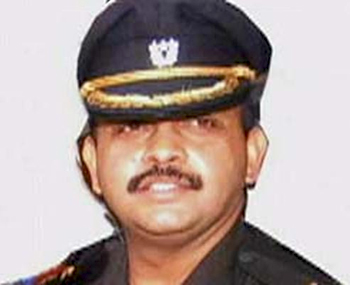
All of a sudden, NIA discovers Purohit's secret letter' against right-wing terror

April 27, 2016

New Delhi, Apr 27: In a fresh twist to the right-wing terror case saga, a 'secret' letter purportedly written by 2008 Malegaon blast accused Lt Colonel Srikant Purohit on October 15, 2008 has fallen into the hands of NIA Investigator. In this, Purohit ironically red flags the emergence of rightwing radical groups to his superiors in Army's Military intelligence wing, warning that this trend could even lead to "communal clashes".

purohith1The letter, which has been accessed by ET, was sent a couple of weeks after the second Malegaon blasts. Here Purohit refers to "An A-2 source", who has "provided some valuable information with regard to the right-wing activities in Maharashtra and Gujarat."

The National Investigation Agency (NIA) said the matter is still under probe but senior officials of the agency believe that the 'input' may have been generated as an "afterthought".

Purohit was arrested by Maharashtra ATS on November 5, 2008 and chargesheeted subsequently along with Sadhvi Pragya Singh Thakur and nine others. In a twopage letter, Purohit also names senior RSS leader Indresh Kumar and says 'he has established sufficient influence over cadres of ABVP and ex-ABVP radical cadres." Indresh had denied all the allegations.

Under the head 'assessment', Purohit tries to mitigate the damage to RSS and writes, "Subversion in an organization like RSS would facilitate actions like one which took place in Gujarat/Malegaon and would further lead to communal clashes which would in turn facilitate fifth columnist, SIMI/IM activists and supporters to go all out in action oriented activities. It may lead to many separatist movements and blame would go onto organization like RSS."

It further states, "One of such associates( of Indresh)—MrPJoshiwasassassinated in Dewas on 29-30, 2007 by unidentified killers. This individual was supposedly involved in the crude bomb blast in Ajmer Sharif Shrine. When he died/was killed, a ticket to Gujarat was foundonhisbody. Theotherpersonwho is operating in that area is one lady by name of Pragya Singh.

Comments

THINK AND
 - 
Wednesday, 27 Apr 2016

When the authorities tries to HIDE TRUTH & twist TRUTH with LIES, they are inviting more TROUBLES in their investigation.. YOU will surely SEE day by day a new PROBLEMs will ARISE when anybody play with the MINDS of PEOPLE.
Anyway whatever cheddi authorities will play, they will surely get for their DEEDS done in this LIFE ... & will Never Succeed in their DECEPTION games ....
But ALLAH is most merciful and He forgives all SINS except associating partners (idols,stones, animals, saints and so on) with him in WORSHIP...
That is the MERCY of ALLAH for those who REPENT and promise never to commit oppression on people. The door of forgiveness with ALLAH is alwz open and those who recognize their CREATOR - Are the ONES who are Successful here in this LIFE and the life after death....

Look who is ALLAH
What is the purpose of LIFE
What will happen when we DIE..
Unless U know about YOUR creator, U will be in DARKNESS.

Yajurveda 40:9 also tell : They enter DARKNESS those who WoRSHIP natural things. They SINK deeper in DARKNESS those who WORSHIP sambhuti (created things)
THINK and PONDER -- Cheddis are draging U to DARKneSS

SK
 - 
Wednesday, 27 Apr 2016

Sreekanth, Mangalore.... i agree with you to some extent.... It is the impotency of CongRSS helped RSS to become so strong......

Add new comment

  • Coastaldigest.com reserves the right to delete or block any comments.
  • Coastaldigset.com is not responsible for its readers’ comments.
  • Comments that are abusive, incendiary or irrelevant are strictly prohibited.
  • Please use a genuine email ID and provide your name to avoid reject.
coastaldigest.com news network
February 14,2020

Bengaluru, Feb 14: In a major embarrassment to the police, the Karnataka High Court has termed as illegal the prohibitory orders imposed under Section 144 of CrPC by the City Police Commissioner in December 2019 in the light of the anti-Citizenship Amendment Act (CAA) protests in Bengaluru.

The orders were passed “without application of mind” and without following due procedures, the court noted. Giving reasons for upholding the arguments of the petitioners that there was no application of mind by the Police Commissioner (Bhaskar Rao) before imposing restrictions, a division bench of the High Court said he had not recorded the reasons, except reproducing the contents of letters addressed to him by the Deputy Commissioners of Police (DCPs). 

The state government had contended that prohibitory orders were passed based on reports submitted by the DCPs who expressed apprehension about anti-social elements creating law and order problems and damaging public property by taking advantage of the anti-CAA protests.  

The High Court bench said the Police Commissioner should have conducted inquiry as stated by the Supreme Court to check the reasons cited by the DCPs who submitted identical reports. Except for this, there were no facts laid out by the Police Commissioner, the court said.

“There is complete absence of reasons. If the order indicated that the Police Commissioner was satisfied by the apprehension of DCPs, it would have been another matter,” it said.  

“The apex court has held that it must record the reasons for imposition of restrictions and there has to be a formation of opinion by the district magistrate. Only then can  the extraordinary powers conferred on the district magistrate can be exercised. This procedure was not followed. Hence, exercise of power under Section 144 by the commissioner, as district magistrate, was not at all legal”, the bench said. 

“We hold that the order dated December 18, 2019 is illegal and cannot stand judicial scrutiny in terms of the apex court’s orders in the Ramlila Maidan case and Anuradha Bhasin case,” the HC bench said while upholding the arguments of Prof Ravivarma Kumar, who appeared for some of the petitioners.   

Partly allowing a batch of public interest petitions questioning the imposition of prohibitory orders and cancelling the permission granted for protesters in the city, the bench of Chief Justice Abhay Shreeniwas Oka and Justice Hemant Chandangoudar observed that, unfortunately, in the present case, there was no indication of application of mind in passing prohibitory orders.

The bench said the observation was confined to this order only and it cannot be applicable in general. If there is a similar situation (necessitating imposition of restrictions), the state is not helpless, the court said.

Comments

Add new comment

  • Coastaldigest.com reserves the right to delete or block any comments.
  • Coastaldigset.com is not responsible for its readers’ comments.
  • Comments that are abusive, incendiary or irrelevant are strictly prohibited.
  • Please use a genuine email ID and provide your name to avoid reject.
News Network
July 28,2020

Hounde, Jul 28: Coronavirus and its restrictions are pushing already hungry communities over the edge, killing an estimated 10,000 more young children a month as meager farms are cut off from markets and villages are isolated from food and medical aid, the United Nations warned Monday.

In the call to action shared with The Associated Press ahead of publication, four UN agencies warned that growing malnutrition would have long-term consequences, transforming individual tragedies into a generational catastrophe.

Hunger is already stalking Haboue Solange Boue, an infant from Burkina Faso who lost half her former body weight of 5.5 pounds (2.5 kilograms) in just a month. Coronavirus restrictions closed the markets, and her family sold fewer vegetables. Her mother was too malnourished to nurse.

“My child,” Danssanin Lanizou whispered, choking back tears as she unwrapped a blanket to reveal her baby's protruding ribs.

More than 550,000 additional children each month are being struck by what is called wasting, according to the UN — malnutrition that manifests in spindly limbs and distended bellies. Over a year, that's up 6.7 million from last year's total of 47 million. Wasting and stunting can permanently damage children physically and mentally.

“The food security effects of the COVID crisis are going to reflect many years from now,” said Dr. Francesco Branca, the WHO head of nutrition. “There is going to be a societal effect.”

From Latin America to South Asia to sub-Saharan Africa, more poor families than ever are staring down a future without enough food.

In April, World Food Program head David Beasley warned that the coronavirus economy would cause global famines “of biblical proportions” this year. There are different stages of what is known as food insecurity; famine is officially declared when, along with other measures, 30% of the population suffers from wasting.

The World Food Program estimated in February that one Venezuelan in three was already going hungry, as inflation rendered salaries nearly worthless and forced millions to flee abroad. Then the virus arrived.

“Every day we receive a malnourished child,” said Dr. Francisco Nieto, who works in a hospital in the border state of Tachira.

In May, Nieto recalled, after two months of quarantine, 18-month-old twins arrived with bodies bloated from malnutrition. The children's mother was jobless and living with her own mother. She told the doctor she fed them only a simple drink made with boiled bananas.

“Not even a cracker? Some chicken?” he asked.

“Nothing,” the children's grandmother responded. By the time the doctor saw them, it was too late: One boy died eight days later.

The leaders of four international agencies — the World Health Organization, UNICEF, the World Food Program and the Food and Agriculture Organization — have called for at least dollar 2.4 billion immediately to address global hunger.

But even more than lack of money, restrictions on movement have prevented families from seeking treatment, said Victor Aguayo, the head of UNICEF's nutrition program.

“By having schools closed, by having primary health care services disrupted, by having nutritional programs dysfunctional, we are also creating harm,” Aguayo said. He cited as an example the near-global suspension of Vitamin A supplements, which are a crucial way to bolster developing immune systems.

In Afghanistan, movement restrictions prevent families from bringing their malnourished children to hospitals for food and aid just when they need it most. The Indira Gandhi hospital in the capital, Kabul, has seen only three or four malnourished children, said specialist Nematullah Amiri. Last year, there were 10 times as many.

Because the children don't come in, there's no way to know for certain the scale of the problem, but a recent study by Johns Hopkins University indicated an additional 13,000 Afghans younger than 5 could die.

Afghanistan is now in a red zone of hunger, with severe childhood malnutrition spiking from 690,000 in January to 780,000 — a 13% increase, according to UNICEF.

In Yemen, restrictions on movement have blocked aid distribution, along with the stalling of salaries and price hikes. The Arab world's poorest country is suffering further from a fall in remittances and a drop in funding from humanitarian agencies.

Yemen is now on the brink of famine, according to the Famine Early Warning Systems Network, which uses surveys, satellite data and weather mapping to pinpoint places most in need.

Some of the worst hunger still occurs in sub-Saharan Africa. In Sudan, 9.6 million people live from one meal to the next — a 65% increase from the same time last year.

Lockdowns across Sudanese provinces, as around the world, have dried up work and incomes for millions. With inflation hitting 136%, prices for basic goods have more than tripled.

“It has never been easy but now we are starving, eating grass, weeds, just plants from the earth,” said Ibrahim Youssef, director of the Kalma camp for internally displaced people in war-ravaged south Darfur.

Adam Haroun, an official in the Krinding camp in west Darfur, recorded nine deaths linked with malnutrition, otherwise a rare occurrence, over the past two months — five newborns and four older adults, he said.

Before the pandemic and lockdown, the Abdullah family ate three meals a day, sometimes with bread, or they'd add butter to porridge. Now they are down to just one meal of “millet porridge” — water mixed with grain. Zakaria Yehia Abdullah, a farmer now at Krinding, said the hunger is showing “in my children's faces.”

“I don't have the basics I need to survive,” said the 67-year-old, who who hasn't worked the fields since April. “That means the 10 people counting on me can't survive either.”


Comments

Add new comment

  • Coastaldigest.com reserves the right to delete or block any comments.
  • Coastaldigset.com is not responsible for its readers’ comments.
  • Comments that are abusive, incendiary or irrelevant are strictly prohibited.
  • Please use a genuine email ID and provide your name to avoid reject.
News Network
February 21,2020

New Delhi, Feb 21: A petition has been filed in the Supreme Court challenging the sedition case registered against a Karnataka school management for allegedly allowing students to stage an anti-CAA, anti-NRC drama that 'portrayed Prime Minister Narendra Modi in poor light'.

The petition seeks quashing of the FIR against the principal and other staff of the Shaheen School at Bidar who have been booked under sections 124-A (sedition) and 153-A (promoting enmity between different groups) of the Indian Penal Code.

In the petition filed on Thursday, social activist Yogita Bhayana has also sought an apex court direction for a proper mechanism to deal with alleged government misuse of the sedition law.

Section 124A of the IPC says that "whoever brings or attempts to bring into hatred or contempt, or excites or attempts to excite disaffection towards... the Government shall be punished with imprisonment for life...".

Bhayana, in the plea, has sought a direction to the Centre and the Karnataka government "to quash the FIR registered in connection of seditious charges against the school management, teacher and a widowed parent of a student for staging a play criticizing CAA, NRC, and NPR."

The petition claimed the police "also questioned students, and videos and screenshots of CCTV footage showing them speaking to the students were shared widely on social media, prompting criticism."

It further quoted the school principal, alleging that "on one occasion, police in uniform questioned students, with no child welfare officials present".

The plea said that the "proceedings were violative of Article 21 (right to life and personal liberty) of the Constitution and abuse of process of law."

"Issue an order directing the Centre to constitute a committee to scrutinise complaints under 124-A IPC and adhere to judgments by the apex court before registering the FIR under the section 124-A IPC," the petition said.

The drama was staged on January 21 by students of fourth, fifth and sixth standard.

The sedition case was filed based on a complaint from social worker Neelesh Rakshyal on January 26.

The complainant has alleged that the school authorities "used" the students to perform a drama where they "abused" Modi in the context of the Citizenship Amendment Act and the National Register of Citizens.

Comments

Add new comment

  • Coastaldigest.com reserves the right to delete or block any comments.
  • Coastaldigset.com is not responsible for its readers’ comments.
  • Comments that are abusive, incendiary or irrelevant are strictly prohibited.
  • Please use a genuine email ID and provide your name to avoid reject.