


Amarnath Yatra begins today; intelligence warns of attack

Agencies
June 28, 2017

Jammu/Srinagar, Jun 28: The annual Amarnath Yatra in Kashmir beginning tomorrow is facing a terror threat, according to an intelligence warning which has prompted the authorities to mobilise the "highest level" of security measures, including satellite tracking system.amarnathyathra
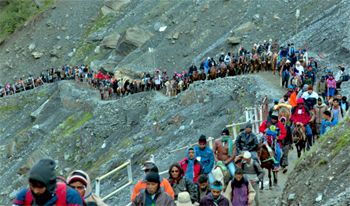
The 40-day-long pilgrimage to the holy cave of Amarnath in the mountainous region of south Kashmir will commence tomorrow from Jammu, about 200 kms from the shrine.

Over 2.30 lakh pilgrims have registered for the yatra and the first batch of over 4,000 pilgrims will be flagged off by Deputy Chief Minister Nirmal Singh for the twin base-camps of Pahalgam and Baltal in Anantnag and Ganderbal districts.

"Intelligence input received from SSP Anantnag reveals that terrorists have been directed to eliminate 100 to 150 pilgrims and about 100 police officers and officials," according to a letter sent by Inspector General of Police (Kashmir Zone) Muneer Khan to the Army, the CRPF, and range DIGs in the state.

"The input is assessed to be a HUMINT (human intelligence) and it needs further corroboration," the IGP said in the letter.

At this stage, the possibility of a sensational attack by a terrorist outfit cannot be ruled out, he said.

"The attack may be in the form of stand-off fire on yatra convoy which they believe will result in flaring of communal tensions throughout the nation," the IGP said in the letter which is being circulated in many groups on Whatsapp.

All the officers and officials deployed on the ground need to remain alert and maintain utmost vigil, he added in the letter whose copy got leaked and went viral on social media.

Khan later tried to play it down, saying there was no need to panic as it was part of information being shared with agencies to check its authenticity.

Jammu and Kashmir DGP S P Vaid said someone has spread it on social media to create panic.

The government has mobilised a heavy security blanket of over 35,000 to 40,000 troops including the police, the Army, the BSF and the CRPF.

In addition to the existing strength of the CRPF in the state, the Centre has provided over 250 companies (25,000 personnel) of paramilitary forces to the state government.

The BSF has deployed over 2,000 troops for the yatra while the Army has provided 5 battalions (about 5000 personnel) and additional 54 companies (5400 personnel) of the police have also been mobilised.

"This Amarnath yatra will have the highest-ever security setup to ensure an incident-free yatra," said Special Director General of CRPF S N Shrivastava.

Asked about the intelligence warning, hesaid, "I will not like to discuss the issue in public but you are aware about the situation in Kashmir. We have taken measures as per the these intelligence inputs and have made appropriate security arrangements."

Describing the yatra as "a big challenge to us", he told reporters, "All security arrangements have been made in view of the threat perception... Elaborate security has been put in place for an incident-free yatra and to ensure safety and security of pilgrims and camps."

As a measure of security, satellite tracking system has been put in place for the safety of convoys carrying the pilgrims, said Shrivastava, who visited the base camp along with CRPF IG Ashkoor Wani to review the preparations.

CCTV cameras, jammers, RoPs, dog squads, bullet-proof bunkers, QRTs, satellite tracking and other security gadgets are being used to maintain vigil in view of increased threat perception due to in increased terror incidents and violence in Kashmir.

BSF DG K K Sharma said in Kolkata, "The situation is very tense this year. This time there is a high level of threat perception. We have taken all precautions regarding deployment of forces and our commandos."

He added, "We will ensure that it passes off peacefully like previous years."

Deputy Commissioner of Anantnag Syed Abid Rasheed Shah said the authorities were cognizant of the security challenge and it had been conveyed to the security forces.

This year's yatra will be eight days shorter against the last years' of 48 days and conclude on Shravan Purnima (Raksha Bandhan) on August 7.

Situated in a narrow gorge at the farther end of Lidder Valley, Amarnath shrine stands at 3,888 metres, 46 km from Pahalgam and 14 km from Baltal.

"The administration is working in close coordination with various agencies to ensure smooth conduct of yatra," said Shah, who is also district yatra officer.

At a meeting, he took detailed account of the arrangements put in place at base camp Nunwan, including the medical facilities, ration, accommodation, sanitation, power drinking water and communication to cater the rush of pilgrims.

He said 450 tents have to be established at base camp Nunwan, out of which 271 have been pitched so far.

The meeting was also informed that a 10-bedded hospital at Nunwan and 20-bedded hospital at Chandanwari have been established besides, ensured availability of adequate stock of life saving drugs and oxygen cylinders, an official spokesman said.

Mountain Rescue Teams (MRTs) of the state police along with rescue teams of various security forces have been pressed into service along with well-equipped fire fighting teams at pre-determined points, officials said.

Oxygen cylinders, ECG machines, defibrillators,oxygen concentrators, CPR machines, X-ray machines, ventilators, resuscitation sets have been installed and all required medicines are available are the hospital.

At Baltal Base Hospital, Shrivastava interacted with doctors deputed from Safdarjang Hospital, Delhi, who are already treating the local residents and service providers.

Residential accommodation and mess facilities for about 250 medical personnel, including those arriving from different parts of the country, to provide medical assistance for the pilgrims have also been put in place.

Comments

Add new comment

  • Coastaldigest.com reserves the right to delete or block any comments.
  • Coastaldigset.com is not responsible for its readers’ comments.
  • Comments that are abusive, incendiary or irrelevant are strictly prohibited.
  • Please use a genuine email ID and provide your name to avoid reject.
News Network
April 27,2020

New Delhi, Apr 27: Prime Minister Narendra Modi on Monday held a video conference with chief ministers to discuss the situation arising due to the coronavirus pandemic in the country, which has been under a lockdown since March 25 to contain the spread of the virus, amid indications that the interaction would also focus on a graded exit from the ongoing lockdown.

This is Modi's fourth such interaction with state chief ministers since March 22 when he discussed coronavirus situation and steps taken both by the Centre and the states to contain the pandemic.

Two days later on March 24, Modi announced a 21-day nationwide lockdown. He extended the lockdown by 19 days on April 14, the last day of the initial three week shutdown, till May 3.

Sources in the government had on Sunday indicated that besides discussing the way forward in dealing with the pandemic, the prime ministers and chief ministers could also focus on a "graded" exit from the lockdown.

In a tweet on Monday, the Prime Minister's Office said Modi and the chief ministers will be discussing aspects relating to the COVID-19 situation.

In his monthly 'Mann ki Baat' radio address on Sunday, the prime minister said the country is in the middle of a 'yudh' (war) and asserted that people have to continue being careful and take precautions.

His note of caution came amidst gradual exemptions being granted by the Centre and states to revive economic activities.

"I urge you not to get overconfident. You should in your over-enthusiasm not think that if the coronavirus has not yet reached your city, village, street or office, it is not going to reach now. Never make such a mistake. The experience of the world tells us a lot in this regard," Modi said while referring to a popular Hindi idiom 'Sawdhani hati, durghatna ghati' (disaster strikes when you lower your concentration).

The Centre and the state governments have been giving gradual exemptions to boost economic activities as also to provide relief to people as some states want further relaxation in areas which have seen few or no coronavirus cases.

Comments

Add new comment

  • Coastaldigest.com reserves the right to delete or block any comments.
  • Coastaldigset.com is not responsible for its readers’ comments.
  • Comments that are abusive, incendiary or irrelevant are strictly prohibited.
  • Please use a genuine email ID and provide your name to avoid reject.
News Network
March 23,2020

Bengaluru, Mar 23: Indian stocks plunged over 9% on Monday, as the rapidly spreading coronavirus pandemic sent major states including the country's capital into a lockdown amid increasing fears that outbreak could bring world economies to a grinding halt.

The NSE Nifty 50 index slipped 9.17% to 7,937.75 by 0408 GMT, while the S&P BSE Sensex was 9.42% lower at 27,093.24.

Over the weekend in India, the virus drove several companies to shut operations and the government sent states into lockdowns, bringing normal life to a grinding halt.

"Panic has gone up domestically because of the lockdown situation," said Vinod Nair, head of research at Geojit Financial Services.

"There is fear that the situation will not be brought under control soon."

The rupee hit a fresh record low of 76.05 against the dollar, as a flight into cash and worries about tightening liquidity boosted demand for the world's reserve currency.

Meanwhile, global markets crumbled, with MSCI's broadest index of Asia-Pacific shares outside Japan sliding nearly 4% as the global death toll climbed to over 14,000, further battering economic activity, and raising fears of a global recession.

After market hours on Friday, the Securities and Exchange Board of India halved position limits for certain stock futures, restricted short-selling of index derivatives and raised margin rates for some shares to curb "abnormally high" volatility amid the pandemic.

In domestic trading, the Nifty PSU Bank Index plunged 8%, while the Nifty bank index crashed nearly 10%.

The Nifty Auto Index slid 9% after several carmakers over the weekend suspended production due to the virus.

Comments

Add new comment

  • Coastaldigest.com reserves the right to delete or block any comments.
  • Coastaldigset.com is not responsible for its readers’ comments.
  • Comments that are abusive, incendiary or irrelevant are strictly prohibited.
  • Please use a genuine email ID and provide your name to avoid reject.
Agencies
June 21,2020

New Delhi, June 21: Diesel prices rise to record high after 60 paise hike in rates, petrol up 35 paise; rates up by Rs 8.88 and Rs 7.97 in 15 days.

Petrol price in Delhi was hiked to Rs 79.23 per litre from Rs 78.88, while diesel rates were increased to Rs 78.27 a litre from Rs 77.67, according to a price notification of state oil marketing companies. 

In Bengaluru, petrol will be costlier by 37 paise at Rs 81.81 per litre, while diesel will cost 57 paise more per litre at Rs 74.43.

Rates have been increased across the country and vary from state to state depending on the incidence of local sales tax or VAT.

The 15th daily increase in rates since oil companies on June 7 restarted revising prices in line with costs after ending an 82-day hiatus in rate revision, has taken diesel prices to a new high. The petrol price too is at a two-year high.

Over 63 per cent of the retail selling price of diesel is taxes. Out of the total tax incidence of Rs 49.43 per litre, Rs 31.83 is by way of central excise and Rs 17.60 is VAT. 

Petrol in Mumbai costs Rs 86.04 per litre and diesel is priced at Rs 76.69.

Prior to the current rally, the peak diesel rates had touched was on October 16, 2018 when prices had climbed to Rs 75.69 per litre in Delhi. The highest-ever petrol price was on October 4, 2018 when rates soared to Rs 84 a litre in Delhi.

When rates had peaked in October 2018, the government had cut excise duty on petrol and diesel by Rs 1.50 per litre each. State-owned oil companies were asked to absorb another Re 1 a litre to help cut retail rates by Rs 2.50 a litre.

Oil companies had quickly recouped the Re 1 and the government in July 2019 raised excise duty by Rs 2 a litre.

The government on March 14 hiked excise duty on petrol and diesel by Rs 3 per litre each and then again on May 5 by a record Rs 10 per litre in case of petrol and Rs 13 on diesel. The two hikes gave the government Rs 2 lakh crore in additional tax revenues.

Oil PSUs Indian Oil Corp (IOC), Bharat Petroleum Corp Ltd (BPCL) and Hindustan Petroleum Corp Ltd (HPCL), instead of passing on the excise duty hikes to customers, adjusted them against the fall in the retail rates that was warranted because of a decline in international oil prices to two-decade lows.

International oil prices have since rebounded and oil firms are now adjusting retail rates in line with them.

In 15 days of hike, petrol price has gone up by Rs 7.97 per litre and diesel by Rs 8.88 a litre.

Comments

Add new comment

  • Coastaldigest.com reserves the right to delete or block any comments.
  • Coastaldigset.com is not responsible for its readers’ comments.
  • Comments that are abusive, incendiary or irrelevant are strictly prohibited.
  • Please use a genuine email ID and provide your name to avoid reject.