


Amidst demand for his release, fever kills Dadri lynching accused

[email protected] (News Network)
October 5, 2016

Noida, Oct 5: One of the 15 accused jailed for Dadri beef lynching case, wherein Mohammad Akhlaq was bludgeoned to death in September last year, died of fever at a hospital in Delhi.
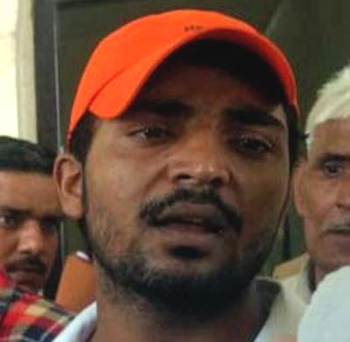
debriJail officials said it was likely that Ravin, a 22-year-old Bisada resident, was suffering from dengue or chikungunya. But the youth's mother and Hindutva groups in his village blamed police for his death, accusing them of negligence.

Ravin, who was arrested on December 21 last year, had been down with fever for four days in Greater Noida's Luksar jail. When his condition deteriorated on Tuesday morning, he was taken to the district hospital in Noida and from there referred to Delhi's LNJP Hospital, where he died around 6pm due to kidney and respiratory failure, doctors said.

"When Ravin had fever for several days, why was he taken to hospital when the situation became critical?" asked Nirmala, his mother. "My son died. He had committed no crime. I want justice." Ravin is survived by his wife and a six-month-old daughter.

District magistrate N P Singh said he had sought a report from the jail superintendent. "This is a very sad incident and we are looking into it. We have formed a committee to examine the matter," he said.

Dr J C Passey, medical superintendent of LNJP Hospital, said, "The patient was rushed to our hospital at 12 pm in critical condition. He had acute fever and kidney dysfunction. Despite our best efforts, he died within a few hours." He said blood samples of Ravin had been sent for dengue and chikungunya tests. "Until the reports come, we cannot comment on the cause of death. He died due to kidney and respiratory failure," Passey said.

Dharmendra Singh, the Gautam Budh Nagar police chief, said, "We received information the accused was suffering from a suspected case of dengue and died in the evening. We are looking into the issue." Luksar jail superintendent M L Yadav did not respond to repeated calls and messages asking for his response.

Ravin, a Class X pass out, worked as a driver when he was arrested in connection with the murder of Akhlaq and the attack on his younger son Danish. He was one of the 18 accused in the charge sheet filed by police in the case but was not among the first few to be arrested in the days after the murder of Akhlaq on September 28 last year.

Following the news of his death, a group of men gathered at the village temple in Bisada and protested. Police rushed personnel to Bisada to keep the situation under control.

Meanwhile, mothers of 13 of the accused have been on an indefinite hunger strike in Bisara since Saturday. A few hours before news of Ravin's death reached Bisara, Sub-Divisional Magistrate Amit Kumar, along with officers from Jharcha police station, met the protesters.

“I am requesting you with folded hands, please release our innocent children and arrest Jaan Mohammad (Akhlaq's brother),” said Lilavati, a local. Akhlaq had been beaten to death by a mob on suspicion of cow slaughter and beef consumption. After his death, an FIR had been registered against him, and six other members of his family, including Jaan Mohammad.

“The hunger strike will continue for two more days… We are giving you (police) two days to arrest Jaan Mohammad. On the third day, if he is still free, we will do what we want. The investigation has been going on for the last three months. Why was there no investigation before our sons were put behind bars?” said Hari Om, a local Hindutva activist.

Also Read: Body of Dadri MURDER ACCUSED kept under tricolor; Rs 1-cr demanded

Comments

Bopanna
 - 
Thursday, 6 Oct 2016

Ravin is a Martyr, rip

Viren Kotian
 - 
Wednesday, 5 Oct 2016

Ravin family should be rewarded 20 lkh rupees

Satyameva jayate
 - 
Wednesday, 5 Oct 2016

God is not blind.....let the chaddis learn a lesson.....this is the tears if akhlaqs family and so the other victims of beef politics.....

Nashal
 - 
Wednesday, 5 Oct 2016

May God bless his soul
Now his parents relatives friend feel very sad, think a while when Akhlaq murdered what will feel Akhlaq's family who was killed by Ravin in front of Akhlaq's family
All guilties are punished God

Mohammed SS
 - 
Wednesday, 5 Oct 2016

Lets Celebrate Murderer Ravin's death and pray almighty Allah to vanish all trouble making creatures from his land. and let other to live peacefully

Rikaz
 - 
Wednesday, 5 Oct 2016

Modi is not mad enough to stop exporting cow meat....getting USD 30 billion out of foreign exchange....if Indians eat beef here is sin...what a double standard....

True indian
 - 
Wednesday, 5 Oct 2016

Stop exporting gau mata’s meet to other countries . pakistanis enjoying indian beef in many countries.
So we request indian govt to stop exporting gau mata.

True indian
 - 
Wednesday, 5 Oct 2016

Gomata is giving in dollars to indian govt. by exporting gomata.

Beef is eaten all over the world. So for that. Lets have world war.

What a stup bunch of jokers

Intelect
 - 
Wednesday, 5 Oct 2016

Even the hell is full

Sacchai
 - 
Wednesday, 5 Oct 2016

Every soul will taste the death, It is not good to comment on a deceased brother, now his affairs with his creator, his good deeds and bad deeds are only with him.

Zainab
 - 
Wednesday, 5 Oct 2016

Ravin was ACCUSED. it wasnt confirmed if he was totally involved. so pray for him and his family..nobody's death should be celebrated!!!

True indian
 - 
Wednesday, 5 Oct 2016

Its god's punishment. Now rot in hell. Have ur gau rakshak in hell.

Robot
 - 
Wednesday, 5 Oct 2016

Hahah. He deserves it. Jhor ka Jhatka....dheerese lage....

Aslam Sheikh
 - 
Wednesday, 5 Oct 2016

Karthik, Being Hindu you must know that Karma doesn't take any supari!!!

Ahad
 - 
Wednesday, 5 Oct 2016

All group members who go to street to fight for the cheddis, should know this REALITY that after crime, u will be in jail and nobody cares...

Ahad
 - 
Wednesday, 5 Oct 2016

Where did his ARROGANCE gone???????????

Add new comment

  • Coastaldigest.com reserves the right to delete or block any comments.
  • Coastaldigset.com is not responsible for its readers’ comments.
  • Comments that are abusive, incendiary or irrelevant are strictly prohibited.
  • Please use a genuine email ID and provide your name to avoid reject.
Ram Puniyani
February 4,2020

As democracy is seeping in slowly all over the world, there is an organization which is monitoring the degree of democracy in the individual countries, The Economist Intelligence Unit. As such in each country there are diverse factors which on one hand work to deepen it, while others weaken it. Overall there is a march from theoretical democracy to substantive one. The substantive democracy will herald not just the formal equality, freedom and community feeling in the country but will be founded on the substantive quality of these values. In India while the introduction of modern education, transport, communication laid the backdrop of beginning of the process, the direction towards deepening of the process begins with Mahatma Gandhi when he led the non-cooperation movement in 1920, in which average people participated. The movement of freedom for India went on to become the ‘greatest ever mass movement’ in the World.

The approval and standards for democracy were enshrined in Indian Constitution, which begins ‘We the people of India’, and was adopted on 26th January 1950. With this Constitution and the policies adopted by Nehru the process of democratization started seeping further, the dreaded Emergency in 1975, which was lifted later restored democratic freedoms in some degree. This process of democratisation is facing an opposition since the decade of 1990s after the launch of Ram Temple agitation, and has seen the further erosion with BJP led Government coming to power in 2014. The state has been proactively attacking civil liberties, pluralism and participative political culture with democracy becoming flawed in a serious way. And this is what got reflected in the slipping of India by ten places, to 51st, in 2019. On the index of democracy India slipped down from the score of 7.23 to 6.90. The impact of sectarian BJP politics is writ on the state of the nation, country.

Ironically this lowering of score has come at a time when the popular protests, the deepening of democracy has been given a boost and is picking up with the Shaheen Bagh protests. The protest which began in Shaheen Bagh, Delhi in the backdrop of this Government getting the Citizenship amendment Bill getting converted into an act and mercilessly attacking the students of Jamia Milia Islamia, Aligarh Muslim University along with high handed approach in Jamia Nagar and neighbouring areas.  From 15th December 2019, the laudable protest is on.

It is interesting to note that the lead in this protest has been taken by the Muslim women, from the Burqa-Hijab clad to ‘not looking Muslim’ women and was joined by students and youth from all the communities, and later by the people from all the communities. Interestingly this time around this Muslim women initiated protest has contrast from all the protests which earlier had begun by Muslims. The protests opposing Shah Bano Judgment, the protests opposing entry of women in Haji Ali, the protests opposing the Government move to abolish triple Talaq. So far the maulanas from top were initiating the protests, with beard and skull cap dominating the marches and protests. The protests were by and large for protecting Sharia, Islam and were restricted to Muslim community participating.

This time around while Narendra Modi pronounced that ‘protesters can be identified by their clothes’, those who can be identified by their external appearance are greatly outnumbered by all those identified or not identified by their appearance.

The protests are not to save Islam or any other religion but to protect Indian Constitution. The slogans are structured around ‘Defence of democracy and Indian Constitution’. The theme slogans are not Allahu Akbar’ or Nara-E-Tadbeer’ but around preamble of Indian Constitution. The lead songs have come to be Faiz Ahmad Faiz’s ‘Hum Dekhenge’, a protest against Zia Ul Haq’s attempts to crush democracy in the name of religion. Another leading protest song is from Varun Grover, ‘Tanashah Aayenge…Hum Kagaz nahin Dikhayenge’, a call to civil disobedience against the CAA-NRC exercise and characterising the dictatorial nature of the current ruling regime.

While BJP was telling us that primary problem of Muslim women is Triple talaq, the Muslim women led movements has articulated that primary problem is the very threat to Muslim community. All other communities, cutting across religious lines, those below poverty line, those landless and shelter less people also see that if the citizenship of Muslims can be threatened because of lack of some papers, they will be not far behind in the victimization process being unleashed by this Government.

While CAA-NRC has acted as the precipitating factor, the policies of Modi regime, starting from failure to fulfil the tall promises of bringing back black money, the cruel impact of demonetisation, the rising process of commodities, the rising unemployment, the divisive policies of the ruling dispensation are the base on which these protest movements are standing. The spread of the protest movement, spontaneous but having similar message is remarkable. Shaheen Bagh is no more just a physical space; it’s a symbol of resistance against the divisive policies, against the policies which are increasing the sufferings of poor workers, the farmers and the average sections of society.

What is clear is that as identity issues, emotive issues like Ram Temple, Cow Beef, Love Jihad and Ghar Wapasi aimed to divide the society, Shaheen Bagh is uniting the society like never before. The democratisation process which faced erosion is getting a boost through people coming together around the Preamble of Indian Constitution, singing of Jan Gan Man, waving of tricolour and upholding the national icons like Gandhi, Bhagat Singh, Ambedkar and Maulana Azad. One can feel the sentiments which built India; one can see the courage of people to protect what India’s freedom movement and Indian Constitution gave them.

Surely the communal forces are spreading canards and falsehood against the protests. As such these protests which is a solid foundation of our democracy. The spontaneity of the movement is a strength which needs to be channelized to uphold Indian Constitution and democratic ethos of our beloved country.

Comments

Add new comment

  • Coastaldigest.com reserves the right to delete or block any comments.
  • Coastaldigset.com is not responsible for its readers’ comments.
  • Comments that are abusive, incendiary or irrelevant are strictly prohibited.
  • Please use a genuine email ID and provide your name to avoid reject.
News Network
July 29,2020

Bengaluru, Jul 29: A day after Congress staged a nationwide 'Save Democracy' protest, Janata Dal (Secular) leader HD Kumaraswamy slammed Congress for "dividing" the political parties and "buying MLAs" and questioned their "democratic behaviour" to lure Bahujan Samaj Party (BSP) MLAs who supported them.

Kumaraswamy, in a media statement, said, "Is it a democratic behaviour to lure MLAs of other parties through political shenanigans and later merging with them?"

"Congress is an expert in dividing political parties and purchase of MLAs," said Kumaraswamy adding, "If you are dividing the like-minded party MLAs through deceit, who would support you?"

He alleged that the term "horse trade" in politics came to be used because of Congress.

Congress had tied to divide the Janata Dal (Secular) in 2004. To this, he added, "To avoid the party being hijacked by the Congress, I had to oust the Congress-JD(S) coalition government through a political coup."

Kumaraswamy further accused, "Haven't the Congress who is making a big noise about the purchase of MLAs divided the JD(S) in the past? Is it not a fact that for the sake of one Rajya Sabha seat, the Congress government in Karnataka purchased eight JD(S) MLAs?"

Both -- Congress and BJP -- are "criminals" in purchase matter, he added.

Rajasthan Congress is in turmoil after simmering differences between Sachin Pilot and Chief Minister Ashok Gehlot came out in the open. Pilot was removed as the Deputy Chief Minister and the state unit chief of Congress.

The Congress has accused the BJP of indulging in horse-trading to bring down the Gehlot government. The BJP has rejected the allegations.

Comments

Add new comment

  • Coastaldigest.com reserves the right to delete or block any comments.
  • Coastaldigset.com is not responsible for its readers’ comments.
  • Comments that are abusive, incendiary or irrelevant are strictly prohibited.
  • Please use a genuine email ID and provide your name to avoid reject.
News Network
May 7,2020

Bengaluru, May 7: Karnataka has revised its standard operating procedure (SOP) for international passengers. The first group of passengers will arrive in the state on May 8.

The number of categories has been reduced to two from three. Category A includes passengers symptomatic on arrival while Category B passengers are those asymptomatic on arrival. These are passengers who are either healthy or those having co-morbidities.

As per the revised SOP, the passenger will be released on the seventh day, if tested negative, to strict home quarantine for another seven days with stamping.

This norm is in contradiction to the Ministry of Home Affairs’ SOP for international passengers. As per the MHA’s SOP, the passengers (asymptomatic) will be under institutional quarantine for 14 days. Testing negative after 14 days, they will be allowed to go home and will undertake self-monitoring of their health for 14 more days.

On the contradiction, Pandey said, "We don't take chances as we rely on tests instead of just quarantining. Other states may be depending on just 14-day institutional quarantine."

"GOI SOP doesn't talk about Covid tests on international passengers. We have put an additional safety layer of three Covid tests on returnees -- one on arrival, second from 5-7 days and last on 12th day. This will ensure definite identification of positive cases even if they are asymptomatic and their subsequent treatment. We should look at the spirit behind the order," he added.

On the 14-day additional reporting period for category B, he said, "It is implied as category B patients should report to us for 14 days after their first 14-day quarantine period is over."

Medical Education Minister Dr K Sudhakar said that the State would follow the Centre’s norms.

Till Tuesday, Karnataka’s SOP had three categories. Under Category A (symptomatic), 14-day institutional quarantine at COVID-19 Health Care Centre was mandatory followed by 14-day reporting period. Under Category B (asymptomatic above 60 years with co-morbidities), seven-day institutional quarantine at hotel/hostel followed by seven-day home quarantine and 14-day reporting period had been recommended. The 14-day home quarantine and 14-day reporting period was mandatory for Category C (asymptomatic).

Comments

Add new comment

  • Coastaldigest.com reserves the right to delete or block any comments.
  • Coastaldigset.com is not responsible for its readers’ comments.
  • Comments that are abusive, incendiary or irrelevant are strictly prohibited.
  • Please use a genuine email ID and provide your name to avoid reject.