Amit Shah re-elected BJP chief; Advani, Joshi skip event

January 24, 2016

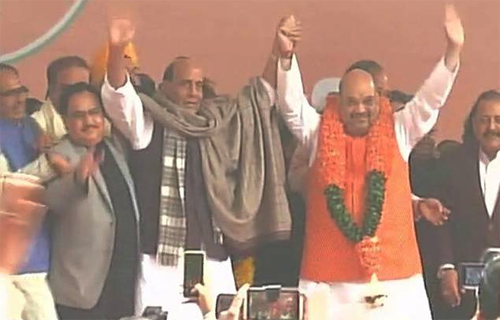
New Delhi, Jan 24: BJP chief Amit Shah has been re-elected as the party President. The announcement was made after top party leaders led by Prime Minister Narendra Modi, a bevy of Union ministers and chief ministers of BJP-ruled states proposed his name for the party President's post during the nomination process today.

shah

Among others who have proposed Shah's name are Union minister Rajnath Singh, Anant Kumar and J P Nadda, M Venkaiah Naidu, besides BJP chief ministers Vasundhara Raje, Raghubar Das, Shivraj Singh Chauhan and others.

BJP Parliamentary Board is scheduled to meet on January 28 evening to welcome Shah into his new term.

This will be first full term, which is for three years, for the close confidant of Modi.

Shah had taken over as the party chief during midway of Rajnath Singh's term after Singh joined the government as the Home Minister in May 2014.

Top BJP veterans including LK Advani and Murli Manohar Joshi, now members of the party's Margdarshak Mandal, skipped the nomination process and Shah's subsequent felicitation at 11, Ashoka Road headquarters of the BJP in New Delhi.

Comments

Goodman
 - 
Sunday, 24 Jan 2016

2 big Magdarshaks skipped as usual.
No discipline, no respect to seniors. so no future to unguided party.

Add new comment

  • Coastaldigest.com reserves the right to delete or block any comments.
  • Coastaldigset.com is not responsible for its readers’ comments.
  • Comments that are abusive, incendiary or irrelevant are strictly prohibited.
  • Please use a genuine email ID and provide your name to avoid reject.
coastaldigest.com news network
February 21,2020

Mangaluru, Feb 21: The local units of Vishva Hindu Parishad and Bajrang Dal today staged a protest in the city against Amulya Leona, who raised pro-Pakistan slogans yesterday in Bangaluru.

Amulya is the daughter of Wazi Noronha, a former leader of minority of wing of BJP in Koppa taluk of Chikkamagaluru district. He had worked in support of hardline BJP leader and Udupi-Chickmagaluru MP Shobha Karandlaje, and D N Jeevaraj, who had represented Sringeri constituency last time.

The 19-year-old B.A. student was arrested on sedition charge after she raised pro-Pakistan slogans to embarrass the organisers of a peaceful protest against the Citizenship (Amendment) Act in Bengaluru.

Demanding stringent action against Amulya, a group of activist of VHP and Bajrang Dal staged protest at Kadri Mallikatte Circle in the city. Speaking on the occasion, M B Puranik and Sharan Pumpwell demanded NIA probe into the incident.

Also Read: Amulya Leona — a Naxal or Sangh Parivar stooge?

Comments

Add new comment

  • Coastaldigest.com reserves the right to delete or block any comments.
  • Coastaldigset.com is not responsible for its readers’ comments.
  • Comments that are abusive, incendiary or irrelevant are strictly prohibited.
  • Please use a genuine email ID and provide your name to avoid reject.
Agencies
July 5,2020

The deadly coronavirus that entered India while there was still nip in the air has beaten rising mercury, humid conditions, unique Indian genome and has entered monsoon season with more potency as fresh cases are only breaking all records in the country.

India recorded a single-day spike of record 24,850 new coronavirus cases on Sunday, taking its total tally to 6.73 lakh corona-positive cases.

Top Indian microbiologists were hopeful in March that after the 21-day lockdown, as summer approaches, the rise in temperature would play an important role in preventing the drastic spread of COVID-19 virus in India.

Several virologists hinted that by June this year, the impact of COVID-19 would be less than what it appeared in March-April.

The claims have fallen flat as the virus is mutating fast, becoming more potent than ever.

According to experts, the novel coronavirus is a new virus whose seasonality and response to hot humid weather was never fully understood.

"The theory was based on the fact that high temperatures can kill the virus as in sterilisation techniques used in healthcare. But these are controlled environment conditions. There are many other factors besides temperature, humidity which influence the transmission rate among humans," Dr Anu Gupta, Head, Microbiologist and Infection Control, Fortis Escorts Heart Institute, told IANS.

There is no built-up immunity to COVID-19 in humans.

"Also, asymptomatic people might be passing it to many others unknowingly. New viruses tend not to follow the seasonal trend in their first year," Gupta emphasized.

Globally, as several countries are now experiencing hot weather, the World Health Organization (WHO) reported a record hike in the number of coronavirus cases, with the total rising by 2,12,326 in 24 hours in the highest single-day increase since COVID-19 broke out.

So far over 11 million people worldwide have tested positive for the disease which has led to over 5,25,000 deaths, according to data from Johns Hopkins University. The US remained the worst-hit country with over 28 lakh cases, followed by Brazil with 15.8 lakh.

According to Sandeep Nayar, Senior Consultant and HOD, Respiratory Medicine, Allergy & Sleep Disorders, BLK Super Speciality Hospital in New Delhi, whether temperature plays a role in COVID-19 infection is highly debated.

One school of thought said in the tropical regions of South Asia, the virus might not thrive longer.

"On the other hand, another school of thought has found that novel Coronavirus can survive in a hot and humid environment and tropical climate does not make a difference to the virus. According to them, this is what distinguishes the novel coronavirus from other common viruses, which usually wane in hot weather," stressed Nayar.

Not much has been studied in the past and no definite treatment or vaccine is available to date.

"Every day, new properties and manifestation of the disease come up. As of now, the only way to prevent this monster is by taking appropriate precautions. Hand hygiene, social distancing, cough etiquette and face masks definitely reduce spread of COVID-19 infection," Nayar told IANS.

Not just top Indian health experts, even Indian-American scientists had this theory in mind that sunshine and summer may ebb the spread of the coronavirus.

Ravi Godse, Director of Discharge Planning, UPMC Shadyside Pennsylvania in the US told IANS in April: "In the summer, the humidity can go up as well, meaning more water drops in the air. If the air is saturated with water and somebody sneezes virus droplets into such air, it is likely that the droplets will fall to the ground quicker, making them less infectious. So the short answer is yes, summer/sunshine could be bettera.

According to Dr Puneet Khanna, Head of Respiratory Medicine and Pulmonology, Manipal Hospital, Delhi, COVID-19 death rates are not too different in tropical countries but since the disease affected them late it was yet to show its peak in these areas.

"The virus can survive well in hot and humid countries and this is proven now," he stressed.

Comments

Add new comment

  • Coastaldigest.com reserves the right to delete or block any comments.
  • Coastaldigset.com is not responsible for its readers’ comments.
  • Comments that are abusive, incendiary or irrelevant are strictly prohibited.
  • Please use a genuine email ID and provide your name to avoid reject.
News Network
May 17,2020

Bengaluru, May 17: Karnataka Deputy Chief Minister and Transport Minister Laxman Savadi on Sunday wrote to Union Minister Nitin Gadkari requesting to issue new lockdown guidelines including permission to operate public transport and said the lockdown has caused a financial loss of Rs 16,00 crore to all four Karnataka Transport Undertakings.

In view of these problems, the state Transport Minister requested Gadkari to permit the deployment of Non-AC buses on scheduled routes to ensure the adequacy of services.

The four State Transport Undertakings (STUs) in Karnataka which are providing bus-based public transport services within the state and to the neighbouring states are Karnataka State Road Transport Corporation (KSRTC), North West Karnataka Road Transport Corporation (NWKRTC), North Eastern Karnataka Road Transport Corporation (NEKRTC) and Bangalore Metropolitan Transport Corporation (BMTC).

"KSRTC, NWKRTC and NEKRTC operate buses for mofussil services i.e. Interdistrict, intradistrict and interstate, whereas BMTC operates only in urban and suburban areas in the city of Bengaluru. The four STUs put together hold a fleet of about 24,900 buses including 1,520 air-conditioned buses and operate about 71.00 lakh km. per day and carries about 98.00 lakh passengers every single day," Savadi outlined in the letter.

The Minister said due to the COVID-19 outbreak and the lockdown that ensued have brought regular bus operations and functioning to a grinding halt.

"This has caused a devastating impact on the operations of all the four STUs due to the combination of lack of revenue and continuing fixed costs such as salaries and pensions to staff, payables against existing loans etc. It has been estimated that the lockdown has caused a financial loss of INR 1,600/- crore to these four STUs," he added.

Savadi said even after post-COVID lockdown, operations and revenues won't reach its previous demand& supply patterns in the next six to eight months due to reduced economic activity and users' perceived risk of contacting COVID in public transport.

In addition to that, "occupancy should be allowed up to seating capacity (without standees). This is essential to meet minimal demand," he said in the letter.

"The crew should wear facemask and hand gloves. The crew with health issues should not be deployed. The face masks should be made mandatory for all the passengers. Only asymptomatic persons should be allowed to travel in public transport. The Government of India may consider staggering working hours for various sectors to reduce peak hour traffic demand," the minister listed out these recommendations in the letter.

Savadi said that with social distancing norm of reduced seating capacity in public transport, it will not be possible to provide transport facility to all the daily passengers. This will create demand for more buses, which cannot be met.

"Restrictions on public transport will lead to passenger commute by overcrowding in smaller vehicles like cars, maxi cabs, goods tempos etc. which will adversely affect preventive measures," he added.

Therefore, Savadi requested Union Minister to look into the above matter and issue fresh guidelines to all the states / UT's.

Comments

Add new comment

  • Coastaldigest.com reserves the right to delete or block any comments.
  • Coastaldigset.com is not responsible for its readers’ comments.
  • Comments that are abusive, incendiary or irrelevant are strictly prohibited.
  • Please use a genuine email ID and provide your name to avoid reject.