


Amit Shah says Congress 'can't preserve democracy'

Agencies
July 14, 2018

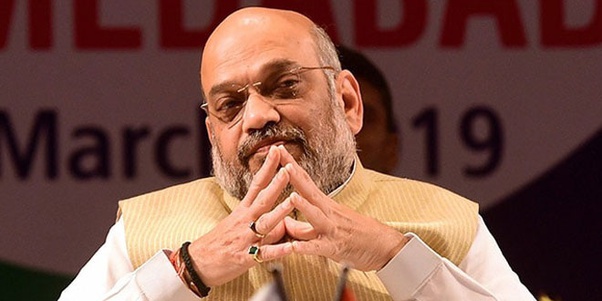
Gandhinagar, Jul 14: In a sharp attack on the Congress and the Gandhi-Nehru family, BJP president Amit Shah said on Saturday that a party which "failed" in establishing internal democracy can never preserve India's democracy.

Before the BJP came to power under the leadership of Prime Minister Narendra Modi in 2014, India was lagging behind other countries in most key areas such as economic growth, agriculture and on social sector indicators, he said.

However in the past four years, things have improved considerably, Shah said, addressing the audience at 'Youth Parliament' organised in the Karnavati University here.

"Before 2014, a particular party remained in power for the maximum period after Independence. But the way these governments functioned, a large part of the population remained deprived of development.

"These people had a feeling that independence brought no benefit for them," he said, without taking the name of the Congress party.

He then highlighted the achievements of the BJP-led government at the Centre.

"After assuming office (in May 2014), the first task Modiji took up was to uplift 50 crore people. In these four years, he brought 30 crore citizens into the formal economy by opening their bank accounts. More than 4.5 crore women were given LPG connections, while 7.5 crore toilets were built during that period," Shah said.

Continuing his attack on the Congress, the BJP chief said though many people sacrificed their lives during the freedom struggle, attempts were made to give credit for Independence to one party or a particular family.

"The party which came to power immediately after Independence has abolished internal democracy in the party. It has become family-centric. A party which has failed to preserve its own internal democratic structure can never preserve the country's democracy," Shah said.

"If we want to preserve democracy in our country, we must establish internal democracy in politics. Since that did not happen in the past, our country could not achieve desired results post independence," the BJP chief said.

Shah said the Indian Space Research Organisation realised its full potential after the Modi government came to power. This was reflected in the ISRO sending a record number of satellites in space in one go in early 2017, he added.

"In the past, the ISRO used to launch one or two or a maximum 13 satellites at one go. But after Modiji came (to power), ISRO launched 104 satellites in one go, leaving the US behind.

"We did that with the same scientists and resources which were there in the past," Shah said.

Referring to the World Economic Forum meet in Davos earlier this year, he again targeted the Congress, saying previous prime ministers - most of them from the Congress party - were concerned about getting photos clicked with world leaders at the conclave.

"In the past, there existed no chance for Indian PMs to address the forum. But this time, despite the presence of many world leaders, Modiji got the privilege to inaugurate the meet and gave his speech in Hindi," he said.

Commenting on the surgical strikes across the LoC in Pakistan-occupied Kashmir, he said Modi's go-ahead to the armed forces for the 2016 raid put India in the league of nations such as the US and Israel, which are known to avenge the killing of their soldiers.

Shah urged the youth to join Modi's mission to build a New India by 2022.

The BJP leader said the New India will be a society free of casteism, poverty, community divisions, dynastic political system, corruption and politics of appeasement.

"Let's take a pledge to build a New India as envisaged by Modiji, who is the most charismatic and popular leader in the world. We all are lucky to have him at the helm of affairs in the country," Shah said.

Comments

Sharief Fairman
 - 
Sunday, 15 Jul 2018

BJP is openly declaring, INDIA is Hindu Rashtra,  No Democracy only Hindutva,   then how these stupid leaders talk about restoring democracy.

This is Hiprocracy on democracy. These people have no right to say on democracy where it is allergice for them.

God help us save our innocent citizens not falling prey into the dirty politics of these goonda party.


Add new comment

  • Coastaldigest.com reserves the right to delete or block any comments.
  • Coastaldigset.com is not responsible for its readers’ comments.
  • Comments that are abusive, incendiary or irrelevant are strictly prohibited.
  • Please use a genuine email ID and provide your name to avoid reject.
News Network
March 23,2020

Dubai, Mar 23: The United Arab Emirates announced on Monday it will temporarily suspend all passenger and transit flights amid the novel coronavirus outbreak.

The Emirati authorities "have decided to suspend all inbound and outbound passenger flights and the transit of airline passengers in the UAE for two weeks as part of the precautionary measures taken to curb the spread of the COVID-19", reported the official state news agency, WAM.

It said the decision -- which is subject to review in two weeks -- will take effect in 48 hours, adding: "Cargo and emergency evacuation flights would be exempt."

The UAE, whose international airports in Abu Dhabi and Dubai are major hubs, announced on Friday its first two deaths from the COVID-19 disease, having reported more than 150 cases so far.

Monday's announcement came hours after Dubai carrier Emirates announced it would suspend all passenger flights by March 25.

But the aviation giant then reversed its decision, saying it "received requests from governments and customers to support the repatriation of travellers" and will continue to operate passenger flights to 13 destinations.

Emirates had said it will continue to fly to the United Kingdom, Switzerland, Hong Kong, Thailand, Malaysia, the Philippines, Japan, Singapore, South Korea, Australia, South Africa, the United States and Canada.

"We continue to watch the situation closely, and as soon as things allow, we will reinstate our services," said the airline's chairman and CEO, Sheikh Ahmed bin Saeed Al-Maktoum.

Gulf countries have imposed various restrictions to combat the spread of the novel coronavirus pandemic, particularly in the air transport sector.

The UAE has stopped granting visas on arrival and forbidden foreigners who are legal residents but are outside the country from returning.

Comments

Add new comment

  • Coastaldigest.com reserves the right to delete or block any comments.
  • Coastaldigset.com is not responsible for its readers’ comments.
  • Comments that are abusive, incendiary or irrelevant are strictly prohibited.
  • Please use a genuine email ID and provide your name to avoid reject.
Agencies
July 29,2020

New Delhi, Jul 29: Calling touchdown of Rafale fighter aircraft at Ambala airbase as "historic day" for Indian Air Force and proud moment for India, Union Home Minister Amit Shah on Wednesday said that "world-class fighter jets will prove to be a game-changer".

In a series of tweets, Shah congratulated Prime Minister Narendra Modi, Defence Minister Rajnath Singh, Indian Air Force and the entire country on this "momentous day".

"Rafale touchdown is a historic day for our vigorous @IAF_MCC and a proud moment for India! These are the world's most powerful machines capable to thwart any challenge in the sky. I am sure Rafale will help our Air warriors to safeguard our skies with its mighty superiority," Shah said in a tweet.

"From speed to weapon capabilities, Rafale is way ahead! I am sure these world class fighter jets will prove to be a game changer. Congratulations to PM @narendramodi ji, DM @rajnathsingh ji, Indian Air Force and the entire country on this momentous day. #RafaleInIndia," he added.

Shah said that Modi government is committed to build India's defence capabilities.

"Induction of these next generation aircrafts is a true testimony of PM @narendramodi's resolve to make India a powerful and secure nation. Modi govt is committed to build on India's defence capabilities. I thank honourable PM for providing this unprecedented strength to our IAF," he tweeted.

Earlier today, the five French Rafale fighter jets touched down at Haryana's Ambala after covering a distance of nearly 7,000 km to join the Indian Air Force.

The jets were given a customary water salute upon their arrival at the airbase, some 220-km from the India-Pakistan border.

The formal induction ceremony of the aircraft would be held later. The aircraft would move out soon to another operational base for operational sorties.

The five Rafale fighter aircraft took off on Monday for India from an airbase in France.
Rafale has multi-directional radar system which can detect 40 targets at the same time in a range of over 100 Kms. It has advance radar warning receiver to identify hostile tracking system a towed decoy system to thwart incoming missile attacks.

Rafale will ensure that our pilots will not have to cross the border to strike the target, that is about 600 Km in enemy territory.

It will get French industrial support for 50 years. India had signed a deal worth over Rs 60,000 crore with France in September 2016 for 36 Rafales to meet the emergency requirements of the IAF.

Comments

Add new comment

  • Coastaldigest.com reserves the right to delete or block any comments.
  • Coastaldigset.com is not responsible for its readers’ comments.
  • Comments that are abusive, incendiary or irrelevant are strictly prohibited.
  • Please use a genuine email ID and provide your name to avoid reject.
Agencies
May 27,2020

New Delhi, May 27: India’s fourth recession since Independence, first since liberalisation, and perhaps the worst to date is here, according to rating agency, Crisil.

CRISIL sees the Indian economy shrinking 5 per cent in fiscal 2021 (on-year), because of the Covid-19 pandemic. The first quarter will suffer a staggering 25 per cent contraction.

About 10 per cent of gross domestic product (GDP) in real terms could be permanently lost. "So going back to the growth rates seen before the pandemic is unlikely in the next three fiscals", Crisil said.

Crisil has revised its earlier forecast downwards. "Earlier, on April 28, we had slashed our prediction to 1.8 per cent growth from 3.5 per cent growth. Things have only gone downhill since", it said.

While we expect non-agricultural GDP to contract 6 per cent, agriculture could cushion the blow by growing at 2.5 per cent.

In the past 69 years, India has seen a recession only thrice as per available data in fiscals 1958, 1966 and 1980. The reason was the same each time a monsoon shock that hit agriculture, then a sizeable part of the economy.

"The recession staring at us today is different," it added. For one, agriculture could soften the blow this time by growing near its trend rate, assuming a normal monsoon. Two, the pandemic-induced lockdowns have affected most non-agriculture sectors. And three, the global disruption has upended whatever opportunities India had on the exports front.

Economic conditions have slid precipitously since the April-end forecast of 1.8 per cent GDP growth for fiscal 2021 (baseline), Crisil said.

On the lockdown extension, it said that the government has extended the lockdown four times to deal with the rising number of cases, curtailing economic activity severely (lockdown 4.0 is ending on May 31).

The first quarter of this fiscal will be the worst affected. June is unlikely to see major relaxations as the Covid-19 affliction curve is yet to flatten in India.

"Not only will the first quarter be a washout for the non-agricultural economy, services such as education, and travel and tourism among others, could continue to see a big hit in the quarters to come. Jobs and incomes will see extended losses as these sectors are large employers," Crisil said.

CRISIL also foresees economic activity in states with high Covid-19 cases to suffer prolonged disruption as restrictions could continue longer.

A rough estimate based on a sample of eight states, which contribute over half of India's GDP, shows that their 'red zones' (as per lockdown 3.0) contributed 42 per cent to the state GDP on average regardless of the share of such red zones.

On average, the orange zones contribute 46 per cent, while the green zones where activity is allowed to be close to normal contribute only 12 per cent to state GDP.

The economic costs are higher than earlier expectations, according to Crisil. The economic costs now beginning to show up in the hard numbers are far worse than initial expectations.

Industrial production for March fell by over 16%. The purchasing managers indices for the manufacturing and services sectors were at 27.4 and 5.4, respectively, in April, implying extraordinary contraction. That compares with 51.8 and 49.3, respectively, in March.

Exports contracted 60.3 per cent in April, and new telecom subscribers declined 35 per cent, while railway freight movement plunged 35 per cent on-year.

"Indeed, given one of the most stringent lockdowns in the world, April could well be the worst performing month for India this fiscal," it said.

Added to that is the economic package without enough muscle. The government recently announced a Rs 20.9 lakh crore economic relief package to support the economy. The package has some short-term measures to cushion the economy, but sets its sights majorly on reforms, most of which will have payoffs only over the medium term.

"We estimate the fiscal cost of this package at 1.2 per cent of GDP, which is lower than what we had assumed in our earlier estimate (when we foresaw a growth in GDP)," it said.

"We believe a catch-up to the pre-crisis trend level of GDP growth will not be possible in the next three fiscals despite policy support. Under the base case, we estimate a 10 per cent permanent loss to real GDP (from the decadal-trend level), assuming average growth of about 7 per cent between fiscals 2022 and 2024," Crisil said.

Interestingly, after the Global Financial Crisis (GFC), a sharp growth spurt helped catch up with the trend within two years. GDP grew 8.2 per cent on average in the two fiscals following the GFC. Massive fiscal spending, monetary easing and swift global recovery played a role in a V-shaped recovery.

To catch-up would require average GDP growth to surge to 11 per cent over the next three fiscals, something that has never happened before.

The research said that successive lockdowns have a non-linear and multiplicative effect on the economy a two-month lockdown will be more than twice as debilitating as a one-month imposition, as buffers keep eroding.

Partial relaxations continue to be a hindrance to supply chains, transportation and logistics. Hence, unless the entire supply chain is unlocked, the impact of improved economic activity will be subdued.

Therefore, despite the stringency of lockdown easing a tad in the third and the fourth phases, their negative impact on GDP is expected to massively outweigh the benefits from mild fiscal support and low crude oil prices, especially in the April-June quarter. "Consequently, we expect the current quarter's GDP to shrink 25 per cent on-year," it said.

Counting lockdown 4.0, Indians have had 68 days of confinement. S&P Global estimates that one month of lockdown shaves 3 per cent off annual GDP on average across Asia-Pacific.

Since India's lockdown has been the most stringent in Asia, the impact on economic growth will be correspondingly larger.

Google's Community Mobility Reports show a sharp fall in movement of people to places of recreation, retail shops, public transport and workplace travel. While data for May shows some improvement in India, mobility trends are much below the average or baseline, and lower compared with countries such as the US, South Korea, Brazil and Indonesia.

Comments

Add new comment

  • Coastaldigest.com reserves the right to delete or block any comments.
  • Coastaldigset.com is not responsible for its readers’ comments.
  • Comments that are abusive, incendiary or irrelevant are strictly prohibited.
  • Please use a genuine email ID and provide your name to avoid reject.