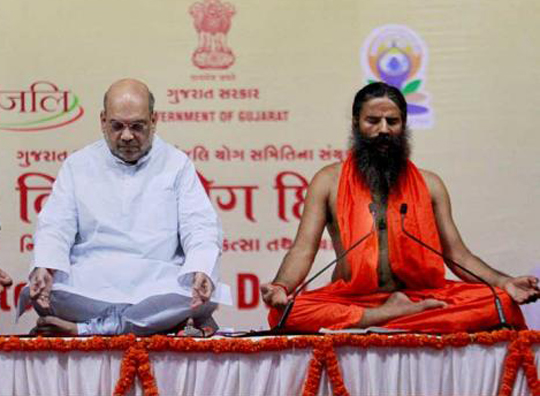
Amit Shah shed body weight, gained political weight: Ramdev

Agencies
June 21, 2017

Ahmedabad, Jun21: "Amit Shah has shed his body weight by doing yoga, but has increased his political weight substantially, giving tension to many."

amit

The politically-fraught comment on the BJP national president came from yoga guru Ramdev on the International Day of Yoga, which saw nearly three lakh people turning up to stretch, turn and twist their bodies.

Shah, along with Gujarat Chief Minister Vijay Rupani, was among the leaders who turned up at the GMDC ground here on the occasion.

"Amit bhai has lost significant weight in recent times. However, on the other side, his political weight has increased substantially. This must have given tension to many. I request them to do yoga to ease their stress," said Ramdev during a breather between two asanas.

Ramdev said the turnout here is all set to make it to the Guinness Book of World Records, whose officials were also present at the event to tabulate the number of participants.

Comments

Add new comment

  • Coastaldigest.com reserves the right to delete or block any comments.
  • Coastaldigset.com is not responsible for its readers’ comments.
  • Comments that are abusive, incendiary or irrelevant are strictly prohibited.
  • Please use a genuine email ID and provide your name to avoid reject.
News Network
March 19,2020

Mar 19: Amidst spiralling cases of COVID-19 in the country, Union Minister of State for Health and Family Welfare Ashwini Kumar Choubey on Thursday advocated "absorbing sunlight" as a possible precaution against coronavirus that has claimed over 8,000 lives globally.

Speaking to reporters outside parliament, Choubey said 10-15 minutes in the sun would build immunity as sunlight provides Vitamin D.

"From 11 am to 2 pm the sun is shining brightly. We should spend at least 10-15 minutes to absorb sunlight so that we get vitamin D which improves the immunity of our body and also kills such viruses. All should be aware of (this fact)," he said when asked about the spread of coronavirus.

COVID-19 cases in India climbed to 169 on Thursday after 18 fresh cases were reported from various parts of the country, according to the Union health ministry.

The cases include 25 foreign nationals -- 17 from Italy, 3 from the Philippines, two from the UK, one each belonging to Canada, Indonesia and Singapore.

The figure also includes three deaths reported from Delhi, Karnataka and Maharashtra so far.

According to the World Health Organisation, the novel coronavirus has killed over 8,000 people globally and infected more than two lakh.

Comments

Add new comment

  • Coastaldigest.com reserves the right to delete or block any comments.
  • Coastaldigset.com is not responsible for its readers’ comments.
  • Comments that are abusive, incendiary or irrelevant are strictly prohibited.
  • Please use a genuine email ID and provide your name to avoid reject.
News Network
May 15,2020

New Delhi, May 15: A group of doctors from the AIIMS, Raipur has recommended restrictions on the use of mobile phones in healthcare institutions amid the COVID-19 pandemic, warning that such devices can be a potential carrier of the virus and lead to infection among healthcare workers.

In a commentary published in the BMJ Global Health journal, the doctors stated that mobile phone surfaces are a peculiar 'high-risk' surface, which can directly come in contact with the face or mouth, even if hands are properly washed and one study indicates that some healthcare workers use phones every 15 minutes to two hours.

Though there have been many significant guidelines from various health organisations like the WHO and CDC focusing on prevention and control of disease, the commentary highlighted "there is no mention of or focus on mobile phones in these guidelines, including the WHO infection control and prevention guidelines, which recommends the use of handwashing".

In healthcare facilities, phones are used to communicate with other health care workers, look up recent medical guidelines, research drug interactions, understand adverse events and side effects, conduct telemedicine appointments and track patients among others, stated the document.

The document has been authored by Dr Vineet Kumar Pathak, Dr Sunil Kumar Panigrahi, Dr M Mohan Kumar, Dr Utsav Raj and Dr Karpaga Priya P from the Department of Community and Family Medicine.

"In their tendency to come in direct contact with the face, nose or eyes in healthcare settings, mobile phones are perhaps second only to masks, caps or goggles," the authors said.

"However, they are neither disposable nor washable like these other three, thus warranting disinfection. Mobile phones can effectively negate hand hygiene... There is growing evidence that mobile phones are a potential vector for pathogenic organisms," they said.

It is the need of the hour to address proper hygienic use of mobile phones in healthcare settings. In a study in India, almost 100 per cent of health workers of a tertiary care hospital used mobile phones in the hospital, but only 10 per cent of them had at any time wiped their mobile phones clean, the commentary published on April 22 said.

"The safest thing to do is to consider your phone as an extension of your hand, so remember you are transferring whatever is on your phone to your hand," Dr Pathak said.

Amidst the ongoing pandemic, two biggest mobile phone companies have uploaded their user support guidelines, saying that 70 pc isopropyl alcohol or Clorox Disinfecting Wipes can be used to gently wipe the exterior surface of phones in switched-off mode.

However, in doing so, the use of bleach or entry of moisture through any of the openings must be avoided, and any harsh chemical may damage the oleophobic screen, leading to damage in the touch screen sensitivity of the phone, the article stated.

Mobile phones are one of the most highly touched surfaces according to the Centers for Disease Control and Prevention (CDC), along with counters, tabletops, doorknobs, bathroom fixtures, toilets, keyboards, tablets and bedside tables.

The doctors recommended restriction on mobile phone usage in healthcare settings like hospital wards, ICUs and operation theatres, while advocating the use of headphones to prevent contact with the face while talking.

There should be no sharing of mobile phones, headphones or headsets of any kind. In addition, where available, the use of interdepartmental intercom facility may be promoted.

"Although hand hygiene and mobile phone use by a person are not mutually exclusive, it is high time to acknowledge the potential role of mobile phones in disease transmission cascade and to take evidence-based appropriate actions. This is especially important, given the ongoing COVID-19 pandemic," the authors said.

They said it is necessary for government agencies and the WHO to generate public awareness and to formulate suitable information, education and communication material on mobile phone hygiene, especially in healthcare settings.

AIIMS, New Delhi, Resident Doctors' Association (RDA) General Secretary, Dr Srinivas Rajkumar T said even outside health care settings, people should pay special attention to the usage of mobile phones as they carry them to all places.

"Phone and computer peripherals like keyboard, mouse, etc. should be covered with transparent plastic covers which can be cleaned without interfering with their function. Cleaning hands by soap or alcohol-based hand sanitizer before and after contact with phone and between contact with other surfaces can decrease the risk of potential transmission.

"Using a handsfree headset, dedicated operator/assistant per ward handling the communication via common line in hospitals while on duty can enable communication without compromising safety," Dr Srinivas said.


Comments

Add new comment

  • Coastaldigest.com reserves the right to delete or block any comments.
  • Coastaldigset.com is not responsible for its readers’ comments.
  • Comments that are abusive, incendiary or irrelevant are strictly prohibited.
  • Please use a genuine email ID and provide your name to avoid reject.
News Network
January 17,2020

Jan 17: India's "high power" communication satellite GSAT-30 was successfully launched in the early hours of January 17, the Indian Space Research Organisation (ISRO) said.

The satellite, aimed at providing high-quality television, telecommunications and broadcasting services, was launched onboard Ariane 5 rocket from French Guiana.

Blasting off from the Ariane Launch Complex in Kourou, a French territory located in northeastern coast of South America at 2.35 am IST, European space consortium Arianespace's Ariane 5 vehicle injected GSAT-30 into the orbit in a flawless flight lasting about 38 minutes.

Arianespace CEO Stéphane Israël tweeted about the successful launch of GSAT-30.

ISRO's U R Rao Satellite Centre Director P Kunhikrishnan, who was present in Kourou, congratulated the ISRO community and Arianespace team on the successful launch.

Calling it an "excellent start" to 2020 for ISRO with the launch, he said, "The mission team at the master control facility have already acquired the satellite and they will immediately complete the post launch operations...."

The 3,357-kg satellite, which was deployed from the lower passenger position of Ariane-5 launch vehicle (VA 251) into to geostationary transfer orbit (GTO), is configured on ISRO's enhanced I-3K Bus structure to provide communication services from Geostationary orbit in C and Ku bands.

The satellite derives its heritage from ISRO's earlier INSAT/GSAT satellite series, and is equipped with 12 C and 12 Ku band transponders.

GSAT-30 is to serve as replacement to the "aging" INSAT-4A spacecraft services with enhanced coverage, ISRO has said, adding the satellite provides Indian mainland and islands coverage in Ku-band and extended coverage in C-band covering Gulf countries, a large number of Asian countries and Australia.

With a mission life of 15 years, GSAT-30 is an operational communication satellite for DTH, television uplink and VSAT services.

The Bengaluru-headquartered ISRO has said the communication payload of GSAT-30 is specifically designed and optimised to maximise the number of transponders on the spacecraft bus.

According to the space agency, the spacecraft would be extensively used for supporting VSAT (Very Small Aperture Terminal) network, television uplinking and teleport services, digital satellite news gathering (DSNG), DTH television services, cellular backhaul connectivity and many such applications.

One Ku-band beacon downlink signal is transmitted for ground-tracking purpose, it added.

For its initial flight of 2020, Arianespace on its website said, it would orbit EUTELSAT KONNECT, a telecommunication satellite for the operator Eutelsat, along with GSAT-30, using an Ariane 5 launch vehicle from the Guiana Space Centre.

EUTELSAT KONNECT – which was produced by Thales Alenia Space for Eutelsat – was riding in the upper position of Ariane 5's payload arrangement, and was released first in the flight sequence at 27 minutes following liftoff.

Since the launch of India's APPLE experimental satellite on Ariane Flight L03 in 1981, Arianespace has orbited 24 satellites, including GSAT-30, for the Indian space agency.

Comments

Add new comment

  • Coastaldigest.com reserves the right to delete or block any comments.
  • Coastaldigset.com is not responsible for its readers’ comments.
  • Comments that are abusive, incendiary or irrelevant are strictly prohibited.
  • Please use a genuine email ID and provide your name to avoid reject.