Amit Shah unveils 5.5 lakh ‘thank you’ letters to PM Modi on CAA

News Network
January 12, 2020

Ahmedabad, Jan 12: Union Home Minister Amit Shah on Saturday unveiled over 5.5 lakh postcards written by Ahmedabad residents to Prime Minister Narendra Modi, thanking him for the Citizenship (Amendment) Act.

The postcards were stacked on the dais as Shah addressed a gathering of BJP workers who formed letters `C A A’ in front of him.

The state BJP claimed that the party’s “largest awareness campaign” in support of the CAA had found a place in Limca Book of Records and World Record of India.

“It is not just words but a letter of thanks written from the heart. Our public outreach programme is a reply to the lies being spread against the CAA,” Shah said addressing BJP workers from his former Assembly constituency Naranpura.

The BJP had promised to enact the CAA in its manifesto, he said, asking why the Congress did not oppose it then.

Targeting Rajasthan Chief Minister Ashok Gehlot, Shah said, “Congress has a government in Rajasthan. The Congress party in that state had promised that Hindus and Sikhs from Pakistan would be given citizenship.

“Why do you oppose it when we fulfill the promise made by you?” the Union home minister asked.

“In 2006 and 2009, Ashok Gehlot wrote a letter for the same. We covered Hindus, Sikhs, Parsis, Christians, all of them under the Act, you had only mentioned Hindus and Sikhs,” Shah claimed.

Saying that Prime Minister Narendra Modi, by bringing in the CAA, granted “human rights to lakhs of people”, he asked why opposition was against it.

He challenged “Rahul Baba” (Congress leader Rahul Gandhi), Mamata Banerjee and Arvind Kejriwal to show if any provision of the CAA took away the citizenship of Indian Muslims.

“There is no such provision. Lakhs and crores of people have come to India from Pakistan, Bangladesh to save their religion, their self-respect, to save themselves. Where else will they go?” he asked.

“From the first prime minister of the country Jawaharlal Nehru to the first home minister, first president of the country, and Mahatma Gandhi himself had said that whoever comes to India from Pakistan will be granted citizenship. Hindus, Sikhs, Buddhists and Jains coming from Pakistan have nowhere else to go,” he said.

Comments

sompady
 - 
Sunday, 12 Jan 2020

From this figure its clear that most of BJP mebers are aganst CAA, Becuase its below 0.5% from Indian population.

Add new comment

  • Coastaldigest.com reserves the right to delete or block any comments.
  • Coastaldigset.com is not responsible for its readers’ comments.
  • Comments that are abusive, incendiary or irrelevant are strictly prohibited.
  • Please use a genuine email ID and provide your name to avoid reject.
News Network
March 27,2020

Mumbai, Mar 27: The Reserve Bank of India (RBI) on Friday lowered the key repo rate by 75 basis points to 4.4 per cent in a bid to arrest the economic slowdown amid coronavirus (COVID-19) outbreak.
The reverse repo rate now stands at 4 per cent, down by 90 basis points, said RBI Governor Shaktikanta Das adding this has been done to make it unattractive for banks to passively deposit funds with the central bank and instead lend it to the productive sectors.
The six-member monetary policy committee (MPC) met on March 24, 25 and 27 and voted 4:2 in favour of the repo rate reduction. The MPC also decided to continue with the accommodative stance as long as it is necessary to revive growth and mitigate the impact of COVID-19 on the economy while ensuring that inflation remains within the target.
"The need of the hour is to shield the economy from the pandemic," said Das. "We need to mitigate the impact of coronavirus, revive economic growth and provide financial stability."
Repo rate is the rate at which a country's central bank lends money to commercial banks, and the reverse repo rate is the rate at which it borrows from them.
The RBI Governor further said that the economic growth and inflation projection will be highly contingent depending on the duration, spread and intensity of the pandemic.
"Global economic activity has come to a near standstill as COVID-19 related lockdowns and social distancing are imposed across a widening swathe of affected countries. Expectations of a shallow recovery in 2020 from 2019's decade low in global growth have been dashed," said Das.
"The outlook is now heavily contingent upon the intensity, spread and duration of the pandemic. There is a rising probability that large parts of the global economy will slip into recession," he said.
However, the RBI has injected liquidity of Rs 2.8 lakh crore via various instruments equal to 1.4 per cent of GDP. "Along with today's measures, liquidity measures equal to 3.2 per cent of GDP. The RBI will take continuous measures to ensure liquidity in the system."
The RBI governor has said that all banking institutions can offer a three-month moratorium on all loans for a period of three months. The RBI has also allowed banks to restructure the working capital cycle for companies without worrying that these will have to be classified as a non-performing asset (NPA).
The three-month moratorium will permit banks to avoid a large onset of NPAs during the 21-day lockdown and keep their books healthy.
Das said banks and other financial institutions should do all they can to keep credit flowing to economic agents facing financial stress on account of the isolation that the virus has imposed.
"Market participants should work with regulators like the RBI and the Securities and Exchange Board of India (SEBI) to ensure the orderly functioning of markets in their role of price discovery and financial intermediation," he said.

Comments

Add new comment

  • Coastaldigest.com reserves the right to delete or block any comments.
  • Coastaldigset.com is not responsible for its readers’ comments.
  • Comments that are abusive, incendiary or irrelevant are strictly prohibited.
  • Please use a genuine email ID and provide your name to avoid reject.
News Network
February 24,2020

Beijing, Feb 24: The lockdown of Guo Jing's neighbourhood in Wuhan -- the city at the heart of China's new coronavirus epidemic -- came suddenly and without warning.

Unable to go out, the 29-year-old is now sealed inside her compound where she has to depend on online group-buying services to get food.

"Living for at least another month isn't an issue," Guo told news agency, explaining that she had her own stash of pickled vegetables and salted eggs.

But what scares her most is the lack of control -- first, the entire city was sealed off, and then residents were limited to exiting their compound once every three days.

Now even that has been taken away.

Guo is among some 11 million residents in Wuhan, a city in central Hubei province that has been under effective quarantine since January 23 as Chinese authorities race to contain the epidemic.

Since then, its people have faced a number of tightening controls over daily life as the death toll from the virus swelled to over 2,500 in China alone.

But the new rules this month barring residents from leaving their neighbourhoods are the most restrictive yet -- and for some, threaten their livelihoods.

"I still don't know where to buy things once we've finished eating what we have at home," said Pan Hongsheng, who lives with his wife and two children.

Some neighbourhoods have organised group-buying services, where supermarkets deliver orders in bulk.

But in Pan's community, "no one cares".

"The three-year-old doesn't even have any milk powder left," Pan told news agency, adding that he has been unable to send medicine to his in-laws -- both in their eighties -- as they live in a different area.

"I feel like a refugee."

The "closed management of neighbourhoods is bound to bring some inconvenience to the lives of the people", Qian Yuankun, vice secretary of Hubei's Communist Party committee, said at a press briefing last week.

Authorities on Monday allowed healthy non-residents of the city to leave if they never had contact with patients, but restrictions remained on those who live in Wuhan.

Demand for group-buying food delivery services has rocketed with the new restrictions, with supermarkets and neighbourhood committees scrambling to fill orders.

Most group-buying services operate through Chinese messaging app WeChat, which has ad-hoc chat groups for meat, vegetables, milk -- even "hot dry noodles", a famous Wuhan dish.

More sophisticated shops and compounds have their own mini-app inside WeChat, where residents can choose packages priced by weight before orders are sent in bulk to grocery stores.

In Guo's neighbourhood, for instance, a 6.5-kilogramme (14.3-pound) set of five vegetables, including potatoes and baby cabbage, costs 50 yuan ($7.11).

"You have no way to choose what you like to eat," Guo said. "You cannot have personal preferences anymore."

The group-buying model is also more difficult for smaller communities to adopt, as supermarkets have minimum order requirements for delivery.

"To be honest, there's nothing we can do," said Yang Nan, manager of Lao Cun Zhang supermarket, which requires a minimum of 30 orders.

"We only have four cars," she said, explaining that the store did not have the staff to handle smaller orders.

Another supermarket told AFP it capped its daily delivery load to 1,000 orders per day.

"Hiring staff is difficult," said Wang Xiuwen, who works at the store's logistics division, adding that they are wary about hiring too many outsiders for fear of infection.

Closing off communities has split the city into silos, with different neighbourhoods rolling out controls of varying intensity.

In some compounds, residents have easier access to food -- albeit a smaller selection than normal -- and one woman said her family pays delivery drivers to run grocery errands.

Her compound has not been sealed off either, the 24-year-old told AFP under condition of anonymity, though they are limited to one person leaving at a time.

Some districts have implemented their own rules, such as prohibiting supermarkets from selling to individuals, forcing neighbourhoods to buy in bulk or not at all.

"In the neighbourhood where I live, the reality is really terrible," said David Dai, who is based on the outskirts of Wuhan.

Though his apartment complex has organised group-buying, Dai said residents were unhappy with price and quality.

"A lot of tomatoes, a lot of onions -- they were already rotten," he told , estimating over a third of the food had to be thrown away.

His family must "totally depend" on themselves, added the 49-year-old, who has resorted to saving and drying turnip skins to add nutrients to future meals.

The uncertainty of not knowing when the controls will be lifted is also frustrating, said Ma Chen, a man in his 30s who lives alone.

"I have no way of knowing how much (food) I should buy."

Comments

Add new comment

  • Coastaldigest.com reserves the right to delete or block any comments.
  • Coastaldigset.com is not responsible for its readers’ comments.
  • Comments that are abusive, incendiary or irrelevant are strictly prohibited.
  • Please use a genuine email ID and provide your name to avoid reject.
Agencies
August 8,2020

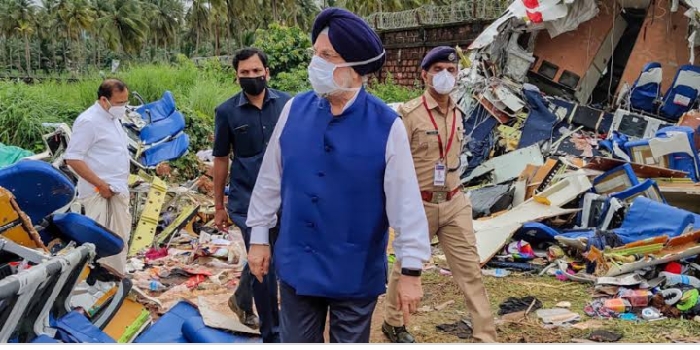
The Civil Aviation Ministry announced an initial assistance of Rs 10 lakh to the dependents of the deceased in the Kozhikode AIE plane crash, while the Kerala government also announced a compensation of Rs 10 lakh each.

Minister of Civil Aviation, Hardeep Singh Puri, who visited the mishap spot on Saturday, said that a detailed probe is already on and the pilot and co-pilot were highly experienced.

He also announced a compensation of Rs 2 lakh each to the injured and Rs. 50,000 each to those who suffered minor injuries. The other normal compensations would be decided in due course.

Puri said that Captain Deepak Vasant Sathe, aged 59, who commandeered the AIE flight, had a flying experience of 10,848 hours, while co-pilot Akhilesh Kumar, aged 32, had a flying experience of 1,723 hours.

"Deepak was one of the most distinguished and experienced pilots. He had a commanding experience of 6,662 hours and was commander of B-737 aircraft for 4,244 hours. He had also operated to Kozhikode international airport 27 times. He joined AIE in 2013 and prior to that he served with the IAF and HAL. He was a figher pilot and a recipient of prestigious sword of honour and a gold medalist," said Puri.

Puri said that even as the flight slipped down to around 35 feet, a major disaster was averted due to timely rescue operations. Local people played an exemplary role and the fire brigade's timely action of cutting the plane body and rescuing the passengers minimised the casualties, he said.

Chief Minister Pinarayi Vijayan also said that the local people and all rescue and relief agencies did a well co-ordinated job. The state government would also meet the entire treatment expenses of the injured.

Till Saturday afternoon, the total number of deaths was 18. While 149 were still in hospitals, 23 were discharged.

Comments

Add new comment

  • Coastaldigest.com reserves the right to delete or block any comments.
  • Coastaldigset.com is not responsible for its readers’ comments.
  • Comments that are abusive, incendiary or irrelevant are strictly prohibited.
  • Please use a genuine email ID and provide your name to avoid reject.