


Anatomy of Basirhat Violence

Ram Puniyani
July 16, 2017

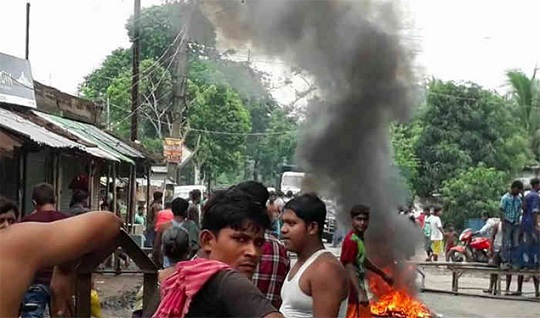
In an insane act of violence two people lost their lives in Basirhat (West Bengal, 04 07 2017). From last quite some time the social media is abuzz that WB is turning Islamist, Hindus are under great threat, their condition is becoming like that of Pundits in Kashmir. The section of TV media projected the view that WB is not safe for Hindus but is a heaven for Muslims. Angry posts are also declaring that Mamata is appeasing Muslims, Islamist Radicals are growing in Bengal with support from the Mamata Government etc.
basirhat-violence

This act of violence was provoked by a facebook post. (July 04, 2017) Once it was known in the area as to who has done the posting, they surrounded the house where the 17 year old boylived. The posting was derogatory to Muslims. As the atmosphere was building up the state machinery kept silent, till the aggressive mob of Muslims surrounded the house. Police intervention was too late. While the boy was saved despite the angry mob which was demanding that boy handed over to them. BJP leaders got hyperactive and visited the area as a delegation. They tried to enter the hospital to see the dead body of Kartik Chandra Ghosh (Age 65). Muslim attackers had killed him. This attempt of the BJP leaders was to derive political mileage from the situation as BJP claimed that Ghosh was President of one of the units of BJP, while Ghosh’s son denied it.

The Governor of West Bengal, K.N. Tripathi, reprimanded Mamata Bannerjee for the violence. Seeing his attitude Mamata got upset and called him as the one belonging to BJP block level leader. Same Governor has been called as a ‘dedicated soldier of Modi Vahini’ by one BJP leader Rahul Sinha. The communal violence has taken a political color, BJP accusing chief minister Mamata Banerjee of appeasement of Muslims while the ruling Trinamool Congress is alleging that BJP is out for inciting communal passions to benefit electorally. Surprisingly with this violence, where two people have lost their life, BJP is demanding the President’s rule in the state, while the law and order has already been restored within a week’s time.

The picture in Bengal is very complex. A section of Muslim leadership is repeatedly doing violence in response to ‘hurt sentiments’. Earlier also violence was unleashed by Muslims in Kaliachak, when one Kamlesh Tiwari had posted something offensive against Prophet Mohammad. The feeling of impunity enjoyed by this section of Muslim leadership is giving a big handle in the hands of Hindutva forces, for which this yet again is opportunity to polarize the society along religious lines. Here in Bengal they don’t have to create the issue of ‘Holy Cow’ or ‘Ram Temple’, it is being provided by this misguided section of Muslim leadership.

The picture is being created that Bengal is in the grip of Islamization as earlier Kaliachak violence and now this violence are being cited to show that Hindus are unsafe here. There was no loss of life in Kaliachak incident but yes there was loss of property, though. The core theme of BJP-RSS propaganda is built around Hindu victimization.

The role of government has been far from satisfactory in this violence, as it had time enough to control the situation but it did not. The law and order machinery must ensure prevention of the buildup of such incidents. By and large one can say that effective system can prevent most of the riots, irrespective of who is the offender. Here the Government should have acted in time.

Surely, Mamata’s alleged appeasement of Muslims does not apply in economic matters. The fact is that the economic conditions of Muslims of Bengal are among the worst in the country. The budgetary allocation for minorities in Bengal is much less than in many other states.

At the same time the communal polarization by the BJP is coming up with the menacing speed. In a state where Ram Navami (Lord Ram’s birth day celebration) was practically unheard of, this year around the Ram Navami procession was taken out with frightening swords in hands. Lord Ganesh festival is also being promoted in the state where Ma Durga had been the main deity so far.

Finally, who benefits from the violence? The studies of different scholars on communal violence in India like those by Paul Brass point out that there is an institutional riot mechanism, the core part of which is the impunity enjoyed by the offenders, the abysmal role of justice delivery system as a whole. Another significant study from Yale University tells us that in the places where communal violence takes place, in the long run at electoral level, it is BJP which stands to benefit. Those who appease the Muslim fundamentalists should note this and see to it that that, to discharge the constitutionally assigned duties are the essence of governance, irrespective of the community involved in the violence.

Let’s summarize the anatomy of violence in Bashirghat. Stage one, the offensive post on face book, two fundamentalist radical sections of Muslims unleash violence, number three the approach of the state government fails in preventing the violence. Number four BJP carries on from there and worsens the atmosphere by playing out videos which showed that Muslims were attacking Hindus in Basirhat. It turned out that videos were not from Bashirhat at all. They were taken from Gujarat violence of 2002. Also clips of a Bhojpuri films showing the molestation of Hindu women were recklessly circulated, the impression being given that this is happening in Basirhat. The same was claimed by BJP’s national general secretary Kailash Vijayvargiya, who said that he had news of Hindu women being raped in the affected area. And lastly drums are beaten about victimization of Hindus in Bengal. One just hopes it will not lead to polarization of communities leading in a state where so far communal violence had been reasonably under check.

Comments

Ashish
 - 
Tuesday, 18 Jul 2017

Mr. Lobo,

What is stopping you from filing a FIR or taking action against her. Stop fooling people wd mere words.

SYED
 - 
Tuesday, 18 Jul 2017

Shame on you BJP K'State MP's. Not even single protest was held due to Mob Lynchings,attacks on dalits and COW Rakshasas. Now they are protesting some unwanted issues to divert the mind of public and to as a breaking news for the chaddi channels. COWARD

Add new comment

  • Coastaldigest.com reserves the right to delete or block any comments.
  • Coastaldigset.com is not responsible for its readers’ comments.
  • Comments that are abusive, incendiary or irrelevant are strictly prohibited.
  • Please use a genuine email ID and provide your name to avoid reject.
Ram Puniyani
February 4,2020

As democracy is seeping in slowly all over the world, there is an organization which is monitoring the degree of democracy in the individual countries, The Economist Intelligence Unit. As such in each country there are diverse factors which on one hand work to deepen it, while others weaken it. Overall there is a march from theoretical democracy to substantive one. The substantive democracy will herald not just the formal equality, freedom and community feeling in the country but will be founded on the substantive quality of these values. In India while the introduction of modern education, transport, communication laid the backdrop of beginning of the process, the direction towards deepening of the process begins with Mahatma Gandhi when he led the non-cooperation movement in 1920, in which average people participated. The movement of freedom for India went on to become the ‘greatest ever mass movement’ in the World.

The approval and standards for democracy were enshrined in Indian Constitution, which begins ‘We the people of India’, and was adopted on 26th January 1950. With this Constitution and the policies adopted by Nehru the process of democratization started seeping further, the dreaded Emergency in 1975, which was lifted later restored democratic freedoms in some degree. This process of democratisation is facing an opposition since the decade of 1990s after the launch of Ram Temple agitation, and has seen the further erosion with BJP led Government coming to power in 2014. The state has been proactively attacking civil liberties, pluralism and participative political culture with democracy becoming flawed in a serious way. And this is what got reflected in the slipping of India by ten places, to 51st, in 2019. On the index of democracy India slipped down from the score of 7.23 to 6.90. The impact of sectarian BJP politics is writ on the state of the nation, country.

Ironically this lowering of score has come at a time when the popular protests, the deepening of democracy has been given a boost and is picking up with the Shaheen Bagh protests. The protest which began in Shaheen Bagh, Delhi in the backdrop of this Government getting the Citizenship amendment Bill getting converted into an act and mercilessly attacking the students of Jamia Milia Islamia, Aligarh Muslim University along with high handed approach in Jamia Nagar and neighbouring areas.  From 15th December 2019, the laudable protest is on.

It is interesting to note that the lead in this protest has been taken by the Muslim women, from the Burqa-Hijab clad to ‘not looking Muslim’ women and was joined by students and youth from all the communities, and later by the people from all the communities. Interestingly this time around this Muslim women initiated protest has contrast from all the protests which earlier had begun by Muslims. The protests opposing Shah Bano Judgment, the protests opposing entry of women in Haji Ali, the protests opposing the Government move to abolish triple Talaq. So far the maulanas from top were initiating the protests, with beard and skull cap dominating the marches and protests. The protests were by and large for protecting Sharia, Islam and were restricted to Muslim community participating.

This time around while Narendra Modi pronounced that ‘protesters can be identified by their clothes’, those who can be identified by their external appearance are greatly outnumbered by all those identified or not identified by their appearance.

The protests are not to save Islam or any other religion but to protect Indian Constitution. The slogans are structured around ‘Defence of democracy and Indian Constitution’. The theme slogans are not Allahu Akbar’ or Nara-E-Tadbeer’ but around preamble of Indian Constitution. The lead songs have come to be Faiz Ahmad Faiz’s ‘Hum Dekhenge’, a protest against Zia Ul Haq’s attempts to crush democracy in the name of religion. Another leading protest song is from Varun Grover, ‘Tanashah Aayenge…Hum Kagaz nahin Dikhayenge’, a call to civil disobedience against the CAA-NRC exercise and characterising the dictatorial nature of the current ruling regime.

While BJP was telling us that primary problem of Muslim women is Triple talaq, the Muslim women led movements has articulated that primary problem is the very threat to Muslim community. All other communities, cutting across religious lines, those below poverty line, those landless and shelter less people also see that if the citizenship of Muslims can be threatened because of lack of some papers, they will be not far behind in the victimization process being unleashed by this Government.

While CAA-NRC has acted as the precipitating factor, the policies of Modi regime, starting from failure to fulfil the tall promises of bringing back black money, the cruel impact of demonetisation, the rising process of commodities, the rising unemployment, the divisive policies of the ruling dispensation are the base on which these protest movements are standing. The spread of the protest movement, spontaneous but having similar message is remarkable. Shaheen Bagh is no more just a physical space; it’s a symbol of resistance against the divisive policies, against the policies which are increasing the sufferings of poor workers, the farmers and the average sections of society.

What is clear is that as identity issues, emotive issues like Ram Temple, Cow Beef, Love Jihad and Ghar Wapasi aimed to divide the society, Shaheen Bagh is uniting the society like never before. The democratisation process which faced erosion is getting a boost through people coming together around the Preamble of Indian Constitution, singing of Jan Gan Man, waving of tricolour and upholding the national icons like Gandhi, Bhagat Singh, Ambedkar and Maulana Azad. One can feel the sentiments which built India; one can see the courage of people to protect what India’s freedom movement and Indian Constitution gave them.

Surely the communal forces are spreading canards and falsehood against the protests. As such these protests which is a solid foundation of our democracy. The spontaneity of the movement is a strength which needs to be channelized to uphold Indian Constitution and democratic ethos of our beloved country.

Comments

Add new comment

  • Coastaldigest.com reserves the right to delete or block any comments.
  • Coastaldigset.com is not responsible for its readers’ comments.
  • Comments that are abusive, incendiary or irrelevant are strictly prohibited.
  • Please use a genuine email ID and provide your name to avoid reject.
Ram Puniyani
February 22,2020

This January 2020, it is thirty years since the Kashmiri Pundits’ exodus from the Kashmir valley took place. They had suffered grave injustices, violence and humiliation prior to the migration away from the place of their social and cultural roots in Kashmir Valley. The phenomenon of this exodus had been due to the communalization of militancy in Kashmir in the decade of 1980s. While no ruling Government has applied itself enough to ‘solve’ this uprooting of pundits from their roots, there are communal elements who have been aggressively using ‘what about Kashmiri Pundits?’, every time liberal, human rights defenders talk about the plight of Muslim minority in India. This minority is now facing an overall erosion of their citizenship rights.

Time and over again in the aftermath of communal violence in particular, the human rights groups have been trying to put forward the demands for justice and rehabilitation of the victim minority. Instead of being listened to those particularly from Hindu nationalist combine, as a matter of routine shout back, where were you when Kashmiri Pundits were driven away from the Valley? In a way the tragedy being heaped on one minority is being justified in the name of suffering of Pundits and in the process violence is being normalized. This sounds as if two wrongs make a right, as if the suffering Muslim minority or those who are trying to talk in defense of minority rights have been responsible for the pain of Kashmiri Pundits.

During these three, many political formations have come to power, including BJP, Congress, third front and what have you. To begin with when the exodus took place Kashmir was under President’s rule and V. P. Singh Government was in power at the center. This Government had the external support of BJP at that time. Later BJP led NDA came to power for close to six years from 1998, under the leadership of Atal Bihari Vajpayee. Then from 2014 it is BJP, with Narerda Modi as PM, with BJP brute majority is in power. Other components of NDA are there to enjoy some spoils of power without any say in the policies being pursued by the Government. Modi is having absolute power with Amit Shah occasionally presenting Modi’s viewpoints.

Those blurting, ‘what about Kashmiri Pundits?’ are using it as a mere rhetoric to hide their communal color. The matters of Kashmir are very disturbing and cannot be attributed to be the making of Indian Muslims as it is being projected in an overt and subtle manner. Today, of course the steps taken by the Modi Government, that of abrogation of Article 370, abolition of clause 35 A, downgrading the status of Kashmir from a state to union territory have created a situation where the return of Kashmiri Pundits may have become more difficult, as the local atmosphere is more stifling and the leaders with democratic potential have been slapped with Public Safety Act, where they can be interned for long time without any answerability to the Courts. The internet had been suspended, communication being stifled in an atmosphere where democratic freedoms are curtailed which makes solution of any problem more difficult.

Kashmir has been a vexed issue where the suppression of the clause of autonomy, leading to alienation led to rise of militancy. This was duly supported by Pakistan. The entry of Al Qaeda elements, who having played their role against Russian army in 1980s entered into Kashmir and communalized the situation in Kashmir. The initial Kashmir militancy was on the grounds of Kashmiriyat. Kashmiriyat is not Islam, it is synthesis of teachings of Buddha, values of Vedant and preaching’s of Sufi Islam. The tormenting of Kashmiri Pundits begins with these elements entering Kashmir.

Also the pundits, who have been the integral part of Kashmir Valley, were urged upon by Goodwill mission to stay on, with local Muslims promising to counter the anti Pundit atmosphere. Jagmohan, the Governor, who later became a minister in NDA Government, instead of providing security to the Pundits thought, is fit to provide facilities for their mass migration. He could have intensified counter militancy and protected the vulnerable Pundit community. Why this was not done?

Today, ‘What about Kashmiri Pundits?’ needs to be given a serious thought away from the blame game or using it as a hammer to beat the ‘Muslims of India’ or human rights defenders? The previous NDA regime (2014) had thought of setting up enclosures of Pundits in the Valley. Is that a solution? Solution lies in giving justice to them. There is a need for judicial commission to identify the culprits and legal measures to reassure the Pundit community. Will they like to return if the high handed stifling atmosphere, with large number of military being present in the area? The cultural and religious spaces of Pundits need to be revived and Kashmiryat has to be made the base of any reconciliation process.

Surely, the Al Qaeda type elements do not represent the alienation of local Kashmiris, who need to be drawn into the process of dialogue for a peaceful Kashmir, which is the best guarantee for progress in this ex-state, now a Union territory. Communal amity, the hallmark of Kashmir cannot be brought in by changing the demographic composition by settling outsiders in the Valley. A true introspection is needed for this troubled area. Democracy is the only path for solving the emigration of Pundits and also of large numbers of Muslims, who also had to leave the valley due to the intimidating militancy and presence of armed forces in large numbers. One recalls Times of India report of 5th February 1992 which states that militants killed 1585 people from January 1990 to October 1992 out of which 982 were Muslims and 218 Hindus.

We have been taking a path where democratic norms are being stifled, and the promises of autonomy which were part of treaty of accession being ignored. Can it solve the problem of Pundits?

Comments

Add new comment

  • Coastaldigest.com reserves the right to delete or block any comments.
  • Coastaldigset.com is not responsible for its readers’ comments.
  • Comments that are abusive, incendiary or irrelevant are strictly prohibited.
  • Please use a genuine email ID and provide your name to avoid reject.
Ram Puniyani
February 10,2020

Noam Chomsky is one of the leading peace workers in the world. In the wake of America’s attack on Vietnam, he brought out his classic formulation, ‘manufacturing consent’. The phrase explains the state manipulating public opinion to have the public approve of it policies—in this case, the attack of the American state on Vietnam, which was then struggling to free itself from French colonial rule.

In India, we are witness to manufactured hate against religious minorities. This hatred serves to enhance polarisation in society, which undermines India’s democracy and Constitution and promotes support for a Hindu nation. Hate is being manufactured through multiple mechanisms. For example, it manifests in violence against religious minorities. Some recent ghastly expressions of this manufactured hate was the massive communal violence witnessed in Mumbai (1992-93), Gujarat (2002), Kandhamal (2008) and Muzaffarnagar (2013). Its other manifestation was in the form of lynching of those accused of having killed a cow or consumed beef. A parallel phenomenon is the brutal flogging, often to death, of Dalits who deal with animal carcasses or leather.

Yet another form of this was seen when Shambhulal Regar, indoctrinated by the propaganda of Hindu nationalists, burned alive Afrazul Khan and shot the video of the heinous act. For his brutality, he was praised by many. Regar was incited into the act by the propaganda around love jihad. Lately, we have the same phenomenon of manufactured hate taking on even more dastardly proportions as youth related to Hindu nationalist organisations have been caught using pistols, while police authorities look on.

Anurag Thakur, a BJP minster in the central government recently incited a crowd in Delhi to complete his chant of what should happen to ‘traitors of the country...” with a “they should be shot”. Just two days later, a youth brought a pistol to the site of a protest at Jamia Millia Islamia university and shouted “take Azaadi!” and fired it. One bullet hit a student of Jamia. This happened on 30 January, the day Nathuram Godse had shot Mahatma Gandhi in 1948. A few days later, another youth fired near the site of protests against the CAA and NRC at Shaheen Bagh. Soon after, he said that in India, “only Hindus will rule”.

What is very obvious is that the shootings by those associated with Hindu nationalist organisations are the culmination of a long campaign of spreading hate against religious minorities in India in general and against Muslims in particular. The present phase is the outcome of a long and sustained hate campaign, the beginning of which lies in nationalism in the name of religion; Muslim nationalism and Hindu nationalism. This sectarian nationalism picked up the communal view of history and the communal historiography which the British introduced in order to pursue their ‘divide and rule’ policy.

In India what became part of “social common sense” was that Muslim kings had destroyed Hindu temples, that Islam was spread by force, and that it is a foreign religion, and so on. Campaigns, such as the one for a temple dedicated to the Hindu god Rama to be built at the site where the Babri masjid once stood, further deepened the idea of a Muslim as a “temple-destroyer”. Aurangzeb, Tipu Sultan and other Muslim kings were tarnished as the ones who spread Islam by force in the subcontinent. The tragic Partition, which was primarily due to British policies, and was well-supported by communal streams also, was entirely attributed to Muslims. The Kashmir conflict, which is the outcome of regional, ethnic and other historical issues, coupled with the American policy of supporting Pakistan’s ambitions of regional hegemony, (which also fostered the birth of Al-Qaeda), was also attributed to the Muslims.

With recurring incidents of communal violence, these falsehoods went on going deeper into the social thinking. Violence itself led to ghettoisation of Muslims and further broke inter-community social bonds. On the one hand, a ghettoised community is cut off from others and on the other hand the victims come to be presented as culprits. The percolation of this hate through word-of-mouth propaganda, media and re-writing of school curricula, had a strong impact on social attitudes towards the minorities.

In the last couple of decades, the process of manufacturing hate has been intensified by the social media platforms which are being cleverly used by the communal forces. Swati Chaturvedi’s book, I Am a Troll: Inside the Secret World of the BJP’s Digital Army, tells us how the BJP used social media to spread hate. Whatapp University became the source of understanding for large sections of society and hate for the ‘Other’, went up by leaps and bounds. To add on to this process, the phenomenon of fake news was shrewdly deployed to intensify divisiveness.

Currently, the Shaheen Bagh movement is a big uniting force for the country; but it is being demonised as a gathering of ‘anti-nationals’. Another BJP leader has said that these protesters will indulge in crimes like rape. This has intensified the prevalent hate.

While there is a general dominance of hate, the likes of Shambhulal Regar and the Jamia shooter do get taken in by the incitement and act out the violence that is constantly hinted at. The deeper issue involved is the prevalence of hate, misconceptions and biases, which have become the part of social thinking.

These misconceptions are undoing the amity between different religious communities which was built during the freedom movement. They are undoing the fraternity which emerged with the process of India as a nation in the making. The processes which brought these communities together broadly drew from Gandhi, Bhagat Singh and Ambedkar. It is these values which need to be rooted again in the society. The communal forces have resorted to false propaganda against the minorities, and that needs to be undone with sincerity.

Combating those foundational misconceptions which create hatred is a massive task which needs to be taken up by the social organisations and political parties which have faith in the Indian Constitution and values of freedom movement. It needs to be done right away as a priority issue in with a focus on cultivating Indian fraternity yet again.

Comments

Add new comment

  • Coastaldigest.com reserves the right to delete or block any comments.
  • Coastaldigset.com is not responsible for its readers’ comments.
  • Comments that are abusive, incendiary or irrelevant are strictly prohibited.
  • Please use a genuine email ID and provide your name to avoid reject.