Another stabbing at B C Road sparks fresh tension in Bantwal taluk

CD Network
July 5, 2017

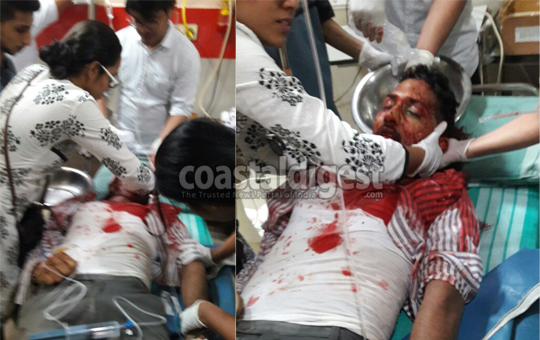
Bantwal, Jul 5: The stabbing spree has continued in communally sensitive Bantwal Taluk. On Tuesday night a gang of unidentified miscreants stabbed a youth at B C Road.

stab3

The victim has been identified as Sharath, a resident of Kandur in Sajipamunnur.

Sharath runs a laundry service by name 'Udaya' near BC Road flyover. The incident occurred around 9.30 p.m. when he was about to leave for home. Miscreants who arrived in a bike stabbed Sharath and fled the spot.

He was immediately admitted to a private hospital in Thumbey and later shifted to another hospital in Mangaluru. The condition of the victim is said to be critical. A few media report claimed that he was an RSS worker.

Sudheer Kumar Reddy, Superintendent of Police, DK, rushed to the spot. Police registered a case and launched a manhunt for the accused.

The stabbing that occurred in spite of the imposition of the prohibitory orders under Section 144 of CrPC has triggered fresh tensions in the taluk which witnessed several untoward incidents in past one and a half month.

Comments

ABDUL AZIZ
 - 
Saturday, 8 Jul 2017

Unecessary attaching innocents, its cowards doing this , they attach innocents,

ALLAH ALMIGHTY WILL DO JUSTIC

ABDUL AZIZ
 - 
Saturday, 8 Jul 2017

ALLAH ALMIGHTY will do the justice , no need to worry
truth will prevail and evil will perish soon

Arshi
 - 
Saturday, 8 Jul 2017

hope cop is not from RSS terrorist group?? By the way, where is Khader and Bava they will appear when everything got over with political dialogue and until today nothing they did for their community in spite of having the power in hand? Now the time to show the heropanthi

M M adyar
 - 
Saturday, 8 Jul 2017

Hope this is sufficient for cop to take action

Abdul khader
 - 
Saturday, 8 Jul 2017

Congratulations Ifti Saab,
Allaha Bless you

Arshi
 - 
Saturday, 8 Jul 2017

Parents, siblings, spouse, children, relatives lost their loved one and RSS targeted innocent lives. Sad indeed. All participating like victory...

Add new comment

  • Coastaldigest.com reserves the right to delete or block any comments.
  • Coastaldigset.com is not responsible for its readers’ comments.
  • Comments that are abusive, incendiary or irrelevant are strictly prohibited.
  • Please use a genuine email ID and provide your name to avoid reject.
News Network
April 2,2020

The Ayodhya police booked a senior journalist on Wednesday for raising questions on Uttar Pradesh Chief Minister Yogi Adityanath's visit to the Ram Janmabhoomi for a religious ceremony amid the lockdown over the novel coronavirus pandemic.

The FIR mentions a tweet by Siddharth Varadarajan, editor of news portal 'The Wire', where he said: "On the day the Tablighi Jamaat event was held, Adityanath insisted a large Ram Navami fair planned for Ayodhya from March 25 to April 2 would proceed as usual and that 'Lord Ram would protect devotees from the coronavirus."

Varadarajan had clarified in another tweet that it was "Acharya Paramhans, Hindutva stalwart and head of the official Ayodhya temple trust, who said Ram would protect devotees from coronavirus, and not Adityanath, though he allowed a public event on 25/3 in defiance of the lockdown and took part himself".

Taking the suo-motu cognizance, Faizabad Kotwali police station incharge Nitish Kumar Shrivastava registered an FIR under sections 188 (disobedience to order duly promulgated by public servant) and 505(2) (statements conducing to public mischief) of the Indian Penal Code for doing "disreputable" comment against the chief minister.

Statement by the Founding Editors of The Wire: pic.twitter.com/frw5oRxw18

— The Wire (@thewire_in) April 1, 2020
Reacting to it, Varadarajan termed the FIR "politically motivated, saying that the offences invoked were not even remotely made out.

Comments

Add new comment

  • Coastaldigest.com reserves the right to delete or block any comments.
  • Coastaldigset.com is not responsible for its readers’ comments.
  • Comments that are abusive, incendiary or irrelevant are strictly prohibited.
  • Please use a genuine email ID and provide your name to avoid reject.
News Network
May 7,2020

Bengaluru, May 7: Karnataka has revised its standard operating procedure (SOP) for international passengers. The first group of passengers will arrive in the state on May 8.

The number of categories has been reduced to two from three. Category A includes passengers symptomatic on arrival while Category B passengers are those asymptomatic on arrival. These are passengers who are either healthy or those having co-morbidities.

As per the revised SOP, the passenger will be released on the seventh day, if tested negative, to strict home quarantine for another seven days with stamping.

This norm is in contradiction to the Ministry of Home Affairs’ SOP for international passengers. As per the MHA’s SOP, the passengers (asymptomatic) will be under institutional quarantine for 14 days. Testing negative after 14 days, they will be allowed to go home and will undertake self-monitoring of their health for 14 more days.

On the contradiction, Pandey said, "We don't take chances as we rely on tests instead of just quarantining. Other states may be depending on just 14-day institutional quarantine."

"GOI SOP doesn't talk about Covid tests on international passengers. We have put an additional safety layer of three Covid tests on returnees -- one on arrival, second from 5-7 days and last on 12th day. This will ensure definite identification of positive cases even if they are asymptomatic and their subsequent treatment. We should look at the spirit behind the order," he added.

On the 14-day additional reporting period for category B, he said, "It is implied as category B patients should report to us for 14 days after their first 14-day quarantine period is over."

Medical Education Minister Dr K Sudhakar said that the State would follow the Centre’s norms.

Till Tuesday, Karnataka’s SOP had three categories. Under Category A (symptomatic), 14-day institutional quarantine at COVID-19 Health Care Centre was mandatory followed by 14-day reporting period. Under Category B (asymptomatic above 60 years with co-morbidities), seven-day institutional quarantine at hotel/hostel followed by seven-day home quarantine and 14-day reporting period had been recommended. The 14-day home quarantine and 14-day reporting period was mandatory for Category C (asymptomatic).

Comments

Add new comment

  • Coastaldigest.com reserves the right to delete or block any comments.
  • Coastaldigset.com is not responsible for its readers’ comments.
  • Comments that are abusive, incendiary or irrelevant are strictly prohibited.
  • Please use a genuine email ID and provide your name to avoid reject.
Media Release
February 14,2020

Veteran journalist P. Sainath has said that the nation is in a crisis. And this crisis is not limited to just the rural area. It has become a national crisis at various areas such as agriculture, education, economy, job creation etc.

He was delivering the endowment lecture on the topic ‘Indian democracy at the post-liberalization and post-truth era’ at Media Manthan 2020 organized by the PG department of journalism and mass communication at St Aloysius College (Autonomous). 

Mr Sainath said that the many policies adopted in the 90s led to India becoming unusually unequal. Referring to the speech Ambedkar had made at the Constituent Assembly while handing over the draft of the Constitution, Mr Sainath said, “Ambedkar had warned about the weakness of Indian democracy that liberty without equality allows the supremacy of a few over the multitude. Liberty, equality and fraternity must be kept together as we cannot have one without the other.” 

Mr Sainath stated that the agrarian crisis was no longer about the loss of productivity, employment or about farmer suicide; it was a societal, civilizational crisis. Commenting on the lopsided policies such as cow-slaughter ban, he explained how cow slaughter ban had adversely affected many industries due to their interdependency. While Muslims who slaughtered cows were rendered helpless, the cattle traders who were mostly OBCs lost their earnings as the cattle prices crashed. An important industry like Kolhapur sandals industry in Maharashtra went bankrupt as a result of the cow slaughter ban in Maharashtra. He said the policymakers had no idea how the rural industries were interconnected. Demonetisation too devastated the rural economy as 98 percent of rural transactions happen through cash. 

Mr Sainath also spoke about the crisis of inequality which affects the Dalits and the Adivasis far more than anyone else as 90 percent of the rural households take home less than Rs 10,000/- per month. “Women are yet another group whose labour is never counted in the gross domestic product. Women and girls globally do unpaid work which amounts to about 12.5 billion working hours per year. Monetarily speaking, this is worth 10.8 trillion dollars,” Mr Sainath added. 

Speaking about the crisis of jobs Mr Sainath said that major companies were laying off employees just to create more profits for the investors and the adoption of artificial intelligence in the industry would further destroy millions of jobs.

Rector of St Aloysius College Institutions Fr Dionysius Vaz SJ, Principal Dr (Fr) Praveen Martis SJ, HOD of Journalism and Mass Communication department Dr (Fr) Melwyn Pinto SJ were present.

‘Veerappan and Vijay Mallya’s business models are interesting!’

Addressing the gathering during his endowment lecture on Friday, Mr Sainath made an interesting comment on the so called ‘revenue model’. “Whenever I visit IIMs and IITs for lectures on my PARI project, the students there ask me what my revenue model for my project is. I tell them that I do not have a revenue model. In fact, journalism does not begin with a revenue model. Gandhiji, Ambedkar, Bhagat Singh were all great journalists. But they did not have a revenue model,” Mr Sainath said.

On a lighter note, he said that the best revenue model that he liked was that of forest brigand Veerappan and liquor baron Vijay Mallya. “Veerappan ruled the forest for forty years and from the top ministers to the villagers he could dictate terms and liver royally. Similarly, Mallya’s revenue model was to steal the banks and run away abroad and live like a king,” Mr Sainath added.

Journalism is not and can never be a business. It is a calling, he opined. While newspaper can be a business, television can be a business, journalism per se cannot be reduced to a business. “Unfortunately today, journalists are recruited on a contract basis and they have no bargaining power; and there are no unions to fight for their cause. Hence, they are at the mercy of the corporate media houses for their survival and are made to write stories that cannot be called journalism,” Mr Sainath said.

Answering a question as to the pressures he faced as a journalist, he said that external pressures from the government or others could be very well handled. It is the internal pressures from once own media house that journalists find it difficult to manage.


 

Comments

Add new comment

  • Coastaldigest.com reserves the right to delete or block any comments.
  • Coastaldigset.com is not responsible for its readers’ comments.
  • Comments that are abusive, incendiary or irrelevant are strictly prohibited.
  • Please use a genuine email ID and provide your name to avoid reject.