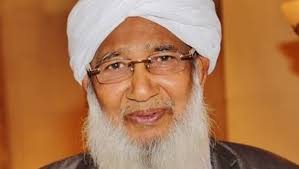
AP Aboobacker Musliyar praises Saudi king, condemns Madinah terror attack

[email protected] (CD Network)
July 14, 2016

Kasaragod, Jul 14: A P Aboobacker Musliyar, general secretary of All India Sunni Scholars Association, has praised the King of Saudi Arabia while condemning the recent terror attack in the holy city of Madinah and other parts of the kingdom.

apThese incidents (terror attacks) that occurred near by the Prophet's Mosque in Madinah, close to a mosque in Al-Qatif and in a car park in Jeddah are very painful to the whole Muslim world and there is no doubt they are criminal acts, he said.

He also added that such kind of criminal acts and terrorism are alien to Islam. He also said that it's the responsibility of the whole Muslim world to condemn these kinds of heinous crimes.

He commended the ways that Custodian of the Two Holy Mosques King Salman and the Saudi leadership has taken for saving the Kingdom from the evils of terrorism and infighting while unrest and insecurity prevail in many parts of the world.

He also emphasized the importance of the combined education — religious and secular — in a press meet in Jeddah recently while he was here for Umrah. He said that combined education is a must to meet the challenges of the modern world.

It's the only way to lead the future generation to the right path, he said, adding, that his institution has been following this model of education from the beginning.

Comments

ali
 - 
Saturday, 16 Jul 2016

AP Musliyar: muslim version of Modi.

he is very clever in lying and good material for Prime Minister Post.

ali
 - 
Saturday, 16 Jul 2016

Musliyaar should be educated regarding Uroos festival and other shirk. Nobody discuss AP, so he himself coming infront of camera to get the publicity.

He was silent during the allegations on Naik.

RSS is planning to give BJP ticket in Kerala, because he is having the good relation with them and can be very useful to devide muslim votes.

Add new comment

  • Coastaldigest.com reserves the right to delete or block any comments.
  • Coastaldigset.com is not responsible for its readers’ comments.
  • Comments that are abusive, incendiary or irrelevant are strictly prohibited.
  • Please use a genuine email ID and provide your name to avoid reject.
News Network
March 30,2020

Bengaluru, Mar 30: The coronavirus scare has taken a toll on the poultry industry in Karnataka with many poultry farm owners culling the birds, insiders in the poultry industry said.

At least one lakh birds have been culled in the last one week, the sources said.

Ever since the news spread about novel coronavirus spreading rapidly, the poultry industry started feeling the heat.

The lockdown spelt further trouble for the industry with reduced business compelling farm owners to go in for the culling.

According to Muddukrishna of C N Nischchith Enterprises, a live chicken dealer in Bengaluru, the culling had taken place in Shivamogga, Kolar and other places.

"There is a drastic decline in business. There are neither customers nor enough supply of birds for sale. We are badly hit. There are many poultry farm owners who have incurred tremendous loss due to the lockdown," Muddukrishna told news agency.

Another major poultry industry owner, having his farms in Channapatna, Ramanagar, Anekal and surrounding places, said he had to get rid of at least 4,000 birds in each of these farms.

"This is not restricted to me alone. There are about 64 major poultry industries who have gone for the drastic measure of culling," said the farm owner.

He said in the last one week, at least one lakh birds have been culled as it was hard for them to maintain them.

"Each bird needs at least a kilogram of grains in three days to eat whereas each kg of poultry food costs about Rs 32. We have about two lakh birds in our farm. How can we maintain if there is no business," rued the poultry farm owner.

The industry has suffered a double whammy.

People gave up eating chicken following rumours that the novel coronavirus COVID-19 is similar to SARS, another virus.

Further, the lockdown has blocked the transportation of these birds, he added.

According to the farm owner, in the last one month, he had suffered a loss of around Rs 15 lakh and if the situation continues for the next three months, his condition would be beyond imagination.

Muddukrishna said the poultry farm association had given a memorandum to the animal husbandry and fisheries department seeking direction on the transportation of these birds.

Accordingly, the secretary in the department of Animal Husbandry and Fisheries A B Ibrahim issued a circular to all the city police commissioners, deputy commissioners of the district, superintendent of police and the CEO of Zilla Panchayath on Friday that the animal husbandry services have been declared as essential services.

Ibrahim said in his circular that the production of chicken birds, sheep, goat, pigs, etc in the farm and their transportation, manufacturing feed, liquid nitrogen meant for veterinary use and other items related to the Animal Husbandry should be permitted.

"Despite the order, our vehicles are stopped and drivers are harassed," alleged Muddukrishna.

Comments

Add new comment

  • Coastaldigest.com reserves the right to delete or block any comments.
  • Coastaldigset.com is not responsible for its readers’ comments.
  • Comments that are abusive, incendiary or irrelevant are strictly prohibited.
  • Please use a genuine email ID and provide your name to avoid reject.
Agencies
May 8,2020

Washington D.C., May 8: The prime time for brain development in a child's life is the first year, where the infant spends most of the time asleep. It is the time when neural connections form and sensory memories are encoded.

However, when sleep is disrupted, as occurs more often among children with autism, brain development may be affected, too.

New research led by the University of Washington finds that sleep problems in a baby's first 12 months may not only precede an autism diagnosis but also may be associated with altered growth trajectory in a key part of the brain, the hippocampus.

The study, which was published in the American Journal of Psychiatry, researchers report that in a sample of more than 400 taken of 6- to 12-month-old infants, those who were later diagnosed with autism were more likely to have had difficulty falling asleep.

It also states that this sleep difficulty was associated with altered growth trajectories in the hippocampus.

"The hippocampus is critical for learning and memory, and changes in the size of the hippocampus have been associated with poor sleep in adults and older children.

As many as 80 per cent of the children with autism spectrum disorder have sleep problems," said Annette Estes, director of the UW Autism Center and senior author of the study.

"In our clinical experience, parents have a lot of concerns about their children's sleep, and in our work on early autism intervention, we observed that sleep problems were holding children and families back," added Estes, who is also a UW professor of speech and hearing sciences.

"It could be that altered sleep is part-and-parcel of autism for some children. One clue is that behavioural interventions to improve sleep don't work for all children with autism, even when their parents are doing everything just right. This suggests that there may be a biological component to sleep problems for some children with autism," said Estes.

To consider links among sleep, brain development, and autism, researchers at the IBIS Network looked at MRI scans of 432 infants, surveyed parents about sleep patterns, and measured cognitive functioning using a standardized assessment.

At the outset of the study, infants were classified according to their risk for developing autism: Those who were at higher risk of developing autism -- about two-thirds of the study sample -- had an older sibling who had already been diagnosed.

Infant siblings of children with autism have a 20 per cent chance of developing autism spectrum disorder -- a much higher risk than children in the general population.

In the current study, 127 of the 432 infants were identified as "low risk" at the time the MRI scans were taken because they had no family history of autism.

They later evaluated all the participants at 24 months of age to determine whether they had developed autism. Of the roughly 300 children originally considered "high familial risk," 71 were diagnosed with autism spectrum disorder at that age.

Problems with sleep were more common among the infants later diagnosed with an autism spectrum disorder, as were larger hippocampi. No other subcortical brain structures were affected, including the amygdala, which is responsible for certain emotions and aspects of memory, or the thalamus, a signal transmitter from the spinal cord to the cerebral cortex.

The authors note that while parents reported more sleep difficulties among infants who developed autism compared to those who did not, the differences were very subtle and only observed when looking at group averages across hundreds of infants.

Sleep patterns in the first years of life change rapidly as infants transition from sleeping around the clock to a more adult-like sleep/wake cycle. Until further research is completed, Estes said, it is not possible to interpret challenges with sleep as an early sign of increased risk for autism.


Comments

Add new comment

  • Coastaldigest.com reserves the right to delete or block any comments.
  • Coastaldigset.com is not responsible for its readers’ comments.
  • Comments that are abusive, incendiary or irrelevant are strictly prohibited.
  • Please use a genuine email ID and provide your name to avoid reject.
News Network
May 10,2020

Gadag, May 9: It is the month of April, and the season of mangoes is very much here. However, the mango farmers of Gadag are suffering huge losses amid the coronavirus lockdown due to the absence of transportation facilities along with several other issues that have been impacting their business adversely.

Speaking to media persons, Vishwanath Odugowdar, a mango farmer said, "Due to transportation problems we are not being able to export mangoes to different countries. We are trying to sell them in nearby markets."

"We are not in a situation to pack, transport and export the mangoes to different countries as we did earlier especially 
when it comes to Alphonso mangoes which is one of the most loved varieties. So, we are packing mangoes at our place. Somehow this year we have got very good quality of mangoes," he added.

Farmers here are incurring huge losses as mandis and markets across the country are shut while the transport of Alphonso mangoes has also come to a halt owing to the lockdown.

The small and medium scale farmers in places like Gadag, Dharwad, Bagalkote in north Karnataka have started packing the mangoes themselves in their farms in a bid to sell the fruit themselves.

Comments

Add new comment

  • Coastaldigest.com reserves the right to delete or block any comments.
  • Coastaldigset.com is not responsible for its readers’ comments.
  • Comments that are abusive, incendiary or irrelevant are strictly prohibited.
  • Please use a genuine email ID and provide your name to avoid reject.