



Arab anti-terror quartet extends Qatar boycott as Doha rejects demands

Agencies
July 6, 2017

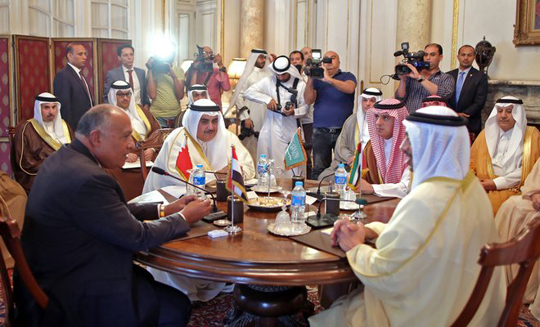
Cairo, Jul 6: Four Arab states calling for combating terrorism vowed Wednesday to maintain their boycott of Qatar, criticizing its “negative” response to their list of demands to end the diplomatic crisis.
boycott

Doha’s response, they said, was “not serious” and betrayed Qatar’s “failure” to realize the gravity of the situation.

The announcement followed a meeting by foreign ministers from the four nations — Saudi Arabia, Egypt, the UAE and Bahrain — in Cairo, shortly after they said they had received Doha’s reply.

“The political and economic boycott will remain until Qatar changes its policies for the better," Saudi Foreign Minister Adel Al-Jubeir said.

Egypt’s Foreign Minister Sameh Shoukry told reporters Qatar’s response to the Arab states’ 13-point list of demands was “negative on the whole.” It did not “lay the foundations for Qatar’s abandonment of the policies it pursues. It’s a position that does not realize the gravity of the situation,” he added.

The ministers did not say what their next steps would be — that, they explained, would be announced after further consultations. They will meet next in Bahrain, but a date has yet to be set.

“We hope wisdom will prevail and Qatar will eventually make the right decisions,” added Shoukry, who said the four nations were acting against Qatar within the boundaries of international law as well as the interest to safeguard regional and international security.

Shoukry said Qatar’s policies could not be allowed to continue and vowed that Egyptian blood would not be shed in vain, a reference to deadly attacks by militants on Egyptian army and security forces.

UAE Foreign Minister Abdullah bin Zayed Al-Nahyan said Qatar was only interested in “destruction, incitement, extremism and terrorism,” rather than in good neighborly relations.

He added: “To defeat terrorism, we must confront extremism, we must confront hate speech, we must confront the harboring and sheltering of extremists and terrorists, and funding them… Unfortunately, we in this region see that our sister nation of Qatar has allowed and harbored and encouraged all of this.”

“Today’s meeting on Qatar was for coordination purposes and we will take full studied decisions later,” said Bahrain’s foreign minister, Khalid bin Ahmed Al Khalifa.

UN Secretary-General Antonio Guterres has sent UN political chief Jeffrey Feltman to the Gulf to discuss how the UN might work with regional partners to resolve the crisis.

UN spokesman Stephane Dujarric told reporters that Feltman has already been to the UAE and was in Kuwait, which is trying to mediate the conflict.

Dujarric says Feltman will be traveling to Doha.

US President Donald Trump, on Wednesday, discussed the Qatari crisis with Egypt’s President Abdel Fattah El-Sisi in a call. The US president called on all sides to negotiate constructively and reiterated the need for all countries to follow thorough on their commitments at the Riyadh Summit to stop terrorist financing and discrediting extremist ideology.

Comments

Add new comment

  • Coastaldigest.com reserves the right to delete or block any comments.
  • Coastaldigset.com is not responsible for its readers’ comments.
  • Comments that are abusive, incendiary or irrelevant are strictly prohibited.
  • Please use a genuine email ID and provide your name to avoid reject.
Agencies
February 16,2020

Al-Jawf, Feb 16: At least 31 people were killed and 12 others were injured here in the al-Maslub district in airstrikes by the Saudi-UAE-led military coalition on Saturday.

"Preliminary field reports indicate that as many as 31 civilians were killed and 12 others injured in strikes that hit al-Hayjah area of the al-Maslub district in al-Jawf governorate," said a statement from the office of the UN resident coordinator and humanitarian coordinator for Yemen.

According to Al Jazeera, the airstrike was conducted hours after the Yemeni Houthis said that they downed a Saudi fighter jet in the same region.

Commenting on the air raids, Lise Grande, the UN's humanitarian coordinator for Yemen, said: "We share our deep condolences with the families of those killed and we pray for the speedy recovery of everyone who has been injured in these terrible strikes."

"So many people are being killed in Yemen - it's a tragedy and it's unjustified. Under international humanitarian law, parties that resort to force is obligated to protect civilians," Grande was quoted as saying.

Comments

Add new comment

  • Coastaldigest.com reserves the right to delete or block any comments.
  • Coastaldigset.com is not responsible for its readers’ comments.
  • Comments that are abusive, incendiary or irrelevant are strictly prohibited.
  • Please use a genuine email ID and provide your name to avoid reject.
News Network
July 23,2020

Beirut, Jul 23: The pandemic will exact a heavy toll on Arab countries, causing an economic contraction of 5.7% this year, pushing millions into poverty and compounding the suffering of those affected by armed conflict, a U.N. report said Thursday.

The U.N.'s Economic and Social Commission for Western Asia expects some Arab economies to shrink by up to 13%, amounting to an overall loss for the region of $152 billion.

Another 14.3 million people are expected to be pushed into poverty, raising the total number to 115 million — a quarter of the total Arab population, it said. More than 55 million people in the region relied on humanitarian aid before the COVID-19 crisis, including 26 million who were forcibly displaced.

Arab countries moved quickly to contain the virus in March by imposing stay-at-home orders, restricting travel and banning large gatherings, including religious pilgrimages.

Arab countries as a whole have reported more than 830,000 cases and at least 14,717 deaths. That equates to an infection rate of 1.9 per 1,000 people and 17.6 deaths per 1,000 cases, less than half the global average of 42.6 deaths, according to the U.N.

But the restrictions exacted a heavy economic toll, and authorities have been forced to ease them in recent weeks. That has led to a surge in cases in some countries, including Lebanon, Iraq and the Palestinian territories.

Wealthy Gulf countries were hit by the pandemic at a time of low oil prices, putting added strain on already overstretched budgets. Middle-income countries like Jordan and Egypt have seen tourism vanish overnight and a drop in remittances from citizens working abroad.

War-torn Libya and Syria have thus far reported relatively small outbreaks. But in Yemen, where five years of civil war had already generated the world's worst humanitarian crisis, the virus is running rampant in the government-controlled south while rebels in the north conceal its toll.

Rola Dashti, the head of the U.N. commission, said Arab countries need to “turn this crisis into an opportunity” and address longstanding issues, including weak public institutions, economic inequality and over-reliance on fossil fuels.

“We need to invest in survival, survival of people and survival of businesses,” she said.

Comments

Add new comment

  • Coastaldigest.com reserves the right to delete or block any comments.
  • Coastaldigset.com is not responsible for its readers’ comments.
  • Comments that are abusive, incendiary or irrelevant are strictly prohibited.
  • Please use a genuine email ID and provide your name to avoid reject.
News Network
July 9,2020

Dubai, Jul 9: The Government of India has announced an additional 104 special repatriation flights from the UAE to India as part of the Vande Bharat Mission, Phase 4 from July 15 - 31.

According to a flight schedule listed on the Ministry of External Affairs (MEA) website, national carriers Air India and Air India Express flights have been scheduled to various cities in 10 Indian states. Each flight has a capacity of 177 passengers.

Vande Bharat Phase 4 officially began on July 3, and in an earlier press briefing Anurag Srivastava, spokesperson of India's Ministry of External Affairs had said 'Phase 4 will focus on repatriation of Gulf-based Indians.

The new additional flights have been organised to cities in Tamil Nadu, Maharashtra, Delhi, Telangana, Punjab, Haryana, Kerala, Uttar Pradesh, Karnataka, and Rajasthan, according to the MEA schedule. To the joy of expats from Maharashtra, at least seven flights have been planned to Mumbai, which has been a less serviced state since the start of the Vande Bharat Mission.

Consul Press, Information, and Culture, Consulate General of India in Dubai Neeraj Agarwal said, "Approximately 100 repatriation flights are planned for the next 23 days, including 50 from Dubai and Sharjah each. If all flights are full, we are looking to evacuate anything between 17,000 to 18,000 passengers in the coming days."

Booking for the newly announced flights will open soon, said Agarwal. "Some of them are already open, and others will be open in the next few days. However, a few flights are subject to slot approvals," he explained.

Commenting on the possibility of flights from India to the UAE, Agarwal said, "We express hope that this too will happen soon."  The flight schedule can be seen here: https://www.mea.gov.in/phase-4.htm

Comments

Hurrah, that's what I was exploring for, what a information! existing here
at this blog, thanks admin of this web site.

Add new comment

  • Coastaldigest.com reserves the right to delete or block any comments.
  • Coastaldigset.com is not responsible for its readers’ comments.
  • Comments that are abusive, incendiary or irrelevant are strictly prohibited.
  • Please use a genuine email ID and provide your name to avoid reject.