


Arab states send Qatar 13 demands to end blockade

Agencies
June 23, 2017

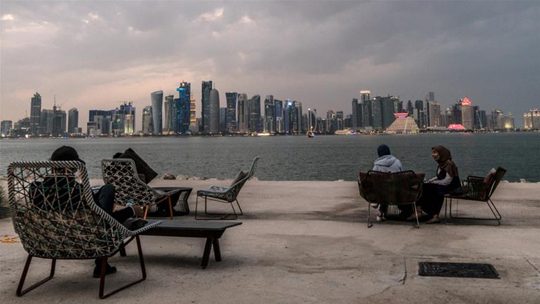
Dubai, Jun 23: Saudi Arabia and other Arab countries that have cut ties to Qatar have issued a list of demands to end the crisis, insisting that Qatar shuts down the Al Jazeera network and scales down ties with Iran.
qatar

In the 13-point list, the countries also demand that Qatar sever all alleged ties with the Muslim Brotherhood and with other groups including Hezbollah, al-Qaeda and ISIL (also known as ISIS) group.

Saudi Arabia, Egypt, the United Arab Emirates and Bahrain cut ties to Qatar this month over allegations the country funds terrorism - an accusation that Qatar denies.

Those countries have now given Qatar 10 days to comply with all of the demands, which also include paying an unspecified sum in compensation.

According to the list, Qatar must refuse to naturalise citizens from the four countries and "revoke Qatari citizenship for existing nationals where such citizenship violates those countries' laws".

Earlier this week, US Secretary of State Rex Tillerson insisted that Qatar's neighbours provide a list of demands that was "reasonable and actionable".

The Iran provisions in the document say Qatar must shut down diplomatic posts in Iran, expel any members of the Iran's Revolutionary Guard, and only conduct trade and commerce with Iran that complies with US sanctions.

The demands regarding Al Jazeera state that Qatar must also shut down all affiliates and other news outlets that Qatar funds, including Arabi21, Rassd, Al Araby Al Jadeed and Middle East Eye.

If Qatar agrees to comply, the list asserts that it will be audited once a month for the first year, and then once per quarter in the second year after it takes effect.

For the following 10 years, Qatar would be monitored annually for compliance.

The document does not specify what the countries will do if Qatar refuses to comply.

List of demands by Saudi Arabia, other Arab nations

1) Scale down diplomatic ties with Iran and close the Iranian diplomatic missions in Qatar, expel members of Iran's Revolutionary Guard and cut off military and intelligence cooperation with Iran. Trade and commerce with Iran must comply with US and international sanctions in a manner that does not jeopardise the security of the Gulf Cooperation Council (GCC).

2) Immediately shut down the Turkish military base that is currently being built, and halt military cooperation with Turkey inside Qatari territories.

3) Sever all ties to all the "terrorist, sectarian and ideological organisations," specifically the Muslim Brotherhood, ISIL, al-Qaeda, Fateh Al-Sham (formerly known as Nusra Front) and Lebanon's Hezbollah. Qatar needs to formally declare those entities as terrorist groups based on the list of groups that was announced by Saudi Arabia, Bahrain, UAE and Egypt, and concur with all future updates of this list.

4) Stop all means of funding for individuals, groups or organisations that have been designated as terrorists by Saudi Arabia, UAE, Egypt, Bahrain, US and other countries.
5) Hand over "terrorist figures," fugitives and wanted individuals from Saudi Arabia, the UAE, Egypt and Bahrain to their countries of origin. Freeze their assets, and provide any desired information about their residency, movements and finances.

6) Shut down Al Jazeera Network and its affiliate stations.

7) End interference in sovereign countries' internal affairs. Stop granting citizenship to wanted nationals from Saudi Arabia, UAE, Egypt and Bahrain. Revoke Qatari citizenship for existing nationals where such citizenship violates those countries' laws.

8) Qatar has to pay reparations and compensation for loss of life and other financial losses caused by Qatar's policies in recent years. The sum will be determined in coordination with Qatar.

9) Qatar must align itself with the other Gulf and Arab countries militarily, politically, socially and economically, as well as on economic matters, in line with an agreement reached with Saudi Arabia in 2014.

10) Submit all personal details of all the opposition members that Qatar supported and detail all support that Qatar has provided them in the past. Stop all contacts with the political opposition in Saudi Arabia, UAE, Egypt and Bahrain. Hand over all files detailing Qatar's prior contacts with and support for those opposition groups.

11) Shut down all news outlets that it funds, directly and indirectly, including Arabi21, Rassd, Al Araby Al Jadeed, Mekameleen and Middle East Eye, etc.

12) Agree to all the demands within 10 days of it being submitted to Qatar, or the list becomes invalid.

13) Consent to monthly audits for the first year after agreeing to the demands, then once per quarter during the second year. For the following 10 years, Qatar would be monitored annually for compliance.

Turkey's Defence Minister Fikri Isik said his country had no plans to review its military base in Qatar and that any demand for its closure would represent interference in the country's relations with the Gulf state.

Isik told broadcaster NTV that he had not yet seen a demand for the base to be shut.

"The base in Qatar is both a Turkish base and one that will preserve the security of Qatar and the region," Isik said in an interview on Friday.

"Re-evaluating the base agreement with Qatar is not on our agenda."

Interference in sovereignty

Al Jazeera's Hashem Ahelbarra said the list is "definitely going to be rejected by Qatar".

"Qatar has said it will only look into the demands once the sanctions are lifted," he said, adding that Qatar had already said that closing Al Jazeera was off the table.

"It is a matter of national sovereignty. Anything that is presented to the Qataris which it considers to be interference in its internal affairs is going to be dismissed," Ahelbarra said.

"Just yesterday the general sentiment we had was that perhaps the international community and GCC will turn toward restoring ties. But at this particular moment, I believe that there will be further escalation, mounting tension because of these demands.

"Specifically, this demand on compensation takes the region into unchartered territory. To ask for compensation, you have to have the Qatari government say; 'sorry, I've made mistakes', and look into every single instance where Qataris made mistakes.

"This is unprecedented in the Arab world. What if the Qataris say the Saudis have to pay compensation for every single civilian killed or innocent life taken all over the world. This is really surreal," Ahelbarra added.

Comments

Ahmed K.C.
 - 
Saturday, 24 Jun 2017

Has anyone survived for being against Israel and USA? the answer is "NO". So, be clever to make judgement.

Add new comment

  • Coastaldigest.com reserves the right to delete or block any comments.
  • Coastaldigset.com is not responsible for its readers’ comments.
  • Comments that are abusive, incendiary or irrelevant are strictly prohibited.
  • Please use a genuine email ID and provide your name to avoid reject.
Agencies
May 30,2020

Mumbai, May 30: Former Bollywood actress Zaira Wasim has deleted her Twitter and Instagram accounts after being heavily trolled for quoting from the Quran while talking about locust attacks.

"So We sent upon them the flood and locusts and lice and frogs and blood: Signs openly self explained: but they were steeped in arrogance -- a people given to sin. --Qur'an 7:133," Zaira had tweeted.

Soon, she started receiving hateful comments from netizens who interpreted her post as a justification of the locust attacks. They felt that Zaira was suggesting that the incident is God's way of expressing wrath.

Shortly after being deluged with such comments, Zaira Wasim deleted her Twitter and Instagram accounts.

However, a section of netizens continue to attack Zaira on her Facebook page, where she put up the same post.

Commenting on the post, a user wrote: "Lady you must have taken into account of those people of JK, Kerala and elsewhere who are also suffering from the virus. Moreover the crops which are damaged by locust had no name as to who will consume them. In this hours of crisis please post something which is positive and reflects your education."

Another user shared: "So according to you, with all due respect every year on the same time period, Allah send locust to India to destroy the crops of poor farmers who are not even involve in the industrial rise, who don't use vehicle to destroy the nature, and Allah send locust only to harm the poor farmers and not the rich one who actually destroy nature."

"So those farmers who lost there fields of crops and will probably go into debt and may also commit suicide, those farmers who feed the nation, who feed you and every one, are sinners?" asked yet another user.

However, there were a few on social media who felt Zaira had done nothing wrong.

"Quoting Quranic Verse is not a crime... Why is every Indian abusing @ZairaWasimmm. She didn't mention any particular nation or religion. I request everyone please stand with #ZairaWasim. She needs our support. #ISupportZairaWasim," goes a tweet.

Comments

Add new comment

  • Coastaldigest.com reserves the right to delete or block any comments.
  • Coastaldigset.com is not responsible for its readers’ comments.
  • Comments that are abusive, incendiary or irrelevant are strictly prohibited.
  • Please use a genuine email ID and provide your name to avoid reject.
Agencies
June 17,2020

Riyadh, Jun 17: Saudi Arabia is expected to scale back or call off this year's hajj pilgrimage for the first time in its modern history, observers say, a perilous decision as coronavirus cases spike.

Muslim nations are pressing Riyadh to give its much-delayed decision on whether the annual ritual will go ahead as scheduled in late July.

But as the kingdom negotiates a call fraught with political and economic risks in a tinderbox region, time is running out to organise logistics for one of the world's largest mass gatherings.

A full-scale hajj, which last year drew about 2.5 million pilgrims, appears increasingly unlikely after authorities advised Muslims in late March to defer preparations due to the fast-spreading disease.

"It's a toss-up between holding a nominal hajj and scrapping it entirely," a South Asian official in contact with Saudi hajj authorities said.

A Saudi official said: "The decision will soon be made and announced."

Indonesia, the world's most populous Muslim nation, withdrew from the pilgrimage this month after pressing Riyadh for clarity, with a minister calling it a "very bitter and difficult decision".

Malaysia, Senegal and Singapore followed suit with similar announcements.

Many other countries with Muslim populations -- from Egypt and Morocco to Turkey, Lebanon and Bulgaria -- have said they are still awaiting Riyadh's decision.

In countries like France, faith leaders have urged Muslims to "postpone" their pilgrimage plans until next year due to the prevailing risks.

The hajj, a must for able-bodied Muslims at least once in their lifetime, represents a major potential source of contagion as it packs millions of pilgrims into congested religious sites.

But any decision to limit or cancel the event risks annoying Muslim hardliners for whom religion trumps health concerns.

It could also trigger renewed scrutiny of the Saudi custodianship of Islam's holiest sites -- the kingdom's most powerful source of political legitimacy.

A series of deadly disasters over the years, including a 2015 stampede that killed up to 2,300 worshippers, has prompted criticism of the kingdom's management of the hajj.

"Saudi Arabia is caught between the devil and the deep blue sea," Umar Karim, a visiting fellow at the Royal United Services Institute in London, told AFP.

"The delay in announcing its decision shows it understands the political consequences of cancelling the hajj or reducing its scale."

"Buying time"

The kingdom is "buying time" as it treads cautiously, the South Asian official said.

"At the last minute if Saudi says 'we are ready to do a full hajj', (logistically) many countries will not be in a position" to participate, he said.

Amid an ongoing suspension of international flights, a reduced hajj with only local residents is a likely scenario, the official added.

A decision to cancel the hajj would be a first since the kingdom was founded in 1932.

Saudi Arabia managed to hold the pilgrimage during previous outbreaks of Ebola and MERS.

But it is struggling to contain the virus amid a serious spike in daily cases and deaths since authorities began easing a nationwide lockdown in late May.

In Saudi hospitals, sources say intensive care beds are fast filling up and a growing number of health workers are contracting the virus as the total number of cases has topped 130,000. Deaths surpassed 1,000 on Monday.

To counter the spike, authorities this month tightened lockdown restrictions in the city of Jeddah, gateway to the pilgrimage city of Mecca.

"Heartbroken"

"The hajj is the most important spiritual journey in the life of any Muslim, but if Saudi Arabia proceeds in this scenario it will not only exert pressure on its own health system," said Yasmine Farouk from the Carnegie Endowment for International Peace.

"It could also be widely held responsible for fanning the pandemic."

A cancelled or watered-down hajj would represent a major loss of revenue for the kingdom, which is already reeling from the twin shocks of the virus-induced slowdown and a plunge in oil prices.

The smaller year-round umrah pilgrimage was already suspended in March.

Together, they add $12 billion to the Saudi economy every year, according to government figures.

A negative decision would likely disappoint millions of Muslim pilgrims around the world who often invest their life savings and endure long waiting lists to make the trip.

"I can't help but be heartbroken -- I've been waiting for years," Indonesian civil servant Ria Taurisnawati, 37, told AFP as she sobbed.

"All my preparations were done, the clothes were ready and I got the necessary vaccination. But God has another plan."

Comments

Add new comment

  • Coastaldigest.com reserves the right to delete or block any comments.
  • Coastaldigset.com is not responsible for its readers’ comments.
  • Comments that are abusive, incendiary or irrelevant are strictly prohibited.
  • Please use a genuine email ID and provide your name to avoid reject.
Agencies
February 23,2020

Bengaluru, Feb 23: Bolstered by the Supreme Court's interim nod for the gazette notification of the Mahadayi Water Dispute Tribunal award by the Central government, Karnataka decided to allot funds for the drinking water project in the state's northwest region, an official said on Saturday.

"Funds will be allotted in the state budget for fiscal 2020-21 to complete the Kalasa-Banduri project across the Mahadayi river for supplying drinking water to the four drought-prone northern districts in the state," the official of the water resources department told media on anonymity.

As Chief Minister B.S. Yediyurappa also holds the finance portfolio, he has agreed to allocate funds for the project, held up for years in the legal battle with the neighbouring Goa and Maharashtra over the sharing of the river water among the three coastal states.

Yediyurappa is slated to present the state budget for the ensuing fiscal in the legislative assembly on March 2.

"We will resume the project work once the Centre notifies the award though it will be binding on the final outcome of the apex court's hearing the review petitions of Goa and Maharashtra against the Tribunal award," the official noted.

A division bench of Justice D.Y. Chandrachud and Justice Hemant Gupta on Thursday passed an interim order on the Tribunal award, allowing the central water resources ministry to notify it for implementation and posted the case for final hearing in July.

The Tribunal on August 14, 2018 allocated 13.42 thousand million cubic feet (tmcft) of the river water to the southern state for irrigation and drinking water supply to towns and villages across Bagalkot, Belagavi, Dharwad and Gadag districts, which are in the arid region of the Deccan plateau.

The four districts are about 400-550 km northwest of Bengaluru in the southern state.

Of the 13.42 tmcft water, 5.5 tmcft will be used in the river basin and for diversion into the depleted Malaprabha reservoir while the balance 7.92 tmcft will be utilized for hydel power generation instead of allowing the water to go into the Arabian Sea on the state's west coast through Goa.

Goa, which opposed Karnataka's demand for 36.66 tmcft, was allocated 24 tmcft, while Maharashtra got 1.3 tmcft.

The Tribunal assessed that 188.06 tmc feet water is available at 75 per cent dependability.

The three-member Tribunal is headed by Chairman Justice J.M. Panchal, Justice Viney Mittal and Justice P.S. Naayana.

The Union government had set up the inter-state Tribunal on November 16, 2010 for the djudication of the Mahadayi basin water allocation among the three riparian and contiguous states.

Goa and Maharashtra claimed 122.6 tmc feet and 6.35 tmc feet of the river water respectively.

The Tribunal, which commenced sittings on September 6, 2012, held 1,209 sittings for over 6 years.

Supreme Court senior counsel F.S. Nariman represented the state before the Tribunal to present its case.

The Tribunal's chairman and two members inspected the river basin area across the three coastal states from December 12-24, 2013.

The 77km-long Mahadayi or Mandovi river originates at Bhimgad in the Western Ghats in Belagavi district and flows into the neighbouring Goa through Maharashtra and joins the Arabian Sea off the west coast.

Though the river flows 29 km in Karnataka and 52 km in Goa, its catchment area is spread over 2,032 km in the southern state as against 1,580 km in the western state (Goa).

Comments

Add new comment

  • Coastaldigest.com reserves the right to delete or block any comments.
  • Coastaldigset.com is not responsible for its readers’ comments.
  • Comments that are abusive, incendiary or irrelevant are strictly prohibited.
  • Please use a genuine email ID and provide your name to avoid reject.