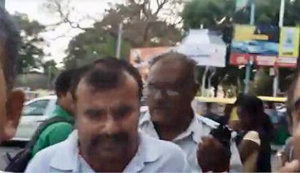
Armymen violate traffic norms, attack police for slapping fine

April 13, 2016

Bengaluru, Apr 13: A sub-inspector of police and a constable attached to Shivajinagar traffic police station suffered injuries after they were attacked by a group of armymen as they were fined for violating traffic norm at BRV Junction on Tuesday.armymen

Krishnamurthy, the SI and Sudheendra N (in pic), the constable, were rushed to Bowring Hospital for treatment of internal injuries, said the police.

Senior officers from the police and army visited the spot and hospital and discussed the incident in detail. The police have decided to furnish a copy of the investigation report to the army higher-ups for action from their end. The police have also decided to enclose video footage of the attack on the cops on duty, said the police.

The incident took place when Krishnamurthy and Sudheendra were on duty at BRV junction around 5.30 pm. Krishnamurthy noticed two men riding a bike on the one-way road. He stopped them and asked them to pay fine of Rs 100. K P Singh, the pillion rider, who was drunk, paid the fine and went away along with the rider, said the police.

Within minutes, Singh and a group of around 25 armymen returned and began an argument with Krishnamurthy for peanalising an armyman. In the melee, Singh slapped Krishnamurthy who sent a wireless message seeking assistance. Cops rushed to the spot, bundled up Singh in Hoysala vehicle and took him to the Commercial Street police station, said the police. Other armymen went back only to return with more men and assault Sudheendra. Upon receiving the information, senior police officers rushed to the spot and dispersed the armymen. They also informed the army higher-ups who rushed to the spot.

One of the armymen was a commissioned officer, but he did not stop others from assaulting a cop on duty. The army higher-ups have assured action from their end for attacking a public servant on duty. A case has been registered with Commercial Street police.

Comments

KhasaiKhaane
 - 
Wednesday, 13 Apr 2016

So How did people share on social media - \Film Stars get likes, How many likes for Army men..\" , \"1 Like - 1 Respect\".. etc..
Share this too. Let the country know the behavior of our well disciplined Army."

HONEST
 - 
Wednesday, 13 Apr 2016

How can they protect the country when they themselves not know what is wrong and right.

Add new comment

  • Coastaldigest.com reserves the right to delete or block any comments.
  • Coastaldigset.com is not responsible for its readers’ comments.
  • Comments that are abusive, incendiary or irrelevant are strictly prohibited.
  • Please use a genuine email ID and provide your name to avoid reject.
News Network
March 28,2020

Bengaluru, Mar 28: Karnataka has reported 10 new positive cases of COVID-19 between 5 pm yesterday and 8 am today, taking the tally to 74 in the state.

"Ten new COVID-19 cases have been reported between 5 pm yesterday and 8 am today, taking the total number to 74 in Karnataka, which includes three deaths and five cured/discharged persons," said the State Health Department on Saturday.

The total number of active COVID-19 cases in the country has climbed to 873, including 78 cured, discharged and migrated cases and 19 deaths, Ministry of Health and Family Welfare said on Saturday.

Comments

Add new comment

  • Coastaldigest.com reserves the right to delete or block any comments.
  • Coastaldigset.com is not responsible for its readers’ comments.
  • Comments that are abusive, incendiary or irrelevant are strictly prohibited.
  • Please use a genuine email ID and provide your name to avoid reject.
News Network
April 10,2020

The Indian government has advised expats in the UAE and the Gulf against travel till flight curbs to their home country are lifted. This follows the clamour from some quarters for special repatriation flights to India.

A senior Indian External Affairs Ministry (foreign ministry) official said Indian citizens are safe in the countries they reside in. Prime Minister Narendra Modi had spoken to leaders of Gulf countries who assured him of their welfare, the Indian foreign ministry said. Meanwhile, the Minister of State for External Affairs, V Muraleedharan,, according to a Malayalam news report, also ruled out special flights.

Responding to a question from Khaleej Times on blue-collar workers' angst following job losses, Vikas Swarup, Secretary West in the foreign ministry said, "Insofar as repatriation is concerned, as you are aware, government has advised against all travel, and Indians have been told to stay where they are, As and when the (21-day) lockdown is lifted, and normal civil aviation resumes, Indians wishing to come back will be able to do so."

According to the latest data from the Indian foreign affairs ministry, there are 1,400 cases of Covid-19 infections among Indian expats in the Gulf region.

Swarup said infected Indians are being treated and kept in isolation in the UAE and Gulf. "Our missions have established contact with all the community leaders and the situation is under control," he said.

Cargo flights operating as usual  

Cargo flights carrying fruits and vegetables from India to the Gulf have not been disrupted and would continue as usual, the diplomat said. "We are also helping with medicines based on the requests of Gulf countries," he said.

Eight million India expats live in the Gulf, including close to three million in the UAE. They account for more than 60 per cent of remittances to their home country.

India's long lockdown of 21 says ends next Tuesday. Indications are that it could be extended. Some states like Orissa have already stretched it till the end of the month and others are expected to follow suit.

The government believes that the disease is now concentrated in 75 districts, and the focus should be on these areas to manage and contain the virus.

Comments

Add new comment

  • Coastaldigest.com reserves the right to delete or block any comments.
  • Coastaldigset.com is not responsible for its readers’ comments.
  • Comments that are abusive, incendiary or irrelevant are strictly prohibited.
  • Please use a genuine email ID and provide your name to avoid reject.
Media Release
February 14,2020

Veteran journalist P. Sainath has said that the nation is in a crisis. And this crisis is not limited to just the rural area. It has become a national crisis at various areas such as agriculture, education, economy, job creation etc.

He was delivering the endowment lecture on the topic ‘Indian democracy at the post-liberalization and post-truth era’ at Media Manthan 2020 organized by the PG department of journalism and mass communication at St Aloysius College (Autonomous). 

Mr Sainath said that the many policies adopted in the 90s led to India becoming unusually unequal. Referring to the speech Ambedkar had made at the Constituent Assembly while handing over the draft of the Constitution, Mr Sainath said, “Ambedkar had warned about the weakness of Indian democracy that liberty without equality allows the supremacy of a few over the multitude. Liberty, equality and fraternity must be kept together as we cannot have one without the other.” 

Mr Sainath stated that the agrarian crisis was no longer about the loss of productivity, employment or about farmer suicide; it was a societal, civilizational crisis. Commenting on the lopsided policies such as cow-slaughter ban, he explained how cow slaughter ban had adversely affected many industries due to their interdependency. While Muslims who slaughtered cows were rendered helpless, the cattle traders who were mostly OBCs lost their earnings as the cattle prices crashed. An important industry like Kolhapur sandals industry in Maharashtra went bankrupt as a result of the cow slaughter ban in Maharashtra. He said the policymakers had no idea how the rural industries were interconnected. Demonetisation too devastated the rural economy as 98 percent of rural transactions happen through cash. 

Mr Sainath also spoke about the crisis of inequality which affects the Dalits and the Adivasis far more than anyone else as 90 percent of the rural households take home less than Rs 10,000/- per month. “Women are yet another group whose labour is never counted in the gross domestic product. Women and girls globally do unpaid work which amounts to about 12.5 billion working hours per year. Monetarily speaking, this is worth 10.8 trillion dollars,” Mr Sainath added. 

Speaking about the crisis of jobs Mr Sainath said that major companies were laying off employees just to create more profits for the investors and the adoption of artificial intelligence in the industry would further destroy millions of jobs.

Rector of St Aloysius College Institutions Fr Dionysius Vaz SJ, Principal Dr (Fr) Praveen Martis SJ, HOD of Journalism and Mass Communication department Dr (Fr) Melwyn Pinto SJ were present.

‘Veerappan and Vijay Mallya’s business models are interesting!’

Addressing the gathering during his endowment lecture on Friday, Mr Sainath made an interesting comment on the so called ‘revenue model’. “Whenever I visit IIMs and IITs for lectures on my PARI project, the students there ask me what my revenue model for my project is. I tell them that I do not have a revenue model. In fact, journalism does not begin with a revenue model. Gandhiji, Ambedkar, Bhagat Singh were all great journalists. But they did not have a revenue model,” Mr Sainath said.

On a lighter note, he said that the best revenue model that he liked was that of forest brigand Veerappan and liquor baron Vijay Mallya. “Veerappan ruled the forest for forty years and from the top ministers to the villagers he could dictate terms and liver royally. Similarly, Mallya’s revenue model was to steal the banks and run away abroad and live like a king,” Mr Sainath added.

Journalism is not and can never be a business. It is a calling, he opined. While newspaper can be a business, television can be a business, journalism per se cannot be reduced to a business. “Unfortunately today, journalists are recruited on a contract basis and they have no bargaining power; and there are no unions to fight for their cause. Hence, they are at the mercy of the corporate media houses for their survival and are made to write stories that cannot be called journalism,” Mr Sainath said.

Answering a question as to the pressures he faced as a journalist, he said that external pressures from the government or others could be very well handled. It is the internal pressures from once own media house that journalists find it difficult to manage.


 

Comments

Add new comment

  • Coastaldigest.com reserves the right to delete or block any comments.
  • Coastaldigset.com is not responsible for its readers’ comments.
  • Comments that are abusive, incendiary or irrelevant are strictly prohibited.
  • Please use a genuine email ID and provide your name to avoid reject.