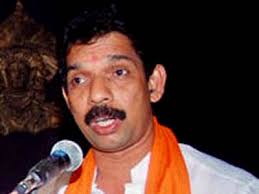
Arson threat: No case against Dakshina Kannada BJP MP until court's direction

[email protected] (CD Network)
January 3, 2017

Mangaluru, Jan 3: Mangaluru city police chief M Chandra Sekhar has said that a court's direction is must to register an FIR against Daskshina Kannada BJP MP Nalin Kumar Kateel as his offence wasnon-cognisable.'

1kateelHe said that the police have already submitted a report to the JMFC court in connection with two separate complaints against Mr Kateel under Section 506 of the IPC for his provocative speech at Konaje during a protest rally on Sunday.

The MP had threatened of setting Dakshina Kananda on fire if the police failed to arrest those who involved in the murder case of Karthik Raj, a local youth who was hacked to death on October 22 last year by unknown miscreants.

Mr Chandra Sekhar said: "We have taken note of the complaint and it amounts to non-cognisable offence under IPC 506. Under this section, offences are categorized as cognizable and non-cognizable.”

“Police can directly register complaint if the comment was cognizable. Under NCR (Non-cognizable Report), police will submit report to JMFC Court and the court will decide about further action," he said.

Also Read: Arson threat: FIR registered against BJP MP after court's direction

Comments

Dodanna
 - 
Tuesday, 3 Jan 2017

As a MP his duty is to take care of the citizen I/O that he still is standing with his old low grade showing rowdism. No need to wait for any judicial advise. Dept must book him non bailable case. Being a MP and behaving like a Desh Drohi he has no right to enter to our respectful parliament house.
This is the right time all peace loving Mangaloreans stand together and demand his resignation n send him behind bar at least for 5years period.
Then u see no pumpwell satyajith or puranik will open their mouth with communal speech.
Jai Hind!

Add new comment

  • Coastaldigest.com reserves the right to delete or block any comments.
  • Coastaldigset.com is not responsible for its readers’ comments.
  • Comments that are abusive, incendiary or irrelevant are strictly prohibited.
  • Please use a genuine email ID and provide your name to avoid reject.
News Network
March 15,2020

While it makes perfect sense for IT employees to work from remote locations via video conferencing and collaboration tools seamlessly - especially in the case of tech giants like Google or Microsoft -- workers from the non-IT companies and small and medium enterprises (SMBs) are the worst-hit in India as most of them have little or no clue about how these messaging and collaboration tools work amid the coronavirus pandemic.

Small companies -- from corporate to education verticals -- are scrambling to get their act together as new coronavirus threat has reached their premises, prompting them to send employees home who have age-old laptops, poor network and connectivity with no UPS backups and little knowledge about how to handle group chat and collaboration software like Zoom, Google Hangouts Meet, Microsoft Teams and Flock etc.

Instead of halting operations, however, businesses can choose to shift towards remote working methods with teaching non-IT staff on how to use the latest digital software to connect and work, say industry experts.

The training will take some time and may hamper productivity in the short run but is a win-win situation for the non-tech companies in the long run, in case any such global emergency arises in the future.

According to a latest report by Gartner, 54 per cent of HR leaders have cited that poor technology and/or infrastructure for remote working is the biggest barrier to effective remote working.

Sandy Shen, Senior Director Analyst, Gartner, says that with COVID-19 disrupting the business landscape, CIOs should relook at the digital fulfillment of market demand.

"The value of digital channels, products and operations is immediately obvious to companies everywhere right now. This is a wake-up call for organisations that have placed too much focus on daily operational needs at the expense of investing in digital business and long-term resilience," warned Shen.

Businesses that can shift technology capacity and investments to digital platforms will mitigate the impact of the outbreak and keep their companies running smoothly now, and over the long term.

"Videoconferencing, messaging, collaboration tools and document sharing are just a few examples of technologies that facilitate remote work. Additional bandwidth and network capacity may also be needed, given the increasing number of users and volume of communications," informed Shen.

The IT industry's apex body Nasscom has asked the government to relax norms for a month to allow work-from-home for technology and back-office employees as a measure to deal with the spread of Covid-19 in India.

Networking giant Cisco said that it has seen "significant growth" in the usage of its web conferencing and video-conferencing service Webex in India.

According to Muneer Ahmad, Business Head, ViewSonic India, due to COVID-19 pandemic, the corporate and educational sector is severely getting affected in the country.

"ViewSonic IFP has a cloud-based software which help teachers and corporates to connect through video conferencing to multiple people at the same time and can split the screen into six screens. It can also connect with various tools like Skype, Cisco WebEx, Zoom, Google Hangouts and GoToMeeting," Ahmad told IANS.

Co-working sector has also taken a hit and the industry is looking at several measures to tackle it -- from ensuring supply of juices rich in Vitamin C to supply of disinfectants and giving work from home facilities.

"The scheduled visits of the clients at our co-working offices have been postponed. Few of our clients have cancelled their outstation meetings and have now started audio/video conferencing for virtual meetings," said Nakul Mathur, MD, Avanta India.

According to reports, India has approximately 1,000 co-working locations (as of September 2019) and is the second-largest market for the co-working industry after China.

As India's first licensed B2B Virtual Network Operator, CloudConnect Communications offers a collaborative platform that allows companies to overcome the COVID-19 threat while maintaining seamless business continuity and optimum employee productivity.

"We offer a secure, robust, reliable, scalable and trackable mobile-first unified communication infrastructure that aids remote teleworking so that businesses can continue operating even under any unforeseen circumstances," said Gokul Tandon, Executive Chairman, CloudConnect Communications.

Comments

Add new comment

  • Coastaldigest.com reserves the right to delete or block any comments.
  • Coastaldigset.com is not responsible for its readers’ comments.
  • Comments that are abusive, incendiary or irrelevant are strictly prohibited.
  • Please use a genuine email ID and provide your name to avoid reject.
Agencies
January 12,2020

New Delhi, Jan 12: In a shocking revelation, one unemployed person committed suicide every hour during 2018 when a total of 1,34,516 suicides, including 92,114 male and 42,391 female, were reported in the country, NCRB's "Suicide in India 2018" says.

The latest data, issued by the National Crime Records Bureau (NCRB), which comes under Ministry of Home Affairs, last week reveals that a total of 12,936 unemployed persons committed suicide in 2018, which accounted for 9.6 per cent of the total suicides, and were of aged below 18 years to above 60 years.

Those below 18 years include 31 males and nine females while those between 18 and 30 years comprise 1,240 male and 180 female. A total of 868 male and 95 female were aged between 30 and 45 years. A number of 237 males and 21 females were aged between 45 and 60 years while 2,431 males and 310 females were above 60 years.

Of the total suicides by unemployed persons, males are 10,687 while the females are 2,249.

The highest number of suicides - 12.3 per cent - committed by unemployed persons were in Kerala (1,585 out of 12,936 suicides), 12.2 per cent in Tamil Nadu (1,579), 9.7 per cent in Maharashtra (1,260 suicides), 8.5 per cent in Karnataka (1,094 suicides) and 7 per cent in Uttar Pradesh (902 suicides).

"Each suicide is a personal tragedy that prematurely takes the life of an individual and has a continuing ripple effect, dramatically affecting the lives of families, friends and communities. Every year, more than 1 lakh people commit suicide in our country. There are various causes of suicides like professional/career problems, sense of isolation, abuse, violence, family problems, mental disorders, addiction to alcohol, financial loss, chronic pain etc," says the NCRB adding it collects data on suicides from police recorded suicide cases.

As per the NCRB, rate of suicides has been calculated using projected population for the non-census years whereas for 2011, the population of the Population Census 2011 was used.

The NCRB data says that a total of 1,34,516 suicides were reported in the country during 2018 showing an increase of 3.6 per cent in comparison to 2017 and the rate of suicides has increased by 0.3 during 2018 over 2017.

Government servants accounted for 1.3 per cent (1,707 out of 1,34,516) of the total suicide victims as compared to 6.1 per cent (8,246 out of 1,34,516) of total victims from Private Sector Enterprises.

Employees from Public Sector Undertakings formed 1.5 per cent (2,022 out of 1,34,516) of the total suicide victims, whereas students and unemployed victims accounted for 7.6 per (10,159 victims) of total suicides. Self-employed category accounted for 9.8 per cent of total suicide victims (13,149 out of 1,34,516).

A total of 10,349 persons involved in farming sector (consisting of 5,763 farmers and cultivators and 4,586 agricultural labourers) have committed suicide during 2018, accounting for 7.7 per cent of total suicides victims (1,34,516) in the country.

A total of 11 transgenders have committed suicide in which three were daily wage earners, one each were 'professionals and salaried persons' and 'unemployed persons' while six falls under 'Other Persons'.


Comments

Add new comment

  • Coastaldigest.com reserves the right to delete or block any comments.
  • Coastaldigset.com is not responsible for its readers’ comments.
  • Comments that are abusive, incendiary or irrelevant are strictly prohibited.
  • Please use a genuine email ID and provide your name to avoid reject.
News Network
April 1,2020

Bengaluru, Apr 1: Karnataka Health Minister B Sriramulu on Wednesday said that 200 people, out of 342 from the state who had attended the religious gathering at Markaz building in Delhi's Nizamuddin area, have been quarantined.

"200 people including four from Bengaluru and five from Belgaum, who participated in Tablighi Jamaat (in Delhi's Nizamuddin), have been quarantined. Total 342 people from Karnataka had attended the event," Sriramulu told reporters here.

The gatherings organised by the Tablighi Jamaat at the Markaz building in Nizamuddin came into the spotlight after multiple coronavirus cases were confirmed amongst those who attended the event held in March.
Twenty-four cases were reported from the national capital alone, apart from Telangana, the union territory of Andaman and Nicobar Islands amongst others.

The minister had earlier said that Bengaluru Urban and Mysuru have been identified among the prime 25 COVID-19 hotspots in the country.
Chikkaballapur, since the last fourteen days, has been emerging as another hotspot, according to Sriramulu.

The total number of coronavirus cases in India has risen to 1,637 after 240 new cases were reported in the country, according to the Ministry of Health and Family Welfare, on Wednesday.

The total number of active cases rose to 1466 in the country, while 132 people have been cured and discharged after receiving treatment, as of 9 am.

Comments

Add new comment

  • Coastaldigest.com reserves the right to delete or block any comments.
  • Coastaldigset.com is not responsible for its readers’ comments.
  • Comments that are abusive, incendiary or irrelevant are strictly prohibited.
  • Please use a genuine email ID and provide your name to avoid reject.