


Arvind Kejriwal's principal secretary, four others arrested in graft case

July 4, 2016

New Delhi, July 4: The CBI on Monday arrested Delhi Chief Minister Arvind Kejriwal's Principal Secretary Rajendra Kumar and four others in connection with a case of showing undue favours to a private company in award of government contracts worth over Rs 50 crore.kejriwal12
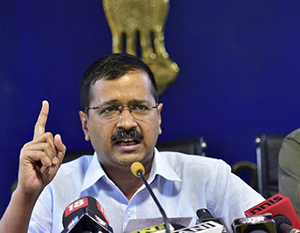
Kumar, a 1989 IAS officer of UT cadre, was called along with Tarun Sharma, a Deputy Secretary in Kejriwal's office, besides three other private persons for questioning at the CBI headquarters this morning.

After being questioned for half a day, the CBI decided to place the two officers under arrest along with a close aide of Kumar, Ashok Kumar and owners of a private firm Sandeep Kumar and Dinesh Gupta.

The CBI had registered a case against Kumar and others in December last year alleging that the officer had abused his official position by “favouring a particular firm in the last few years in getting tenders of Delhi government departments”.

The charges pressed by the CBI are under sections 120-B of IPC (criminal conspiracy), and 13(2), 13(1)(d) of the Prevention of Corruption Act (Criminal conspiracy, criminal misconduct etc) for allegedly favouring a private company –Endeavour Systems Pvt. Ltd.– in bagging five contracts.

The CBI alleged that the accused persons had entered into a criminal conspiracy and caused a loss of Rs 12 crore to the Delhi Government in award of contracts between 2007 and 2015, and claimed that the officials had taken “undue benefit” of over Rs three crore while awarding the contract.

“The CBI has today arrested five persons including a senior civil servant, Government of Delhi, another official of Delhi government, two directors of a Delhi-based private company and a private person.

“The allegations relate to bribery and abuse of official position by the said senior civil servant and others to favour a Delhi based private company in award of contracts of Delhi government,” CBI's Chief Press Information officer R K Gaur said, adding the arrested accused persons will be produced before court tomorrow.

This is the same case in which CBI had come under scathing criticism from court which directed it to return documents sought by the Delhi government seized during December 15, 2015 raids on Kejriwal's office.

“The CBI cannot retain the documents in the garb of the argument that investigation is in progress without whispering the fact in what manner they are related to the present case (against principal secretary Rajendra Kumar).

“The acceptance of vague reasons like investigation is still in progress implies that CBI is recognised with unbridled power to investigate even in violation of the relevant laws and regulations,” Special CBI Judge Ajay Kumar Jain had said in his order in January this year.

The case was registered on a complaint from former Delhi Dialogue Commission (DDC) member Ashish Joshi to the Delhi government's Anti-Corruption Branch (ACB) earlier last year. The complaint was forwarded to CBI in July last following which the agency registered an FIR after a five-month probe.

According to CBI, the five contracts were allegedly awarded to Endeavour Systems when Kumar was holding various posts in the Delhi government and include a project for the development of a comprehensive management system to Endeavour Systems without any tendering process.

The CBI alleged that as Secretary, Health, in the Delhi government, Kumar facilitated the award of a manpower project to the firm without inviting tenders.

The CBI claimed, as commissioner, trade and taxes, Kumar helped the firm bag a contract for development of software applications for his department.

He was also accused of committing irregularities in award of contract for a facility management system for the trade and taxes department. As secretary to the Chief Minister, he allegedly facilitated the award of Delhi Jal Board contract for enterprise resource planning to the firm.

Comments

Satyameva jayate
 - 
Monday, 4 Jul 2016

Election time....modijis politics....

Add new comment

  • Coastaldigest.com reserves the right to delete or block any comments.
  • Coastaldigset.com is not responsible for its readers’ comments.
  • Comments that are abusive, incendiary or irrelevant are strictly prohibited.
  • Please use a genuine email ID and provide your name to avoid reject.
News Network
March 28,2020

Bengaluru, Mar 28: Sun Tsu, in 'The Art of War' speaks of a skilful general who can subdue his enemy without any fighting. This constitutes the ultimate triumph which is referred to as stratagem. Today, we would need one such when we are faced with the '21-day corona challenge' for India.
Nearly four weeks back, Dr Jyothsna Rao, Dr Gururaj Rao and I sat across the OPD in the afternoon at HCG Bengaluru discussing our ongoing cancer immunology research. While on this topic, we drifted into the discussion on the coronavirus. During this engaging discussion, we wondered the similarity of the enigma between the virus and cancer. I paused to ask Dr Jyothsna and Dr Guru - how we wish we could do something against this virus.
Dr Jyothsna is a PhD from NCBS and had worked under Dr Ralph Steinman, physician and researcher from Rockefeller University, who won the Nobel Prize for his discovery of the dendritic cell and its role in adaptive immunity in 2011. Dr Gururaj is a molecular and cell biologist who did his PhD at the Chapel Hill, University of North Carolina and is the Director of iCrest.
Jyothsna while hearing our perplexing conversation on the covid intervened, "Yes, surely. I think we should take a break from cancer and focus on the innate and adaptive immunity role in COVID-19."
Thus began this sincere attempt to relook the human immune system from the eyes of the COVID-19.
We have 10 types of immune cells at the least which are widely dispersed in millions across the body. When our body is invaded by a foreign organism (bacteria, fungi or virus), these cells work with each other to destroy the invader.
Now, the question is - how do the immune cells talk to each other? They use small-molecule substances called cytokines (cyto means cells; kine means movement). There are many cytokines that are involved in work on the immune system. The most relevant for viruses are interferons.
Interferons (IFN) as the name reflects have an ability to interfere with the viral activity and stop their multiplication. These specialised signal proteins are released by our cells in response to a viral attack to forewarn other cells. They help build the antiviral proteins within the cells to kill the virus as it tries to invade the new cells.
Historically, interferons are a group of cytokines known to be potent antiviral agents against viruses and a hallmark cytokine induced by the host upon viral infections. Interferons possess unique immunoregulatory activities and are signature cytokines released by (TH1) T immune cells, which are crucial in viral infections.
As the outbreak of COVID-19 grapples us, an urgent need for finding strategies to combat the virus is growing. Coronaviruses (CoVs) are a group of RNA viruses. In patients infected with coronavirus, it was indicated that the activation of the IFN does not occur until 48 hours post-infection. Thus the delayed IFN-related antiviral response by the healthy cells leads to coronavirus evade the immune response.
Numerous studies have presented the success in defeating CoVs by the direct administration of IFNs. In a combination as a concoction, it was shown to synergistically inhibit the virus replication in vitro.
Moreover, it is understood that the earlier induction of IFNs in children although they have a less developed immune system could be the reason behind the children being least affected.
The key to success in reducing the disease fatality might be the stimulation of the immune responses to trigger IFN production at the very early stages of the disease, which might be done through the administration of IFN. Despite the evidence for the efficacy of IFNs in treating CoV-induced infections, the proper dosing and ideal timing for such interventions needs to be verified in clinical trials.
For the later stages of the diseases in advance stages where patients are on ventilator and have developed respiratory distress, we propose to utilise the mesenchymal cells derived from donor bone marrow that have been known to treat acute respiratory syndrome. Mesenchymal cells are known to possess anti-inflammatory activity and thus used often in autoimmune diseases.
With this scientific background, we have activated T cells from healthy donors, in a cGMP facility at iCrest - HCG hospital with an enriched cocktail of cytokines rich in Interferons. Injections of this cocktail we believe will result in a surge of cytokines in the body of the infected person and will boost his ability to fight the virus in the early phases. We are in the initial phases of this study and hope to be ready in the coming weeks with meaningful data on its potential utility.
Currently, it awaits government approvals (Union and state) and we have applied to central drugs authority for their initial evaluation and further directions.
As my Guru often expounded the philosophy of 'Seva' - the goal of education is knowledge, the end goal of knowledge is service. In this attempt to serve our fellow humans at this brink of unprecedented crisis, medical fraternity stands with you and promises to do our best for your safety.
We assure to exhaust every bit of our spirit in this fight against coronavirus. We have lost the sight of shores and travelled thus far, but that is the mandatory first step to cross the ocean. Are we going to succeed in this battle, is something only time will answer. 

Comments

Add new comment

  • Coastaldigest.com reserves the right to delete or block any comments.
  • Coastaldigset.com is not responsible for its readers’ comments.
  • Comments that are abusive, incendiary or irrelevant are strictly prohibited.
  • Please use a genuine email ID and provide your name to avoid reject.
News Network
May 29,2020

Bengaluru, May 29: Seven out of ten (72 per cent) workers in Karnataka reported having lost their employment during the COVID-19-induced lockdown, according to findings of a survey by Azim Premji University, in collaboration with ten civil society organisations.

The university said in a statement it conducted "a detailed" phone survey of 5,000 workers across 12 states in the country, to gauge the impact of the COVID-19 lockdown on employment, livelihoods, and access to government relief schemes.

The survey covered self-employed, casual, and regular wage and salaried workers and it released the findings for Karnataka on Thursday.

Seventy-six per cent of urban workers and 66 per cent of rural workers lost their employment, the survey findings said.

For non-agricultural self-employed workers and wage workers, who were still employed, average weekly earnings fell by two-third.

More than four in ten salaried workers (44 per cent) saw either a reduction in their salary or received no salary during the lockdown.

Six out of ten households reported that they did not have enough money to buy even a weeks worth of essential items, according to the survey.

Eight out ten households reported a reduction in food intake, while less than three in ten vulnerable households (27 per cent) in urban Karnataka received any form of cash transfer from the government, it said.

In summary, the disruption in the Karnatakas economy and labour markets is enormous. Livelihoods have been devastated at unprecedented levels during the lockdown.

The recovery from this could be slow and very painful, the statement said.

As a response to the findings of this survey, the team which has conducted the survey suggested a universalisation of the PDS to expand its reach and implementation of expanded rations for at least the next six months.

It suggested cash transfers equal to at least Rs.7000 per month for two months, and proactive steps like expansion of MGNREGA, introduction of urban employment guarantee, and investment in universal basic services, among others.

Comments

Add new comment

  • Coastaldigest.com reserves the right to delete or block any comments.
  • Coastaldigset.com is not responsible for its readers’ comments.
  • Comments that are abusive, incendiary or irrelevant are strictly prohibited.
  • Please use a genuine email ID and provide your name to avoid reject.
News Network
April 9,2020

Bengaluru, Apr 9: 10 new positive cases have been confirmed in Karnataka, apart from the recent fatality of an 80-year-old woman from Gadag district, the health department said on Thursday.

The fresh cases have been reported in the state from last evening to Thursday noon.

Till date, 191 COVID-19 positive cases have been confirmed, which includes 6 deaths and 28 discharges, the update said.

Among the 10 positive cases, eight are contacts of patients who have already tested positive- one each from Belagavi, Mandya and Chikkaballapura, two from Mysuru, and three from Bagalkote; while two from Bengaluru city are with a travel history to Delhi.

Three cases from Bagalkote are children- two boys of 4 and 13 years of age, and one girl of 9 years old.

The elderly woman died on April 8 in Gadag, the department said in its mid-day situation update.

Confirming that her reports tested positive on April 7, officials had said, she had a history of Severe Acute Respiratory Infection (SARI).

Comments

Add new comment

  • Coastaldigest.com reserves the right to delete or block any comments.
  • Coastaldigset.com is not responsible for its readers’ comments.
  • Comments that are abusive, incendiary or irrelevant are strictly prohibited.
  • Please use a genuine email ID and provide your name to avoid reject.