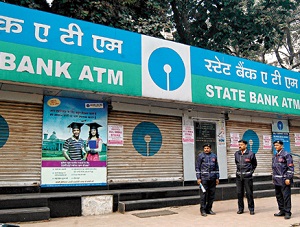
ATMs remain shut as banks replace old currency notes

November 9, 2016

New Delhi, Nov 9: All ATMs will remain shut today and tomorrow as banks replace the now declared invalid Rs 500 and Rs 1,000 notes with new currency papers.State-Bank

Last night, after the government's announcement of withdrawal of Rs 500 and Rs 1,000 notes, people rushed to ATMs to withdraw lower denomination valid currency notes. However, banks closed ATM operations past mid-night.

Banks are also closed today for cash balancing and stocking up of lower denomination Rs 50 and Rs 100 notes and high security new Rs 500 and Rs 2,000 notes.

Customers can deposit their old Rs 500 and Rs 1,000 notes in their bank accounts tomorrow, and also exchange it with lower denomination or the new security feature Rs 500 and Rs 2,000 notes but with a limit of Rs 20,000 a week.

The new high security feature Rs 500 and Rs 2,000 notes will initially be available at branches from tomorrow and at ATMs from November 11. Since most of the cash deposit machines are inside the branches, people can deposit their old currencies only tomorrow when the branches open.

Meanwhile, the government has cautioned people that since cash deposit in a account above certain limit will be monitored by Financial Intelligence Unit and tax authorities so one should refrain from someone else money.

Besides, depositing money in bank accounts, the Rs 500 and Rs 1,000 notes can also be exchanged with lower denomination currency notes at designated banks and post offices on production of valid government identity cards like PAN, Aadhaar and Election Card from November 10 to November 24 with a daily limit of Rs 4,000.

Comments

Rikaz
 - 
Wednesday, 9 Nov 2016

Good that corrupts are having a bad day....for aam aadmi its not a big deal.....RBI did a great and wonderful job....

Add new comment

  • Coastaldigest.com reserves the right to delete or block any comments.
  • Coastaldigset.com is not responsible for its readers’ comments.
  • Comments that are abusive, incendiary or irrelevant are strictly prohibited.
  • Please use a genuine email ID and provide your name to avoid reject.
News Network
April 18,2020

Bengaluru, Apr 18: Karnataka Health Minister B Sriramulu drew flak from his own party the BJP as well as the Congress for allegedly letting hundreds of people throng the Rupangudi Road in Ballari to collect food packets from him.

Visuals showed that the people came in hordes and fell on each other to collect the packets Sriramulu was distributing to the poor and needy as relief measure in the wake of lockdown.

The videos showed the minister standing with his team by the roadside and spreading out tables all along to distribute the food kit to the poor people.

Those in the queue had elderly people too.

A majority of people who rushed to grab the food packets did not bother to protect themselves with a mask.

"Whoever has done he has committed a blunder whether it is Sriramulu in Ballari or Anand Singh in Hospet.

All these elected representatives want to show that they are serviing the people in their constitutuency," said Karnataka BJP spokesperson Go Madhusudana.

Flaying the leaders of all political parties for defying norms, Madhusudana sad this has become fashionable for the leaders to perform 'cheap shows'.

He advised Sriramulu that it should have been done with door-to-door delivery of food packets instead of arranging it at the public place.

Congress spokesperson K E Radhakrishna said a case should be registered for defying regulations.

"I am all appreciation for Prime Minister Narendra Modi and Karnataka chief minister B S Yediyurappa who were the first to wake up and do something good for the people.

Now I feel sorry for them.

I wonder why they cannot control their own partymen.

People should file FIR against him (Sriramulu)," Congress spokesperson Prof K E Radhakrishna said

Slamming the alleged VVIP culture in the country, Radhakrishna said when the nation is facing a crisis, lavish marriages and grand birthday parties were organised. In the midst of all this health minister organises a food distribution mela, he added.

Attempts to reach the minister went in vain.

However, speaking to reporters at Ballari, Sriramulu admitted that the cases suddenly shot up in the state because of disregard to social distancing.

"People's support to lockdown is essential.

People have to maintain social distancing, without which we cannot control it," the minister said.

Comments

Add new comment

  • Coastaldigest.com reserves the right to delete or block any comments.
  • Coastaldigset.com is not responsible for its readers’ comments.
  • Comments that are abusive, incendiary or irrelevant are strictly prohibited.
  • Please use a genuine email ID and provide your name to avoid reject.
Agencies
February 20,2020

India ranked 77th on a sustainability index that takes into account per capita carbon emissions and ability of children in a nation to live healthy lives and secures 131st spot on a flourishing ranking that measures the best chance at survival and well-being for children, according to a UN-backed report.

The report was released on Wednesday by a commission of over 40 child and adolescent health experts from around the world. It was commissioned by the World Health Organization (WHO), UN Children's Fund (UNICEF) and The Lancet medical journal.

In the report assessing the capacity of 180 countries to ensure that their youngsters can survive and thrive, India ranks 77th on the Sustainability Index and 131 on the Flourishing Index, it said.

Flourishing is the geometric mean of Surviving and Thriving. For Surviving, the authors selected maternal survival, survival in children younger than 5 years old, suicide, access to maternal and child health services, basic hygiene and sanitation, and lack of extreme poverty.

For Thriving, the domains were educational achievement, growth and nutrition, reproductive freedom, and protection from violence.

Under the Sustainability Index, the authors noted that promoting today's national conditions for children to survive and thrive must not come at the cost of eroding future global conditions for children's ability to flourish.

The Sustainability Index ranks countries on excess carbon emissions compared with the 2030 target. This provides a convenient and available proxy for a country's contribution to sustainability in future.

The report noted that under realistic assumptions about possible trajectories towards sustainable greenhouse gas emissions, models predict that global carbon emissions need to be reduced from 39·7 giga­ tonnes to 22·8 gigatonnes per year by 2030 to maintain even a 66 per cent chance of keeping global warming below 1·5°C.

It said that the world's survival depended on children being able to flourish, but no country is doing enough to give them a sustainable future.

"No country in the world is currently providing the conditions we need to support every child to grow up and have a healthy future," said Anthony Costello, Professor of Global Health and Sustainability at University College London, one of the lead authors of the report.

"Especially, they're under immediate threat from climate change and from commercial marketing, which has grown hugely in the last decade," said Costello – former WHO Director of Mother, Child and Adolescent health.

Norway leads the table for survival, health, education and nutrition rates - followed by South Korea and the Netherlands. Central African Republic, Chad and Somalia come at the bottom.

However, when taking into account per capita CO2 emissions, these top countries trail behind, with Norway 156th, the Republic of Korea 166th and the Netherlands 160th.

Each of the three emits 210 per cent more CO2 per capita than their 2030 target, the data shows, while the US, Australia, and Saudi Arabia are among the 10 worst emitters. The lowest emitters are Burundi, Chad and Somalia.

According to the report, the only countries on track to beat CO2 emission per capita targets by 2030, while also performing fairly – within the top 70 – on child flourishing measures are: Albania, Armenia, Grenada, Jordan, Moldova, Sri Lanka, Tunisia, Uruguay and Vietnam.

"More than 2 billion people live in countries where development is hampered by humanitarian crises, conflicts, and natural disasters, problems increasingly linked with climate change," said Minister Awa Coll-Seck from Senegal, Co-Chair of the commission.

The report also highlights the distinct threat posed to children from harmful marketing.

Evidence suggests that children in some countries see as many as 30,000 advertisements on television alone in a single year, while youth exposure to vaping (e-cigarettes) advertisements increased by more than 250 per cent in the US over two years, reaching more than 24 million young people.

Studies in Australia, Canada, Mexico, New Zealand and the US – among many others – have shown that self-regulation has not hampered commercial ability to advertise to children.

Children's exposure to commercial marketing of junk food and sugary beverages is associated with purchase of unhealthy foods and overweight and obesity, linking predatory marketing to the alarming rise in childhood obesity, it said.

The number of obese children and adolescents increased from 11 million in 1975 to 124 million in 2016 – an 11-fold increase, with dire individual and societal costs, the report said.

To protect children, the authors call for a new global movement driven by and for children.

Specific recommendations include stopping CO2 emissions with the utmost urgency, to ensure children have a future on this planet; placing children and adolescents at the centre of global efforts to achieve sustainable development, the report said.

New policies and investment in all sectors to work towards child health and rights; incorporating children's voices into policy decisions and tightening national regulation of harmful commercial marketing, supported by a new Optional Protocol to the UN Convention on the Rights of the Child, it said.


Comments

Add new comment

  • Coastaldigest.com reserves the right to delete or block any comments.
  • Coastaldigset.com is not responsible for its readers’ comments.
  • Comments that are abusive, incendiary or irrelevant are strictly prohibited.
  • Please use a genuine email ID and provide your name to avoid reject.
coastaldigest.com news network
May 28,2020

Bengaluru, May 28: The Karnataka government has done away with previously mandatory COVID-19 testing for asymptomatic international travellers. 

The development comes a day after the government issued a circular, which allowed placing of international travellers into home quarantine if they had completed seven days of institutional quarantine.

A circular signed by Jawaid Akhtar, Additional Chief Secretary to the State Government, dated May 27, says that any “person who has completed seven days of institutional quarantine and is asymptomatic can be permitted for home quarantine with a COVID-19 test (RT-PCR), subject to undergoing a medical check-up.”

This check-up equates to thermal screening (with a required temperature of under 37.5C or 99.5F and pulse oximetry of under 94%). 

The circular added that all elderly people, over the age of 60, and those with comorbidities (such as Diabetes mellitus, hypertension, asthma, heart ailment, renal disease...etc) are “required to be clinically evaluated diligently prior to shifting them for quarantine.”

On Wednesday, Pankaj Pandey, Commissioner, the Department of Health and Family Welfare said that these new guidelines were based on recommendations from the COVID Task Force. A member of the COVID Task Force said that new strategies had been formulated based on the latest findings on how the SARS-Cov-2 virus affects people.

Comments

Add new comment

  • Coastaldigest.com reserves the right to delete or block any comments.
  • Coastaldigset.com is not responsible for its readers’ comments.
  • Comments that are abusive, incendiary or irrelevant are strictly prohibited.
  • Please use a genuine email ID and provide your name to avoid reject.