



Australia dismisses company's claim to have found possible Malaysian plane wreckage

April 29, 2014
Australia_dismisses

Sydney/Australia, Apr 30: The Australian agency heading up the search for the missing Malaysian jet has dismissed a claim by a resource survey company that it found possible plane wreckage in the northern Bay of Bengal.

The location cited by Australia-based GeoResonance Pty Ltd. is thousands of kilometres north of a remote area in the Indian Ocean where the search for Flight 370 has been concentrated for weeks.

“The Australian led search is relying on information from satellite and other data to determine the missing aircraft's location. The location specified by the GeoResonance report is not within the search arc derived from this data,” the Joint Agency Co-ordination Center, which is heading up the search off Australia's west coast, said in a statement on Tuesday. “The joint international team is satisfied that the final resting place of the missing aircraft is in the southerly portion of the search arc.”

GeoResonance stressed that it is not certain it found the Malaysia Airlines plane which vanished on March 8 during a flight from Kuala Lumpur to Beijing, but called for its findings to be investigated.

The company uses imaging, radiation chemistry and other technologies to search for oil, gas or mineral deposits. In hunting for Flight 370, it used the same technology to look on the ocean floor for chemical elements that would be present in a Boeing 777: aluminum, titanium, jet fuel residue and others.

GeoResonance compared multispectral images taken March 5 and March 10 — before and after the plane's disappearance — and found a specific area where the data varied between those dates, it said in a statement. The location is about 190 kilometres (118 miles) south of Bangladesh.

Malaysian Defence Minister Hishammuddin Hussein said Tuesday that China and Australia were aware of the announcement. “Malaysia is working with its international partners to assess the credibility of this information,” a statement from his office said.

India, Bangladesh and other countries to the north have said they never detected the plane in their airspace. The jet had contact with a satellite from British company Inmarsat for a few more hours, and investigators have concluded from that data that the flight ended in the southern Indian Ocean.

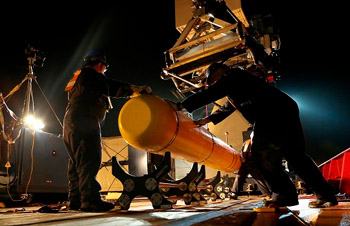
No wreckage from the plane has been found, and an aerial search for surface debris ended Monday after six weeks of fruitless hunting. An unmanned sub is continuing to search underwater in an area where sounds consistent with a plane's black box were detected earlier this month. Additional equipment is expected to be brought in within the next few weeks to scour an expanded underwater area. That search could drag on for eight months.

Earlier:

Australian company says it may have found MH370 wreckage
MH370_wreckage

Kuala Lumpur, Apr 29: An Australian marine exploration company has claimed that it has found the wreckage of the crashed Malaysian plane in the Bay of Bengal, 5,000 km away from the current search location in the Indian Ocean.

Adelaide-based GeoResonance on Tuesday said it had begun its own search for the missing flight MH370 on March 10 and that it has detected possible wreckage in the Bay of Bengal, 5000 km away from the current search location, the Star newspaper reported.

GeoResonance's search covered 2,000,000 square kilometres of the possible crash zone, using images obtained from satellites and aircraft, with company scientists focusing their efforts north of plane's last known location, using over 20 technologies to analyse the data including a nuclear reactor, company spokesperson David Pope said.

He claimed his company used technology originally designed to find nuclear warheads and submarines.

Mr. Pope said GeoResonance compared their findings with images taken on March 5, three days before MH370 went missing, and did not find what they had detected at the spot.

“The wreckage wasn't there prior to the disappearance of MH370. We're not trying to say it definitely is MH370. However, it is a lead we feel should be followed up,” said Mr. Pope.

Malaysia's Department of Civil Aviation Director-General Azharuddin Abdul Rahman told the paper that Malaysia was unaware of the report of the finding.

“We will have to check and verify this report,” he said.

Another GeoResonance spokesperson, Pavel Kursa, said several elements found in commercial airliners were detected at the Bay of Bengal spot identified by GeoResonance.

“We identified chemical elements and materials that make up a Boeing 777...these are aluminium, titanium, copper, steel alloys and other materials,” said Mr. Kursa in a statement.

The Beijing-bound Malaysia Airlines flight MH370- carrying 239 people, including five Indians, an Indo-Canadian and 154 Chinese nationals - had mysteriously vanished on March 8 after taking off from Kuala Lumpur.

The mystery of the missing plane continued to baffle aviation and security authorities who have so far not succeeded in tracking the aircraft despite deploying hi-tech radar and other gadgets.

Comments

Add new comment

  • Coastaldigest.com reserves the right to delete or block any comments.
  • Coastaldigset.com is not responsible for its readers’ comments.
  • Comments that are abusive, incendiary or irrelevant are strictly prohibited.
  • Please use a genuine email ID and provide your name to avoid reject.
News Network
May 27,2020

Geneva, May 27: The number of confirmed cases of COVID-19 worldwide has increased by nearly 100,000 over the past 24 hours to surpass 5.4 million, the World Health Organisation (WHO) said.

According to the WHO, the global case tally currently stands at 5,404,512 -- a rise by 99,780 over the past day.

The death count worldwide amounts to 343,514 -- an increase by 1,486.

Most cases of infection are recorded in the Americas -- 2,454,452, with 143,739 deaths.

Comments

Add new comment

  • Coastaldigest.com reserves the right to delete or block any comments.
  • Coastaldigset.com is not responsible for its readers’ comments.
  • Comments that are abusive, incendiary or irrelevant are strictly prohibited.
  • Please use a genuine email ID and provide your name to avoid reject.
News Network
May 27,2020

Washington, May 27: Most viruses and other germs do not spread easily on flights, the US Center for Disease Control and Prevention has said in its COVID-19 guidelines which do not recommend following social distancing between two passengers inside a plane or keeping the middle seat unoccupied.

As a result of coronavirus pandemic, air traffic inside the US has come to a near halt. Air traffic is said to be down to about 90 per cent. For all travellers coming from overseas, the Center for Disease Control and Prevention (CDC) has recommended 14 days quarantine.

"Most viruses and other germs do not spread easily on flights because of how air circulates and is filtered on aeroplanes," the CDC has said in its set of COVID-19 guidelines for air travellers.

However, it noted that the air travellers were not risk-free especially in the time of the coronavirus pandemic and recommended Americans to avoid travel as far as possible.

"Air travel requires spending time in security lines and airport terminals, which can bring you in close contact with other people and frequently touched surfaces," it said.

"Social distancing is difficult on crowded flights, and you may have to sit near others (within six feet), sometimes for hours. This may increase your risk for exposure to the virus that causes COVID-19," the CDC said.

But instead of recommended social distancing inside commercial planes, the CDC has advised a series of preventive and hygienic measures to be taken by the airlines pilot and crew to prevent the spread of coronavirus.

The US Department of Transportation and Federal Aviation Administration in its latest safety alerts for operators on May 11 said that air carriers and crews conducting flight operations having a nexus to the US, including both domestic and foreign air carriers, should follow CDC's occupational health and safety guidance.

The CDC issued its guidelines in first guidelines for the airlines and airline crew on March and again in May.

The CDC, which has issued an exhaustive social guideline measures in various sections, is silent on keeping the middle seat of a plane unoccupied so as to maintain the six feet distance between two passengers.

It calls for the plane crew to report to the CDC a traveller with specific COVID-19 symptoms like fever, persistent cough, difficulty in breathing and appearing unwell.

Asking the airlines and cabin crew to review infection control guidelines for cabin crew, the CDC recommends several measures for cabin crew to protect themselves and others, manage a sick traveller, clean contaminated areas, and take actions after a flight.

Prominent among them include washing hands often with soap and water for at least 20 seconds, particularly after assisting sick travellers or touching potentially contaminated body fluids or surfaces and use of alcohol-based hand sanitizer (containing at least 60 per cent alcohol) if soap and water are not available.

Airlines should consider providing alcohol-based hand sanitizer to cabin and flight crews for their personal use, it said.

The CDC guidelines do not recommend following social distancing inside a plane between two passengers or keeping the middle seat unoccupied. But it asks to minimise contact between passengers and cabin crew and the sick person.

"If possible, separate the sick person from others (by a distance of 2 meters or 6 feet, ideally) and designate one crew member to serve the sick person. Offer a facemask, if available and if the sick person can tolerate it. If a facemask is not available or cannot be tolerated, ask the sick person to cover their mouth and nose with tissues when coughing or sneezing," said the CDC guidelines.

If no symptomatic passengers were identified during or immediately after the flight, the CDC recommends airlines to follow routine operating procedures for cleaning aircraft, managing solid waste, and wearing PPE.

"If symptomatic passengers are identified during or immediately after the flight, routine cleaning procedures should be followed, and enhanced cleaning procedures should also be used," it said.

Clean porous (soft) surfaces (e.g, cloth seats, cloth seat belts) at the seat of the symptomatic passengers and within 6 feet of the symptomatic passengers in all directions, it added.

Comments

Add new comment

  • Coastaldigest.com reserves the right to delete or block any comments.
  • Coastaldigset.com is not responsible for its readers’ comments.
  • Comments that are abusive, incendiary or irrelevant are strictly prohibited.
  • Please use a genuine email ID and provide your name to avoid reject.
News Network
May 18,2020

Washington, May 18: US President Donald Trump on Sunday called his predecessor Barak Obama a ‘grossly incompetent president’.

The Trump’s reaction came after Obama on Saturday criticised the US authorities' response to the coronavirus outbreak.

“He (Obama) was an incompetent president. That’s all I can say. Grossly incompetent,” Trump told reporters at the White House on his arrival from Camp David.

Trump was responding to a question on the virtual commencement address by Obama a day earlier.

In his address to college graduates, Obama had said that the COVID-19 pandemic has exposed the American leadership.

“More than anything, this pandemic has fully, finally torn back the curtain on the idea that so many of the folks in charge know what they’re doing,” Obama said without naming officials.

“A lot of them aren’t even pretending to be in charge,” he added.

There was no immediate response from the office of the former president on the remarks made by Trump.

Comments

Add new comment

  • Coastaldigest.com reserves the right to delete or block any comments.
  • Coastaldigset.com is not responsible for its readers’ comments.
  • Comments that are abusive, incendiary or irrelevant are strictly prohibited.
  • Please use a genuine email ID and provide your name to avoid reject.