


'Azadi' slogans raised at Amnesty event: Bengaluru Police Commissioner

August 17, 2016

Bengaluru, Aug 17: Three days after the controversial event, Bengaluru Police Commissioner N S Megharikh on Tuesday night confirmed that 'Azadi' (freedom) slogans were raised at a cultural programme Amnesty International India organised here on alleged human rights violations in Jammu and Kashmir.
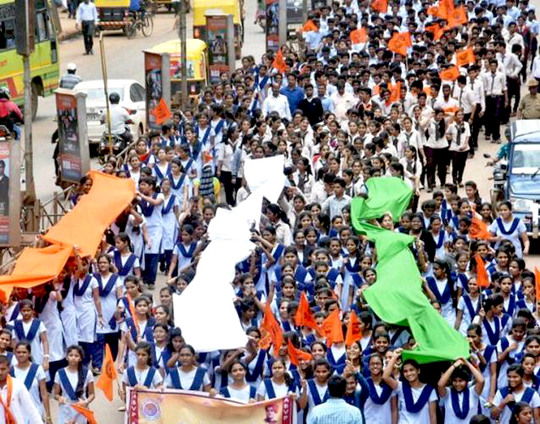
Antiamnesty

"Towards the end of the programme, a group of persons who were among the audience raised slogans seeking 'Azadi'. When the situation was getting volatile, the organisers suspended the programme and the police dispersed the people gathered there," said Megharik in a statement on Tuesday night.

Clarifying that police permission was neither sought nor given, as the event was an indoor function at United Theological College in the city on August 13, Megharikh said police persons were, however, deployed as the programme was brought to the notice of the local police station.

"During the function, it appears that some argument took place among the members of the audience regarding the action taken by the Indian army in Kashmir," the police chief pointed out.

Amnesty organised the programme, Broken Families' , which had an interactive discussion on peace and justice in Kashmir and where three families from the strife-torn valley shared human rights violations they faced with the rest of India.

"During the course of investigation, all possible evidence, including video footage will be collected, examined and appropriate legal action will be taken against the perpetrators of the alleged offence," Megharikh asserted.

The event is supposed to be part of a three-city tour of select families, covering Bengaluru, Mumbai and New Delhi.

The police chief also noted that Akhila Bharatiya Vidyarthi Parishad's (ABVP) organising secretary Jayaprakash had given a complaint, alleging that Amnesty representatives and other participants had indulged in anti-national slogans and criticised the role of Indian army.

The Rashtriya Swayamsevak Sangh's (RSS) affiliated student wing also submitted with the complaint a video footage of the function, showing some of the participants raising 'Azadi' slogans loudly a couple of times in unison.

"The complainant demanded legal action against such persons. After obtaining legal opinion, an FIR was registered on the complaint on August 15 under various sections of the IPC (Indian Penal Code)," Megharikh added.

The case has been entrusted to the assistant commissioner of police in the J C Nagar sub-division, as charges of sedition, rioting, unlawful assembly and promoting enmity were mentioned in the FIR.

None of our employees shouted anti-India slogans at event: Amnesty

Bengaluru, Aug 17: Amnesty International India chapter on Tuesday said none of its employee shouted any anti-India slogan at an event in Bengaluru on Kashmir, allegations based on which the sedition charge was slapped against the human rights body.

Amensty India said the allegation mentioned in a complaint by an ABVP representative against it were “without substance” and that the only discussion at the event on Saturday was about allegations of human rights violations and denial of justice in Jammu and Kashmir.

The local police slapped sedition charge against Amnesty on Monday based on the allegation that anti-India slogans were raised at the event organised by it.

“No Amnesty International India employee shouted any slogans at any point,” the human rights organisation said in a statement referring to allegations that “slogans were raised that Indian Kashmir should be a part of Pakistan.”

To the charge that the event indirectly supported terrorists, Amnesty said the only discussion that had taken place was about allegations of human rights violations and denial of justice to families in Kashmir.

“These are issues that have regularly been discussed in the media. They have been written about at length by members of Parliament, politicians, judges and civil society,” it said.

The event was held as part of a campaign based on the report “Denied: Failures in accountability for human rights violations by security force personnel in Jammu and Kashmir”, published in July 2015, it said.

Amnesty said the report was based on in-depth research in Jammu and Kashmir, including interviews with family members of “victims”, RTI applications, examination of police and court records, and interviews with civil society groups, lawyers, and government officials.

The families of three Kashmiri victims that were interviewed for the report were invited to share their stories at the event, said Amnesty.

About allegations that some people at the event tried to assault ABVP activists, it said, “No Amnesty International India employee was involved in any form of assault.”

“Towards the end of the event, some of those who attended raised slogans, some of which referred to calls for 'Azaadi' [freedom]. Amnesty International India as a matter of policy does not take any position in favour of or against demands for self-determination. However, Amnesty International India considers that the right to freedom of expression includes the right to peacefully advocate political solutions. Amnesty International India had invited the Bengaluru police to be present at the event in the interest of the security of the invited families and other attendees,” the statement said.

About allegations that a women employee of Amnesty and two others raised raised anti-national slogans, it said they were not present on stage at any point during the event.

Amnesty said footage of the event was shared with the police.

The rights body said Amnesty had worked extensively on human rights violations in Pakistan, including “the enforced disappearances and unlawful killings of political activists in Balochistan, violations by security forces in the Federally Administered Tribal Areas (FATA), and violence against journalists by groups including the ISI”.

Comments

Shuaib
 - 
Thursday, 18 Aug 2016

RSS is scared of Azadi MOvement

Rashid
 - 
Wednesday, 17 Aug 2016

Azadi slogans was also raised by JNU students also.. but not from India,, Azadi from RSS, Azadi from Poverty, Azadi from cruel laws like afspa...
Azadi slogans from India also raised in JNU also... but by whom , still under investigation... here also , as per commissioners report.. when ABVP goondas tried to stop the programme, some people raised anti India slogans... but who ? must be investigated.... sangh affiliated org are expert in such activities... there is probability of their involvement.

Fairman
 - 
Wednesday, 17 Aug 2016

The solution for Kashmir problem is not militarily.

This is pre-existing problem, dating back to independence era.
There was a treaty which calls for referendum when they want to quit the Indian union. There was a resolution witnessed by UNO.

The previous gov't has sent fact finding team consisting of very senior most journalists. Their finding was also the same as what the Kashmiris are asking for referendum.

Now who is the looser. Not only Kashmiris, our innocent military and police force. Let we Indian look deeply for solution, keeping our spirit of truth and justice.
The ruling come on the basis of fairness to all sides, regardless how dearly it costs as long as the justice is done to all.

There is a easy solution, but our leaders don't want to do it for personnel benefits.

We should stick to 1 point of Justice and fairness.
- That is if keeping Kashmir with us a just and fair without causing injustice, we should not bow to anybody.

- If losing of Kashmir is justified then we should do it with our conscience as long as justice and truth are prevailed. God will help us for our honesty.

Bottom line, why should our people, our police, our military die and their entire family should suffer. Who will fill this loss.

Our these brave soldiers to defend the nation from external invasion. Their life is not cheaper for dying for leaders selfishness.
These leaders may die without solving and carrying forward the problems to our future generation where future generation has to die, sacrifice for nothing.
May God help us.

Add new comment

  • Coastaldigest.com reserves the right to delete or block any comments.
  • Coastaldigset.com is not responsible for its readers’ comments.
  • Comments that are abusive, incendiary or irrelevant are strictly prohibited.
  • Please use a genuine email ID and provide your name to avoid reject.
coastaldigest.com news network
July 30,2020

Manglauru, July 30: There will be no congregational prayer on Eid Al-Adha at the historic Eidgah mosque in Mangluru’s lighthouse hill this year due to covid-19 pandemic. 

The decision to suspend the Eid prayers in Eidgah was taken as per the guidelines issued by the State Board of Auqaf, said Haji Y Abdullah Kunhi, president of Zeenat Baksh Central Juma Masjid and Eidgah Masjid.

However, Eid prayer will be held at Zeenat Baksh Central Juma Masjid on July 31 at 7 a.m.

Muslims in coastal Karnataka will be celebrating Eid al-Adha on July 31 whereas Muslims in other parts of Karnataka and India are celebrating the festival on August 1.  

Comments

Add new comment

  • Coastaldigest.com reserves the right to delete or block any comments.
  • Coastaldigset.com is not responsible for its readers’ comments.
  • Comments that are abusive, incendiary or irrelevant are strictly prohibited.
  • Please use a genuine email ID and provide your name to avoid reject.
Wafa Sultana
April 4,2020

Over the last couple of days when the world was occupied with unifying efforts to fight the deadly Covid19 pandemic, sections of Indian media provided viewers a familiar scapegoat – the Indian Muslims – who are often stereotyped as a community being constantly at loggerheads with the citizenry and the State. Biased media channels were quick to resort to blaming the entire Muslim community for the spread of the disease in the country, thanks to an ill-timed Tablighi Jamaat gathering at its international headquarters in Delhi’s Nizamuddin. Unsurprisingly, the opprobrium was also marked by a sudden spike in WhatsApp forwards of videos with people wearing skullcaps licking spoons and performing Sufi breathing rituals, suggesting some sort of wild conspiracy on the part of the community to spread the virus.  Some media channels were quick to formulate, hypothesize and provide loose definitions of a newly discovered form of Jihad i.e. ‘Corona Jihad ’ thereby vilifying the Islamic faith and its followers.

While the investigation on the culpability of the organizers of the Nizamuddin event is still ongoing, there is enough information to suggest that the meeting was held before any lockdown was in force, and the problem began when there was no way of getting people out once the curfew was announced. Be that as it may, there is little doubt that organizing a meet of such a scale when there is a global pandemic smacks of gross misjudgment, and definitely the organizers should be held accountable if laws or public orders were defied. Attendees who attempt to defy quarantine measures must be dealt with strictly. However, what is alarming is that the focus and narrative have now shifted from the unfortunate event at Nizamuddin to the Tablighi Jamaat itself.

For those not familiar with the Tablighi Jamaat, the organization was founded in 1926 in Mewat by scholar Maulana Mohammad Ilyas. The Jamaat’s main objective was to get Muslim youth to learn and practice pristine Islam shorn of external influences. This is achieved through individuals dedicating time for moral and spiritual upliftment secluded from the rest of the world for a brief period of time. There is no formal membership process. More senior and experienced participants typically travel from one mosque to other delivering talks on religious topics, inviting local youth to attend and then volunteer for a spiritual retreat for a fixed number of days to a mosque in a nearby town or village to present the message to their co-religionists. Contrary to ongoing Islamophobic rhetoric, the movement does not actively proselytize. The focus is rather on getting Muslims to learn the teachings and practices of Islam.  This grassroots India-based movement has now grown to almost all countries with substantial Muslim populations. Its annual meets, or ‘ijtemas’ are among the largest Islamic congregations in the world after the annual Haj. One of the reasons for its popularity and wide network in the subcontinent and wordwide is the fact that it has eschewed the need for scholarly intervention, focusing on peer learning of fundamental beliefs and practice rather than high-falutin ideological debates. The Tablighi Jamaat also distinguishes itself from other Islamic movements through its strictly apolitical nature, with a focus on individual self-improvement rather than political mobilization. Hardships and difficulty in the world are expected to be face through ‘sabr’ (patience) and ‘dua’ (supplication),  than through quest for political power or influence. In terms of ideology, it is very much based on mainstream Sunni Islamic principles derived from the Deobandi school.

So, why is all this background important in the current context? While biased media entities have expectedly brought out their Islamophobic paraphernalia out for full display, more neutral commentators have tried to paint the Tablighi Jamaat as a fringe group and have tried to distance it from 'mainstream Muslims'. While the intent is no doubt innocent, this is a trap we must not fall into. This narrative, unfortunately, is also gaining ground due to apathy some Muslims have for the group, accusing it of being “disconnected from the realities of the world”. Unlike other Muslim organizations and movements, the Tablighi Jamat, by virtue of its political indifference, does not boast of high-profile advocates and savvy spokespersons who can defend it in mainstream or social media.  The use of adjectives such as 'outdated' and 'orthodox' by liberal columnists to describe the Jamaat feeds into the malignant attempt to change the narrative from the control of the spread of the pandemic due to the Nizamuddin gathering to 'raison d'etre' of the organization itself.

A large mainstream religious group like the Tablighi Jamaat with nearly a hundred-year history, normally considered to be peaceful, apolitical and minding its own business is now suddenly being villainized owing to unfortunate circumstances. Biased media reactions filled with disgust and hate seem to feed the Indian public conscience with a danngerous misconception - to be a nominal Muslim is okay but being a practicing one is not.  For those committed to the truth and fighting the spread of Islamophobia, the temptation to throw the entire Tablighi Jamaat under the bus must be resisted.

The writer is a lawyer and research scholar at Qatar University. Her research interests include Islamic law and politics.

Comments

zahoorahmed
 - 
Saturday, 4 Apr 2020

great article! provides a great perspective on tableeg jamat

Add new comment

  • Coastaldigest.com reserves the right to delete or block any comments.
  • Coastaldigset.com is not responsible for its readers’ comments.
  • Comments that are abusive, incendiary or irrelevant are strictly prohibited.
  • Please use a genuine email ID and provide your name to avoid reject.
News Network
February 9,2020

Thiruvananthapuram, Feb 9: Kerala has sanctioned the setting up of 28 fast track courts for speedy trial in rape cases and other cases registered under the Protection of Children from Sexual Offences (POCSO) Act.

State Social Justice and Women and Child Development Minister KK Shailaja said the state government has decided to set up POCSO courts to ensure that the culprits get the punishment they deserve. She said the decision has been taken in the wake of rising violence against women and children.

"The Union Law Ministry has recently sanctioned the opening of 28 POCSO fast track special courts in Kerala at the request of the state government. The project will be implemented jointly by the High Court, Law and Home Departments under the leadership of the Department of Women and Child Development," the Minister said.

The four courts are alloted in Thiruvananthapuram district, three in Thrissur and Malappuram districts, two each in Kollam, Kottayam, Idukki, Ernakulam, Palakkad, Kozhikode and Kannur districts.

The Minister informed that POCSO courts are jointly established by the central and state governments and according to the High Court data, 12,234 POCSO and rape cases are pending in the state.

Comments

Add new comment

  • Coastaldigest.com reserves the right to delete or block any comments.
  • Coastaldigset.com is not responsible for its readers’ comments.
  • Comments that are abusive, incendiary or irrelevant are strictly prohibited.
  • Please use a genuine email ID and provide your name to avoid reject.