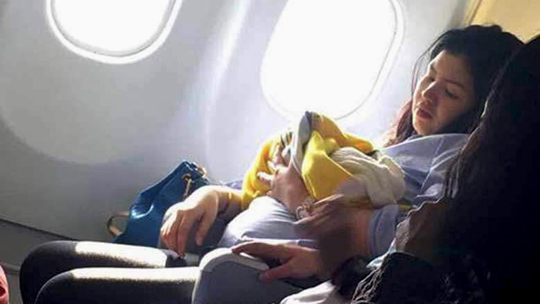
Baby born in Dubai – Philippines plane gets a lifetime of free flights

August 17, 2016

Dubai, Aug 17: A baby unexpectedly born on a Cebu Pacific Air flight from Dubai to the Philippines has lady luck smiling at her ALREADY and she doesn't even know that yet.

bornair

"The lady started having contractions mid-flight, about five hours while going from Dubai to the Philippines. She was set to give birth in October, so this came as a surprise, even to her mother," wrote Missy Berberabe Umandal, an eye-witness in herFacebook post who was aboard that same flight.

Her post has been shared more than 3,500 times in just two days. "I am sharing this story purely because I find it very inspiring, but I never intended it to go viral," she added.

"We only heard one semi-loud screech, and a few seconds later, there were tinier, cute screeches, and it was when we knew the baby was born," Umandal wrote.

The flight was diverted in India to ensure the baby's safety, making it 18 hours of travel instead of 9, Umandal says there were no complaints.

Makes one wonder, "I wish I was born in that flight too!"

Had the most 'NORMAL' flight ever with Cebu Pacific Air. A woman near our seat gave birth to a healthy baby girl, on our...

Posted by Missy Berberabe Umandal on Sunday, August 14, 2016

Comments

Manual jack
 - 
Wednesday, 17 Aug 2016

Well wisher has become \MAMU\" congratulations"

Manual jack
 - 
Wednesday, 17 Aug 2016

It's not a new story . It's gross negligence by airline who always fails to check and it's common in that sector specially from use to manila . Dye to negligence of airline many missed the connecting flights and many got spoil mood of holidays. I would suggest all who missed the flight must sue Cebu Pacific.

well wisher
 - 
Wednesday, 17 Aug 2016

Congragulation sister.

Add new comment

  • Coastaldigest.com reserves the right to delete or block any comments.
  • Coastaldigset.com is not responsible for its readers’ comments.
  • Comments that are abusive, incendiary or irrelevant are strictly prohibited.
  • Please use a genuine email ID and provide your name to avoid reject.
News Network
March 26,2020

Hubballi, Mar 25: The people living in rural areas of North-Karnataka region have become more aware about deadly Corona virus as they are leaving no stone unturned to prevent people of Bengaluru and other metropolitan cities from entering into their villages. People have put thorny plants on all roads at the outskirts connecting their villages and deployed youths to conduct patrolling round the clock till next 21 days.

Their motto is to prevent their own villagers getting infected from the outsiders especially from cities like Bengaluru and other two-tier cities where positive virus cases are on the rise. They have also take precautionary measures in the wake of Chief Minister B S Yediyurappa's call to the people to return to their native places.

Several people have also dug up the roads leading to their villages to block the entry of outside vehicles. They have put a condition to the outsiders to enter into their villages only after proper health check-up to confirm that they are not infected with Corona positive.

"We don't have access to the proper medical care if Corona virus is entered into our village. The Primary Health Centres are not functioning properly and these centers are facing lack of adequate staff and medical equipments unlike in big cities.Therefore, those who have deserted our village to employ in various jobs in Bengaluru and other cities should confirm that they are tested negative for the virus", said Mallikarjun Patil of Kudal village in Hangal taluk of Haveri district. The village has totally banned the outsiders into their village and warned their fellow villagers to return immediately if they have visited to their relatives' homes in neighboring villages to observe 21-day lockdown.

Hundreds of youths in Itanal village of Chikkodi taluk of Belagavi have also resorted to similar tactics and patrolling in all roads at the outskirts by holding sticks to prevent outsiders from entering into their village until April 14.

People of Hunagunti village in Ron taluk and Kotamuchagi village in Gadag taluk have also adopted similar plan by parking tractors at th outskirts to prohibit the entry of outsiders. They have also created awareness in their villages by beating drums urging the people not to venture outside village for next three weeks.

The police officials have resorted to lati-charge at various places in urban areas when people gathered in large numbers to buy essential commodities.

Comments

Add new comment

  • Coastaldigest.com reserves the right to delete or block any comments.
  • Coastaldigset.com is not responsible for its readers’ comments.
  • Comments that are abusive, incendiary or irrelevant are strictly prohibited.
  • Please use a genuine email ID and provide your name to avoid reject.
Agencies
May 8,2020

Washington D.C., May 8: The prime time for brain development in a child's life is the first year, where the infant spends most of the time asleep. It is the time when neural connections form and sensory memories are encoded.

However, when sleep is disrupted, as occurs more often among children with autism, brain development may be affected, too.

New research led by the University of Washington finds that sleep problems in a baby's first 12 months may not only precede an autism diagnosis but also may be associated with altered growth trajectory in a key part of the brain, the hippocampus.

The study, which was published in the American Journal of Psychiatry, researchers report that in a sample of more than 400 taken of 6- to 12-month-old infants, those who were later diagnosed with autism were more likely to have had difficulty falling asleep.

It also states that this sleep difficulty was associated with altered growth trajectories in the hippocampus.

"The hippocampus is critical for learning and memory, and changes in the size of the hippocampus have been associated with poor sleep in adults and older children.

As many as 80 per cent of the children with autism spectrum disorder have sleep problems," said Annette Estes, director of the UW Autism Center and senior author of the study.

"In our clinical experience, parents have a lot of concerns about their children's sleep, and in our work on early autism intervention, we observed that sleep problems were holding children and families back," added Estes, who is also a UW professor of speech and hearing sciences.

"It could be that altered sleep is part-and-parcel of autism for some children. One clue is that behavioural interventions to improve sleep don't work for all children with autism, even when their parents are doing everything just right. This suggests that there may be a biological component to sleep problems for some children with autism," said Estes.

To consider links among sleep, brain development, and autism, researchers at the IBIS Network looked at MRI scans of 432 infants, surveyed parents about sleep patterns, and measured cognitive functioning using a standardized assessment.

At the outset of the study, infants were classified according to their risk for developing autism: Those who were at higher risk of developing autism -- about two-thirds of the study sample -- had an older sibling who had already been diagnosed.

Infant siblings of children with autism have a 20 per cent chance of developing autism spectrum disorder -- a much higher risk than children in the general population.

In the current study, 127 of the 432 infants were identified as "low risk" at the time the MRI scans were taken because they had no family history of autism.

They later evaluated all the participants at 24 months of age to determine whether they had developed autism. Of the roughly 300 children originally considered "high familial risk," 71 were diagnosed with autism spectrum disorder at that age.

Problems with sleep were more common among the infants later diagnosed with an autism spectrum disorder, as were larger hippocampi. No other subcortical brain structures were affected, including the amygdala, which is responsible for certain emotions and aspects of memory, or the thalamus, a signal transmitter from the spinal cord to the cerebral cortex.

The authors note that while parents reported more sleep difficulties among infants who developed autism compared to those who did not, the differences were very subtle and only observed when looking at group averages across hundreds of infants.

Sleep patterns in the first years of life change rapidly as infants transition from sleeping around the clock to a more adult-like sleep/wake cycle. Until further research is completed, Estes said, it is not possible to interpret challenges with sleep as an early sign of increased risk for autism.


Comments

Add new comment

  • Coastaldigest.com reserves the right to delete or block any comments.
  • Coastaldigset.com is not responsible for its readers’ comments.
  • Comments that are abusive, incendiary or irrelevant are strictly prohibited.
  • Please use a genuine email ID and provide your name to avoid reject.
News Network
March 27,2020

Kollam, Mar 27: A young IAS officer in Kerala has been booked by police after he left the state violating instructions to remain under home quarantine following his recent return from honeymoon abroad, officials said on Friday.

A First Information Report has been registered against Kollam sub-collector Anupam Mishra, who hails from Uttar Pradesh, based on a report from the Health department about the violation, Kollam Superintendent of Police T Narayanan said.

Describing the action of the officer as a “serious matter”, District Collector B. Abdul Nasser said Mishra had returned to Kerala on March 19 from his Malaysia-Singapore trip and was advised to remain under quarantine, as per the protocol for overseas returnees in the backdrop of coronavirus outbreak.

On his return to Kerala from the foreign trip, Mishra had undergone medical examination and did not show symptoms. His personal staff, including gunman, have also been kept under observation.

However, the officer had left for his brother’s place in Bengaluru without informing anyone, Nasser said.

When the Collector got in touch with him, Mishra informed him that he was in Bengaluru.

“He was on leave after his marriage and took permission to travel to Malaysia and Singapore. On his return I advised him to remain under home quarantine. Seems like he left to be with his family at Bengaluru,” Nasser told PTI.

However, police said Mishra’s mobile tower location shows Kanpur in Uttar Pradesh.

Authorities came to know on Thursday that Mishra, who had been staying alone in his quarters at Kollam, was not there after health department staff, who regularly visit people in quarantine, found the lights in his house switched off, police sources said.

“The officer has gone without prior permission or leave. He did not have any symptoms of the virus. Without informing us, he left. It is a serious matter, the collector said adding Mishra has been asked to provide his current address and travel details to Bengaluru.”

When an officer leaves his jurisdiction, he is supposed to inform the government, which Mishra did not do. He has also not taken prior permission for leaving the state, the later told reporters.

Coronavirus: Conflicts on hold for now as players face a common enemy
 China bars foreign visitors as imported COVID-19 cases rise
The state government has sought an explanation from the officer in this regard.

A case has been registered against him under various sections of the Indian Penal Code including 188 (disobedience to order duly promulgated by public servant), 269 (Negligent Act likely to spread infection of disease dangerous to life) and 271 (disobedience to quarantine rule), police said.

Kollam, is the only district in the state, which has not reported any positive case of COVID-19 so far. A total of 176 positive cases have been reported in the state so far.

Comments

Add new comment

  • Coastaldigest.com reserves the right to delete or block any comments.
  • Coastaldigset.com is not responsible for its readers’ comments.
  • Comments that are abusive, incendiary or irrelevant are strictly prohibited.
  • Please use a genuine email ID and provide your name to avoid reject.