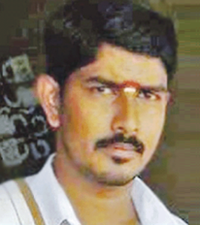
Bajrang Dal activist murder: 4 accused surrender before Moodbidri court

[email protected] (CD Network)
June 8, 2017

Mangaluru, Jun 8: Four of the seven absconding accused in Bajrang Dal activist Prashant Poojary murder case have surrendered to a local court in Moodbidri in Dakshina Kannada district.prashant

The surrendered accused are: Akbar (30) from Valachil, Siraj (28) from Ullal, Anwar and Tajuddin from Bajpe. They appeared before the Moodbidri court together on Wednesday. The court remanded the four in judicial custody for 14 days.

Poojary, a 29 year old flower seller and member of Bajrang Dal, was hacked to death by three pillion riders who came in three motorbikes on 9 October 2015 at about 7.00 am in Moodbidri town. According to sources, Poojary's involvement in immoral policing and attacks on cattle traders led to his murder.

Police had booked 17 persons in connection with the murder and arrested 10 among them within a few of weeks. One suspect Mohammad Imtiaz Gantalkatte was arrested from Mumbai airport as he was attempting to flee India for Dubai.

Most of the suspects arrested in the past have been released on bail. One of the accused, Mustafa Kavoor, was murdered in Mysuru jail by inmates. Nawaz Mangaluru, Irshad Bajpe and Mustaf Bajpe are still absconding.

Comments

Add new comment

  • Coastaldigest.com reserves the right to delete or block any comments.
  • Coastaldigset.com is not responsible for its readers’ comments.
  • Comments that are abusive, incendiary or irrelevant are strictly prohibited.
  • Please use a genuine email ID and provide your name to avoid reject.
Agencies
May 8,2020

Washington D.C., May 8: The prime time for brain development in a child's life is the first year, where the infant spends most of the time asleep. It is the time when neural connections form and sensory memories are encoded.

However, when sleep is disrupted, as occurs more often among children with autism, brain development may be affected, too.

New research led by the University of Washington finds that sleep problems in a baby's first 12 months may not only precede an autism diagnosis but also may be associated with altered growth trajectory in a key part of the brain, the hippocampus.

The study, which was published in the American Journal of Psychiatry, researchers report that in a sample of more than 400 taken of 6- to 12-month-old infants, those who were later diagnosed with autism were more likely to have had difficulty falling asleep.

It also states that this sleep difficulty was associated with altered growth trajectories in the hippocampus.

"The hippocampus is critical for learning and memory, and changes in the size of the hippocampus have been associated with poor sleep in adults and older children.

As many as 80 per cent of the children with autism spectrum disorder have sleep problems," said Annette Estes, director of the UW Autism Center and senior author of the study.

"In our clinical experience, parents have a lot of concerns about their children's sleep, and in our work on early autism intervention, we observed that sleep problems were holding children and families back," added Estes, who is also a UW professor of speech and hearing sciences.

"It could be that altered sleep is part-and-parcel of autism for some children. One clue is that behavioural interventions to improve sleep don't work for all children with autism, even when their parents are doing everything just right. This suggests that there may be a biological component to sleep problems for some children with autism," said Estes.

To consider links among sleep, brain development, and autism, researchers at the IBIS Network looked at MRI scans of 432 infants, surveyed parents about sleep patterns, and measured cognitive functioning using a standardized assessment.

At the outset of the study, infants were classified according to their risk for developing autism: Those who were at higher risk of developing autism -- about two-thirds of the study sample -- had an older sibling who had already been diagnosed.

Infant siblings of children with autism have a 20 per cent chance of developing autism spectrum disorder -- a much higher risk than children in the general population.

In the current study, 127 of the 432 infants were identified as "low risk" at the time the MRI scans were taken because they had no family history of autism.

They later evaluated all the participants at 24 months of age to determine whether they had developed autism. Of the roughly 300 children originally considered "high familial risk," 71 were diagnosed with autism spectrum disorder at that age.

Problems with sleep were more common among the infants later diagnosed with an autism spectrum disorder, as were larger hippocampi. No other subcortical brain structures were affected, including the amygdala, which is responsible for certain emotions and aspects of memory, or the thalamus, a signal transmitter from the spinal cord to the cerebral cortex.

The authors note that while parents reported more sleep difficulties among infants who developed autism compared to those who did not, the differences were very subtle and only observed when looking at group averages across hundreds of infants.

Sleep patterns in the first years of life change rapidly as infants transition from sleeping around the clock to a more adult-like sleep/wake cycle. Until further research is completed, Estes said, it is not possible to interpret challenges with sleep as an early sign of increased risk for autism.


Comments

Add new comment

  • Coastaldigest.com reserves the right to delete or block any comments.
  • Coastaldigset.com is not responsible for its readers’ comments.
  • Comments that are abusive, incendiary or irrelevant are strictly prohibited.
  • Please use a genuine email ID and provide your name to avoid reject.
News Network
June 28,2020

Bengaluru, Jun 28: Novel coronavirus has claimed another police officer's life here, official sources said on Sunday.

According to official sources, the deceased police officer attached to station in Whitefield division had collapsed in his home on Saturday.

The 57-year-old Police officer, working as an Assistant Sub-Inspector (ASI) who was diagnosed with COVID-19 infection, also reportedly suffered from breathing related problems, the sources said.

Comments

Add new comment

  • Coastaldigest.com reserves the right to delete or block any comments.
  • Coastaldigset.com is not responsible for its readers’ comments.
  • Comments that are abusive, incendiary or irrelevant are strictly prohibited.
  • Please use a genuine email ID and provide your name to avoid reject.
News Network
January 1,2020

Kalaburagi, Jan 1: Fighting penury and partial blindness in one eye, a 39-year-old part-time Kannada lecturer from Kalaburagi district is set to become a commercial tax officer after cracking the Karnataka Administrative Services.

Ambadas Kamble, from Kotana Hipparaga village in Aland taluk, had to take a three-year gap during his school and college years - one-year break after completing Class VII and two years to clear subjects after he failed in II PU examinations. During those three years, he joined his brothers in masonry work to supplement the family's income.

Sweeping aside all hurdles with grit and determination, Ambadas studied Kannada literature for both undergraduate and postgraduate to land the post of a part-time lecturer in a Kalaburagi college. His father died when he was a child, and mother Chandamma supported her family of six - besides, Ambadas, she has two sons and two daughters - by working in houses in the neighbourhood.

Ambadas said he would like to dedicate his success to his mother, who died in the year 2012. "My mother encouraged me to chase my dream - financial difficulties notwithstanding - and allowed me to spend time in the library when my siblings were busy doing menial jobs to fund my education. I'm grateful to my brothers too," he said.

His two brothers are working as masons in Mumbai, having quit studies midway and deciding to support Ambadas - the first in the family to complete graduation. He did high school at Tadkal village in Aland taluk, and college in Kalaburagi.

The lecturer, who's 40% blind in the right eye, cracked the KAS examinations in his third attempt and stood 706th in the state. He has been selected for first-grade officer's post. Alongside, he's doing PhD in Kannada literature.

When his efforts finally paid off, Ambadas landed four job offers: Hostel warden at Morarji Desai hostel, at an SC/ST hostel, post of a lecturer and the tax officer's post. He picked the fourth to serve the state in right earnest.

Comments

Add new comment

  • Coastaldigest.com reserves the right to delete or block any comments.
  • Coastaldigset.com is not responsible for its readers’ comments.
  • Comments that are abusive, incendiary or irrelevant are strictly prohibited.
  • Please use a genuine email ID and provide your name to avoid reject.